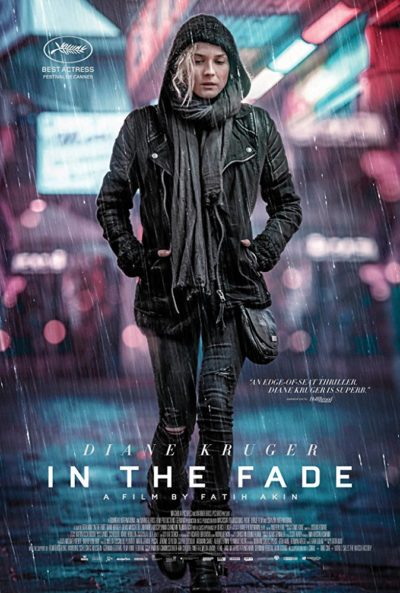

In The Fade

★★★
“Death wish, too.”

I spent most of the movie going back and forth as to whether or not this qualified for inclusion here. Was its lead, perhaps, just too subdued and reactive to be called an “action heroine”? It wasn’t until after the very final scene that I finally was able to decide it does merit a spot. Though make no mistake, this is a long, slow-burning fuse before it goes off.

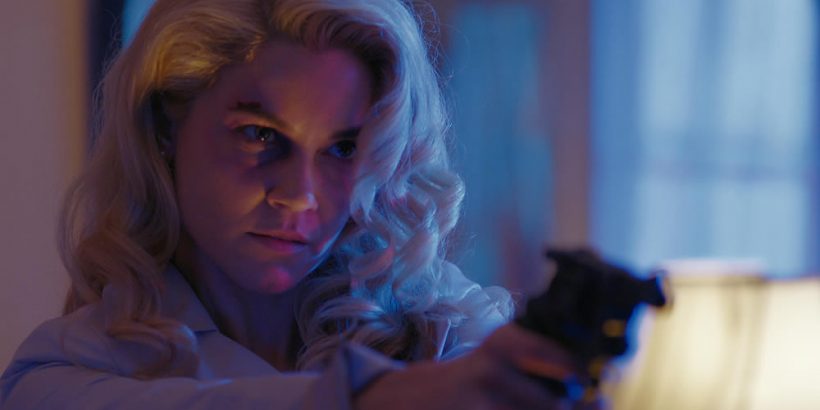
The life of Katja Şekerci (Kruger) is torn apart when a bomb is left outside her husband’s office, killing both him and their young son. Initially, the cops suspect his past has caught up with him – he did time in prison for dealing hashish. While Katja believes otherwise, matters are not helped by Katja’s relapse into drug-use to deal with the pain. Eventually, she is proven right, and the police arrest a husband and wife pair of neo-Nazis (Hilsdorf and Brandhoff). They are tried, but the law fails to deliver the justice Katja wants, and she is forced to take matters into her own hands, despite the pleas of her lawyer (Moschitto) to trust the system.

As vigilante movies go… this one probably doesn’t. It’s instead divided into three acts: the first covers the explosion and its immediate impact; the second the trial; and the third what ensues thereafter, as Katja tracks down the perpetrators. In a more traditional genre entry, the first two would be disposed of in about 15 minutes, but here, they’re much more the focus. In particular, we see, in almost painful detail, Katja’s progress through the stages of grief – though it’s less a passage through them, and more a downward spiral towards a pitch-black version of acceptance. Indeed, she’s in the middle of a suicide attempt, filmed in disturbingly chill passivity, when she gets news of the terrorists’ arrests.

I have some issues with certain aspects of the plot. For instance, her conviction this was a terrorist attack, while eventually right, seems to come out of thin air. I’m also less than certain it’s quite as easy to make a bomb as is suggested [I’m pretty sure  – and certainly hope – that even looking up instructions on Google would quickly get you watched, especially given the circumstances here] However, her single-minded dedication to punish those she holds responsible, regardless of the personal cost, is striking, and there’s no arguments about the strength of Kruger’s portrayal either, which is excellent. You truly feel her grief, and this makes everything she does subsequently, a natural product of it.

Confucius supposedly said, “Before you embark on a journey of revenge, dig two graves.” This is a feature adaptation of that concept, with Katja more or less fatally wounded – at least, inside – along with her husband and child. This is not an uplifting film by any means. Indeed, it manages to become more depressing the longer it goes on, and considering the real starting point is a six-year-old being literally blown into pieces, that’s quite a feat. Not necessarily a bad thing, of course; although the net result is a film of merit, yet one I’m unlikely to watch again.

Dir: Fatih Akin
Star: Diane Kruger, Denis Moschitto, Hanna Hilsdorf, Ulrich Brandhoff
a.k.a. Aus dem Nichts

I, Olga Hepnarova

★★★
“Czech, please…”

I am a loner. A destroyed woman. A woman destroyed by people… I have a choice – to kill myself or to kill others. I choose TO PAY BACK MY HATERS. It would be too easy to leave this world as an unknown suicide victim. Society is too indifferent, rightly so. My verdict is: I, Olga Hepnarová, the victim of your bestiality, sentence you to death.

Women who kill are rare. Women who kill multiple victims at once, without male associates, are rarer still. Among the few who have been recorded as such was Olga Hepnarová, a 22-year-old Czech, who in 1973 deliberately drove a truck into a group of people waiting for a tram in Prague. Eight were killed, and a dozen injured. The day before she had sent a “manifesto” explaining her actions to two local newspapers. As the extract above suggests, she saw herself as a victim, inflicting punishment on the society which she blamed for bullying her. Hepnarová showed absolutely no remorse, and became the last woman executed in Czechoslovakia, being hung in December 1975.

This is all historical and documented fact, but helps lend this feature version of Hepnarová’s life a bleak relentlessness. Presuming you’re aware of the story (and one imagines most of the Czech audience would be, if not necessarily those in other countries), you know exactly where it’s going to end up – with a short drop, though the film takes the specifics of that as read. So there’s no suspense to be had, and to be fair, that isn’t the point at all. It’s more about trying to get inside the mind of Hepnarová: how does someone get to the stage where committing an act of mass murder becomes not only plausible, it also becomes inevitable?

It was clearly a combination of factors. Olga displayed signs of mental illness from a young age, including a suicide attempt by overdose in her early teens, and as depicted here, has severe difficulty forming any kind of relationship – though the lack of effort she puts into them from her side is notable. She seems to stand outside the human race, at one point saying, “I can’t talk to anybody. I’m alone everywhere. People just talk and gather and laugh even at things I don’t find funny at all,” and later bluntly stating “The world has no value.” I’m not sure if her comments come from court transcripts, medical documents or were invented for the purpose of the film, but according to the makers, “We didn’t write anything that we didn’t know to be true – if we didn’t know it for sure, we removed it from our script.”

There’s no denying it sometimes packs a wallop – not least given events subsequent to filming, in Nice and elsewhere, with terrorists taking enthusiastically to vehicular mayhem for their own causes – and the blank nihilism in Olszanska‘s performance is chilling. But I can’t say any real insight into the psychology of her psychopathy feels like it was obtained. It’s clear she was bullied, and that was a factor, but what is offered feels like a facile simplification: hell, I had more than my share of being bullied at school, and didn’t kill anyone. There is eloquence to her own words, and I wish there had been more of this. For despite black-and-white cinematography which makes it feel like a contemporary retelling, rather than four decades later, the rest feels flat and largely uninteresting.

Dir: Petr Kazda and Tomás Weinreb
Star: Michalina Olszanska, Martin Pechlát, Klára Melísková, Marika Soposká

Infinite Waste by Dean F. Wilson

Literary rating: ★★★½
Kick-butt quotient: ☆☆☆

This initially seemed like a borderline entry, which I kept reading purely for entertainment. It’s about an exploratory star-ship, the Gemini, out on the very edge of known space, which comes across a giant barge, packed with nuclear waste and populated by a race of rat-humanoids, the Raetuumak. The Gemini is an appropriate name for the craft, as it’s effectively two separate ships, each with their own captain and very different approaches. Maggie Antwa, commander of Gemini Right, is a cautious scientist who abhors violence in any form, and was compelled to take on this mission after being involved in a environmentalist rebellion against the ruling Empire. Over in Gemini Left, on the other hand, Skip Sutridge is a square-jawed believer in shooting first and asking questions… well, never, to be honest. He has been sent to the fringes, probably to try and keep him out of trouble.

It doesn’t work. Skip finds himself captured by the Raetuumak, leaving Maggie to strap on the battle armour and rescue her co-captain. That’s not the end of the matter though, as they discover the barge is an interstellar weapon, aimed at the heart of the Empire. Worse still, is the creature made of pure shadow that stalks the corridor of the ship, absorbing the energy of anyone it touches: this is one of the Umbra, long since considered to be no more than the bogeymen of fairy tales. Not only is this belief incorrect, they’re now apparently returning from their exile to take on the Empire. Maggie and Skip will have to put aside their deep philosophical differences to deal with both this massive dirty bomb, and the Umbra.

It’s Maggie’s character arc which eventually qualifies this for here: she and Skip are complete opposites, who initially share only mutual loathing. Yet they eventually realize that neither one of their approaches will be sufficient to defeat this threat. As the book states, “He was sword and she was shield. Separately, they were vulnerable. Together, if they could ever find a way to really work with each other, they would be powerful beyond measure.” That’s really the core of the book here: the convergence on a middle ground which is able to make use of both their undoubted talents. It’s Maggie who drives this, with the solo rescue of Skip proving her courage and audacity, and forcing him to admit her abilities. Yet, she also finds that her long, deep-held pacifism has limits: after realizing the need to deal with the Umbra, “Perhaps for the first time in her life, the thought of killing something didn’t upset her at all.”

I have to say, the way in which it is eventually dealt with, was more than a little weak: if they’re so easily defeated, it’s hard to see how the Umbra could be any kind of threat to the galaxy. Yet, except for that moment, this was a strong page-turner. As mentioned at the start, kept me interested even in the early going, when its action heroine credentials were in doubt. Both Skip and Maggie are capable of carrying the story on their own, and the pairing of them is an effective combination. I’m intrigued to see where they go from here.

Author: Dean F. Wilson
Publisher: Currently only available as part of the Dominion Rising collection for Kindle.
Book 1 in the Infinite Worlds series.

It Stains the Sands Red

★★
“Aunt Ruby goes on a trip.”

As the world goes through the zombie apocalypse, Molly (Allen) and boyfriend Nick (Mondesir) are elsewhere. Specifically, driving through the desert near Las Vegas, heading towards an airfield where they are going to catch a flight to Mexico – and, hopefully, safely. After their car gets stuck in the sand, Nick is attacked by a lone zombie (Riedinger), Molly flees on foot, striking out in the hopes of getting to the airfield, and pursued by the relentless creature. For it turns out the heroine is having her period, which allows the zombie to track her – and also lends a rather different meaning to the film’s title…

It’s the kind of idea which would have made a strong short film, but falls apart when stretched to feature length. To reach that duration, the story has to bolt on all manner of additional elements, most of which don’t work, while also leaving some gaping plotholes, through which an entire army of the undead could stumble. For instance, there are moments where the zombie is just feet behind Molly; then, in the next scene, she’s far enough ahead to be able to stop for a snooze. Given she seems to have no athletic ability and is clad in shoes which are as far from desert-traversing footwear as imaginable, it feels as if she’s teleporting ahead of her pursuer. Similarly, when she reaches her destination, the script is flipped, and this coke-snorting bitch suddenly becomes a devoted mother, desperate to return to Las Vegas and be re-united with her child. It’s a startlingly unconvincing development.

The aspect that perhaps works best is a surprising one: the relationship between Molly and her pursuer, in particular after he saves her from an unpleasant fate. It’s largely unwitting – just his nature in action – and requires more suspension of disbelief in the way he suddenly can apparently enter stealth mode. But it adds a nice wrinkle, albeit one which is rapidly discarded for the film’s change in direction over the final third. There, the film abandons any effort at inventiveness, and returns to the same furrow which has pretty much been ploughed into the ground [admittedly, where you would expect to find a furrow] by the multitude of zombie films, TV shows, books and games churned out over the past decade or so.

To the makers’ credit, they did at least realize they needed to find something new, a different direction which would help their creation stand out from the walking dead crowd. It’s unfortunate they managed to screw things up in almost every direction once they got past that decision, beginning with a heroine who is startlingly unlikable for the vast bulk of its running time. At one point, she whines at her pursuer, “You’re like every guy I’ve ever met a bar!” I couldn’t help thinking, that’s the kind of comment which says more about the person making it, than the target. You might find yourself rooting for the zombie.

Dir: Colin Minihan
Star: Brittany Allen, Juan Riedinger, Merwin Mondesir

I Spit On Your Grave 2

★★★
“Model prisoner.”

This sequel is almost entirely unrelated to the original, beginning with a new, fresh character who will be tortured within an inch of her life, before escaping and roaring back for revenge. However, it manages to be a little more coherent, even as it replaces the redneckophobia of the original, with much more straightforward xenophobia.
The victim here is Katie Carter (Dallender), a wannabe model who takes advantage of a free photography portfolio session, offered by sleazy, Eastern European cameraman Ivan (Absolom) and his assistant, Georgy (Baharov). The latter becomes obsessed with her, and won’t take no for an answer. When Katie’s screams alert her apartment building’s caretaker, he’s stabbed by Georgy, leaving Ivan to clean up the mess. Still, it’s nothing that a large crate, stamped “Bulgaria”, can’t solve… When Katie discovers what’s awaiting her in Sofia, she’ll wish she’d been the one left in a pool of blood.

The narrative here is a bit more coherent. For instance, an early scene establishes that Carter is no shrinking violet, being a Midwest girl who knows a thing or two about hunting vermin. We also get to see more of the period between her escape, and her returning to take action – she survives with the help of a kindly local priest. He’s about the only Eastern European character here who is not an utter scumball, and in that aspect, I was reminded a fair amount of the first Hotel movie.

Initially, I thought it was going to spend the entire film in New York, and that might not have been a bad thing. Monroe is good at capturing the “urban jungle” aspect of the city, in much the same way as Abel Ferrara. There are a number of elements early on that brought Ms. 45 to mind, with that classic of the rape-revenge genre also having a sequence in a photographer’s studio. Dallender has the kind of willowy steel look as Zoe Tamerlis, too. It’s a shame it didn’t retain that approach, instead of becoming some kind of cautionary tale about foreign travel.

Once it leaves that setting, however, and scurries off to Sofia, the film becomes less interesting, more or less going down the same path as the original. Indeed, some of the beats are exactly the same, e.g. the heroine appears to find sanctuary in an authority figure, only to have that yanked away from her. Some of the resulting unpleasantness is hard to watch – please note, I’ve seen more than my fair share of cinematic nastiness, so I do not squirm easily – and that applies on both sides of the brutality. But its impact is never more than a visceral shudder. To be truly effective, it needs to pack an emotional punch as well, and in the main, that’s not present. It’s technically solid, and that may be part of the problem; it perhaps should be a little less polished, and rougher around the edges, in line with the content.

Dir: Steven R. Monroe
Star: Jemma Dallender, Yavor Baharov, Joe Absolom, Aleksandar Aleksiev

I Spit On Your Grave

★★½
“The Hills have thighs.”

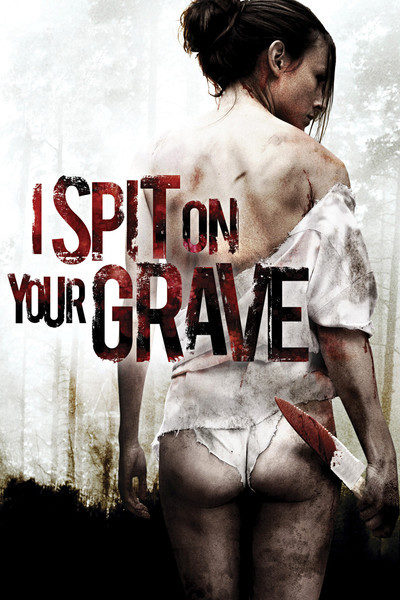
Having been pleasantly surprised by I Spit on Your Grave 3: Vengeance is Mine, I thought I should rewind and catch the first two films in the series, see if they were also above expectations. Sadly, the answer is “not really”. The first, in particular, suffers as a direct remake of the notorious original, directed in 1978 by Meir Zarchi (originally released, to little attention, as Day of the Woman). It fails from our perspective for much the same reasons, mostly through being more interested in the rape than the revenge. Though there is a certain, nasty inventiveness to the latter, which salvages the final third.

Writer Jennifer Hills (Butler) moves into to a remote cabin she has rented, in order to have peace and quiet while she pens her next book. Before she has even arrived there, she has crossed paths with the local rednecks, a trio led by Johnny (Branson). Things escalate from there, until the trio – along with the “developmentally-challenged” local plumber, burst into Jennifer’s house, and brutally assault her. She manages to flee, seeking sanctuary, only for things to go from bad to worse. But she is just able to escape with her life, falling into a creek and vanishing from her assailants.

At this point, she effectively vanishes from the film as well, which is part of the problem. There’s a logical gap here, in need of explanation. Who takes care of her? And if she’s working on her own, how is a skinny little thing like Jennifer, whose background is entirely in writing (rather than – oh, I dunno – construction), capable of dragging around the unconscious bodies of the men as she takes her revenge? I mean, she suspends one of them up in the air, dangling over a bathtub like a trussed chicken. That’s not trivial. I did enjoy the imagination in the savage vengeance, which does surpass that of the original. We get a face dissolving, fish-hooks and the ol’ rape by shotgun. Jennifer is not messing around, shall we say.

It’s a shame the film didn’t emphasize the intellectual angle a bit more. Initially, it seems that Hills’s brain is the threat to the locals, who have no idea how to handle or even interact with someone who is clearly their mental superior. However, any efforts in this direction are rapidly abandoned, in preference for her simply being physically attractive. Post-attack, too, it doesn’t really appear she’s using her brain, so much as feral cunning. It certainly does go a long way to explaining how royally screwed-up Jennifer is by the time Butler revisited the character (under a different director) in Part 3. Yet, it’s also clear that the lengthy depiction of the abuse suffered by the character does as much to detract from as emphasize the reasons for that damage.

Dir: Steven R. Monroe
Star: Sarah Butler, Jeff Branson, Daniel Franzese, Rodney Eastman

If Looks Could Kill

★★★
“Keeps the pot boiling energetically enough.”

I’ve been a fan of The Asylum studio for a while. They’re famous – or infamous – mainly for two things. Originally, they churned out “mockbusters”, films that rode the advertising coat-tails of larger budget and more famous movies, using titles such as (I kid you not), Snakes on a Train. More recently, they are also creators of the cult Sharknado series for SyFy. However, The Asylum can and will, make more or less anything they think will turn a profit. Their quality of output does vary, shall we say. Yet I was entertained by this slice of Lifetime fluff ‘n’ nonsense more than expected, mostly due to effective performances from the two leads.

There’s Faith Gray (Estes), whose new job as a beat cop has re-united her with Detective Paul Wagner (Kosalka), for whom she has always had a “thing.” But at an incident in a local bar, he meets and ends up beginning a relationship with, Jessica Munroe (Spiro). She’s a drop-dead blonde with aspirations of becoming a movie star – not something easily accomplished in Stillwater, Oklahoma. Before you can say “We’ll be right back after these words from our sponsors,” she’s pregnant and married to Paul. Faith, however, thinks there’s something not quite right about Jessica, though her investigation could be considered more as jealousy-induced stalking. It’s certainly painted as such by its target.

The film never tries to hide the fact that Jessica is nutty as a fruitcake. As a result, its plotting is instead very much concerned just with getting the story from Point A to B, offering few surprises. I’m not exactly convinced by the “Based on a true story” claim here. And let’s not even start with the police procedures depictede: let’s just say, Stillwater PD could use some re-training, and move on. Yet the pleasures outweighed the deficiencies; in particular, as mentioned, watching the mousy Faith and psychotic glam-girl Jessica face off. The latter gets most of the cinematic highlights, vamping it up to great effect. Witness, for example, her hyper-ventilating in order to place a convincingly panicked phone call to her lover. Guess all Jessica’s acting classes finally paid off!

I admit, there’s something fun about watching a manipulative sociopath at work: there’s a reason Dangerous Liaisons is one of the all-time greats. Spiro isn’t quite at Glenn Close standards, yet both she and Estes give it their all, and elevate the material to enjoyable nonsense. Even if we didn’t quite get the hellacious cat-fight climax for which I was hoping, it’s always good to see a film where both protagonist and antagonist are women, and there’s no doubt all the effort went into Faith and Jessica, with the male characters barely registering. Paul, in particular, is so easily deceived you wonder how he ever became a detective. Yet, as pulpy nonsense goes, this hour and a half certainly went by quickly and painlessly enough.

Dir: James Cullen Bressack
Star: Stefanie Estes, Summer Spiro, Tomek Kosalka, Brian Shoop

The Institute

★★★½
“A girl has no name.”

Game of Thrones, this clearly isn’t. But both Chris and I were struck by the similarities between what befalls the main character here, and the re-programming which Anya Stark underwent at the hands of the Faceless Men. Because the first, and arguably key, step in both is to destroy the existing personality, so there is a blank slate – the phrase “tabula rasa” is explicitly used here – on which the new character can be drawn. In this case, the victim is Isabel Porter (Gallerani), a young woman who has sunk into depression after the death of her parents. She opts for a stay at the Rosewood Institute, a highly regard mental sanatorium in Baltimore.

It soon turns out those who run it have an extremely creepy agenda, sitting somewhere between local hero Edgar Allen Poe and the Illuminati. Through a mix of drugs and mind-control techniques, Isabel is being transformed from the somewhat rebellious but polite young woman who went in, into… Well, it’s kinda hard to say. But it turns out that her rebellious streak may be about the most robust aspect of her personality, and those in charge will perhaps end up wishing they had left well alone. For when you destroy all moral governors in someone, what’s left can potentially turn round and bite their purported master.

While certainly not for everyone, this is a horror/conspiracy combination which puts it right in our wheelhouse. And perhaps surprisingly, the “based on a true story” claim has more veracity than you might expect. Between the war, poor female patients were basically sold to upper-class families, and put to work by them, as little more than slaves, in what has been described as “a well-oiled human trafficking operation.” The bizarre ritual ceremonies depicted here, do appear to be the fruits of imagination – though I would say whoever was responsible has done their paranoid homework with some of the details.

There’s a strong feminist subtext, with the story set in a time when women were expected to be seen and not heard – Isabel describes her curiosity as a symptom of mental illness. It’s a joy when the tables are turned, though I’m not quite so sure about the final twist, which seems wholly unnecessary, to put it mildly.  I also enjoyed the more Gothic aspects, not least a sequence which is lifted wholesale from one of Poe’s most famous stories. Gallerani is excellent in the central role, and that’s probably a good thing, since some of the other performances aren’t, not least James Franco as Dr. Cairn, who appears to have strolled in from a fancy-dress party. And I’ve no clue at all, what Pamela Anderson is doing in this.

Taking this seriously, would likely be a mistake. Treat it as something inspired by, and in the lurid spirit of, a Victorian “penny dreadful” story, however – right down to the hunchback – and you’ll find plenty of fun here.

Dir: James Franco and Pamela Romanowsky
Star: Allie Gallerani, James Franco, Tim Blake Nelson, Lori Singer

The Ilsa, She-Wolf of the S.S. series

The late seventies was something of a golden era for exploitation, but few films have sustained their notoriety as well as the Ilsa series. Even more than forty years after the release of the first film starring Dyanne Thorne, there’s still something repellent and uncomfortable about the whole concept. Which is, of course, part of its transgressive appeal. Safe to say that the four films, made between 1975 and 1977 represent perhaps the most politically incorrect franchise ever to receive a theatrical release. Join with us, why don’t you, as we explore the mad, sick and twisted world of Ilsa, beginning with what still remains today, one of the most notorious grindhouse films ever made.


Ilsa, She-Wolf of the S.S.
★★★★

I used to have an Ilsa, She-wolf of the SS T-shirt, but only ever dared wear it once in public – the looks of hate it provoked were simply too much to bear, though I don’t exactly kowtow to moral pressure or political correctness easily. And when I bought the DVD in the Hollywood Virgin Megastore, a complete stranger standing next to me commented to the effect that this wasn’t the sort of thing we needed to see getting re-released. Such is the power of Ilsa.

Hence, I write with trepidation: even in the sordid yet enchanting world of exploitation cinema, She-Wolf is notorious. Three decades after being made, it remains unreleased – and possibly unreleasable – in the United Kingdom, and in our house, the DVD sat on the shelf for two years, since I feared Chris would instantly leave me if we watched it. And she is no shrinking violet, but a woman who (to my ultimate delight) regards an uncut DVD of The Story of Ricky as a fine birthday present. Luckily, Chris is right beside me as I type this, and I get to produce this article as a married, rather than divorced man.

I should point out, before the inevitable accusations come in, that the mark awarded to the film is scored on a radically different scale from “normal” movies. I don’t recommend this movie unless you possess a very black sense of humour, are immune to being offended by fictional material, have carefully stowed all children and maiden aunts, and switched off all moral qualms.

Even so, the question must still be asked, is a Nazi camp a suitable setting for any piece of entertainment? No, probably not. But tell that to the producers of Hogan’s Heroes, a comedy set in a similar location. [Indeed, She-Wolf was filmed on Hogan’s sets, and the private life of star Bob Crane, was no less sordid than most exploitation films – as shown in Paul Schrader’s Auto Focus, which would make a fine double-bill with She-Wolf]. Or perhaps Schindler’s List, which in my opinion is more guilty of exploiting the Holocaust (interestingly, She-Wolf never mentions the J-word – it’s just a natural reaction these days to equate Nazi camps with Jews).

If I may digress for a moment, I find List a truly cynical work: Steven Spielberg performs his usual adept emotional manipulation, but what purpose is served? Like all docudramas, it alters the facts, and no Aryan Nation adherent will sit through a three-hour plus, black and white film for “educational” reasons. It seems more like a cynical, and successful, attempt to win Spielberg an Academy Award. Ask yourself an awkward question: would it have won seven Oscars if it had been about gypsies?

Like Schindler, the cinematic Ilsa was based on a real character. Ilsa Koch was the “Bitch of Buchenwald,” whose practices perhaps surpassed those in the movie, including the stripping and curing of human skin – particularly from tattoed inmates – for her collection of lampshades, gloves, etc. Unlike her fictional counterpart, she survived the war, being sentenced to live in prison, but sadly, didn’t live to see a twisted depiction of her life, committing suicide in 1967.

At least She-Wolf is upfront about its exploitational nature, despite an opening title which reads, in part, “We dedicate this film with the hope that these heinous crimes will never occur again.” This is such an implausible claim, you can’t even begin to take it seriously, especially when the next scene shows Ilsa (Dyanne Thorne) writhing atop one of the camp’s inmates. We don’t initially ‘know’ it’s her (though I doubt anyone is fooled!), until she returns, dressed as the commandant of Medical Camp 9.

It’s not long before her true persona is revealed, as she castrates her lover, fulfilling in a twisted way her promise that he wouldn’t return to the camp. The arrival at camp of a new batch of inmates allows the depiction of a whole new range of potential tortures, even if there is a surprising amount of plot going on too:

  • Ilsa’s attempts to prove women are better than men at handling pain…
  • Her growing infatuation with American prisoner Wolfe (Gregory Knoph)…
  • The prisoners’ plans to revolt…
  • The imminent arrival of a General on a tour of inspection…
  • The equally imminent arrival of Allied forces.

Though, being honest, these are secondary to the depiction of a huge range of sadistic and/or fetishistic practices. Floggings, electric dildos, decompression, surgery, golden showers, bondage – it’s all here, as well as good old-fashioned sexuality, making this truly a film with something for everyone. This is part of what makes for such uncomfortable viewing, it mixes the repellent and the fascinating unlike any other movie ever made – the closest I can think of would be Pasolini’s Salo, but that is Art, and consequently extremely tedious. That’s something you can certainly not say about Ilsa, where every few minutes brings some new unpleasantness to contemplate.

The “fascinating” would be Dyanne Thorne, whose portrayal is spot on, and without which the film would be no more than a parade of atrocities. She was already in her 40’s when it was made, and it’s rare, even nowadays, for a female character of that age to be shown with such unfettered sexuality. Admittedly, Thorne’s German accent is awful (she can’t even pronounce “Reich” correctly), but it’s a captivating and iconic performance of charisma and amorality.

It’s difficult to criticize the rest of the participants, since an awful lot of them seem to have suspiciously short filmographies, and I suspect pseudonyms were being used e.g. writer “Jonah Royston”, lead actor “Gregory Knoph” and, of course, producer “Herman Traeger” was in reality Dave Friedman, who worked with Herschell Gordon Lewis on the likes of Blood Feast and 2000 Maniacs. The only notable name, save an uncredited Uschi Digard, is Maria Marx, playing Anna, the prisoner whom even Ilsa cannot break – ironically Marx’s parents left Germany as refugees from Hitler. She was married to Melvin Van Peebles and is Mario’s mother.

Technically, it’s several steps better than you might think; there’s nothing complex or innovative, admittedly, but simply being coherent and in-focus puts it several levels above many video nasties, most of which are lamentably inept. Joe Blasco’s make-up effects hit the mark with disturbing frequency, though perhaps the most memorable moments are those which go beyond simple gore. For example, the dinner party entertainment, consisting of a naked woman suspended by piano wire, with her only support a steadily melting block of ice. This kind of stuff is simply wrong, yet I’ve little doubt worse things went on. [But for the most stomach-churning WW2 atrocity film, see Men Behind the Sun, covering the Japanese occupation of China and their human experiments]

While Ilsa wasn’t the first “video Nazi” (Love Camp 7 in 1967 predates it), it is certainly the most infamous, and is perhaps exploitation cinema in its most elemental form, going places where ordinary films would never dare to tread. Others among the most notorious films of the 1970’s have now been accepted into society (Texas Chainsaw Massacre, for example, now gets shown on British network TV), Ilsa still remains a pariah. If you have any interest in “polite society”, merely having the film on your shelf is an act of some courage – though any acknowledgement of its power and qualities, as here, does perhaps count as reckless. :-)

Ilsa is the antithesis of the word “heroine”, yet is undeniably a strong, independent female character (albeit one which proves that such traits are not necessarily a good thing), and on that ground alone, deserves recognition. There’s something almost rabidly feminist about her assertions of the superiority of women, and she is certainly a candidate for the most warped, despicable, relentlessly evil female character in cinema history. At the very least, the films remind us of the fragility of history: had things been only a little different, we could be living in a society where Ilsa was the heroine…

Dir: Don Edmonds
Star
: Dyanne Thorne, Gregory Knoph, Tony Mumolo, Maria Marx

[I acknowledge the invaluable contribution of The Ilsa Chronicles, by Darren Venticinque and Tristan Thompson, published by Midnight Media, without which this article would be very plain in appearance!]

Ilsa, Harem Keeper of the Oil Sheiks
★★★

haremThe success – or notoriety – of She-Wolf inevitably led to a sequel. riding roughshod over trivial issues like Ilsa having been killed at the end. Nor does anyone pay the slightest heed to thirty years having passed since the end of World War II, without her having apparently aged a day. That’s exploitation, folks! For this takes place in the modern era, with the Middle East replacing Germany, as the title suggests. Ilsa is now the right-hand woman of El Sharif (Alexander, a pseudonym for Jerry Delony), whose duties mostly involve keeping him supplied with a steady supply of more or less pliable Western woman for his sexual needs. Some discretion becomes necessary, due to the arrival of American businessman and thinly-disguised Dr. Kissinger lookalike, Dr. Kaiser (Roehm, a pseudonym for Richard Kennedy) and his “aide” Adam Scott (Thayer, a pseudonym – as in the original, you’ll be detecting a theme here – for Max Thayer), who is actually a CIA agent. Bedding Ilsa, he turns her against El Sharif, and when she is punished for her disloyalty, she switches sides entirely, supporting the nephew and assisting in a palace coup aimed at overthrowing her former employer.

If not quite in as spectacularly poor taste as the original, it certainly isn’t going to be mistaken for a Disney movie, with exploding IUDs, forced plastic surgery, burning alive, any amount of more mundane tortures and soft(ish)-core sex, plus copious amounts of gratuitous nudity from just about every female in the cast. Those include the return of Russ Meyer favourite Uschi Digard, who gets a larger role than in the first film, and also Haji from Faster Pussycat, who plays an undercover asset for Scott, whose mission is discovered by Ilsa. Having a tape-recorder that looks about the size of a briefcase was probably, in hindsight, a bad move… Outside of Ilsa, however, the two most memorable are Ilsa’s sidekicks, Satin and Velvet (Tanya Boyd and Marilyn Joy – the latter would play Cleopatra Schwarz in The Kentucky Fried Movie the following year), who appear inspired by Bambi and Thumper in Diamonds are Forever. They kick ass, not least while topless and oiled, ripping off the testicles of one delinquent soldier with their bare hands, so he can be added to Ilsa’s stable of eunuchs. That’s an incentive policy I hope my workplace doesn’t adopt.

It’s significantly slicker than She-Wolf, with considerably better production values, but that isn’t unequivocally a good thing for the grindhouse genre, since it’s the rough edges which tend to make for the most memorable entries. You get the sense here the makers were more self-consciously going for the shock and outrage, rather than them stemming organically from the setting, and their deliberate nature makes them less effective. I was also disappointed in how Ilsa suddenly switched into acting like a love-struck schoolgirl at the drop of one good bedding at the hands (or whatever) of Adam: that isn’t the villainess for which I signed up. Still, it is kinda nice to reach the end and not feel that you need a shower, with the camp elements here helping to lighten the tone, and providing a welcome reminder than none of this should be taken in the slightest bit seriously.

Dir: Don Edmonds
Star: Dyanne Thorne, Michael Thayer, Victor Alexander, Wolfgang Roehm

Ilsa, the Wicked Warden
★½

wardenDirector Jess Franco has something of a cult following, which I never understood. Sure, there are worse directors out there, but there aren’t many duller ones. I had the misfortune to watch two of his films this week: the other was his Count Dracula, and managed to be coma-inducingly tedious, despite haviing Christopher Lee and Klaus Kinski, two actors I would watch recite the telephone directory. This “bootleg Ilsa” entry is perhaps even worse. It wasn’t originally intended as part of the series – a big giveaway is that Dyanne Thorne’s character isn’t even blonde – but at some point ended up re-titled and redubbed to turn the originally-named “Greta” into “Ilsa”. To avoid any additional confusion, the latter is how I’ll refer to her.

It’s certainly not far from the other entries in tone or content. Ilsa (Thorne) runs a lunatic asylum, Las Palomas Clinic, in the South American jungle, that specializes in young women with sexual issues such as nymphomania or lesbianism (in other words, the photogenic ones!). When one escapes, making it to the house of Dr. Arcos (Franco) before being recaptured and vanishing, the good doctor raises concerns. He’s approached by her sister, Abby Phillips (Bussellier), and agrees to have  her committed to the asylum under an assumed name, so she can find out what’s going on. Turns out the place is also being used as a black site for political dissidents, with Ilsa also running a side-line of pornographic films starring the inmates. Discovering this will require Abby to get through not just Ilsa, but also Juana (Romay), the top dog at the facility, who abuses her position ever bit as much.

This is mind numbingly dull, with a capital D, despite an almost constant parade of female nudity – the clinic appears to suffer from a shocking lack of underwear. While the other entries in the series are fairly equal-opportunity in their viciousness, with both sexes falling foul of Ilsa’s sadism, this frequently descends into fully-fledged misogyny – even if the perpetrators are often women too. If you make it all the way through, you’ll likely need a shower, though it’s more probably your interest will have made an exit before that becomes necessary. It doesn’t even have the grace to focus on Ilsa, with Abby being the central character for much of it. About the only section likely to stick in your mind is the very end – again, if you haven’t found anything better to do – where Franco suddenly decides he’s making the world’s first cannibal women-in-prison film.

Not helped by a dub that appears to be English as a second language, containing made-up words such as “provocate,” this solidifies Franco’s position as among the least talented directors in cinema history. Despite having already helmed over 80 movies by this point in his career, there’s no indication he had learned anything from the experience, delivering a feature-film which all but entirely squanders its main asset, Thorne’s charisma. Nice though it would be to claim the political angle was subtle satire regarding life in post-Franco Spain, that would seem a real stretch. If I never have to sit through two of his movies in the same week again, it will be too soon.

Dir: Jess Franco
Star: Tania Busselier, Dyanne Thorne, Lina Romay, Jess Franco
a.k.a. Greta: Haus Ohne Männer; Greta, the Mad Butcher; Ilsa: Absolute Power; Wanda, the Wicked Warden

Ilsa, the Tigress of Siberia
★★½

tigressIf the second film showcased Ilsa’s apparently miraculous immortality, the fourth and final is even more implausible, taking place both in 1953 Soviet Russia, and 1977 Montreal, with Thorne looking more or less identical in both, save for a change in hairstyle. It begins in a gulag, where Ilsa has found a new use for her sadistic talents overseeing a Siberian prison, the Soviets presumably being willing to overlook that whole pesky “Nazi war criminal” thing. There, she has clearly not mellowed, spearing an escaped prisoner, and ensuring he’s dead by having his head smashed with an enormous mallet. Oh, and the name “Tigress” isn’t just a sobriquet, given she keeps one of them in a pit. The new arrivals include political dissident Andrei Chikurin, (Morin), whom she vows to break, and the son of a Politburo member, imprisoned for drunken hooliganism. When the regime in Moscow changes after Stalin’s death, Ilsa swiftly packs up shop: as with her Nazi camp, the aim is to dispose of all the prisoners and leave no witnesses, but Chikurin survives.

24 years later, he’s part of a hockey team playing games in Canada, and goes to a whorehouse with some team-mates, completely unaware that it’s run by Ilsa, who now has a new line in mind-control technology, which she uses both on her hookers and rival gangsters, to cement her position. She’s startled to see him and, concerned he’s out for revenge, kidnaps Chikurin. However, that backfires, as it brings her back to the attention of the Soviets – not least the Politburo members who still holds a grudge against her for the death of her son, and who sets the local office of the KGB on her tail. Which makes this an extremely rare case of a North American movie from the time where the KGB are not the bad guys. It’s also worth noting that even the mind-control aspects are not that far-fetched, since the CIA’s infamous Project MKUltra had a Montreal outpost from 1957 to 1964 at McGill University, information revealed a couple of years prior to Tigress‘s 1977 release.

The first half does ramp up the violence at the cost of the sex, mostly because Ilsa is close to being the only woman in the gulag. But the second half flips that around, as we get into the prostitution ring, and to be honest, given the amount of time devoted to them, the film would be more accurately titled Ilsa, Madam of Montreal. And that’s a bit of a shame, because it’s probably the stuff in the frozen wastes of Siberia that are more interesting than a prosaic and forgettable crime story, which is what the second half collapses into. Even Ilsa seems to be a kinder, gentler model; I can only blame Canada for this disappointing softness. There is some ironic appropriateness to the ending, which sees Ilsa stuck in the middle of a frozen lake, burning her money to try and stay warm. Though compared to the fate which befell many of those who cross their path, this is certainly weak sauce as well. It’s a shame they did not apparently proceed with an entire film based in Siberia, as what results instead is little more than half a true Ilsa film.

Dir: Jean LaFleur
Star: Dyanne Thorne, Michel Morin, Tony Angelo, Terry Coady

Iron Swallow

★★
“A bit hard to swallow.”

ironswallowGenerally, if someone is roaming the country, carrying out brutal attacks on apparently innocent citizens, blinding and disfiguring them, they’d be the villain of the piece, right? Not so here. For despite such distinctly non-heroic actions, Iron Swallow (Lee) is the heroine, disabling the men she holds responsible for killing her father years earlier. Needless to say, they’re not exactly impressed with the situation. To make matters worse, someone is flat-out killing her targets, intent on covering up something or other, and is trying to make it look like Swallow is responsible, by leaving her trademark darts behind at the scene. There are also two friends (Tao and Chung) rattling around, the son and pupil respectively of the region’s leading martial arts master Chu Hsiao Tien (Yuen), who get involved in the murky situation because Chu is one of Swallow’s targets and has hired a particularly loathsome assassin to bury the case.

Murky is, to be honest, putting it mildly, and the plot here appears to have been constructed from finest quality raw ore, taken from the Kung Fu Cliché mine. And I stress the word “raw”, since there doesn’t appear to have been much processing, in the way of logical thought, given to those ideas between their conception and the screen. It’s the kind of kung-fu film where you can’t be sure whether they made the story up as they went along – however, if they had, it would explain a lot of the tedious incoherence. I read another review which called this a martial arts version of I Know What You Did Last Summer, and that’s a decent enough summary. At one point, Chris meandered in and wondered whether this was the source film for Kung Pow: Enter the Fist, based mostly on Swallow’s hair-style. Though she says that for about 40% of period kung-fu films, so it probably doesn’t mean much.

It’s certainly one of those cases where you might as well bring a book, and forget about trying to follow the indigestible lumps of plot between the action scenes. Fortunately, those are decent enough to sustain interest, and relatively copious, particularly in a final third which more or less abandons the plot, replacing it with multiple varieties of fisticuffs. Swallow’s skills are obvious, and given multiple opportunities to shine. It’s a shame that Lee was never allowed to showcase her own identity, in the way Angela Mao received, instead being the victim of a highly dubious marketing campaign which alleged she was Bruce Lee’s sister. Whatever the short-term benefit that brought, it did her career no good in the longer term, and she was all but gone from the screen by the end of the seventies. I have to wonder if whoever came up with that genius idea, was also responsible for the script here…

Dir: Judy Lee, Don Wong Tao, Ting Wa Chung, Yee Yuen
Star: Chang Pei-Cheng
a.k.a. Shaolin Iron Eagle