


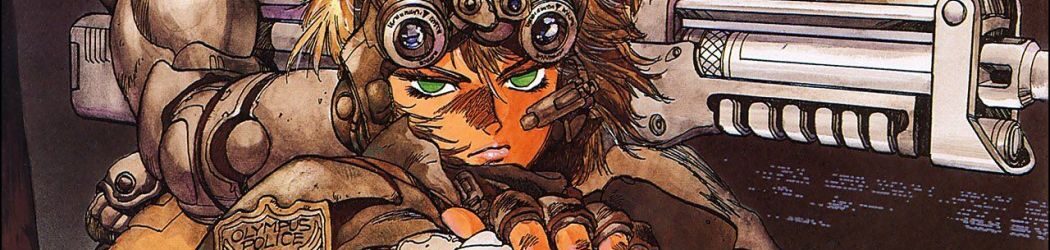

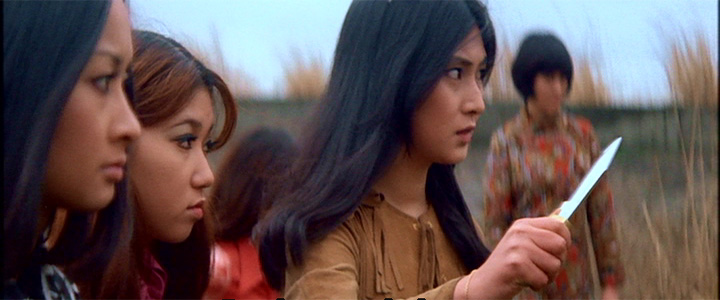
 “Pinky violence” is a genre of cinema that flourished in Japan during the 1970’s. It was spawned from the “pink film” genre of sexploitation movies, which started the previous decade with Satoru Kobayashi’s Flesh Market, which grossed over 100 million yen on a budget of just eight million. It was originally the domain mostly of independent producers and studios, but as the Japanese market became tougher, due to competition from imported movies and other forms of entertainment, major studios like Nikkatsu and Toei moved in to the field. While the former took the more traditional route, Toei opted to merge sex with the other staple of exploitation cinema, violence.
But what makes them of interest here, is their focus on women as the central characters, active participants in the violence, rather than simply being passive victims. Frequently, the heroines are sukeban, a term which means “delinquent girl” or “bad girl”, often operating in conjunction with, or leading, other girls in a gang, This may form part of a larger Yakuza enterprise, or work entirely independently. Sometimes, the focus is on obtaining revenge or justice for some past crime, whether against the girl or someone she loves. The ratio of sex to violence did vary, as did the setting: while most had a contemporary setting, films like Lady Snowblood took the themes are ran them out against a period backdrop.
While the ‘golden era’ of the genre is generally considered to be in the seventies, the influences and general themes continue on. They can be seen in the likes of the Female Prisoner Scorpion and Zero Woman series, and arguably, even in the new wave of Tokyo Gore movies, such as Mutant Girl Squad or Gothic & Lolita Psycho. We started by reviewing the four movies included in the box-set released by Panik House in December 2005. While it’s now out of print, its contents remains available from various sources, and it’s as good a place to begin as any. Further entries will continue to be added during the coming months, with the movies listed in order of release date.
See also
- Operation Pussycat
- Prisoner Maria: The Movie
- Sasori
- Scorpion: Double Venom
- Scorpion’s Revenge
- Sukeban Hunters
And, in chronological order
- Legend of the Poisonous Seductress: Female Demon Ohyaku
- Delinquent Girl Boss: Blossoming Night Dreams
- Girl Boss Blues: Queen Bee’s Counterattack
- Delinquent Girl Boss: Worthless to Confess
- Rika the Mixed-Blood Girl
- Wandering Ginza Butterfly 2: She-Cat Gambler
- Girl Boss Blues: Queen Bee’s Challenge
- Girl Boss Guerilla
- Wandering Ginza Butterfly
- Rica 2: Lonely Wanderer
- Criminal Woman: Killing Melody
- Rica 3: Juvenile Lullaby
- Female Yakuza Tale: Inquisition and Torture
- Girl Boss: Escape From Reform School
- Terrifying Girls’ High School: Lynch Law Classroom
- The Yakuza Wives
- Bloodbath at Pinky High, Part 1
- Bloodbath at Pinky High, Part 2
 After she gets word, back in their native Russia, that her sister has been killed in Toronto, Karma (Bechard) vows revenge on those responsible. This pulls her in to a seedy, dangerous world of sex trafficking, with women being lured from Eastern Europe to the West, with the promise of legitimate jobs, only to forced on arrival into working as strippers or worse, by the criminal elements who organize and run the business, with a fist of iron. As Karma stabs, shoots and bludgeons her way up the chain of command, those at the top grow increasingly restless. Initially, they think a rival gang is responsible, but the evidence eventually convinces them Karma is, indeed, a bitch,
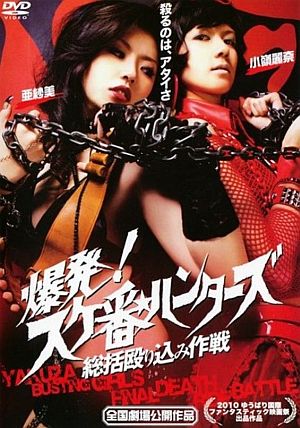 This teetered on the edge of a seal of approval, but didn’t quite make it. While there are some lovely moments, two great leads and the recreation of the pinky violence genre from the sixties and seventies, there’s just too much dead wood and pacing flaws, that leave it just short. Still certainly worth a look, with Asami (Asami) and Junko (Rena) going head-to-head as they battle each other for supremacy in the girl-gang world. Junko seems to have got the upper hand, leaving her rival buried for dead in the desert [or whatever passes for a desert in Japan]. But Asami is just warming up: she claws her way, literally, back from the grave, teams up with her old gang-members, and sets about extracting revengs on Junko and her crew.
 So opens this rare example of British grindhouse. We don’t generally
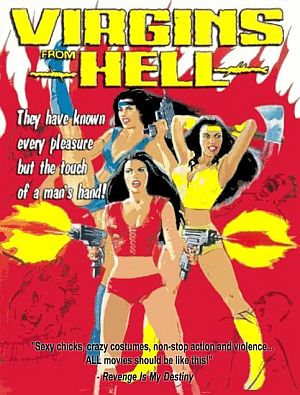 Let’s be clear: most of the entertainment to be found in this, is strictly of the “so bad it’s fun” variety. For instance, we perpetually found ourselves in Evil Overlord mode, i.e. “If ever I become an evil overlord, I will ensure my compound is not dotted with large, explosive barrels, clearly marked DANGER.” The lameness of this is often amusing, such as the complete aversion to nudity, an obvious product of its origins – the heroines even take baths with their clothes on. Other elements are just bizarre, if educational: it appears, if you get shot, you can jam a live snake into the wound and it will come out holding the bullet in its teeth.
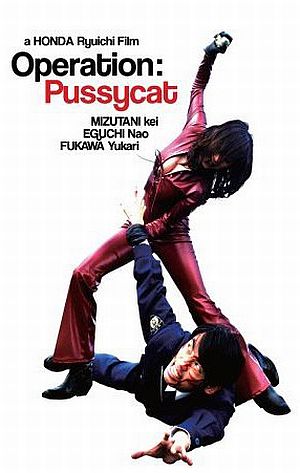 Faster, Pussycat is one of the icons of the action heroine genre, literally entire decades ahead of its time. This Japanese version uses a lot of the same elements, starting with a trio of go-go girls on the lam, under their macho leader. They stumble across a wheelchair-bound man and his muscular if taciturn companion, who appears to be stashing a large sum of money somewhere on the premises. If only they could find it… There’s also an innocent who gets entangled in the web of deceit and counter-deceit – in the original, it was because she witnessed them kill her boyfriend, while in this case, it’s after she apparently witnesses the three beat up a policeman, who stopped them for speeding, and discovered the dead body stashed in the back of their pick-up truck.
 Crime-writer Rikke (Vibe) heads out to her former home in the country for a quiet few days catching up on her work. There she bumps into a guy whom she hasn’t seen since she was eight, but who still seems to have the hots for her. She declines his advances, telling him of her husband back in the city, but he persists in his efforts, along with his policeman friend, and the backward clerk in a local convenience-store. A dead animal is left on her doorstep, and that’s only a precursor to a long, brutal assault on Rikke that leaves her battered and bruised, almost beyond recognition. However, barely have the rapists left, before she is already planning her revenge on each one of them, and it will be every bit as unpleasant.
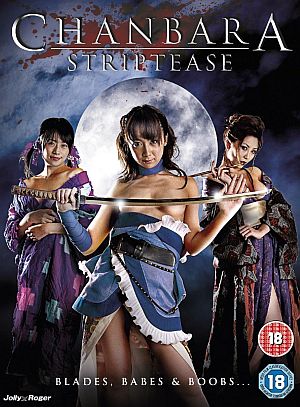 Lili is a devotee of Sayama Hashinryu, a deadly form of swordsmanship passed down from woman to woman. She goes through the initiation rite, which involves being blindfolded and given a drink which knocks her unconscious. She comes to, about three hundred years in the past, in feudal Japan, naked. When she gathers her senses, she rescues a local village-girl from some ninjas, but to cut a long story short, discovers in the process that when Lili exposes her breasts, they emit a pinkish glow, and she becomes far better at swordplay. Turns out the poor villagers are suffering extortion from the evil Lady Okini (Asa), so Lili turns into the Magnificent One [or Magnificent Two, if you know what I mean, and I think you do], while also falling for Hikoichi (Matsuda), the brother of the girl she rescued. However, it turns out that Lili is not the only one in possession of a supernatural bosom; Lady Okini is also so equipped. Battle cleavages are thus drawn…
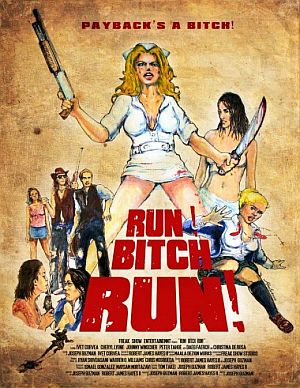 I can certainly appreciate where the makers are trying to go with this one. Two Catholic schoolgirls, selling Bible door-to-door to raise funds for their educational establishment. Unfortunately, they knock on the wrong door: this is actually a whorehouse, run by the psychotic Lobo (Tahoe), who has just killed one of his hookers. The two are kidnapped: one is killed, while the other (Lyone) is left for dead, naked, in the nearby woods. She is taken to hospital, but has only a single thought in her head: revenge. Stealing a nurse’s uniform, she checks out, intent on taking our her wrath on Lobo and his no-less depraved sidekicks.
 ★★★★

 Rob Zombie has had an interesting career, to say the least. From the early days as the front-man of heavy-metal band White Zombie, through his own solo work [heavily influenced by B-movies], and then on into his movies. That started with the fairly-crap House of 1000 Corpses, then the better Devil Rejects, and then his remakes of the first two Halloween movies, which were ok, as remakes of horror classics go. And then there’s The Haunted World of El Superbeasto, an animated feature which I stumbled across on cable. Well, actually, Chris did: “I Tivo’d a movie for you,” she said. And, surprisingly, she stayed for the entire thing, and appeared to enjoy this animated feature. Which is odd, because it has much the same gleeful, excessive insanity as Bitch Slap, which she walked out on.
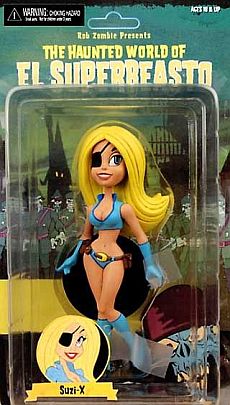 Zombie was responsible for the Werewolf Women of the SS faux-trailer in Grindhouse, and brings much the same gleeful approach to proceedings here. Indeed, we first see Suzi-X kidnapping the head of Hitler, which is kept alive in a jar (as in They Saved Hitler’s Brain), and then has to escape by fighting her way through a massive pack of Nazi zombies (that’d be from Shock Waves). Carnage ensues, as it pretty much does, any time Suzi-X is on the screen, which is a lot – she gets far more of the action than El Superbeasto does. Proceedings culminate in a lengthy, slo-mo catfight, entirely necessary to the plot, between her and Von Black, while the soundtrack cheerily informs us that “It’s OK to jerk off to cartoons – the Japanese do it every day – so rub one out for the USA…”