
★★
“More bomb than cherry.”
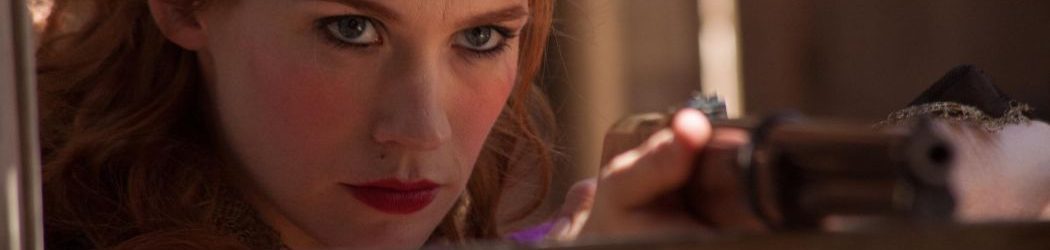
 Cherry (Julin – yep, that appears to be her surname) is a stripper, whose life takes a turn for the worse when she is assaulted by five customers in a private room at the club where she works. The cops aren’t able to do anything, so she takes the law into her own hands, with the help of her brother (Rodriguez), who accidentally kills one of the perpetrators when he goes to demand help with Cherry’s medical bills – no prizes for guessing how that request goes. As the others realize someone is out to get them, and who that someone ins, they hire Bull (Hackley), a gigantic hitman, to stop Cherry before she gets to them.
It’s clearly attempting to re-create the grindhouse era, but wimps out on most levels – for example, Cherry is a stripper who never shows any significant flesh. That’d perhaps be forgivable, if Julin’s performance hit the required notes elsewhere, but it wobbles uncertainly from giggly schoolgirl, incapable of forming any kind of plan to violated bitch, capable of ramming a vehicle into someone’s head (in probably the film’s most impressive moment). The other performances are similarly shaky, with the possible exception of Manning as the club owner, who captures the necessary tone for his role. Hackley is so shamelessly channeling Samuel L. Jackson from Pulp Fiction it goes beyond irritating into amusing – then past that, back into irritating again [Chris wondered if it was a white guy in blackface, it’s so clichéd!]. The action is equally as mixed a bag, swerving from well-staged to sloppy, occasionally even within
The overall impact is occasionally effective, with a couple of scenes that deliver the necessary wallop. But too often, it feels half-hearted, like they had a vague interest in resurrecting the grindhouse era, rather than a passion or drive, and it’s certainly all but lacking the “grind.” While I’m all in favour of emphasizing the “revenge” over the “rape” aspects of the story, the latter is so toned-down and muted – the assault itself is barely shown here – that the justification for the former is almost non-existent. That makes it difficult for the audience to get on board, when the ends don’t appear to justify the means.
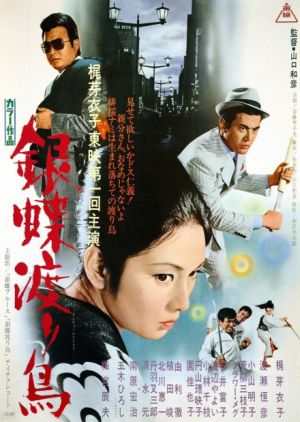 Nami is sent to jail for killing a Yakuza boss, and when she is released, returns to the Ginza district of Tokyo to live with her uncle, who runs a pool hall. She gets a job as a hostess in a bar, with the help of her new friend Ryuji (Watase), but the quiet life doesn’t last for long, even as she tries to help the widow of the man she killed – whose petition on behalf of Nami is what helped lead to her early release. For the local mob, in the shape of Okada (Nanbara) and his gang, are sniffing around the bar, seeking to take it over. To settle things, Nami offers to take on Okada’s champion at billiards, a challenge the gangster readily accepts, not realizing he has just been hustled, and that Nami is no mean player herself. Can she win – and even if she does, will Okada live up to his side of the bet?
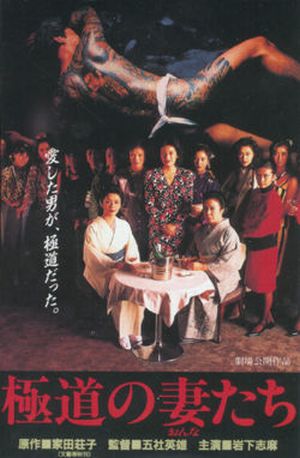 Perhaps a better title, however, would be Yakuza Sister, since this is a tale of two siblings. Tamaki (Iwashita) is an actual mid-level Yakuza wife, who is running their branch of the gang in the jailed absence of her husband, and doing quite well at it, enhancing its size and reputation. She is largely estranged from both her sister Makoto (Kitase) and their father – she’s a bartender, he works in his machine shop, but it’s clear from the get-go that his time is limited [this isn’t much of a spoiler when you see him coughing his lungs out while simultaneously chain-smoking]. Two things upset their semi-orderly lives. The overall head of Tamaki’s clan dies, opening up a power vacuum which sets off a struggle between rival factions, and Tamaki attempts to arrange a ‘suitable’ marriage for her sister. Makoto rebels, taking up instead with Kiyoshi Sugita (Sera) – which is unfortunate, because he’s a loyal member of the faction now battling Tamaki’s group for control.
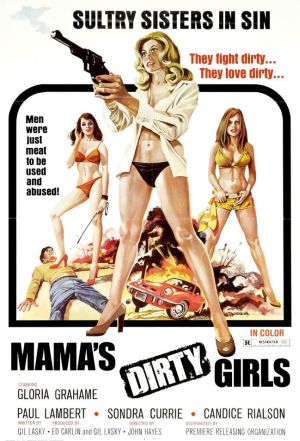 While the title suggests something inspired by Corman’s Big Bad Mama, this is a contemporary tale which, in some ways, is actually closer to Faster Pussycat. It has a great deal more nudity, right from the opening scene in which Becky (Rialson) stares into a mirror, and puts on her bikini-top… very… slowly… However, the titular Mama (Grahame) is nowhere near the level of Varla, and the movie feels more like a pale imitation, despite the additional breasts.
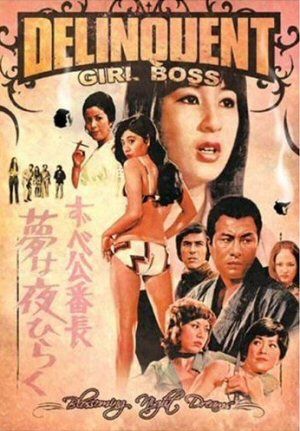 This was my first true vintage “pinky violence” movie, though I had bumped against some fringe entries in the genre before e.g. Female Convict Scorpion: Jailhouse 41, which I enjoyed and really must get round to reviewing for here some time. This one…not so much. It focuses on Rika (Oshida), who gets out of reform school, and gets a job as a ‘companion’ at a bar, where most of the girls have a similarly troubled background. The local Yakuza boss is sniffing around, and his path crosses Rika’s after she (semi-unwittingly) helps a colleague steal some drugs from them. As a result, the house mother/bar owner, is on the hook for three million yen, plus interest.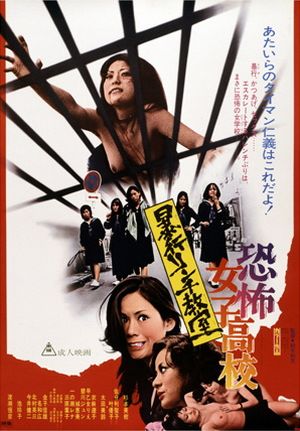
 This was the title that finally ‘broke’ Chris, and she wondered what the hell I was Googling to come across this movie. Shame she missed it, as despite some rather nasty sexual sadism, it’s among the best of the genre. Girl gang leader Noriko (Sugimoto) is assigned to the “School of Hope”, a morally-bankrupt educational establishment for delinquent girls. It’s principal is entirely ineffectual, and it’s actually run by the vice-principal (Imai), with the collaboration of the “Disciplinary Committee,” a group of the girls he allows to dish out punishment. Noriko isn’t going to stand for that, and teams up with a sleazy journalist (Watase) to bring down both the Committee and those in charge.
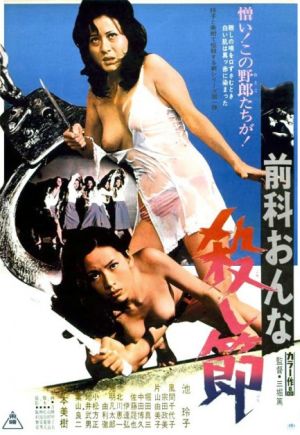 With a bit more of an intricate plot than most entries, this is the tale of revenge served cold. The Oba Yakuza gang shoot one of their flunkies up with drugs and dump his dead body in a ditch. His daughter, Maki (Ike), tries to stab the boss responsible (Hayama) in a nightclub, but she is, frankly, a bit crap with a blade; the attack fails, and she ends up in prison. There, after proving her toughness in a jail “I quit” match, she is accepted by the other girls, including the heavily-tattooed Masayo (Sugimoto). A few years pass, and Maki gets out of jail; her friends are waiting, and they agree to help in her plan for vengeance. This involves Tetsu, the psycho scion of the Hamayasu clan, who used to rule things before the Oba group came in and kicked their asses. Maki will use him as the scapegoat, to trigger war between the groups, then step in to take out Oba once he has been weakened. That’s the plan, anyway, with Maki whoring herself out, to (gasp!) foreigners and even (shock!) a black airman to get resources. However, a large spanner in the works is that Masayo is also Oba’s wife…
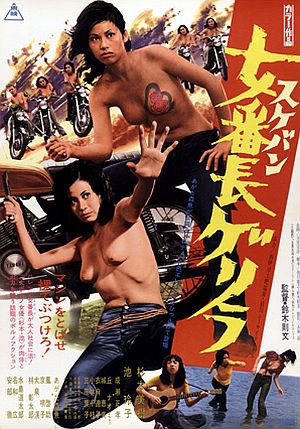 After my disappointing first foray, this is more like it, right from the moment Sachiko (Sugimoto) rips open her top, revealing a heavily-tattooed breast, before she and her Red Helmet Gang of biker chicks kick the asses of another, male gang who are hassling them. It’s clear that Sachiko deserves the title far more that the ‘Delinquent Girl Boss’. She and her crew from Tokyo head off to Kyoto, where they face off against, and end up taking control of, the local girl gang – some of whom are none to happy by this invasion [Kyoto being the former capital, its residents seems to hold a grudge against those from Tokyo]. Sachiko ends up on the wrong side of the local Yakuza, one of whom has a sister, Nami (Ike), who is an independent free-agent girl gangster, affiliated with none, but kinda over-seeing all. Sachiko meets and falls for a boxer, Ichiro (Mizushimi), after he helps her girls out of a tough spot with the Yakuza, and follows him to a seaside resort where he is training. Needless to say, love does
 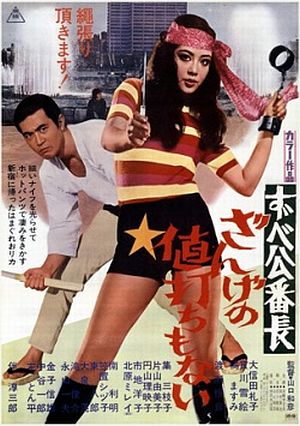 When Rika (Oshida) gets out of reform school, she goes to visit her friend Midori (Katayama), and gets a job working in the garage belonging to Midori’s father Muraki (Ban), even though Midori is estranged from him – except when she needs money to pay off her boyfriend’s gambling debts to the local Yakuza under Boss Ohya (Nobuo Kaneko). Another friend of Rika’s is working in an “art studio”, doing nude modelling to support her sick husband, and still others are hostesses at the Ginza Girls cabaret, a dance-hall which Ohya’s gang are also extorting for protection money. After Muraki has to take a loan using the garage as collateral to pay Ohya, Rika tries to offer herself as an alternative to the boss. This goes about as well as you’d expect, though there’s a genuinely cool twist in which we find someone isn’t quite who we seem. There’s a tragic fatality, which sets the scene for all the girls to get together and take on Ohya’s gang.