 ★★★½
★★★½
“I’d have settled for two of three.”
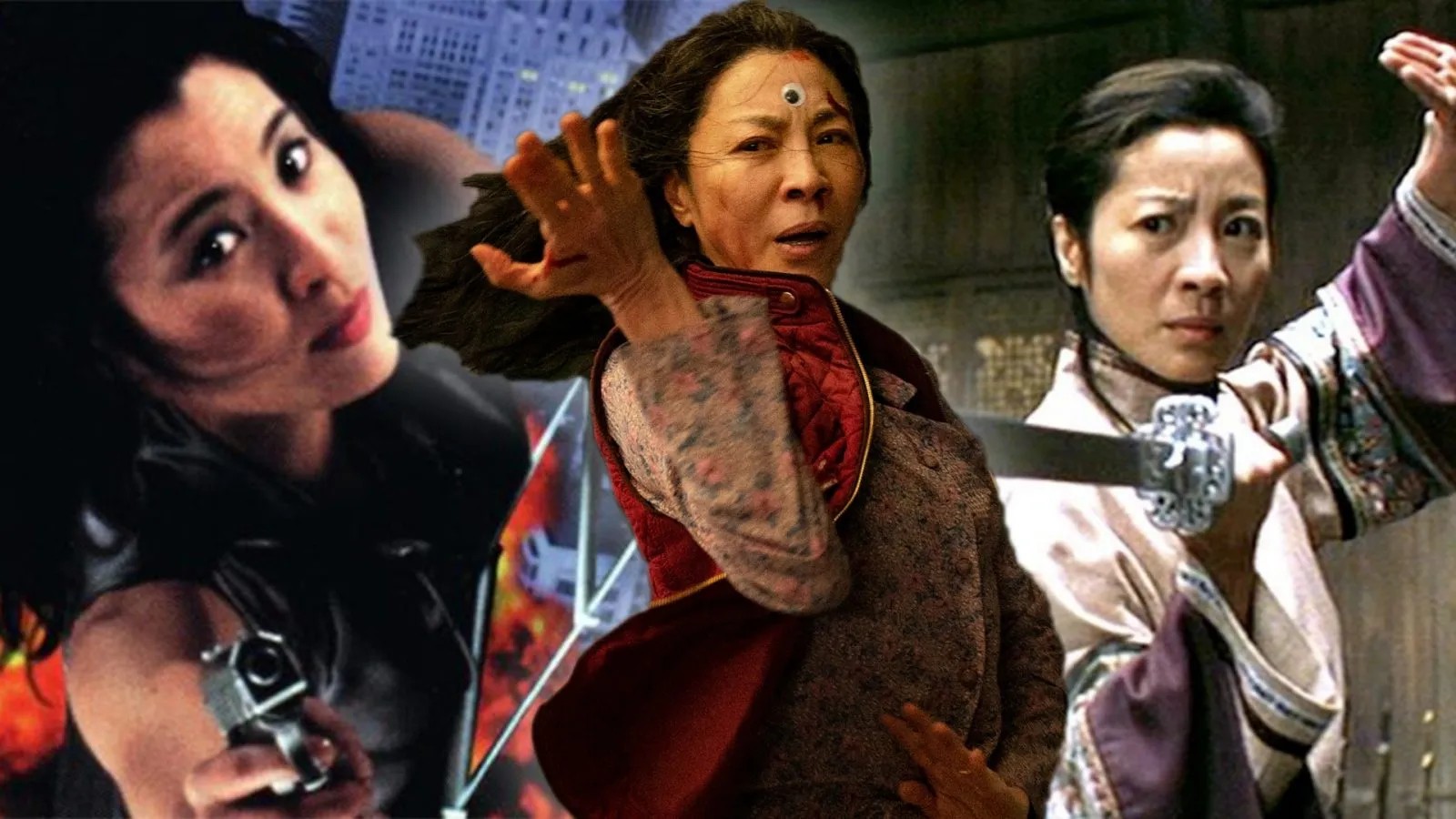
This has been a long, long time coming. I’ve been a fan of Yeoh since seeing her Hong Kong starring debut, Yes, Madam, which came out all the way back in 1985. Over the years since, her career has had its ups and downs, including complete retirement after her marriage in the late eighties. She returned, and is the only actress to have appeared in two movies rated five stars here: Heroic Trio and Crouching Tiger, Hidden Dragon. But her career in Hollywood has been limited to sterling support roles, in both movies and television, encompassing everything from Bond film Tomorrow Never Dies through Star Trek: Discovery to Crazy Rich Asians. A starring role, appropriate to her talents, never seemed to come along.
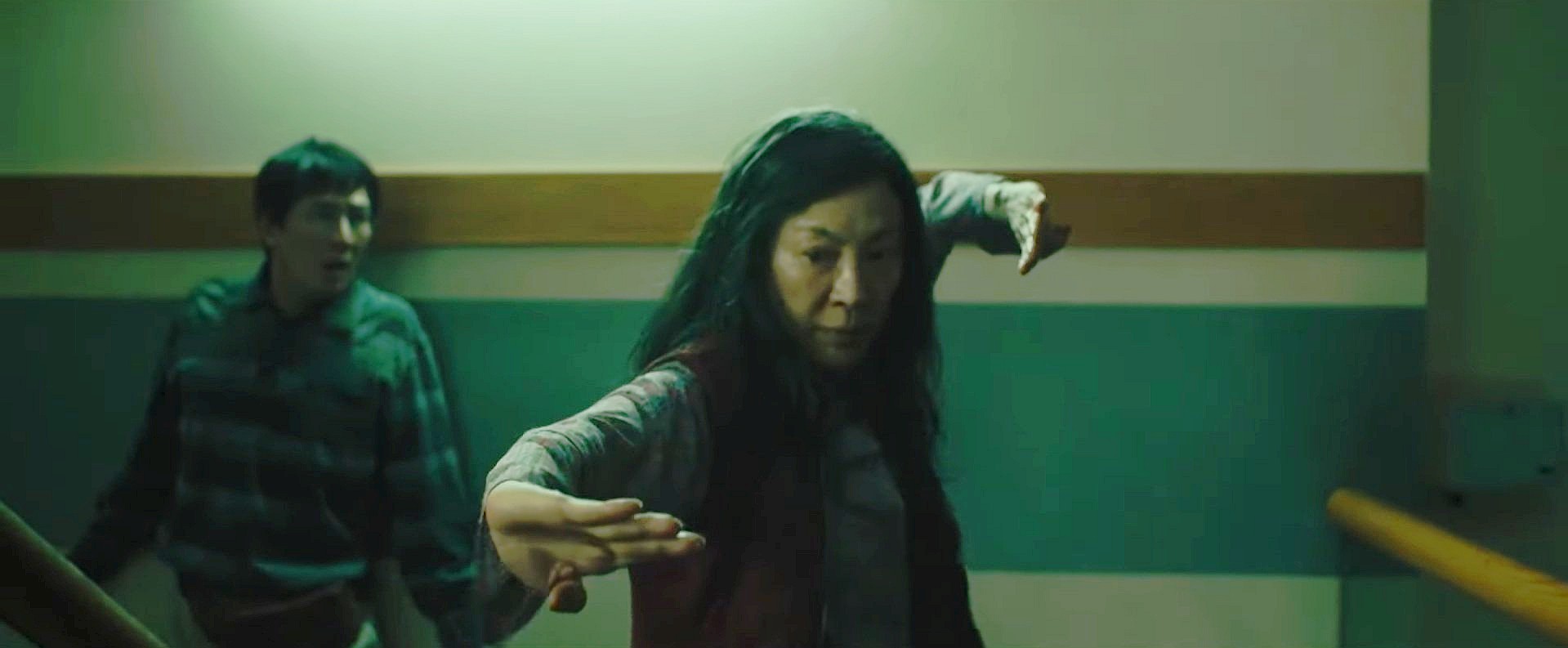
Until now. Thirty-seven years after Yes, Madam, and at the age of 59, this film finally puts Yeoh where she deserves to be: front and centre. Yet, perhaps partly due to how long I’ve been waiting for this, I must confess to being a bit disappointed this is not a classic to match the titles listed above. Oh, it certainly has its moments, and Yeoh is as good as expected. However, its 139-minute running-time feels more a curse than a blessing. The concept at its core is almost infinite in scope, and I did feel the movie was trying to include all of it. Less could have been more, with a targetted approach preferable to the relentless overload adopted by the makers, which left me feeling as if I was drinking from a fire-hose.
The multiverses here literally rotate around Evelyn Wang (Yeoh), who runs a laundromat teetering on the edge of failure, with her husband, Waymond (Quan). Their marriage is also failing, her relationship with her daughter, Joy (Hsu) is on rocky ground, and she has to go to an appointment with hard-ass IRS tax auditor Deirdre Beaubeirdra (Curtis). The last is where things kick off, as she is visited by a Waymond from an alternate universe, who tells Evelyn she is the only hope of foiling the evil Jobu Tupaki. That’s an alternate Joy, who has gone insane and created a black hole-like vortex which could destroy all the multiverses. Fortunately, Evelyn’s abject failings at life give her the ability to tap into all the skills and knowledge of the other, better versions of herself.
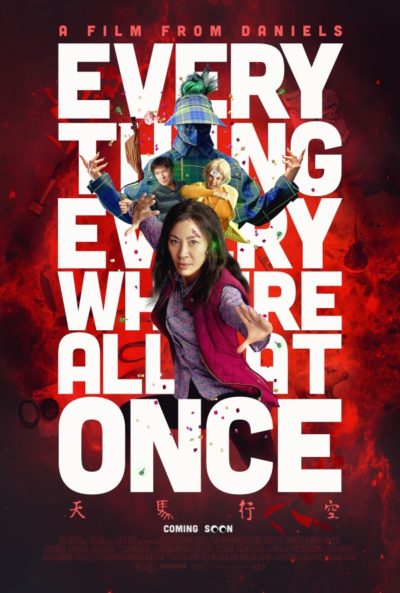 Like I said: almost infinite in scope. Apparently, co-writer/director Kwan was diagnosed with ADHD during the creative process: to be frank, it shows. While the imagination on view is admirable, the film bounces about between ideas at a ferocious rate, almost regardless of whether they deserve it. We spend an inordinate amount of time in a multiverse where everyone has long, floppy fingers. Yet there is also buttplug-fu, which is an example of the movie going places you’d never have expected could be so entertaining. Or a lengthy, surprisingly engrossing, scene in which two rocks in an otherwise lifeless multiverse have a conversation in captions. Because why not?
To the film’s credit, it never abandons its characters, and that helps keep it grounded. Albeit only just, on occasion the movie standing on its tippy-toes as it tries desperately to avoid being blown away by its own excesses. It’s perhaps telling that, despite all the film’s visual bluster, the most effective moment for me was among the simplest, one character telling another, “In another life, I would’ve been happy just doing laundry and taxes with you.” As such, Yeoh is the story’s heart, and gets to demonstrate her unquestionable acting talent. It has been fascinating to see the development of that, especially considering her lack of not just experience but any formal training. I mean, she first entered the field close to four decades ago, as a former Miss World contestant. How many of them eventually go on to get talk of an Oscar?
It’s as a result of this that I kept watching the film, because I genuinely cared what happened to Evelyn. I wanted to see her figure it all out and make peace with the various forces trying to tear her humdrum life apart. From that angle, it’s close to soap-opera, albeit an unusually effective one. Except, of course, the means by which that peace is potentially achieved, includes multiverse hopping, and fighting an evil version of your own daughter, who wields a gurgling plughole of doom. It’s the overlap between the mundane and bizarre where this finds its own voice. The problem is, it tries too hard to live up to the title. Sure, give us everything, everywhere. I’d just rather it hadn’t done so, all at once.
Yet, similarly, it leaves an awful lot of potential on the table. Why is kung-fu virtually the only talent Evelyn uses? Tap into a universe where she’s a cab driver, and give us an epic car-chase. Or the one where she’s a cat-burglar, for heist purposes. It’s not hard to come up with a dozen such threads. Perhaps the makers were constrained by their budget, a relatively cheap $25 million – less than Crazy Rich Asians. They do an admirable job of squeezing value out of it; again, the sheer pace probably helps, with your brain trying so desperately to keep up, it’s hard-pushed to pay attention to any of the finer details.
But I’m glad I won’t go to my grave with my final paid cinematic experience being Terminator: Dark Fate. [Though the two Neanderthals beside us, talking loudly and checking their phones throughout, really make me think we are done with theatres] The Daniels deserve credit for the obvious invention displayed, and this is the kind of original property I’m happy to support, over another sequel and/or shitty comic adaptation. I also must mention the supporting cast, who are uniformly great, particularly Hsu as both aggravated daughter and multiiverse threatening villainess [There’s also a cameo by another eighties Hong Kong action actress, Michiko Nishiwaki. Maybe she’ll get her own movie next?]. That it stars one of the most under-rated actresses in Hollywood, finally getting the opportunity she deserves, is alone reason enough to see this. Just don’t expect too much.
Dir: Dan Kwan, Daniel Scheinert
Star: Michelle Yeoh, Stephanie Hsu, Ke Huy Quan, Jamie Lee Curtis




 There are times when I end up asking myself deep philosophical questions, like “Why am I doing this?” or “Isn’t there something else on which I can use my time?” In this case it, was “Who thought a sequel to the painful exercise which was Ebony Hustle was necessary?” To be fair though, this is an improvement. A half-star might be pushing it, to the point I did wonder about introducing a ★¾ rating. Or possibly a ★ and 11/16. It’s not good, to be clear. But it’s definitely less aggressively incompetent, with some of the most annoying rough edges smoothed down. For example, the audio this time mostly (although not entirely) lives around the same level, and there’s only one Facetime scene.
 When the best part of a movie is the opening credits, we have a problem. That’s the case here, with an 007-influenced montage that feels as if it cost more than the entire rest of the film to put together. However, by that point, the movie was already on thin ice, because the volume of the music was roughly three times that of dialogue in the pre-credit scene. Lunging repeatedly for the button on the remote is always a red flag for any indie movie, and proved accurate here. The same goes for the gratuitous name-checking of much better black heroines, such as
  When I see “Reader discretion is advised,” on an Amazon page, I tend to take it with a grain of salt. I’ve been enjoying media at the outer edges for longer than most readers here have been alive, and so am not easily shocked, disturbed or offended, to put it mildly. I’m ussure this quite managed to do any of those, but I will definitely say this: yes, reader discretion
 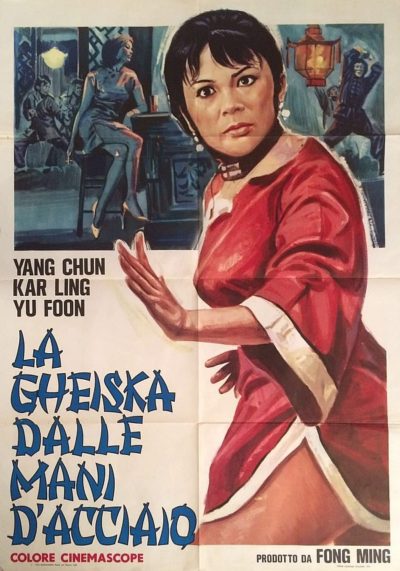 I’m just going to begin by quoting the opening credit titles. Spelling, grammar and punctuation as received. “At the early stage of Republic of China, Yuan Hsi Hai wanted to rebel the democratic government & be the king. But there were 300,000 soldiers at Yuan Wan under the command of General Tsai obstructed his desire, so he cheated General Tsai to Peking & confined his movements. So Yuan who lived in Chu Jen Hall could fulfil his ambition but…” I reproduce this because, to a large extent, that’s everything I’ve got in terms of the over-arching plot here. It’s all about Tsai (Kwan) getting out of the city, in order to lead his troops and, presumably, frustrate Yuan’s dictatorial ambitions.
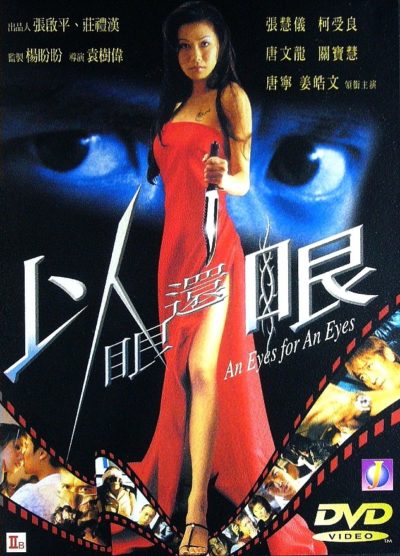 This opens with a scene that is almost a direct life from the similarly titled
  For six months or so, our morning routine involved the consumption of an episode of Parks and Recreation with breakfast. Our favourite character on the show was Ron Swanson, but not far behind was April Ludgate, played by Aubrey Plaza. She was the mistress of deadpan misanthropy, delivering lines like “I’m just gonna live under a bridge and ask people riddles before they cross.” We’ve not seen her in much since the show ended, but the concept of April Ludgate, career criminal, was too delicious to pass up. So here we are, yet I must admit, Plaza is almost good enough to make us forget April. Well, except for one roll of the eyes, which was vintage Ludgate.
 She plays Emily, a young woman saddled with an inescapable pit of student loans, for a basically useless qualification, and an unfortunate felony relegating her to food delivery work. A chance encounter brings her into contact with Youcef (Rossi). She earns $200 for making a fraudulent credit-card transaction on his behalf, and is offered the chance to earn ten times that, for a larger, riskier purchase. With regular employment clearly not the solution, Emily embraces her new, illegal career, working with Youcef, much to the disdain of his Lebanese brothers. As their infighting escalates, Youcef decides to cut and run, only to be beaten to the punch. Emily won’t stand for that: “You’re a bad influence,” says Youcef, as he and Emily prepare to rob his brother. He’s not wrong.
  I had forgotten how much I really did not like the
 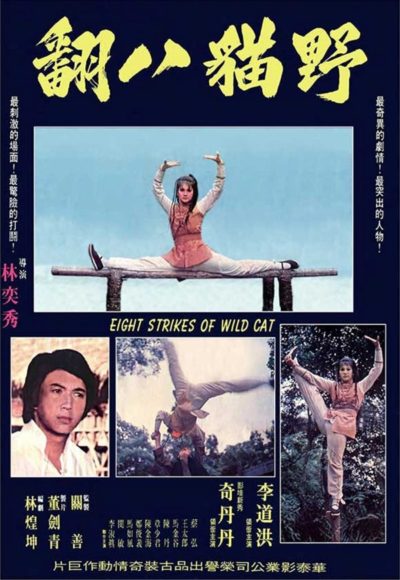 I guess this is, at its heart, about the quest for a treasure map that has been torn into two pieces. Though you could be forgiven for not really noticing, as most of the cast seem to forget about it for the bulk of the running time. The heroine is Shao Wa (Chi), whose father is killed by the Three Rats in their quest for the map. She ends up being punted off a cliff and presumed dead by them. Naturally – it’d be a short movie otherwise – she’s not as dead as they think. She’s rescued by the inevitable kung-fu master and his annoying sidekick, Lee Ta Fa (Hung), who nurse her back to health, and give her the skills necessary to beat the Three Rats.
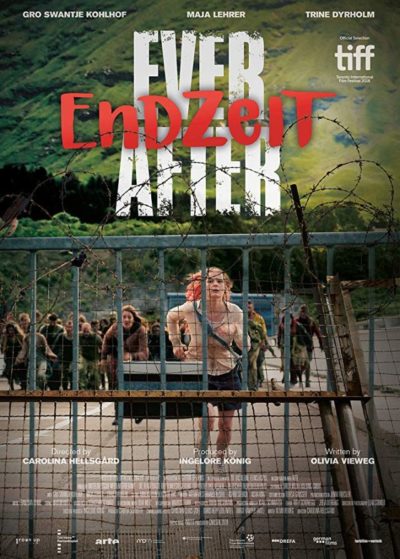 This is not your normal action heroine film. Nor is it your normal zombie apocalypse film. While it certainly nods in both directions, it seems entirely committed to going in its own direction. My mental jury is still out on whether or not this was a good thing or not. I think if I’d perhaps been prewarned what to expect, I might have been better equipped to handle this. It takes place after the outbreak of a plague, with the dwindling number of survivors now holed up in two cities: Weimar, where infection is an immediate death sentence, and Jena, reported to be trying to research a cure.