




 ★★★½
★★★½
“McResident Evil”
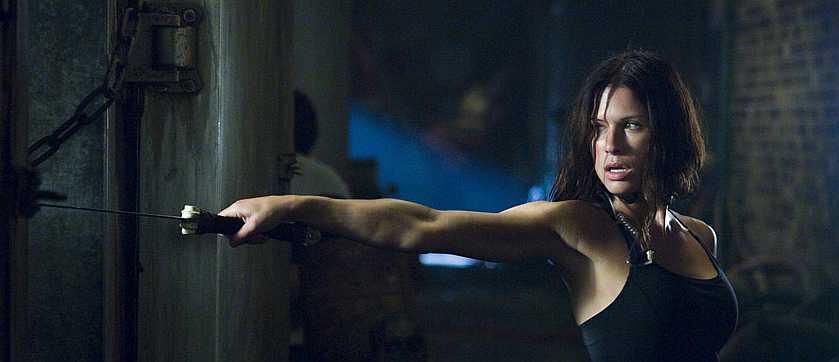
Basically every review I read of this has started off by stating it’s a cross between…well, perm any three from Mad Max, Escape From New York, Aliens, I am Legend, 28 Days Later and Resident Evil, depending on how well-informed the writer is about the action and horror genres. That’s fair enough: there’s no denying that Marshall has chosen here to create a film that is as much as compilation of influences as anything, and this therefore falls short of his previous work, The Descent, which went places few recent horror films have gone. However, most reviews sniffily stop there or, worse still, engage in petty cinematic snobbery: witness Jeff Otto of ReelzChannel.com – I’m not going to do him the honor of linking to the piece – who says, “Not pre-screening this one was a smart move on Universal’s part. It has no need for critics because the people who will enjoy this movie are very unlikely to possess the cognitive skills or attention span to read a review anyway.” I came up with several witty rejoinders to that, but opt instead for the tried and tested one of, fuck you, Jeff Otto. For sometimes you don’t want something that pushes the boundaries of cinema; the films listed in the first paragraph are (mostly) classics, and if you’re going to steal from anywhere, steal from the best.
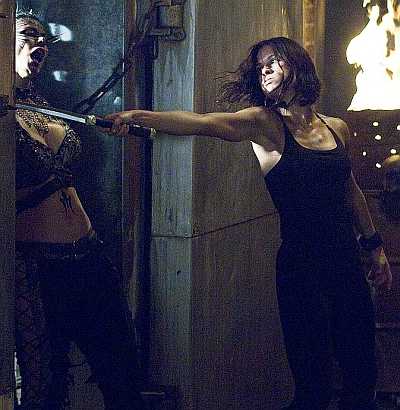 In the near future (next week, actually at the time of going to press), Glasgow falls prey to the Reaper virus, which is exactly what it sounds like. The government in London deal with the problem by building a 30-foot wall along the border and sealing off Scotland – which is basically the approach taken by the government to problems in Scotland since, oh, about 1707. [Hello, born there!] 30 years later, however, the virus breaks out in London, and all of a sudden, the information that people are still alive in Scotland, suggesting they found a cure, is now of more than academic interest. To get the cure, they send Eden (Mitra) up North, to find Kane (McDowell, appearing in about two scenes, then taking his salary and leaving), who might just have the solution. However, things do not go as planned, needless to say, not least because Glasgow is inhabited by nothing but psychopathic thugs with poor dress sense and bad skin, stuck in the past. So, no change, then. [Hello, not born there – East Coast Scotland, represent!]
It’s clear that Marshall has a strong interest in action-heroines, having not only directed The Descent but also written Killing Time. Mitra also has something of a track record, having been one of the live-action Lara Crofts for Eidos a few years back. Here, however, she comes across as more of a Kate Beckinsale wannabe – my first reaction when I saw the trailer was this it was Kate. That works better in Underworld or Resident Evil, where the setting gives us reason to believe that the central character has special powers of one kind or another; as a straight-up action heroine, Mitra is just not physical enough to convince. This may perhaps explain the limited amount of physical action she does; a fight against another woman warrior, appears to have been edited with a weed-whacker, but another, in which she goes one-on-one with an armored knight, is pretty decent.
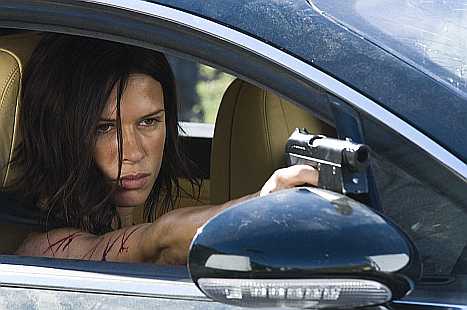 It all builds to a monumental car-chase, though you have to suspend disbelief there, as apparently Bentley cars will start right out of the crate, even if they’ve been sitting there for thirty years. You can also plough them through an exploding bus, amongst a litany of other torments, and they’ll come out the other side with barely a scratch. Again, if you’re going to ground your film in the ‘real world’, admittedly a questionable concept given the plot synopsis above (and I haven’t even got to the more outrageous elements yet!), then mis-steps such as these should be avoided. They’ll just give the more moronic end of the critical fraternity – paging Jeff Otto – blunt objects with which to whack your film about the head, as they ride off on their high horse. They only bothered me slightly, since I was already in full-on disbelief suspension, and since the resulting car-chase was cheerfully destructive, I’m inclined to give it some slack.
There’s also a certain point at which it’s clear that Marshall is operating tongue in cheek: it may be the sign on the Glaswegian bus which reads ‘Out of Fucking Service’, or in the castle where Cane and his followers have regressed to medieval times, yet have left up another sign, this one saying ‘Gift Shop’. Or that two of the soldiers in Eden’s party are called Miller and Carpenter: the directors of Mad Max and Escape From New York being George Miller and John Carpenter, of course. Or the elaborately choreographed ritual of human flesh-eating, like an Archaos show [there’s an 80’s reference for you!], set to a song by punk icon Siouxsie and the Banshees. Though the immediately-preceding use of Fine Young Cannibals was, I admit, a bit much. Still, let go, don’t expect the atmosphere of The Descent – this is much closer in tone to Marshall’s preceding Dog Soldiers – and just enjoy the gloopy violence or slabs of black humour which pepper the film, and you’ll have a more than adequate time.
Dir: Neil Marshall
Stars: Rhona Mitra, Bob Hoskins, Craig Conway, Malcolm McDowell
 Let me be perfectly clear: one of the above stars is purely for entertainment value, since this is one of those movies which is so bad as to become enjoyable, purely on that level. There is hardly an aspect of this film which is not badly-executed: the script is badly thought-out, the performances are almost without exception woeful, and the continuity has to be among the worst of all time. One actress goes from a colored top and no bra, to a bra, to a white top and no bra, in successive scenes, while another enters a pool in a bikini, comes out topless, and five second later has the top back on and is dry. We laughed like drains, I tell you. Oh, you want the plot? Mousy scientist Helen (Kitchen) is trying to find a brain chemical that will unleash humanity’s psychic powers, using imprisoned serial-killer Horn (Marks) as her source. Even though the resulting chemical is green and glowing, in a way not seen since Re-Animator, she decides to test it on herself. This unleashes her alter-ego, Cassandra, who embarks on a plot to enslave mankind to her will. It’s up to her assistant Gary (Klitzner), along with a homicide detective (Rivers) to stop her.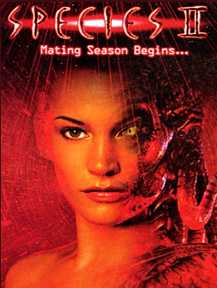
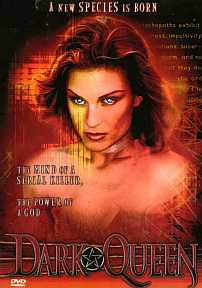 It should be entirely clear which series the distributors of Dark Queen are hoping you’ll mistake their film for an entry in. In reality, this is not fit to lick Natasha Henstridge’s boots; it’s really much closer to Dr. Jekyll and Sister Hyde, yet as such, is still a dismal failure – that whirring sound you hear is Robert Louis Stevenson spinning in his grave. However, even as it fails on just about every cinematic level, fans of bad cinema may find this has its merits. However, even there, it may still divide opinions: I had rather more fun with this than Chris [she, on the other hand, liked the midget-vampire movie, Ankle Biters, which I found almost unwatchable]. You can certainly sense where they were aiming with this; however, the execution is, frankly, so awful as to drain any potential from it, almost entirely.
 ★★½
★★½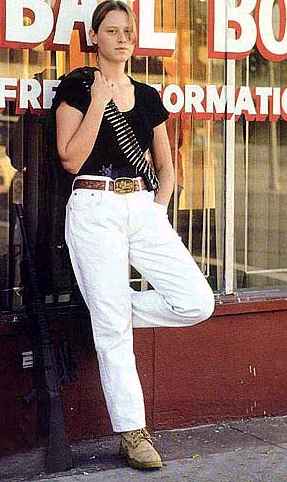 “This is based on a true story…sort of” is how the pre-credit disclaimer goes. Which does, at least, show far more honesty by Tony Scott than the usual claims in such things – Blair Witch and Wolf Creek shuffle their feet nervously. Unfortunately, my response would have to be, “This is a watchable movie…sort of.” Scott brings his usual, hyper-kinetic style to the table, but I was prepared for that and so didn’t mind it. No, the major problem was the derailment of the film from the potentially fascinating and probably unique character of Domino, into yet another heist movie. So instead of any insight into personality, we get to watch a bunch of gangsters and low-lives, of whom Domino is merely one, double-cross each other. It’s an hour of watching the corpse of Barbaro being beaten, if you get my drift; even Scott has been here before, to better effect, in True Romance.
 The film is filled with distracting stunt casting in the minor roles. This includes Christopher Walken, Mena Suvari, Lucy Liu, Jacqueline Bisset, two guys from Beverly Hills 90210 playing themselves, Macy Gray, Tom Waits and even Jerry Springer, though the episode of his show here is far duller and more earnest than the real thing. Walken is, inevitably, the only one to make much of an impression, playing a reality TV producer who wants to make Domino a star. He’s described as having the attention span of a ferret on crystal meth, probably an adequate metaphor for the film as a whole. It lacks the patience to stay with and develop any of the characters, so sniffs around them for two minutes, before scurrying off to find someone else instead.

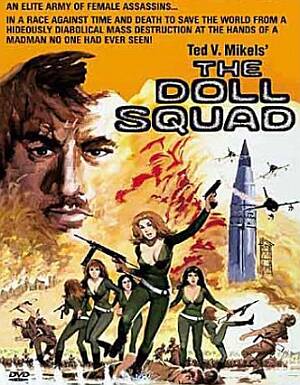 To describe this as eagerly anticipated would be… well, wholly wrong, actually. I’ll tell you how long the DVD has sat on our shelf: I bought it on
  As Kim Possible proves, there’s certainly scope for a high-school action heroine who has to save the world from evil. Unfortunately, here, the potential largely gurgles down the plughole, in favour of a smug, self-satisfied romantic comedy, that manages to be as bland as a film about teenage lesbians could be. Amy Bradshaw (Foster) gets a perfect score on the test hidden within the SAT, and is recruited into a spy academy; there, with her classmates (Good, Ritchie and the always amusing Devon Aoki), she carries out secret missions, wears plaid skirts and agonises over her relationship with her boyfriend.
 The action isn’t too bad initially, with a sprightly shootout in a restaurant. However, that’s your lot, save the “daring” lesbian angle. Though, being mainstream cinema, it’s just a couple of clothes-on kisses, and bad, unconvincing romance is no fun, regardless of a character’s orientation. This aspect is so po-faced and politically correct – it is, clearly, supposed to be taken Very Seriously – that proceedings come to a grinding halt, while what appears to be the director’s iPod on shuffle plays as a witless soundtrack. Look! An Erasure song! How appropriate! ‘Cos, y’know, they’re
  This bleak, nihilist view of 1980’s Hong Kong ran into severe trouble with local censors, for its depiction of the colony as populated solely by violent brutes. Leading these is Pearl (Lin), a teenage girl who redefines the term “troubled”, and whose brother (Lo) is a cop with a short fuse. She witnesses a hit-and-run accident and browbeats the three kids involved into joining her in a relentlessly-escalating series of violent escapades. When they find themselves in possession of 800 million yen belonging to gun-smugglers, you just
  When the island site of a proposed resort starts seeing mutilated bodies turn up, they call in Feng Shui specialist Mayuko (Tanaka) to investigate. However, as she herself discovers, she’s no ordinary psychic, but the next in a line of guardians dedicated to stopping demons from entering the human world. With the aid of some conveniently informative dreams, a down-to-earth cop (pro-wrestler Mutoh, known in the West as The Great Muta) and a sword she finds underwater, it’s up to Mayuko to stop the Hellmouth from openi…er, save the world.
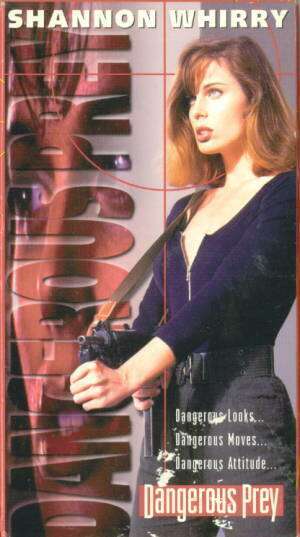 If you
  Going in, I knew this had a reputation for incoherent plotting, but after 10+ years watching HK movies, I figured I’d cope. Wrong: I sank within two minutes. An incomprehensible opening voiceover makes this feel like part 17 of an ongoing series; from there on, characters, sects, and magical kung-fu abilities (such as Shifting Stance, which lets you blink in and out of reality, or the self-explanatory Melting Stance) arrive with rush-hour frequency. Basic principle: various factions struggle for martial arts supremacy. Central to these battles are four women, who initally fight among themselves, before realising they must band together to face the ultimate enemy. If I said more, I’d be engaging in wild speculation.