 ★★★½
★★★½
The Girl with the Dragon Tattoo
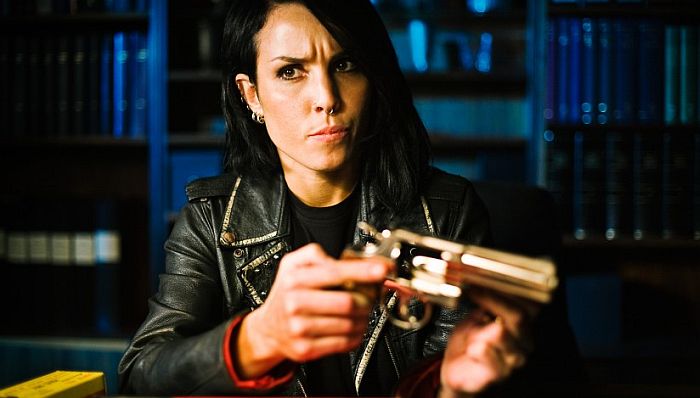
I think we know the exact moment we fell in love with the character of Lisbeth Salander, the central character both in Stieg Larsson’s Millennium trilogy, and the Swedish films based on the books. It would be the scene in the first film where she goes back to see the man who had been sexually abusing her. Little did he know, on her last visit, she had recorded the whole event. This time, she knocks him out, ties her assailant up, forces him to watch the video and then engages in a spot of amateur tattoo work, leaving him with “I am a sadistic pig and a rapist” etched permanently across his torso. Yeah. You go, girl.
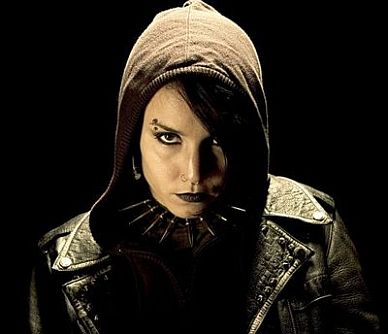 Salander is not your typical action heroine: she’s 5’4″, weighs maybe 90 lbs dripping wet, and anti-social to a degree that may be pathological. But she possesses a mind like a steel-trap, impressive computer hacking skills, a steely resolve and a zero-tolerance policy for anyone who abuses women [the Swedish title of the first book and film translates as “Men Who Hate Women”, and misogyny is something of a theme throughout the trilogy]. This was demonstrated very early: at the age of twelve, and fed up of seeing her father hurt her mother, she doused him in petrol and set him on fire. Like I said: “zero-tolerance”.
We first meet Lisbeth in Dragon Tattoo, using her skills to conduct surveillance on Mikael Blomkvist (Nyqvist), a journalist who has just lost a libel case and is facing prison as a result. As a result of her report, Blomkvist is hired by Henrik Vanger (Sven-Bertil Taube), to investigate the disappearance, forty years previously, of his niece Harriet, who was also Blomkvist’s babysitter. It has been nagging at Vanger ever since, and he feels his time is running out to find the truth. Reviewing the evidence, Blomkvist finds names and numbers in Harriet’s bible, but it’s Lisbeth, helping ‘remotely’, who cracks the code, revealing them to be verses from Leviticus about punishing sinners. The two gradually peel away the years to reveal the truth, a serial-killer whose crimes go back to just after the war – a truth that proves very uncomfortable for some in the Vanger family.
To some extent, Lisbeth is secondary to that plot, but she also has her own concerns to deal with. After the incident involving her father, she spent most of her youth under psychiatric observation. Even after release, she is still effectively ‘on probation’, under the control of various court-appointed guardians. The latest, a lawyer named Bjurman (Andersson) is a truly slimy jerk, who abuses his position to extract sexual favours from Lisbeth. After all, she’s just a little girl – what could she possibly do? See the opening paragraph for specifics there, if you’d forgotten.
Dir: Niels Arden Oplev
Star: Michael Nyqvist, Noomi Rapace, Sven-Bertil Taube, Peter Andersson
★★★★
The Girl Who Played with Fire
 It’s in the second film, Fire, that Lisbeth really comes into her own. After a period traveling the world, she returns to Sweden, and pays a visit to Bjurman, who has been looking into tattoo removal – she warns him off doing that, threatening him with his own gun. However, she leaves the gun behind, and Bjurman then uses it to frame Lisbeth for the murder of two crusading journalists, who were working on a story exposing sex traffickers, and those using the women they provide, for Blomkvist’s magazine. With both the police, and the real perpetrators – the criminal gang who control the traffic – trying to track her down, Lisbeth is forced underground. Fortunately, Blomkvist is able to help, as Lisbeth turns the table and goes after the shadowy “Zala” who leads the crime syndicate.
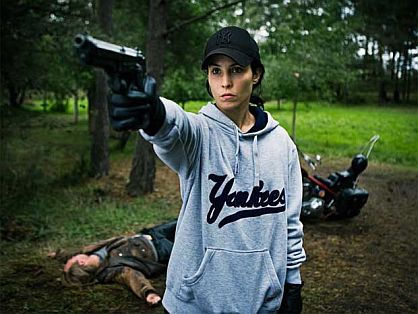 There’s a number of very interesting aspects to the film, such as how Blomkvist and Salander don’t meet until the final scene – I can’t think of many other film where the two central protagonists do that [Heat comes close]. But it’s most memorable for the unstoppable force which Salander has become, utterly fearless, whether it’s taking on a pair of bikers or going into the heart of enemy territory. Even when you think it’s all over for her, she crawls her way back in a way which would make The Bride applaud. It’s curious, yet somehow entirely fitting, to see her as an updated, adult version of another Scandinavian literary and cinematic icon: Pippi Longstocking. Except, to steal a line from Romy and Michelle, she’s like a Pippi who smokes and says “shit” a lot.
Salander’s personality is abrasive, and she clearly has difficulty relating to people or showing them anything even approximating affection: the closest she gets is a bewildered silence. I think the only time we saw her give a genuine smile was in the third film, when she received news that someone she hated had been killed. And yet, people like Blomkvist warm to Lisbeth, initially pitying the circumstances in which she finds herself, yet eventually seeing the human beneath the multiple layers of defensive ice. Fiercely loyal to her (very few, admittedly) friends, and as lethal as a boxful of well-shaken, peeved rattlesnakes to her enemies, the second film proves her to be smart, and as quick with her fists as her brain.
Dir: Daniel Alfredson
Star: Michael Nyqvist, Noomi Rapace, Yasmine Garbi, Paolo Roberto
★★★½
The Girl Who Kicked the Hornets’ Nest
The third film, like the second, has Blomkvist and Salander apart for almost the entire movie; they meet only right at the end, in a way which is as low-key and unobtrusive as an Ikea coffee-table, yet somehow feels entirely appropriate. This time, their separation is because Salanger is in custody for attempted murder, following the events at the end of Fire. The secret group in authority, whose activities are in danger of being exposed, intend to avoid the embarrassment of a trial by getting Salander certified as insane, so she can be locked up as mentally incompetent. This brings her back to confront Dr. Peter Teleborian (Ahlbom), the man in charge of the institute where Lisbeth spent two years. However, Blomkvist asks his lawyer sister, Annika (Hallin), to take up the case. Can they reveal the truth before Lisbeth is committed to Teleborian’s sinister care one more?
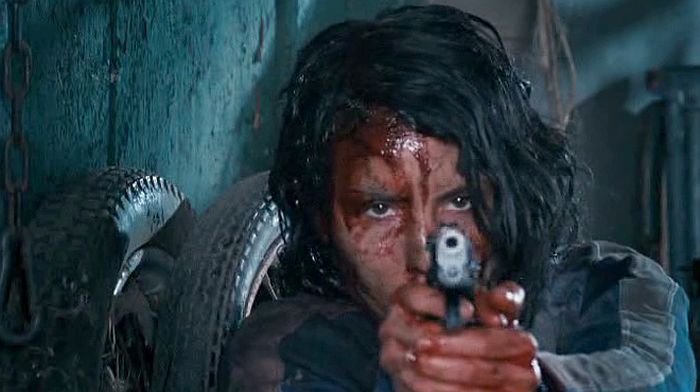
While undeniably a good end to the trilogy, tying up the loose ends and dishing out justice in a solid, satisfying way, it seems a shame to have Lisbeth locked up for 95% of the film. This is much more a purely-investigative thriller than the first two, which were more action-oriented. Here, there’s a fight in a restaurant for Blomkvist, and Salander’s only action is an admittedly impressive battle in a warehouse against an unstoppable force. Much as at the end of the first movie, she doesn’t actually kill the opponent herself, though here, that would be more due to a lack of ammunition for her impromptu weapon. While a nice final act by which to remember Salander, it’s not representative of her more passive role in this entry.
 The trilogy of books have sold more than 50 million copies worldwide, though sadly, Larsson didn’t see their success, as he died in 2004, before they were published. The success of the films, which have grossed a total of more than $210 million worldwide – a phenomenal sum for any non-English language series – has led to the inevitable Hollywood remake. Pause for eye-rolling here… Except, the American Tattoo does have David Fincher at the helm, so I’ll wait until seeing it – while, naturally, reserving the right to administer a good kicking in due course. The first pictures of Rooney Mara as Lisbeth (right), don’t exactly inspire confidence, as she looks more like some kind of coked-up fetish supermodel than anything else. Daniel Craig plays the role of Blomkvist, which would seem to make him a bit more glamourous too.
I guess we’ll see, but Fincher and Mara will certainly have their work cut out. I can’t help thinking of the lukewarm remake of another, highly-lauded Scandinavian movie, Let the Right One In, and the overall history of such things is not cause for optimism. But even in a worst case scenario, we’ll still have the books and Noomi Rapace’s steel-cold portrayal. Wikipedia says that when Larsson was 15 years old, “he witnessed the gang rape of a girl, which led to his lifelong abhorrence of violence and abuse against women. The author never forgave himself for failing to help the girl, whose name was Lisbeth,” even though much of his life was spent fighting oppression, in various forms. But with his creation of a new style of heroine, one appropriate for the 21st century, Larsson has, unwittingly, perhaps achieved redemption.
Dir: Daniel Alfredson
Star: Michael Nyqvist, Noomi Rapace, Annika Hallin, Anders Ahlbom




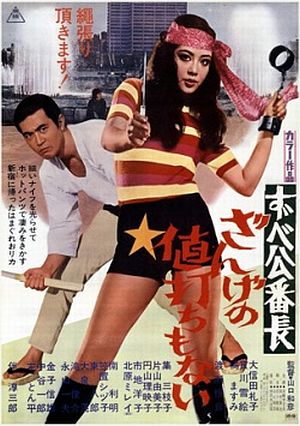 When Rika (Oshida) gets out of reform school, she goes to visit her friend Midori (Katayama), and gets a job working in the garage belonging to Midori’s father Muraki (Ban), even though Midori is estranged from him – except when she needs money to pay off her boyfriend’s gambling debts to the local Yakuza under Boss Ohya (Nobuo Kaneko). Another friend of Rika’s is working in an “art studio”, doing nude modelling to support her sick husband, and still others are hostesses at the Ginza Girls cabaret, a dance-hall which Ohya’s gang are also extorting for protection money. After Muraki has to take a loan using the garage as collateral to pay Ohya, Rika tries to offer herself as an alternative to the boss. This goes about as well as you’d expect, though there’s a genuinely cool twist in which we find someone isn’t quite who we seem. There’s a tragic fatality, which sets the scene for all the girls to get together and take on Ohya’s gang.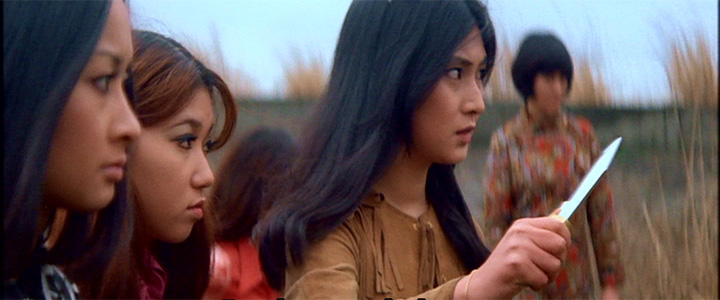
 If you’re going to use a cover like this, you’d better live up to it, even if we can forgive the heels as artistic license. And while not a complete lie, this takes far too long to deliver, and comes up short of expectations. Holly (Kosaka) is a nightclub singer, separated from her husband, who got custody of their daughter due to a DUI Holly got, with the daughter in the car. On arrival at his house to pick up their child for a scheduled visit, she finds him missing – and a gun in the basement, along with a case of drugs. She calls the police, but ends up getting arrested after the police find her husband’s body, and her fingers on the murder weapon, which has mysteriously moved from the basement to the scene of the crime. The drugs have also vanished; while held in jail over the weekend, Holly gets a visit from their owner, who busts her out and insists she return with him and his thugs to the house to show her where they are. Can she escape their grasp, rescue her daughter and find out who the real murderer was?
 The US border is all that separates El Paso, Texas, from Ciudad Juarez in Mexico, but the two cities’ ways of life are worlds apart. On the Mexican side, the bodies of women turn up, almost every week: sexually assaulted, with signs of torture and/or body parts missing. The police barely bother to investigate; the victims tend to be far from home, low-paid workers in the factories which drive Juarez’s employment. Into this comes police captain Blanca Bravo (de la Reguera), who vows to track down the perpetrators. But doing so pits her against the multinationals who could do without the bad publicity; against her commander, who says to her face that “women make good nurses, but lousy police officers”; and state politicians, who are uneasy about exactly what she might uncover.
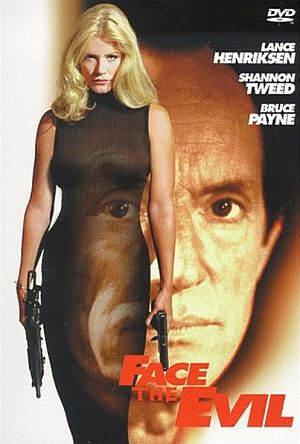 In many ways, this is a shameless rip-off of a shameless rip-off, trying to recapture the success of the original. It’s not quite as successful, lacking the gleeful sense of energy which help its predecessor overcome its (obvious) limitations. Once more, Tweed plays action actress Sharon Bell, this time filming her latest work in Eastern Europe. She arranges for the film to do some location work in a gallery owned by sister, Bobbi (Heitmeyer), which is just about to open an exhibition, showcasing artefacts that were looted by the Nazis in World War II. The gallery is taken over by Eric Dane (Henriksen) and his crew, who seal the place off from the outside world, intent in stealing a lethal German nerve agent hidden in the base of one of the sculptures. Unfortunately, inside at the time are both sisters, along with the movie director Jack Terry (Payne), who is scouting the place out.
 I think this really comes down to a question of managing expectations. Hearing this was a film based on the life of Monica Proetti, Canada’s premiere female bank-robber, responsible for 20+ hold-ups before being gunned down by the cops… Well, seems like plenty of potential for action, doesn’t it? The reality is less concerned with the robberies, than the events which lead up to them. Monique Sparvieri (Bonnier) lives in the Montreal slums, working part-time as a hooker, for fun and profit. Her first husband Michael (Schorpion), is a safe-cracker who vanishes after his planned robbery is snatched from under his nose. She then hooks up with Gaston (Huard), another member of the team, and begins her own life of crime. When he is sent to jail in the mid-1960’s, she is left with limited options to provide for her children, and goes full-bore into the banking business, with yet another lover, Gerald (Dupuis).
 This teetered on the edge of a seal of approval, but didn’t quite make it. While there are some lovely moments, two great leads and the recreation of the pinky violence genre from the sixties and seventies, there’s just too much dead wood and pacing flaws, that leave it just short. Still certainly worth a look, with Asami (Asami) and Junko (Rena) going head-to-head as they battle each other for supremacy in the girl-gang world. Junko seems to have got the upper hand, leaving her rival buried for dead in the desert [or whatever passes for a desert in Japan]. But Asami is just warming up: she claws her way, literally, back from the grave, teams up with her old gang-members, and sets about extracting revengs on Junko and her crew.
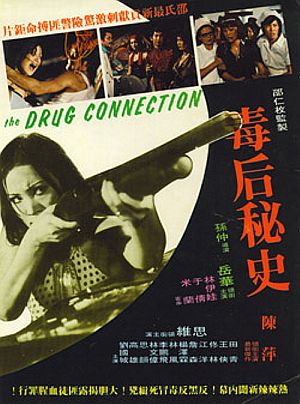 Not to be confused, in any way with SexyKiller, this 1976 Shaw Brothers film is more of an unofficial remake of Coffy. Wanfei (Ping), a nurse by day, decides to go vigilante by night, after her sister falls victim to druglords and ends up brain-damaged and drooling. With most of the police force in the pockets of the dealers, Wanfei opts to go undercover as a drug-addict of loose morals, so she can make her way up the chain of command, to deliver justice on behalf of her sister to the sinister Boss (Hsia). This finds her an ally in Weipin (Hua), a childhood friend and honest cop whose hands are tied by pesky bureaucratic niceties, like “needing a search warrant”; she’s also encouraged by her pundit boyfriend (Wei), who has long taken a strong anti-drug stance.
 Ji-Won (Lee Yo-Won) and her friend So-Hyun (Kim) make a trip to the seaside, borrowing a car from a friend. However, the auto turns out to have a couple of guns in it, lost by a gangster and cop in a poker game. The weapons come in handy when the girls need to escape from some assailants, but when they are joined by a manic waitress with no sense of gun-control, the now-trio find themselves on the run from police. A clothing-store owner with a grudge, completes the quartet, as they try to make their way back to Seoul – and they are pursued not only by the cops, also by the previous owners of the guns, who need to get them back to prevent issues of their own. Conversely, their exploits and subsequent media attention are getting them fans of their own, with the titular website (it stands for Adoring Four Revolutionary Idols Korea Association) extolling their virtues and provoking copycat crimes.