



★★★
“Truly a book of two halves, Brian.”
 Coincidentally, a year after the first collection, I find the time to read volume two; this contains two stories rather than two-and-a-fragment, but weighs in at about forty pages or so longer. Same price though, I am pleased to note… The first, Legion, takes our FBI agent and her semi-vampiric colleagues off to the post-flood city of New Orleans where a demonic force has been unleashed, which is capable of transferring its presence from one body to another. Hmmm…sounds not unlike Fallen, perhaps? That aside, I did enjoy this one thoroughly: the pace is good and, if the eventual destination of the entity is not perhaps a surprise (it’s quite close to the pair, shall we say), it makes for some great set-pieces. The best of these involves a church where the possessed victim is resting up, which results in a hellacious battle that’s genuinely exciting. The story elements are tidied up nicely too, leaving this a self-contained and effective tale.
However, despite the second story possessing a great title – The Phantom of the Soap Opera – I was much less engaged by it. The set of a daytime TV drama is plagued by mysterious ‘accidents’ of an occult nature, which leads to the pair re-uniting in order to investigate, triggered by a call from an old friend of Scarletti’s. There is just not enough meat on the bones of this one, though perhaps Koehler wasn’t happy with it either, since there is a lot of back-story added here. Indeed, to such a degree that it burdens the main characters, and its relevance to the main plot is doubtful. I’m also growing rather disillusioned by Blackburn’s relationship to the Jackal, the full vampire who saved her life in volume one; Koehler is treading dangerously close here, to the cliches which eventually sank the Anita Blake series.
Another small peeve was a surprising number of typos in the volume, such as “a traveling bad slung over one shoulder.” Though I’m far from immune to these myself [even if you can only have the ‘u’ in ‘colour’ when you pry it from my cold, dead hands, dammit], and I did smile at one, when Blackburn was served by a “gun-chewing waitress.” I’d be sure to leave her a good tip. Overall, not quite as good as the first compilation, though that’s largely down to the second story – individually, Legion rates a ****, but Phantom only **, getting stuck in a morass of its own making. While that leaves the review ending on a disappointing note, Blackburn remains an engaging heroine, and if Koehler can get back to more action-oriented writing in the next volume (as she showed herself eminently capable of in Legion), I’ll be waiting eagerly.
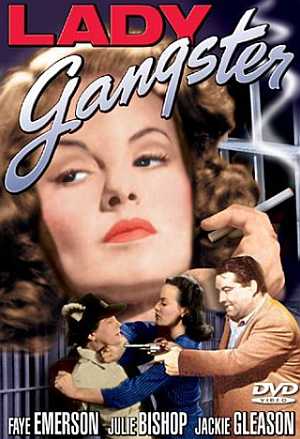 Having watched both Transformers and Miami Vice over the past week, it’s nice to see a film that doesn’t hang around: coming in at sixty-two minutes, Lady Gangster has hardly a line of dialogue that does not propel the story forward. Based on the play, Ladies They Talk About (previously a 1933 film starring Barbara Stanwyck), this centers on Dorothy Burton, member of a gang of bank-robbers. She takes the rap for one of their jobs, and goes to jail, but is also the only one who knows where the loot is hidden. Childhood friend Kenneth Phillips (Wilcox), now a renowned broadcaster, tries to help Dorothy get parole, but she has also made an enemy inside the prison, who is just as keen our heroine does not get released, and her former gang colleagues have their own interests, needless to say.
 I think I can safely say that this films fails miserably on just about every level. Now, I am probably not the target audience for this unashamedly ‘urban’ movie, but that didn’t stop me from enjoying the works of Pam Grier. This, on the other hand… Three women (Brown, Nurse and Sha – though I’ve my suspicions that one of them might just be a man) are arrested under dubious circumstances, but are bailed out to investigate the murder of one’s brother, a rising rapper. They get employed at his record-label, the questionably-spelled Murda Boi records, to scope out the suspects. Was it his partner in the label? The sleazy CFO? Or the mail-room man?
 ★★½
★★½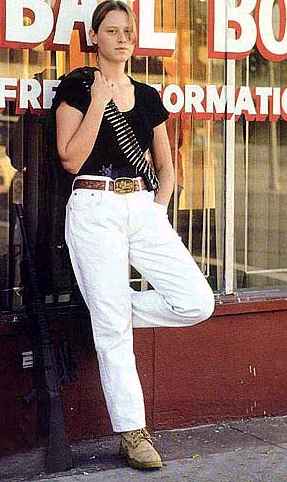 “This is based on a true story…sort of” is how the pre-credit disclaimer goes. Which does, at least, show far more honesty by Tony Scott than the usual claims in such things – Blair Witch and Wolf Creek shuffle their feet nervously. Unfortunately, my response would have to be, “This is a watchable movie…sort of.” Scott brings his usual, hyper-kinetic style to the table, but I was prepared for that and so didn’t mind it. No, the major problem was the derailment of the film from the potentially fascinating and probably unique character of Domino, into yet another heist movie. So instead of any insight into personality, we get to watch a bunch of gangsters and low-lives, of whom Domino is merely one, double-cross each other. It’s an hour of watching the corpse of Barbaro being beaten, if you get my drift; even Scott has been here before, to better effect, in True Romance.
 The film is filled with distracting stunt casting in the minor roles. This includes Christopher Walken, Mena Suvari, Lucy Liu, Jacqueline Bisset, two guys from Beverly Hills 90210 playing themselves, Macy Gray, Tom Waits and even Jerry Springer, though the episode of his show here is far duller and more earnest than the real thing. Walken is, inevitably, the only one to make much of an impression, playing a reality TV producer who wants to make Domino a star. He’s described as having the attention span of a ferret on crystal meth, probably an adequate metaphor for the film as a whole. It lacks the patience to stay with and develop any of the characters, so sniffs around them for two minutes, before scurrying off to find someone else instead.
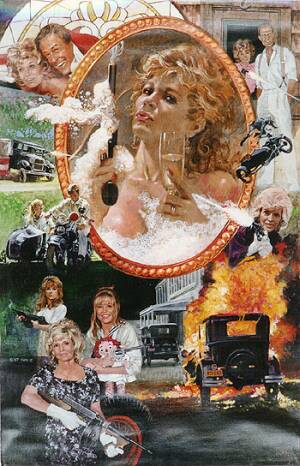 A Roger Corman production. Those four words cover much turf, both good and bad; this inclines toward the latter, simply because it takes an interesting premise, and goes next to nowhere with it. It’s less a sequel to, than a remake of the 1974 film, also starring Dickinson, which is generally believed to be superior. However, that isn’t on heavy cable rotation this month, so you’re stuck with the follow-up. Dickinson plays Wilma McClatchie, evicted from her home by uncaring businessman Morgan Crawford, and whose husband is killed in the process. She and her daughters Billie-Jean and Polly take up a life outside the law, but when Crawford makes a run for governor, their crimes take on a political perspective, as they aim to sabotage his campaign.
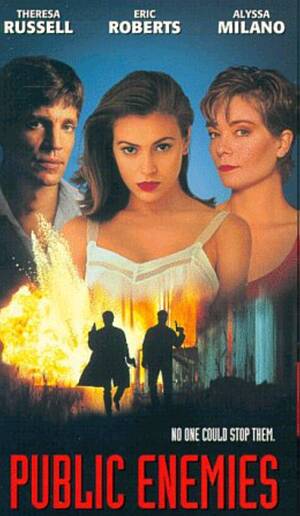 The story of Ma Barker, legendary leader of a bank-robbing gang consisting mainly of her sons, has inspired multiple movies, from relatively well-known (Roger Corman’s Bloody Mama) to obscurist (Ma Barker’s Killer Brood from 1960). They all play
 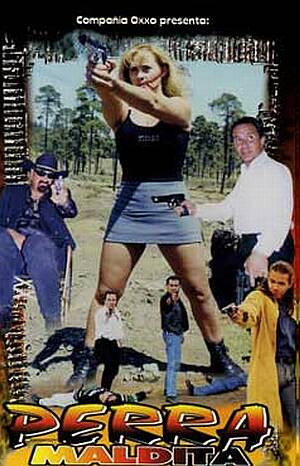 Camelia (Palmer) sees her way out of the ghetto in Ramiro (Saenz), a friend of her father’s who always has more than enough easy money. She convinces him to employ her as an apprentice, but discovers she likes sharing his life of drug-deals and casual slaughter. But they soon find out, they may not be the only ones capable of a good double-cross…
 This Brazillian-shot entry has a lot of good ideas, and some excellent moments, but comes up short with a script that borders on the incomprehensible. For example, in the middle of the film, the hero and heroine are both shot with tranquilizer darts – but no subsequent mention or explanation of this ever appears. This kind of sloppy plotting plagues the movie; it’s almost half-way through before the basic story becomes clear.
 There’s lots to appreciate, not least the actors. As opposed to many films, Hagen here actually looks like she could kick your ass, and the flashback fight sequence is excellent – I’d like to have seen more of that, and all the battles are well staged and shot. While Perry is somewhat bland, he’s effective in action; Richardson is a B-movie veteran for almost two decades (Hollywood Chainsaw Hookers, Attack of the 60-foot Centrefold, etc.), and has a nice, world-weary air here. But Putney (left) is perhaps the best find as Daniel’s gun-toting sidekick, Jackie; the final scene between her and her boss is fabulously intense. And there are other cool little aspects, in things like Daniel’s henchmen.
 If the inspiration for this one wasn’t clear, Goro Yasukawa’s score will soon enlighten you: Sergio Leone. A character with a mysterious past and equally obscure agenda comes into a lawless town, and kicks ass. For The Man With No Name and his horse, read Saki (Yonekura) and her Harley. Given that Leone basically ripped off Akira Kurosawa’s Yojimbo in A Fistful of Dollars to begin with, the irony is satisfying. She has come to Tsuson – surely a nod to Tucson, less than two hours down the dusty Arizona I-10 from where I write this – to take on Tojo (Tsurumi), the local mob boss, who commits his crimes with impunity from the safety of an American Air Force base. She gets his attention when she interferes with his robbery of a wages truck, and takes the money herself. The two had met previously, though Tojo doesn’t recognise Saki; you’ll probably work out the basic circumstances long before the film reveals them, but it does add a couple of unexpectedly nasty twists of the knife.
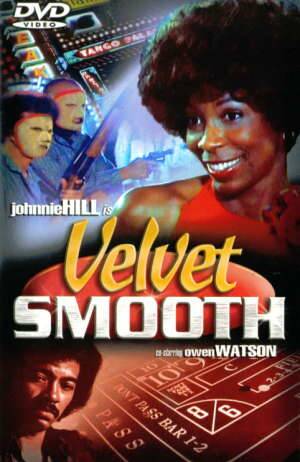 Let’s be perfectly clear about this: at least one, possibly more, of the points awarded to this movie only apply if you, like us, are connoisseurs of the trash aesthetic. If you delight in bad acting, poor action and technical ineptness, this is for you. Otherwise…consider yourself warned. Not to be confused with Jeannie TNT Jackson Bell, this was Johnnie Hill’s only film – and when you’ve seen it, you’ll understand why. She plays Velvet, a private investigator brought in, along with her two female sidekicks (also adept in martial arts, even if we are redefining the word “adept” here), when someone starts encroaching on a crime lord’s territory. Who is behind this? And who is behind them?