



★★★½
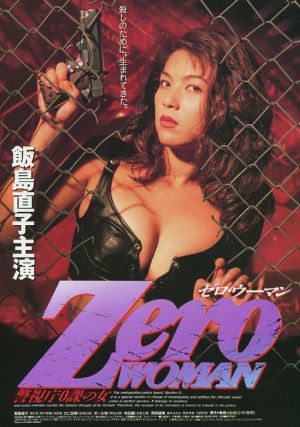 Probably the least accurate title of any film ever – at least Friday the 13th put out a few movies before using “final” – you definitely should begin here if you’re looking for much coherence. Rei (Iijima) is now partly employed as secretary to the head of Section Zero, but also takes out criminals for whom traditional channels of law enforcement aren’t enough, for one reason or another. She also pals around with Takako (Fukuoka), a detective from another section and a girl he helped bring out of delinquency, in what’s vaguely intimated as a love triangle. One night, they witness a hit and run, and discover the perpetrator (Suzuki) is the daughter of a powerful economic figure. Despite encountering official resistance, Rei and Takako persist with their investigation and, inevitably, this brings out more robust sanctions.
This does take some time to get going: it’s probably about 25 minutes before the car-micide in question, really kicks things off, and the film is more or less in a holding pattern until then. Still, Iijima certainly looks the part, and unlike some of the other occupants of the position, you don’t get the sense she got the role purely for her willingness to disrobe. Indeed, she manages even to take a shower and gun down an intruder without straying much beyond the boundaries of PG-13. Not that there’s exactly a shortage of nudity in this production, most of it coming from Suzuki, who is portrayed as being kinda depraved and heavily into S/M. Indeed, this seems the case for the director, as Rei spends a far too large chunk of the second half, tied up and being tormented by what can only be described as a cackling sex dwarf [literally half his lines must have been, “Bwahahahaha!”]. Quite what this says about Enokido’s predilections, is probably best glossed-over.
There’s a cool colour palette used here, mostly blues and grays, and a couple of scenes which will certainly stick in the mind. One is the previously mentioned shower-ambush, and the other is one where Rei is on the phone to Takako, when their conversation is rudely interrupted on his end: gradually, she realizes that something is very, very wrong. It’s expertly crafted, with good performances from both ends of the telephone line, and you can’t help wondering that more of this, rather than so much of the Laughing Gnome, would have elevated this to a classic. Instead, it’s merely hints at greatness, and settles for being solid and effective, starting the franchise in a way of which the original movie could only have dreamed.
Dir: Koji Enokido
Star: Naoko Iijima, Takako Fukuoka, Misayo Haruki, Miho Suzuki
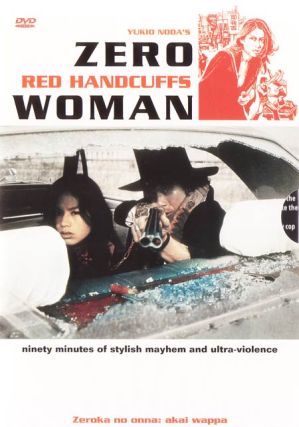 When the series started in 1974, it originally appeared to be trying to take on the Female Convict Scorpion series at its own game – both were inspired by Toru Shinohara manga series. However, going by the fact it took more than two decades for a second entry in the series, I can only presume the commercial returns weren’t anywhere near as strong. This starts off well, with policewoman Rei (Sugimoto) luring in, and then blowing away, the man responsible for torturing and killing another woman. Turns out the perpetrator was a diplomat and in the resulting scandal, Rie is sent to jail. Her chance at redemption comes when a gang of thugs stumble into the kidnapping of the daughter of a politician (Tamba): to avoid a scandal, Rie is offered a pardon if she infiltrates the kidnappers and kills them all. Initially, all goes to plan, with the first member taken out quickly, but it soon becomes clear the other members are rampaging psychos, and the situation rapidly spirals out of control, to the point where the politician yanks his support and orders the deaths of everyone, in the name of damage limitation – including both his daughter and Rie.
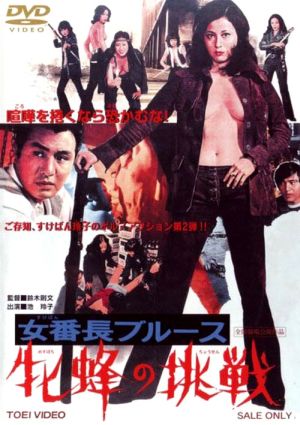 If the first Queen Bee movie was a fairly effective romp through the genre, that’s a lot less the case fot the follow-up, with Ike largely floundering around, as Maki, the leader of the Pearl Gang, who finds herself embroiled in a battle with another crew, the Black Lilies and their leader, Yuri (Kazama). Their spat is interrupted, when the Kuroji clan of yakuza throw their weight behind the Black Lilies. However, the triumph of the Lilies is short-lived, as they find out that they are about to be forced into life as prostitutes, for the benefit of their new allies, ending their life of freedom in the ‘hood. There are also subplots in which Yuri’s former boyfriend, Eizo wants to be a top racing driver, bringing him into conflict with the yakuza as well, and a suitcase filled with stolen guns.
 Recent high-school graduate Cassie (Cobb) works at a bank alongside her mother (Quinlan), bickering about the usual things, such as whether to go to college or not. This mundance existence is suddenly interrupted by a robbery: Cassie is stunned to realize the raiders are actually some of her school friends. When they realize this, the girls are forced to take her along, and she discovers the cause of the crime – the father of one (Thomson) has been kidnapped while on business in Mexico. Meanwhile, Mom is tracking down her kidnapped daughter, FBI agent Mendoza (Blasi) is also on the hunt, and one of the girl gang has her own plans for the ill-gotten gains, which doesn’t involve any ransom.
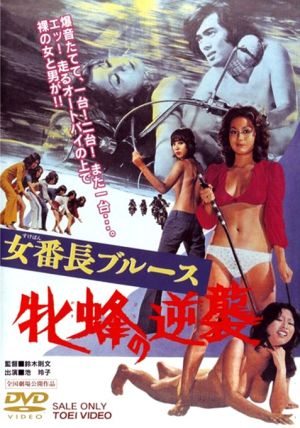 Reiko (Ike) is leader of the Athens Gang, a low-level all-girl gang, who specialize in car thefts and rolling naive salarymen with the lure of hot sex. They’re part of a hierarchy, which includes a male gang under whom they loosely operate, who are in turn on the fringes of a Yakuza group. There’s also a motor-cycle gang and its leader (Taki) who don’t obey anyone, and that independence is really what Reiko wants, even though her group is obliged to follow certain rules, such as not getting attached to any man. Things are disrupted by the return of former leader Jun (Kagawa) from reform school: will Reiko be able to hold on to her position? It’s just one of a large number of plot threads here: you also get the blackmail of a pop star; a hitman agreeing to one last mission; a gangster estranged from his wife and daughter; sex on motorcycles for no apparent reason; a journalist with a nose for scandal; and, of course Reiko failing to follow her own rule about no attachments.
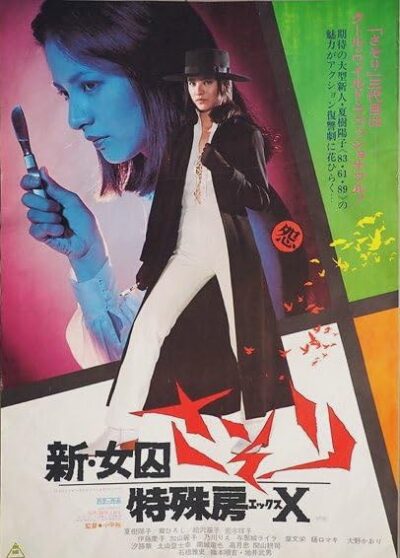 The comparisons of Takigawa to Lazenby above proved appropriate in another way, both being canned after one entry playing the iconic title character, which is probably just as symptomatic of something. The replacement here as Nami Matsushima is Natsuki, who seems to go back toward a more taciturn heroine, closer to the original. But it’s, effectively, another reboot, with not even a nod to the previous entry. In this case, the heroine is a nurse, framed for her involvement in the hospital murder of a politician who was threatening to expose corrupt practices.
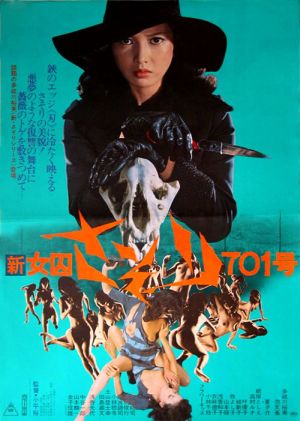 Just goes to show that the “cinematic reboot” is not a 21st-century invention, e.g. Batman or James Bond. For a mere three years after Meiko Kaji showed her sting as Nami, the studio reset the series, giving it a new director, new (and much more talkative) lead actress, and returning Nami Matsushima to a happy, criminal record-free young women, with a loving boyfriend. Except, of course, he turns out not to love her quite as much. Things start to collapse after her sister uncovers evidence of major government corruption, and passes it to Nami, shortly before being kidnapped. After Nami uncovers the truth – her sister is killed and she is framed for the murder, with the help of her boyfriend, and sentenced to 15 years in prison. Initially an easy mark for the tough girls in her cell, Nami soon develops her mean streak. And she’s going to need it, because the politician behind it all is looking to tidy up the loose end she represents, by killing her and making the death look like a suicide. Name turns the tables, in incendiary fashion, and it’s clear that she’s one loose end that won’t be quietly disposed of.
 Nami (Kaji) is about to get married, but her wedding day is rudely interrupted by the arrival of the cops, who arrest her. On the way to prison (and, unsurprisingly, death row, given the body count left behind in the previous three movies), she takes out the driver, causing a crash. The injured Scorpion staggers away, and is rescued by Kudo (Tamura), a former political radical who was brutalized by the police for his actions, and so has a massive load of resentment against them. After being informed of Kudo’s harbouring of Nami by a worked at the sex-club where he works, the cops take him in: and use both physical and psychological torture to try and make him give up her location. Eventually arrested, Nami is sentenced to death, but the cops intend to make sure the time leading up to her execution is as unpleasant and possible, and the detective in charge, Hirose (Tsukata), is intent on making even Nami’s death as lonely an experience as possible.
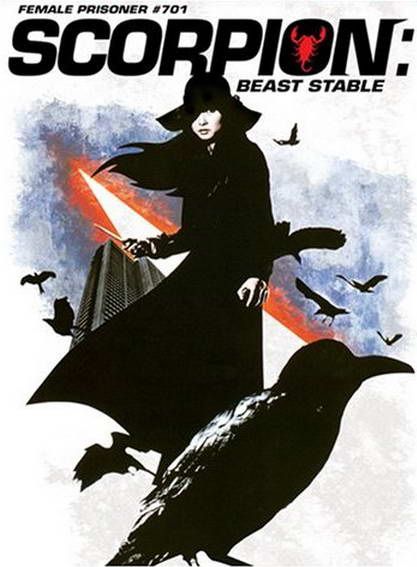 When this begins, Nami (Kaji) is on the run, and slices the arm off Detective Kondo (Narita) after he handcuffs himself to her. She befriends street hooker Yuki (Watanabe), who runs foul of the locak Yakuza gang by turning tricks on their turn, while trying to care for her brain-damaged brother, whom she also services sexually, to stop him from raping women(!). After Nami is involved in the death of a gang member who was blackmailing her, the gang’s madam Katsu (Lee), who knew the Scorpion from her own prison days, captures her, locking our heroine up in a literal big bird-cage. But after the true horror of the Yakuza’s treatment of their women is revealed (it starts with a golf-club going where no golf-club should ever go), Nami escapes and carves a bloody path of revenge on those responsible. When Katsu realizes what’s going on, she turns herself in to the police, figuring jail will be safe from Sasori’s wrath. Take a wild stab in the dark… Which, by coincidence is exactly what Katsu deserves.
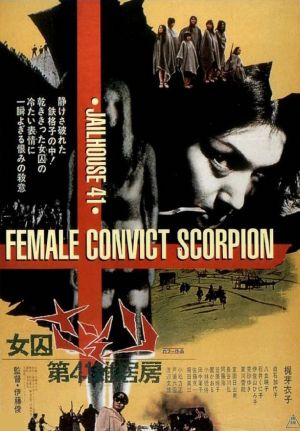 Right from the start, Nami (Kaji) established her utterly hardcore credentials, as she’s trying to dig her way out of the dungeon where she has been for the past year. With a spoon. Held in her teeth. She’s let out for the day because a bigwig is visiting, but takes the opportunity to attack warden Goda (Watanabe), almost depriving him of the sight of his other eye. As punishment for the resulting riot, Goda sends four guards to gang-rape Nami, and all the inmates are sent to a hard-labour camp. On the way back, they beat Nami as punishment, leaving her near-dead but it turns out that was just her ruse to get the guards to open the back of the van and escape. She leads the women across a blasted landscape, revenge once more on her mind, with Goda’s men in hot pursuit.