



★★★½
“Joan of Arc, without the religion. Or stake.”
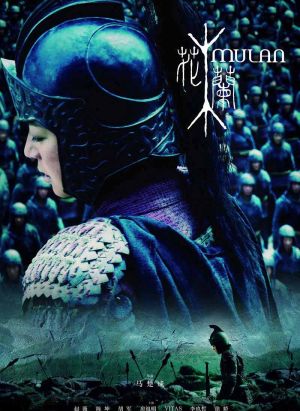 Inspired by the same poem as Disney’s much-loved feature, this has the same basic idea – a young woman impersonates a man in order to save her father from being drafted in the army. However, this takes a rather different approach, being much darker in tone, not that’s this is much of a surprise, I guess. It’s also a lot longer in scope, with Mulan (Zhao, whom you may recognize as the heroine/goalkeeper from Shaolin Soccer), rather than fighting a single campaign, becoming a career soldier and rising through the ranks as a result of her bravery in battle, eventually becoming a general, tasked with defending the Wei nation from the villainous Mendu (Hu). He has killed his own father in order to take control, and has united the nomadic tribes of the Rouran, amassing an army of 200,000 to invade Mulan’s home territory. She comes up with a plan to lure him into a trap, but when she is betrayed by a cowardly commander, things look bleak indeed for Mulan and Wentai (Chen), one of the few who know her secret.
Initially, I was rather unconvinced by Zhao who, being in her mid-30s, is a tad old to be playing the dutiful daughter. But given the longer view taken by the movie, the casting makes sense, and she ends up fitting into the role nicely; there’s a steely determination which develops over the course of the film, and by the end, you can see why she has become a commander. That’s one of the themes of the movie: duty, contrasted with the terrible losses war can inflict on a personal level, Mulan being largely powerless to watch as almost all her friends end up dying in battle. “I’ve fought battle after battle,” she says, “Lost one after another of my brothers, I really don’t want to fight any more.” There’s almost a neo-totalitarian implication to the final message, however, which suggests that everyone – even those who have sacrificed everything already – need to put aside their personal interests for the greater good of the state.
There’s a nice balance between the action and emotional aspects, but Zhao doesn’t actually do much in the latter department after the battle which gets her noticed. She’s broken out of army jail to take part, after confessing to stealing a jade pendant, in order to avoid a strip-search [death before dishonour]. After that, she’s more a leader than an actual fighter: heavy is the head that wears the general’s helmet is the moral here, and it’s driven home effectively enough, thanks mostly to Zhao’s solid performance.
Dir: Jingle Ma
Star: Zhao Wei, Chen Kun, Hu Jun, Jaycee Chan
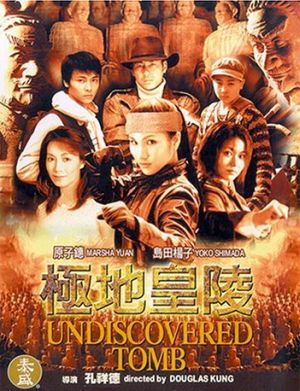 Obviously inspired by a certain raider of tombs, this has Yuan as Georgia, who was rescued from an orphanage, along with her sister (Koinuma) and trained in… well, raiding tombs. When their foster father vanishes while on an expedition seeking the secret of immortality, the two siblings head off to look for him, only to come under attack from a range of locals, natives and the local fauna. Meanwhile, Professor Ivy Chan (Shimada) links up with billionaire art-collector Michael Lui (Wong), and discovers that shady forces are after a relic possessed by Ivy, and that they need to follow the girls into the remote jungle.
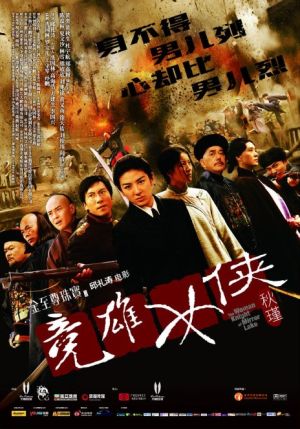 I find the line between “terrorist” and “freedom fighter” an interesting one, drawn not so much by any objective measure, but by the viewer’s perspective and historical hindsight. Qiu Jin is a good example: she fought against the perceived oppression – particularly of women – by the Qing dynasty in the early 20th century, and ended up getting publicly beheaded for her support of revolutionary factions, by the government of the time. Now? A heroine and a martyr, who has an official museum ‘n’ stuff. Funny how things work out.
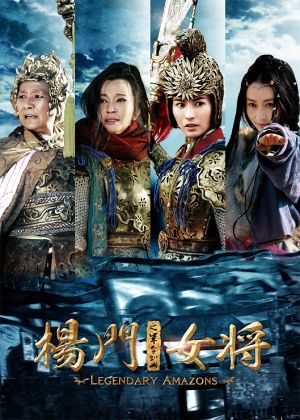 To be honest, I have very little clue about what was going on here. Oh, the basics are clear enough. After losing their patriarch General Yang Zongbao (Ren) in battle, a noble family opts to send everyone out to the West to defend the realm from the usual invaders. They’re almost entirely female, but all possess significant ass-kicking ability, with their own particular weapon of choice. These are listed, in rapid order, near the start of the movie, and I’d suggest taking copious notes, because you won’t be able to recognize them otherwise: one armour-clad woman looks very much like another when they’re in battle. It’d probably have helped if they’d had a number on the back of their helmets or something. Hey, it’s not like this is a model of historical accuracy to begin with.
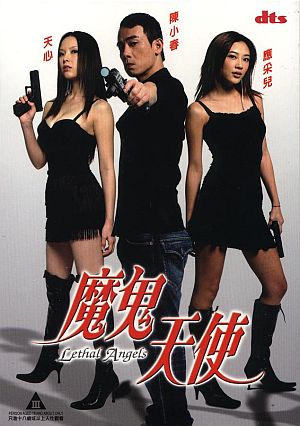 Winnie (Lee) has a grudge: against gang boss Bowen (Yuan) in particular, but also against just about any man who abuses women. She puts together a team of four underlings, such as Yoyo (Sum), whose family was killed by thugs, and uses them to take out anyone whose lustful desires overwhelm their common sense. Now, it’s time for the big one: Bowen. Winnie sends Yoyo in as an undercover nanny, to scope things out and obtain evidence of Bowen’s illegal dealings. However, once in, she finds out that Bowen is now largely reformed, and Yoyo also objects to Winnie’s plan to wipe out all of Bowen’s family, including his six-year old daughter. Meanwhile, she’s also being investigated by Jet (On), a cop who knew and almost dated her at college, and is on the case of the mysterious deaths of mob bosses at the hands of beautiful ladies.
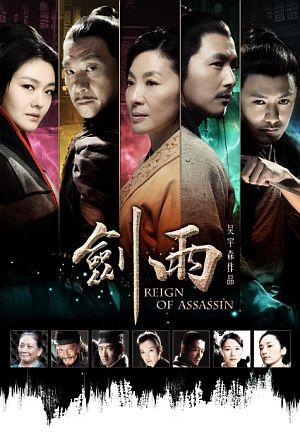 The most disappointing film of 2010? I went in with huge expectations, based on reviews that said, “The best swordplay film since Crouching Tiger, Hidden Dragon..” O RLY? I know Crouching Tiger. Crouching Tiger is one of my favourite movies. And Reign of Assassins, you’re no Crouching Tiger. It’s a confused, poorly-shot mess that proved a struggle to endure and a challenge to stay awake, right from the opening lump of introduction. Stick with me for this synopsis. The remains of a Buddhist monk, split in two, are said to turn whoever has them into a kung-fu master. The Dark Stone gang, under the Wheel King (Wang), want to possess them, and get one half, but gang member Drizzle makes off with the body parts, undergoes plastic surgery that turns her into Michelle Yeoh and takes up a quiet life as a fabric seller. She meets and marries Jiang Asheng (Jung), until her secret identity is revealed in a bank raid, and the Dark Stone gang come after her again. However, turns out Jiang isn’t who he seems either…
 It’s nice to see Hong Kong making a decent action heroine film: that’s really where the genre started off, and it’s been responsible for some of the best entries in the field. That said, this doesn’t quite deserve to be placed on the same level, but star Jiang Lui Xia certainly has her potential – my immediate thought is to put her in the same film as Jeeja Yanin, and we might really have something. [Sidenote: Jiang got her big break as the result of a couple of unusual ways. Viral videos she posted on the Internet, which in turn got her a slot on a reality show called The Disciple in Hong Kong, produced by Jackie Chan. The winner – not her – got to star in a feature.] Much like her Thai colleague, Jiang is clearly a martial artist first, and actress…well, probably fifth or sixth, despite her resemblance to Shin Eun Kyung from My Wife is Gangster. She seems to have three expressions, used in strict rotation, and the plot is frankly implausible nonsense too.
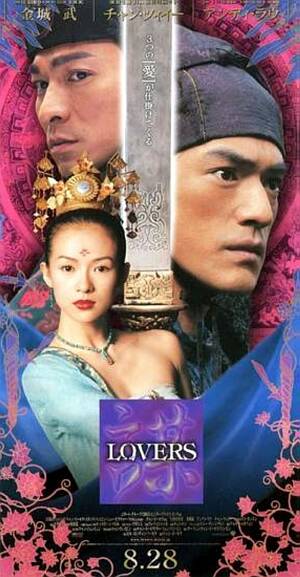 Since the success of Ang Lee’s Crouching Tiger, fellow arthouse director Zhang Yimou seems to have become obsessed with one-upping Lee. First was Hero, a sumptuous and multi-levelled tale of revenge and betrayal starring Jet Li; now, we get House which while slightly smaller in scale, is clearly going for the same tragically romantic feel as CTHD. Policeman Leo (Lau) suspects Mei (Zhang), an arrested blind prostitute, is part of the titular rebel group, so sends Jin (Kaneshiro) to win her confidence by helping her ‘escape’, then going with her to the Flying Daggers’s base. However, it gives nothing away to say that Mei and Jin start having feelings for each other, as they battle through the countryside, and it’s no surprise to discover that several other characters aren’t what they seem either.
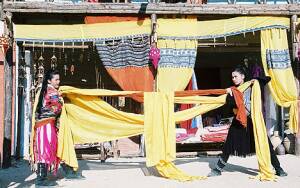 I liked, and enjoyed the original film, and at first, this seems to have a great chance at surpassing it. The opening fight between our two heroines, one (Choi) a slave-trader, the other (Chung) an enforcer for the Empress, is a masterpiece that combines wire-work, CGI and gimmickry – camerawork from Azumi and what looks like a mutant Klingon batleth – to fabulous (if not fully convincing) effect. All this in a mythical kingdom where women rule, and men are reduced to “dumbbells”, while the cast includes both Jackie Chan and Donnie Yen. Even if the connection to the original is tenuous at best, the potential here doesn’t need to be specified.
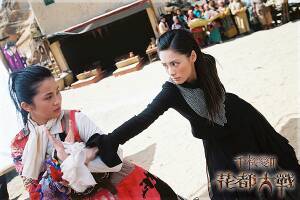 On the plus side, both Twins put in surprisingly solid performances – Choi, in particular, is much less irritating than before, though remains outshone by Chung. However, they still aren’t enough on their own to sustain a movie, despite the parade of celebrity cameos, especially when co-stars Chen and Fong are woefully short of the mark. With a $10.2 million budget, I just wish they’d spent a few more dollars on the script and some decent actors. Then, it might have lived up to the marvellous first fifteen minutes.
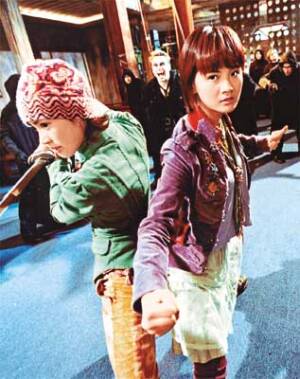 For something crafted largely as a vehicle for its two female, pop-singing stars (the titular Twins), this is much better than you’d expect – compare, say, any Mary-Kate and Ashley film. Sure, it’s dumb. Sure, it’s loaded with cheesy romance and totally unnecessary celebrity cameos. But it also has more fun with the vampire genre than any movie since the original Buffy, and the action, directed by the hugely under-rated Donnie Yen, is far superior.