



★★
“Not as sharp as I hoped.”
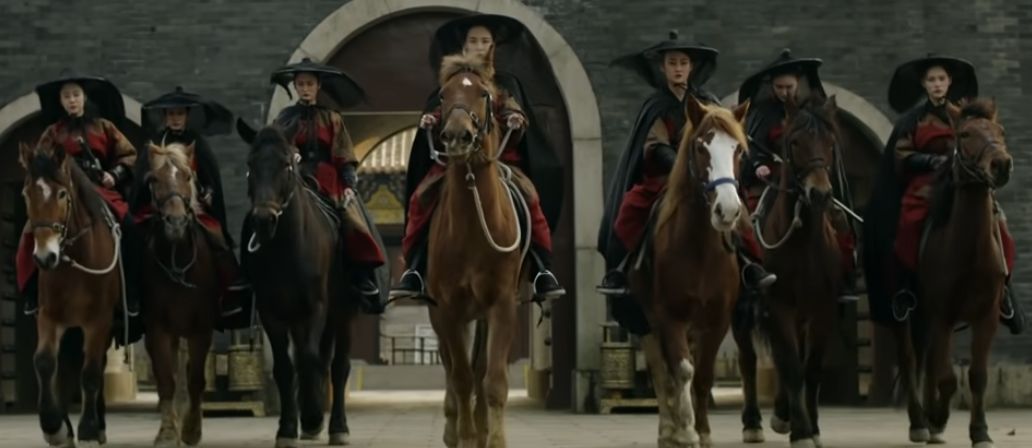 This takes place in early 15th century China, when Zhu Di (Zhang) had taken over the throne from his nephew, Wen Du (also played by Zhang), forcing the latter to go into hiding. Zhu is protected by his all-female Imperial Guard, under the leadership of Qing Lian (Xu). Actually, all seven of them have the surname Qing, which confused the heck out of me at first. But it actually makes sense, as they were taken in as babies, and brought up for the express purpose of protecting Zhu Di. Anyway, he gets word that Wen is to be found in a house of ill-repute, and send the Qings after him. Lian is injured in the raid, but her life is saved by Li Gexiao. When she returns to Zhu, however, he’s having none of it and orders her to kill Li, knowing he is actually the dethroned Emperor Wen. Lian opts not to carry out the emperor’s orders, and so the remaining Imperial Guard sisters are sent out by Zhu, to make her pay for her disloyalty.
As the still at the top shows, they certainly look the part, and are impressive when doing the slo-mo thing, marching around, clad all in black and with their capes flying behind them in the breeze. I also can’t complain about the overall production values to be found here. This looks like a reasonable amount of money was spent on it: period pieces are never cheap, and the costumes, buildings, etc. here look decent. However, this never manages to rise above the level of something you’d have on in the background as eye candy. Firstly, the action is not very good, with a style closer to the Western approach, of fast cuts that appear designed to conceal either a) the participants’ lack of skill, or b) that nothing particularly much is going on. Even in quantity it’s deficient, with large chunks where it’s too chatty. That’s if you can get past the opening narration, which left me feeling as if I should be taking notes for a history mid-term.
It doesn’t help that the other six Qing’s are pretty much interchangeable, with no real personalities to speak off, and only about three expressions between the lot of them. Despite the lengthy flashback to their training as kids, I never got much of a sense of sisterhood, which makes the final act kinda suspect. Not helping matters, and consigning it firmly to the “below average” category, is an ending which comes in the shape of another info-dump, then heading abruptly into the end credits, before even 65 minutes have passed. It thus feels less like a complete movie, than a pilot for a show on the Chinese equivalent of the CW. By which I mean, all style and precious little substance, beyond a romance that never manages to be more than lightly convincing. And like CW shows, it probably looks better in the trailer than the reality.
Dir: Wang Bin
Star: Xu Zilu, Zhang Dake. Hou Meng, Zhu Meixuan
 Over in my non-GWG life, I’ve been on
 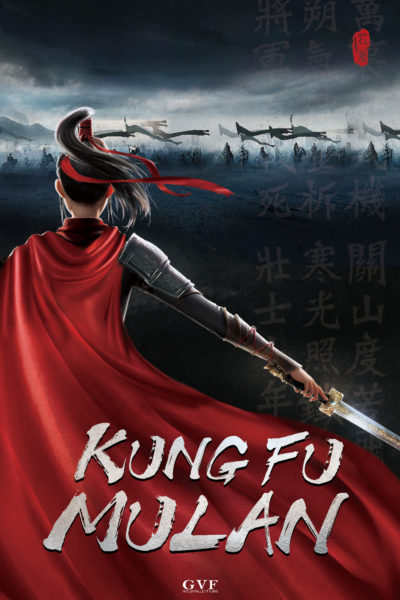 Going into this, I was expecting it to be really terrible. After all, this Chinese animated version seemed to be little more than a mockbuster, riding on the trails of Disney’s
  Yang Yang (Yang) is an impetuous young policewoman, whose career is on thin ice after shooting the target of what was supposed to be a surveillance operation. Her superior officer – who also happens to be her uncle – is forced to re-assign her, and sends Yang to operate undercover as a student in a high school from which girls have been going missing. The leading suspect is an arrogant pupil who has recently been accused of sexually assaulting a classmate. Teacher Wu Xie (Zhou) is a witness in the case, so Yang is also tasked with making sure he isn’t pressured into changing his statement. Fitting in is going to be part of the problem for Yang – despite the help of Molly (Li), who takes the “new girl” under her wing.
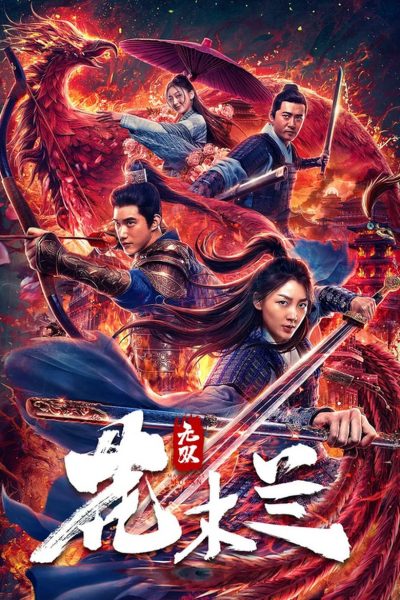 I suppose this could be claimed to be a “mockbuster”, not so different from the sound-alike films released by The Asylum, e.g. Snakes on a Train. There’s no doubt this was made to ride the coat-tails of its far larger and better advertised big sister. And it’s not alone, with at least two other Chinese films apparently in production, one animated and the
 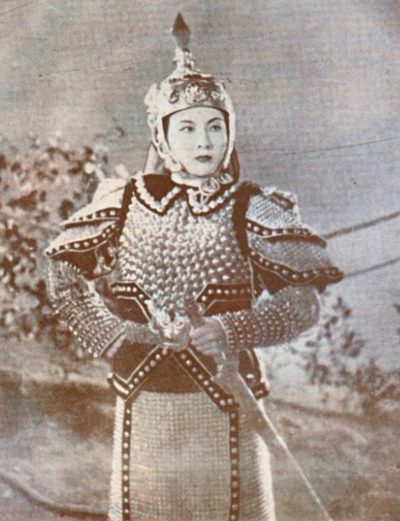 Y’know, considering this is now more than eighty years old, this was likely better than I expected. Chen makes for a solid and engaging heroine, right from the start, when she tricks the residents of a nearby village, who demand she hand over the proceeds of her hunting [I am hoping the dead bird which plummets to the ground with an arrow through it, less than three minutes in, was a stunt avian…]
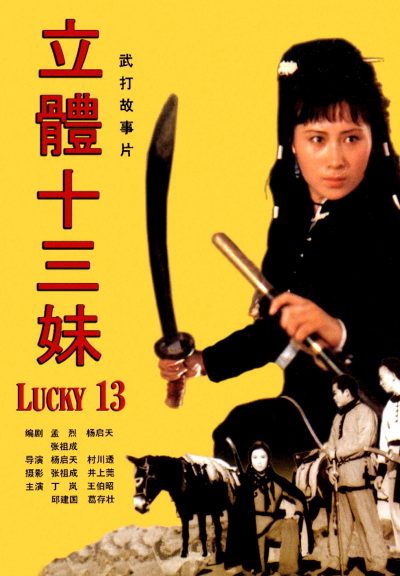 Despite a mangled title, what you have here is a straightforward tale of vengeance – and its attempts to diverge from that narrative are when the film is at its least interesting. Evil general Ji Xian Tang kills the parents of Ho Yu Fung (Ding): well, I suppose technically he only kills her father, her mother committing suicide by the corpse. In some remarkably unsubtle foreshadowing, Yu Fung is told, “This broadsword is our family heirloom. Our hope for vengeance is in your hands.” Given this, it’s no surprise she escapes with the help of a brave sacrifice from a servant, and becomes the pupil of a kung-fu master.
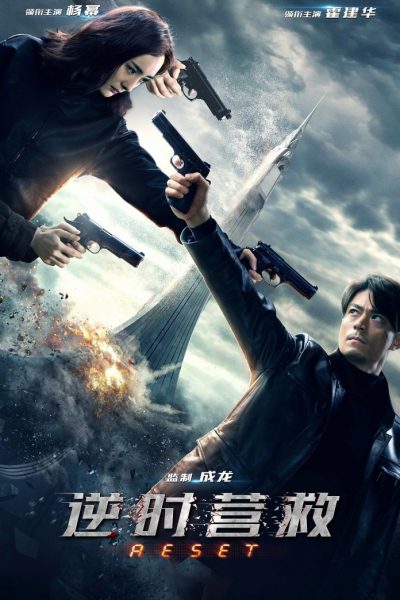 China seems to have discovered SF in a big way of late, most recently with The Wandering Earth, the biggest blockbuster you’ve probably never heard of. At time of writing, it’s the #7 film at the world-wide box-office this year, though 99% of its tally came in its home country. A couple of years earlier, this film made much less impact, yet for me is superior. It’s a time-travel piece, not dissimilar to Run Lola Run, with a triptych repeating the same events in three different ways, as the heroine strives to achieve a satisfactory outcome.
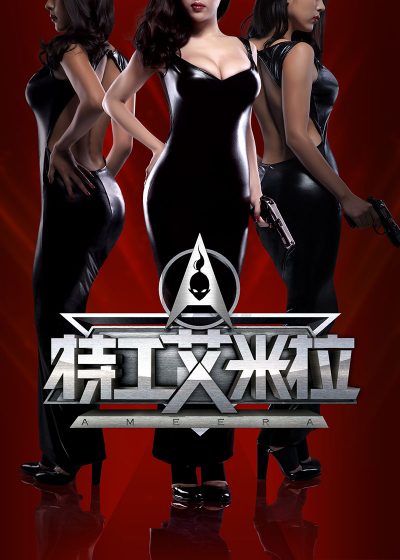 I should probably have learned from my first experience with Ms. Hu: the thoroughly mediocre jungle ensemble piece which was
  After reading some particularly scathing reviews of this, e.g. “stunningly atrocious”, I was braced for something