
★★★★
“Lady Snowblood, Hong Kong edition”
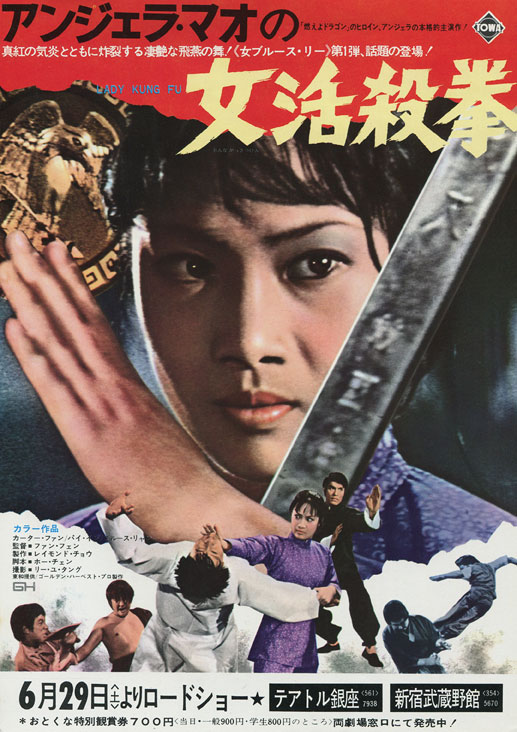
 I guess, the old saying “just there for Godzilla” definitely applies to me. This movie is far from perfect, but as long as I see some skilled fighters in fancy costumes battling it out, I’m in. Additional points are given if the respective dub is at least tolerable. Broken Oath is actually an interesting movie. It is kind of a remake of Japanese classic Lady Snowblood with Meiko Kaji from 1973. The difference is that this Golden Harvest production, from producer Raymond Chow, stars Angela Mao.
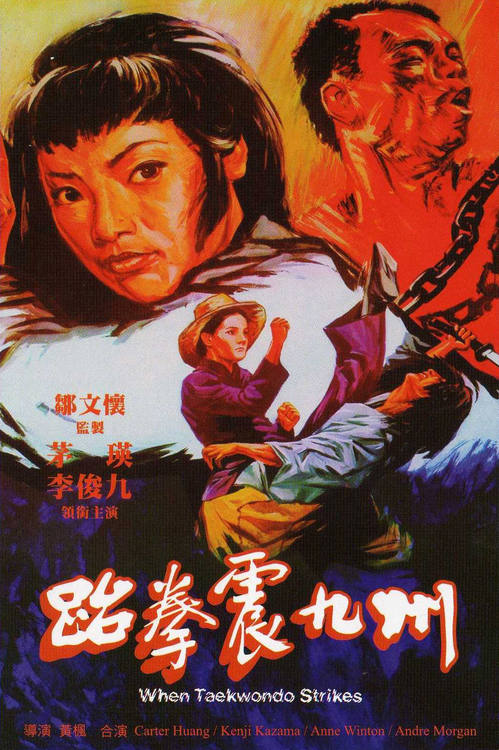
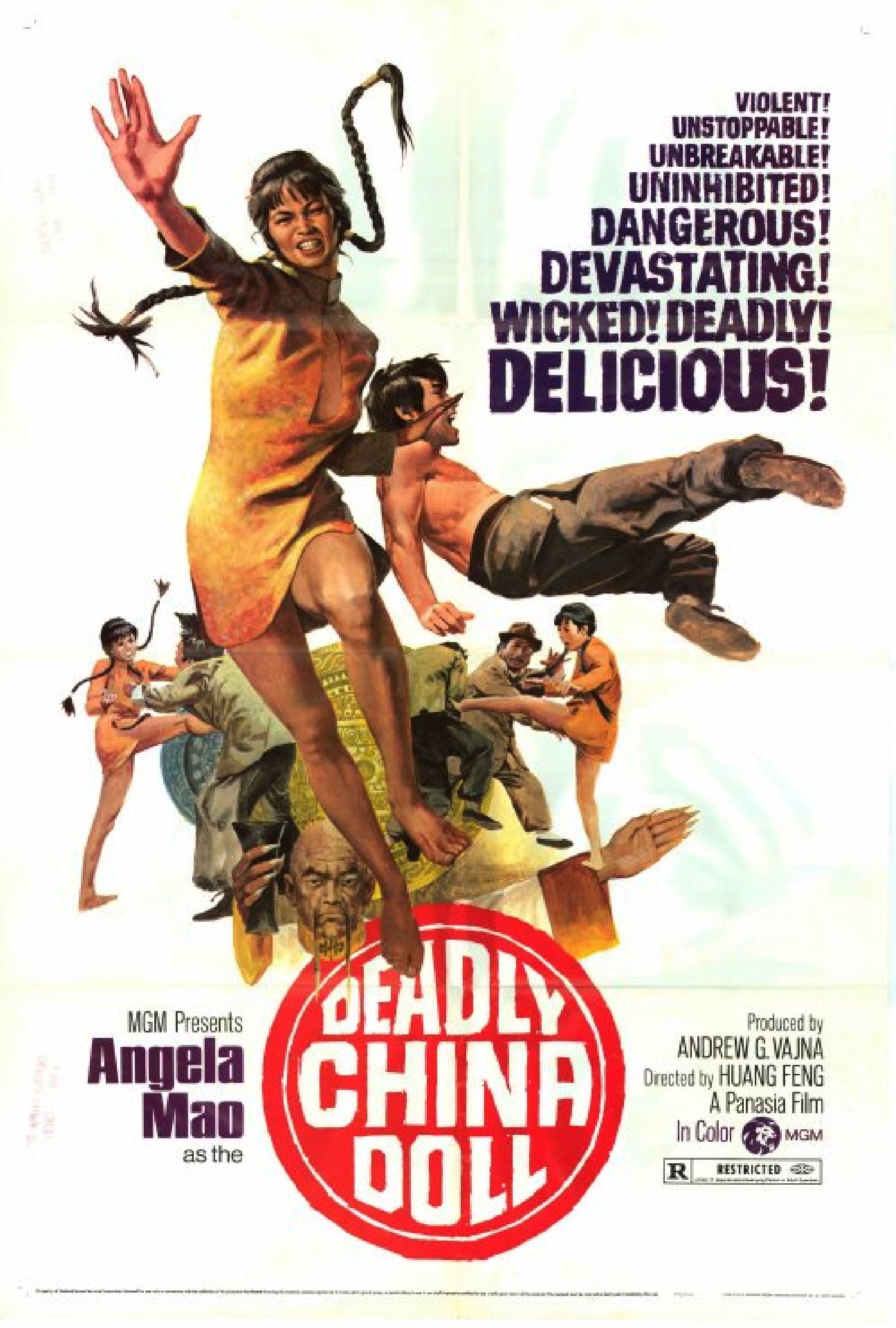
She was probably the biggest female martial arts star at the time in Asian movies and had the status of a female Bruce Lee. She had starred with Lee in Enter the Dragon and one-time James Bond George Lazenby in two other movies, and also worked with classic directors like Chang Cheh and King Hu. Some of her famous films include Lady Whirlwind, When Taekwondo Strikes, Hapkido, The Fate of Lee Khan and many others. In the seventies. she could hardly walk down a street without being instantly recognized.
Broken Oath was to be her last movie for Golden Harvest which is quite inexplicable because she was a major star – did they let her go or was that her own decision? After that, she began working in Taiwanese movies with obviously lesser budgets. She lasted in movies for quite some time until the early 90s when she retired from film business. In a way it’s a pity that her golden era more or less ended in the 1970s, considering the success stars such as Michelle Yeoh, Jackie Chan, Jet Li or Donnie Yen would later enjoy – and continue to do so – in the West.
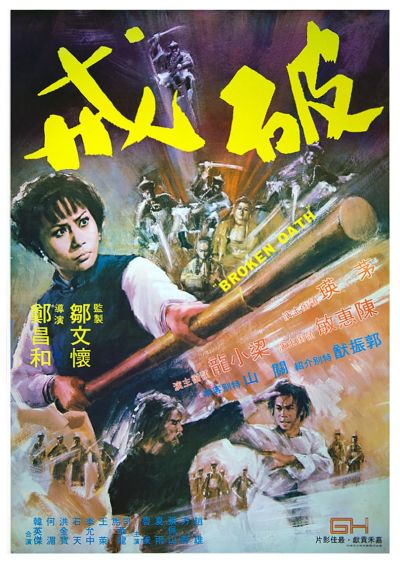 Broken Oath follows the story beats of Lady Snowblood quite closely – until it slowly becomes its own thing. It’s comparable to how Temptress of a Thousand Faces freely emulated the French Fantomas movies of the sixties. Like the Japanese original, it starts with a woman sent to prison where she gives birth to a child. On her death-bed she reveals her story of how her husband, General Liu, was killed by a gang of hoodlums; after resisting a rape attempt by one of them, she was sent to prison because the police didn’t believe her.
She gives birth to a girl and asks her “sisters” (inmates) to take care of the child, and to raise it to take revenge for the death of her parents. Instead, one of them, subsequently referred to as the girl’s godmother, gives her to a Buddhist nunnery with the blessings of the abbess who doesn’t think that the cycle of violence should continue. In the English dub, the little girl is called “Lotus”; the subtitles call her Jie Lian, though her original name was Xiao Mei. In any case, she has violent tendencies, though for some unspecified reason these Buddhist scholars are constantly fighting when not listening to the wisdom of Buddha. Lotus ends up killing three drifters in the wood when they try to rape her.
As she has “broken her oath” (to Buddha, I guess), she has to leave the nunnery and goes to live with her godmother, from whom she learns how to become a pickpocket and gets to know her friend and colleague Ah Shu. From there on, the movie loses connection to the original movie which I see as a good thing. Jie Lian finds the murderers, though the plot is essentially hardly more than the bones of a story, rather than a fully fleshed-out narrative. It unnecessarily complicates itself with the introduction of new characters and side-stories, but in the end the overall simplicity is indeed for the better of the movie.
For some time, I wondered if this movie was really worth my attention: I just wanted to see Angela Mao show me how hard and high she could kick. Fortunately, the film didn’t let me down. But it has to be said, it needed more than half of the movie until the whole martial arts machinery kicked – as it were! – into high gear. After being saved by an old, wise man named Qi Feng from the poisonous dust of one opponent. and his subsequent death at the hands of uber-villain Zhao Cai (both took part in the raid on Jie Lian’s parents, with Qi Feng now getting redemption by saving Lotus), things escalated quite quickly.
I have to say, I personally still prefer the melancholic elegiac beauty of Lady Snowblood and Meiko Kaji’s unmistakable charisma (I’m aware that Jim gave that movie a low rating, but for me that Japanese chanbara movie is an absolute high-ranking classic. To each their own, as they say), but the sheer number of ideas that this movie here bombards you with is remarkable. Let’s see… Steel claws as weapons; a liquid, one villain uses to spit fire and burn his victims to death; blades on a string used like a yo-yo. by an opponent played by Sammo Hung; a hat that goes over the whole head of Master Yun (later revealed to be Zhao Cai); sword fights; butterfly needles; group attacks, attack scorpions; and secret passages through stone caves hidden behind book shelves.
Really, the last 30-40 minutes of this go like gangbusters! I only wish the first half of the movie would have been like that, too. Granted, a story needs time to be built up, but let’s be honest: there is not much of a story here. Just the outspoken will for revenge, and that only happens after the godmother tells Lotus about her past. It is revealed at the end that the villains had planned to overthrow the government 20 years ago; General Liu discovered their treachery and was therefore killed. Better a good reason late than never, I guess. These things can’t quite disguise some carelessness in the story-development.
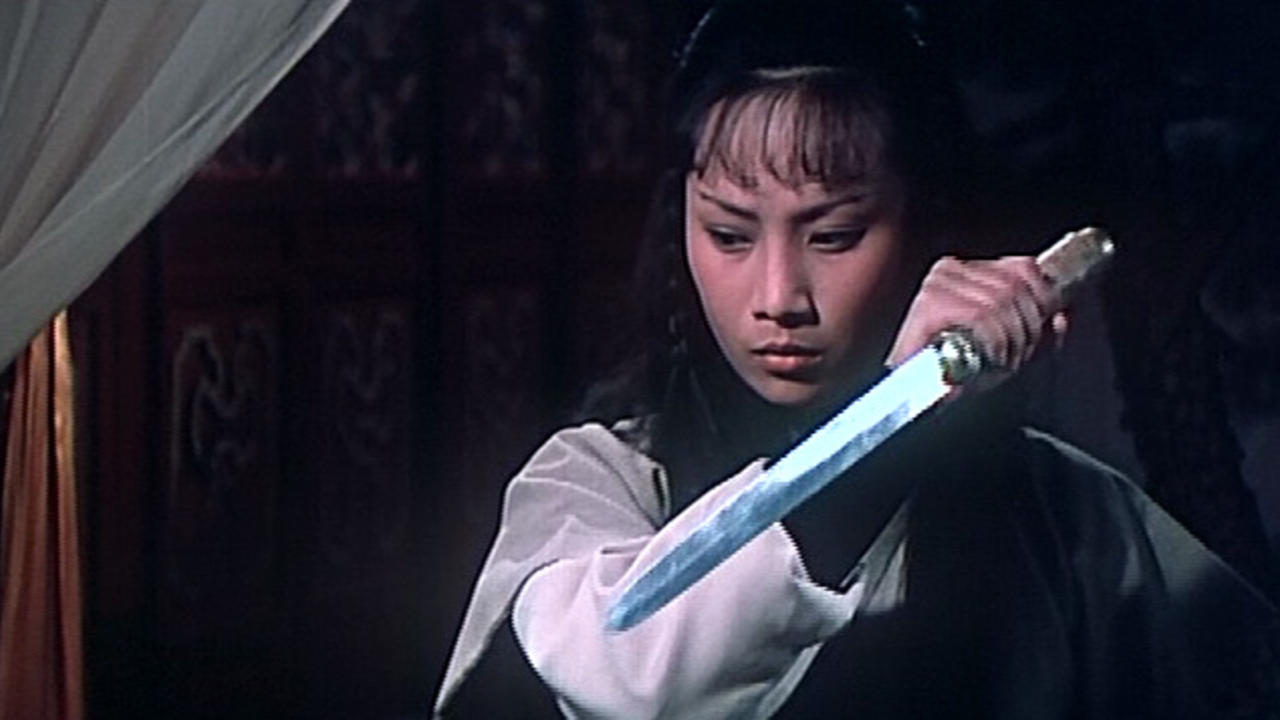 For example, Ah Shu seemed to be built up as a love interest. But he is killed off in a way, as well as the heroine’s reaction to it, which is so casual I wondered why he was even in the story. There is another character supposedly killed – silly me, believing that – who is suddenly back there to support the combatants in their fight again. The whole “she is poisoned and has to be cured” episode feels like a pointless story element, with no good reason except for extending the movie’s run time (admittedly I saw the theatrical version at 98 minutes; there is an extended version around 5 minutes longer), and giving Mao the chance to lay down and take a short break.
The actors here… well, they are Chinese actors in seventies wuxia and act accordingly. One shouldn’t expect Oscar-worthy performances here. The evil villains are evil and the rest of the actors hardly make much of an impression. Angela Mao is adequate as expected, though of course I’m more interested in her fighting skills than her acting talents. She moves elegantly and swiftly and I do believe she can fight off and kill more than half a dozen men, attacking her all at once. She is great “hero material”, and I applaud every action of hers. But I can hardly detect any burning pain underneath, or an insatiably hot appetite for revenge. Comparing that with the painful, tragic, almost longing for death portrayal of Kaji might be unjust. But it is also inevitable.
Of course, the dubbing doesn’t help. Yes, one should see movies like this in the original language version with subtitles, but I prefer a dub when I can get one. I don’t know from when this one comes (possibly the movie’s release in 1977), but the performances aren’t Anthony Hopkins and Jodie Foster acting, to say the least. I’m just happy to get lip-synched dialogue. It mostly plays inside buildings, temples or halls, giving the impression this is first and foremost a studio production. There are only a few scenes on location, though these are nice to look at. While I don’t rank the movie lower for it, I liked the beautiful, natural surroundings of Lady Snowblood much more. It’s just a matter of taste.
That said, as a whole I liked the production design, which makes you feel that the movie’s budget went into it, along with the historical Chinese costumes and some effects. It’s in contrast to Mao’s later Taiwanese films, where I can confirm she was working on a notably lower quality standard. This movie definitely has its qualities. As an old saying (incorrectly attributed to Oscar Wilde) goes: “Imitation is the sincerest form of flattery”. This might be true not only for Lady Snowblood, which Quentin Tarantino paid tribute to in Kill Bill – Vol. 1, but also for Broken Oath, as the fight between Sammo Hung and Angela Mao is definitely mirrored in the one between Chiaki Kuriyama and Uma Thurman.
Dir: Chang-hwa Jeong
Star: Angela Mao, Michael Wai-Man Chan, Siu-Lung Leung, Shan Kwan
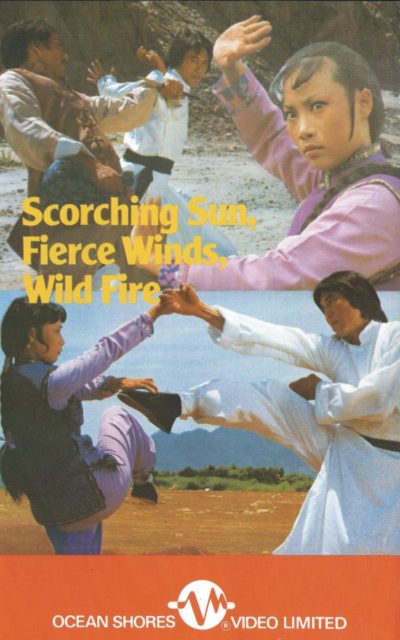 The first thing which will hit you about this 1979 Taiwanese co-production is the utterly shameless way it hijacks John Williams’s soundtrack to Star Wars. 93 minutes later, as the end credits roll, accompanied by more unauthorized liftage… That’s probably still going to be the main element of this you will remember. For the rest is largely a confusingly-plotted and not very well executed bit of chop socky. Despite Angela Mao’s presence, second on the list of participants, she is a long way behind the main character, in terms of both screen time and action.
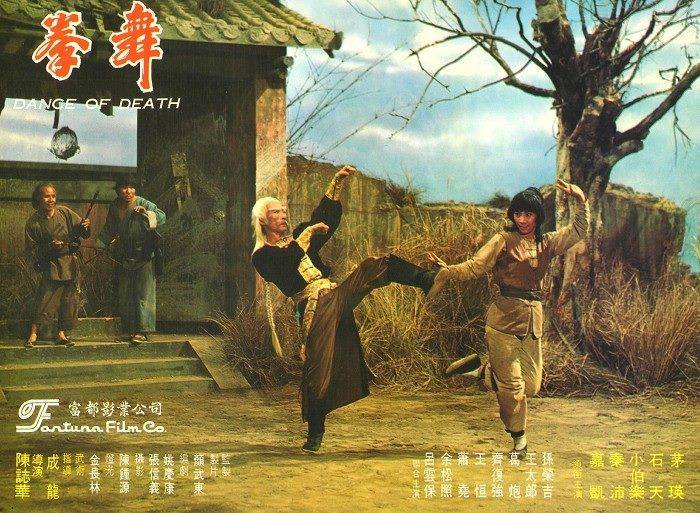 There were aspects which still befuddle me, such as most of the plot. Why, exactly, is Angela Mao pretending to be a boy? It’s completely unconvincing, and entirely unnecessary to the story-line. No-one ever discovers her true gender: it’s almost as if this were originally written for a man, then they got Mao, and in all the excitement, forgot (or, alternatively and equally credibly, couldn’t be bothered) to change the script. The rest of it is an odd mix. It’s partly vengeance with Fei Fei (Mao) out to pick up enough martial arts skill to take revenge on those who killed her family. Yet this sits alongside slapstick comedy which you’d not expect given the title, such as the two kung fu masters – one drunk, one stoner – whom she tricks into sharing her talents, or the villain with the world’s tiniest fan whom she defeats on her way to the big bad.
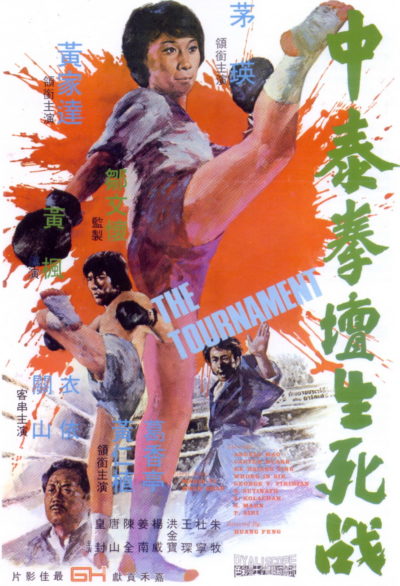 There’s a lot of chit-chat about face, honour and respect here. It begins when the master of a kung-fu school, Lau, has his daughter kidnapped by local hoodlums, after he won’t cough up protection money. Perhaps surprisingly, rather than using his skills to kick their arses, he sends two students to Thailand, including his son, Hong (Wong) in an effort to win the necessary funds. Hong loses, the other student is killed, and Lau is drummed out of the local Kung-Fu Association for having disgraced the name of Chinese martial arts by losing to foreigners. He’s so devastated, he hangs himself, leaving it up to his daughter, Siu Fung (Mao) to restore the family name, learn how to mesh Chinese kung-fu with Thai boxing, and rescue her sister. Quite the “to-do” list, I’d say.
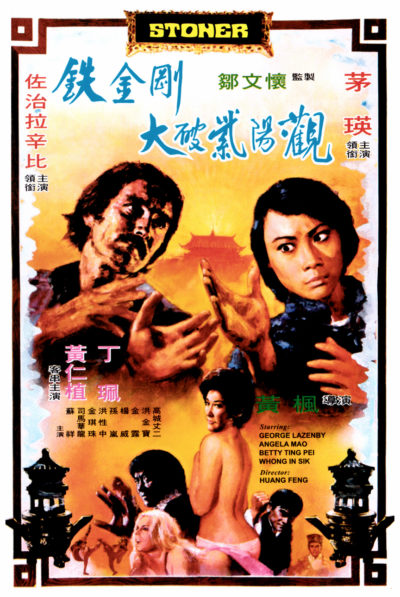 This production had a long, convoluted and quite interesting path to the screen. While Lazenby was always on board, the original plan was for him to be a Western bad guy, going up against Bruce Lee and Sonny Chiba. But Lee’s death – oddly, he was supposed to have had dinner with Lazenby that night – resulted in Chiba quitting, and Warner Bros then also backed out of their worldwide distribution deal. It was reworked as a much smaller film, at less than one-tenth the original budget (although at around $850,000, was still very expensive for the time, location and genre), with Lazenby now teaming up with Angela Mao.