★★★★
“The mother of all vengeance stories.”
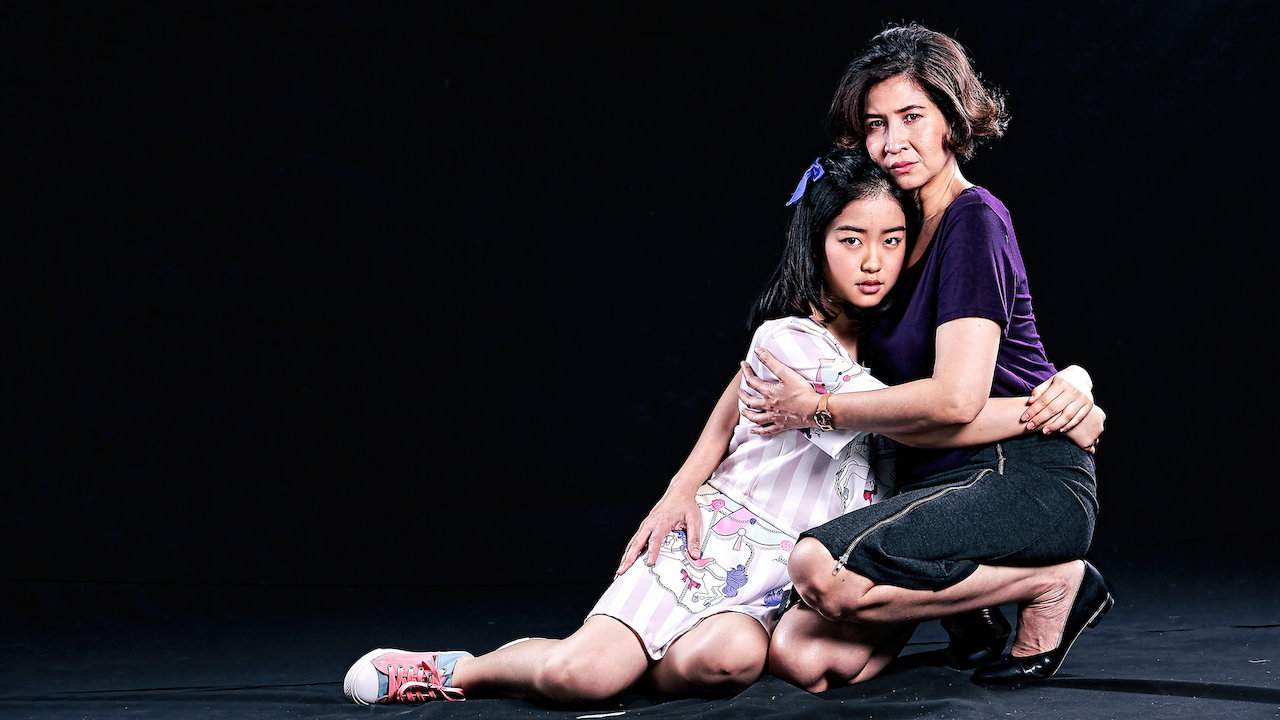
 This is the first Thai TV series I’ve seen, and while I suspect it’s not exactly par for the course, I found it undeniably impressive. Behind a generic title, it’s easily the most intense of the telenovelas I’ve seen, regardless of location. [Note: various sources have different names for the characters: for consistency, I’m giving the ones used by Netflix] It’s a long, extended rampage of vengeance, in which the heroine, Maturos (Panyopas), goes after the perpetrators of a particularly vicious group-rape. The assailants are a local gang, who extract revenge on both Maturos and her daughter, Peung (Ruayruen), following their co-operation with the police. It’s an assault which leaves Matukron almost catatonic, and when half the gang are found not guilty in the subsequent trial, Maturos opts to find her own justice, adopting a variety of characters to get close to them. But the killing comes at the cost of her own sanity, which splits her personality into two: a caring and compassionate half, and an alternative persona which demands ever-more savage vengeance.
 The story is told in the context of Maturos’s trial, so we know there’s no question of her getting away with it [that would probably have been a step too far!]. But will she get the death penalty, life imprisonment, or be found not guilty by reason of insanity? The show unfolds in flashback, occasionally interrupted with moments from the trial, telling the story of how she came to be facing multiple charges of murder. It begins with mother and daughter leaving their abusive husband and father. It’s the resulting precarious financial situation, moving them into a flat in a less than desirable neighbourhood, and bringing them into contact with the gang. They accidentally come into possession of a drug stash belonging to the posse, and hand it over to the authorities.
This triggers the brutal punishment on them both, on top of a building during a storm. It’s a lengthy ordeal, which occupies much of episode #4, with Maturos and Peung left lying on the roof. Though the police are able to arrest the suspects, the rain washes away much useful forensic evidence; only three of the seven are convicted, despite the best efforts of Inspector Patorn (Tangtong). He feels responsible for what happened, and had been somewhat involved in a relationship with Maturos before the attack. Afterward, however, that quickly proves to be impossible.
Indeed, it’s not long before Maturos’s alter ego, Roong, starts to show up. At first, she is subservient, appearing only in mirrors, but gradually becomes to dominate, taking control for much of the time. Not helping matters – though it is one of the most interesting angles – is the encouragement of Yuki Fukushida (Amratisha), who rescues Maturos from an abduction attempt by her ex-husband. Yuki runs a “victim’s support group”, for those abandoned by justice. It’s really more to do with helping them acquire the necessary set of skills to punish those who did them wrong. Needless to say, her encouragement doesn’t do much for our heroine’s sanity, instead letting her tap into her inner psychopath. The ex-husband is the first to experience that.
For the four unconvicted perpetrators, the pattern in the following episodes is similar. As shown on the poster (above, right), Maturos adopts a range of disguises – old woman, porn distributor, bar girl, human trafficker, or even a man – in order to get close to them. Having done so, eventually, she strikes, rendering them helpless, most typically with a sedative injection. She makes them record an apology to Peung, before finally dispatching them – albeit only after removing their genitals. Their deaths are never quick or easy, and are depicted at quite some length, as well as with a brutality which I found surprising. Thai TV may have severe limitations on sexual content, but violence is clearly seen as much less of a problem.
As 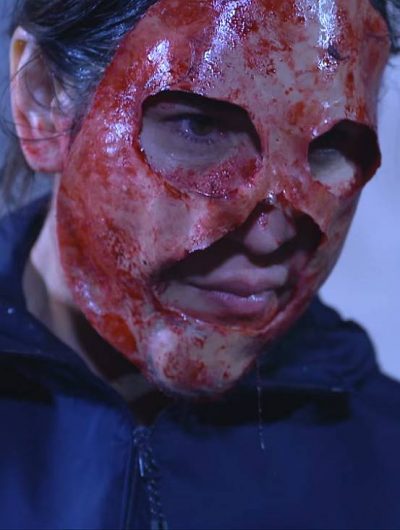 the body count increases, the remaining gang members grow increasingly suspicious, and harder to track. Inspector Patorn is also beginning to put two and two together, and Maturos’s psychiatrist, Dr. Nattha, discovers her patient’s split personality, meeting Roong. Even after Patorn realizes her involvement in the murders, he agrees to let her act as bait to lure in the three remaining gang members, who have escaped from prison and, having reached the same conclusion, are coming for their own revenge.
But Maturos is playing a longer game, and it all builds to a final confrontation on the same rooftop where it began. As the image on the left suggests, she ends up going full Silence of the Lambs, wearing the face of one of her targets as a mask, and her final “disguise”. Though we still have to wait for the court’s verdict on her fate, with the case triggering a national debate regarding the death penalty, in addition to the question of Maturos’s culpability.
As on screen, so in real life, with the series proving a word of mouth hit in Thailand, and sparking similar discussions on the criminal justice system. The show’s ratings improved from as low as 1.3 in the early going, partly due to a late-night slot resulting from its content, reaching 3.7 for the finale. Deservedly so, because it was very effective: a real page-turner in televisual form. It certainly doesn’t pull any punches, and seems to be radically different from the typical “lakorn”, as the popular soap operas in Thailand are known. Though a 2014 study discovered that 80% of them depicted rape or sexual violence, I suspect few did so in such an uncompromising way as here.
It may, indeed, perhaps go too far occasionally. Chris largely lost her sympathy for Maturos, after watching her bring Peung along on one of her murders – even I have to admit, that is fairly questionable parenting, split personality or not. And watching the heroine don blackface in her prostitute character was perhaps something which didn’t transfer well, culturally. However, given the length of the series (24 x 50-minute episodes), such mis-steps are infrequent, and more than balanced out by a great performance from Panyopas. That’s especially so when she’s acting opposite her malevolent self, in a way which feels almost like a maternal version of Gollum.
It’s her portrayal which glues the series together; outside of sensei Yuki, the supporting cast of characters feel more functional than memorable, on both sides of the law. How successful you find the show as a whole is thus likely heavily dependent on how convincing you find her performance. Personally, I was more than satisfied with it, and while this may be optimistic, hope to find similar quality elsewhere in the lakorn genre.
Dir: Sant Srikaewlaw
Star: Lalita Panyopas, Pornsroung Ruayruen, Saksit Tangtong, Rudklao Amratisha
a.k.a. Lah (The Hunt)




 First, the good news. Whatever the issue was with
  There are times when I feel I need a ★¾ rating. Two stars here would suggest a degree of genuine competence, which this undeniably lacks. But on the other hand, ★½ suggests something which is largely unmemorable, and that isn’t the case either. You won’t forget this. In particular, you won’t forget the scene where the heroine yanks some (suspiciously sausagey) intestines out of a victim, rubs them over her face and then – there’s no other way to describe this – masturbates the intestines. That’s three words I never thought I would write in a row. On that basis (and that basis alone), I’ll err on the side of generous.
 For whatever reason – presumably misguided stylistic reasons – the great bulk of the film is buried in darkness. Seriously, three-quarters of the film feels like it’s illuminated solely by natural lighting. And given it mostly takes place underground, in rooms with no windows, this is a major problem. The movie reaches its literally darkest moment during an early scene where the camera pans over an underlit set to an even more underlit door where someone has entered to deliver a message. You cannot see who it is. You just hear a disembodied voice, before the camera pans back. It’s a horrible mis-step, whether due to poor shooting, a poor transfer, or a bit of both. It largely dooms the movie, to the point where even an energetic final third is unable to rescue proceedings. For how can you begin to enjoy something you can’t see?
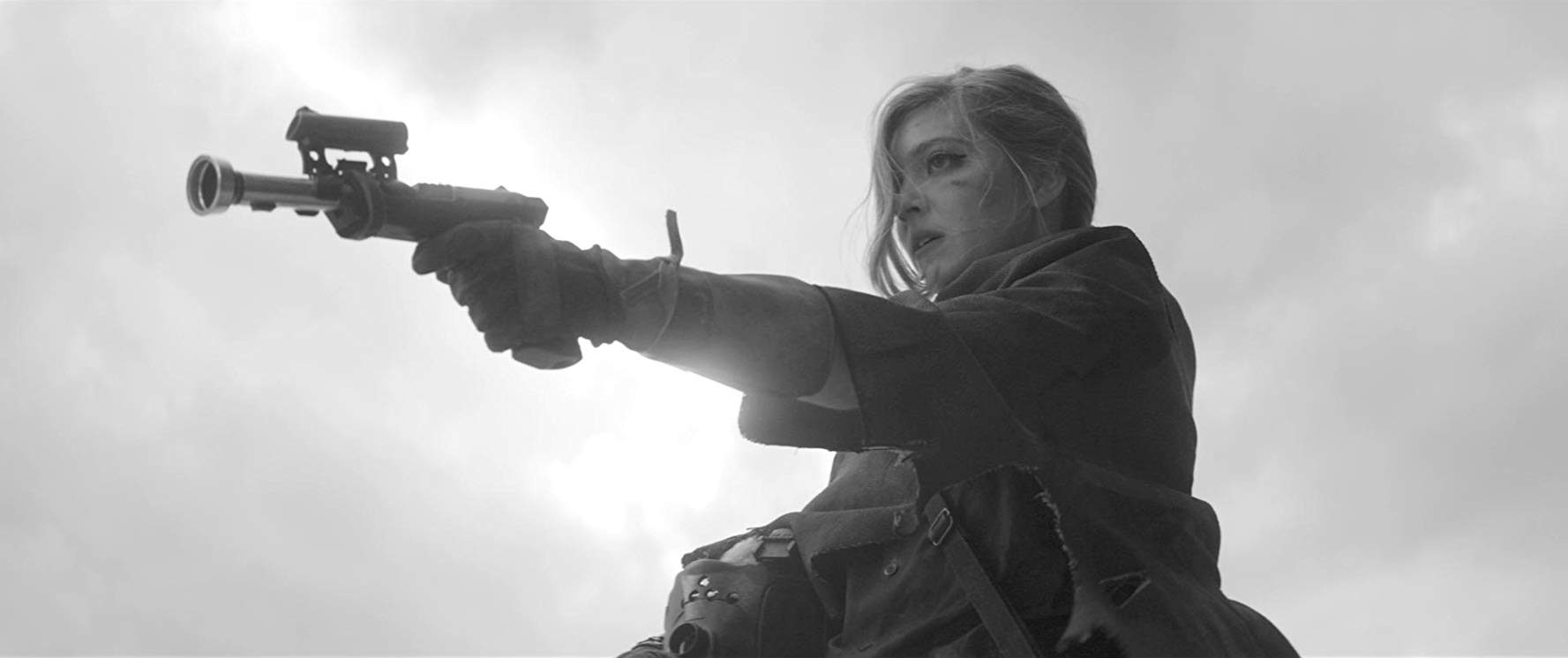
 In the late 22nd-century, Earth is pretty much screwed. The impact of a giant meteor killed a huge number of people, wiped out the everyday infrastructure, and sent the world into perpetual twilight. Thirty years ago, the wealthy upped and left, never to be seen again, abandoning the rest of the survivors to scramble in the ruins of civilization, simply trying to survive. Holly Danger is one of them, a salvager who lives by her wits in the labyrinth of a coastal city’s destruction. Which means dodging the seekers, addicts of the hyper-destructive drug, Plush, as well as the outskirts, those who come in to the city and raid it for supplies.
 There are some very interesting ideas here. Unfortunately, probably too many of them. As a result, the end-product feels like a half-baked collection of semi-formed thoughts – none of which are explored to the extent they deserve. It begins with an apocalypse, apparently triggered in order to stave off an alien invasion. Fast-forward a few years, and we join Sarah (Hutchinson), one of four children who are shortly to be teleported to a space station orbiting around another planet, which is the target for future habitation, and where the President of Earth now resides. Except an alien sympathizer stages an assassination attempt, leaving the children dropped onto the planet’s surface, along with the Commanfer (Trigo), who had a role in the apocalypse seen earlier. But he ends up being taken over by a parasite which turns him psychotic and he begins hunting down the children. Who need to locate the President, who also crash-landed nearby, because…
 Struggling artist Summer (Oldham) takes on a temporary job as a phone-sex operator to make ends meet. It gives her a very jaundiced view of men, having had to plunge into the worst and most sordid depths of their fantasies. After realizing that some pose a more direct threat, and funded by hush money from one of her customers, she buys the car of the title. and takes their information, along with the tapes she has recorded of them, on a little road-trip across the South and West of America. She’s heading towards her sister (Hinchley), bringing the perverts to justice as she goes, and seeking closure for her own past.
 Despite a startling cover, this isn’t as sleazy as it seems. Indeed, even the title appears to be erring on the side of restraint, having apparently avoided the more obvious (and arguably, accurate) one of Killer Pussy. While the heroine certainly has an… interesting choice of costume, that’s as far as the film wants to go. It’s an odd approach: a sleeve like that sets up certain sets of expectations, which the movie has no apparent interest in matching. It’s not as if anyone of a sensitive nature is going to have got past the cover, so it seems odd to exercise such self-discipline when it comes to the content.
 You could skip the first 30-45 minutes of this, and it really would not affect your enjoyment level significantly. It seems to be one of those cases where the director is far more in love with the dialogue and characters than they deserves, and so we have to sit through far too much flapping of jaws by the latter, delivering the former in inane and uninteresting conversation, before we get to the meat of the story. Which is, as follows.