



★★★½
“And then there’s the (Godfrey) Ho…”
Things we learned from this movie:
- Being a prostitute is a healthier career for women than being an assassin – “unless the men have AIDS”.
- Your neighbours will never call the police, even when a lengthy gun-battle breaks out on your property.
- The CIA operates openly on American soil, and has apparently replaced the Secret Service in investigating counterfeit money.
- The best way to give a woman an orgasm, is to fill a condom with milk, prick a hole in the end, and squirt it onto her panties. Who knew.
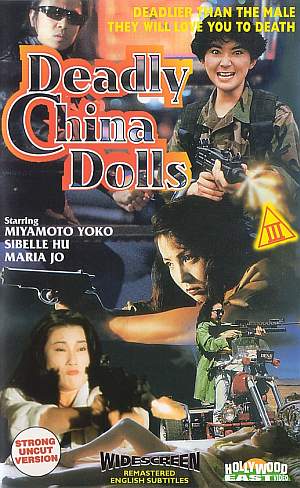
Any questions? In the loopy world of Category 3 Hong Kong films, which cover pretty much every bizarre scenario imaginable, Lethal Panther remains on the outer edge. I’m not quite sure how the makers got someone with a decent track record like Sibelle Hu to appear: I suspect she was sent a script for a completely different movie, probably entitled Lady Super Cop Goes to Manilla or something, since she only has about two scenes with the other lead actresses. I would imagine that her reaction, on seeing the finished product, must have been something similar to that experienced by Helen Mirren at the premiere of Caligula – and was presumably followed by a stern note to her agent the next morning.
The story centers on two assassins, one from Vietnam (Yuen), the other from Japan (Miyamoto), hired to come to the Phillippines and kill the head of an underworld gang that’s making a killing with counterfeit dollars. They’re employer is the boss’s nephew, who wants to take over operations: when that mission is accomplished, he then turns the two hit-women on each other, to tidy up the loose ends. They end up injured and recuperating at the home of a friendly prostitute, where they discover they are not so different. However, fate intervenes, in the shape of one’s brother, who returns from France. Meanwhile, a CIA agent (Hu) is looking into the funny money, and when her target is gunned down at a wedding, switches her attentions to the killers.
The formula here is straight-forward: an action scene about every ten minutes and some gratuitous nudity every twenty. And when I say ‘gratuitous’, I mean it; the last item listed in the first paragraph counts as the most bizarre use of dairy products Chris or I have seen in a very long time [Chris is floating Carmen Electra’s milk-bath in The Chosen One as a credible contender, but I don’t recall the specifics there]. None of the other sex scenes reach quite the same level of insanity, but they give the film a sleazy quality that it probably would have done better without.
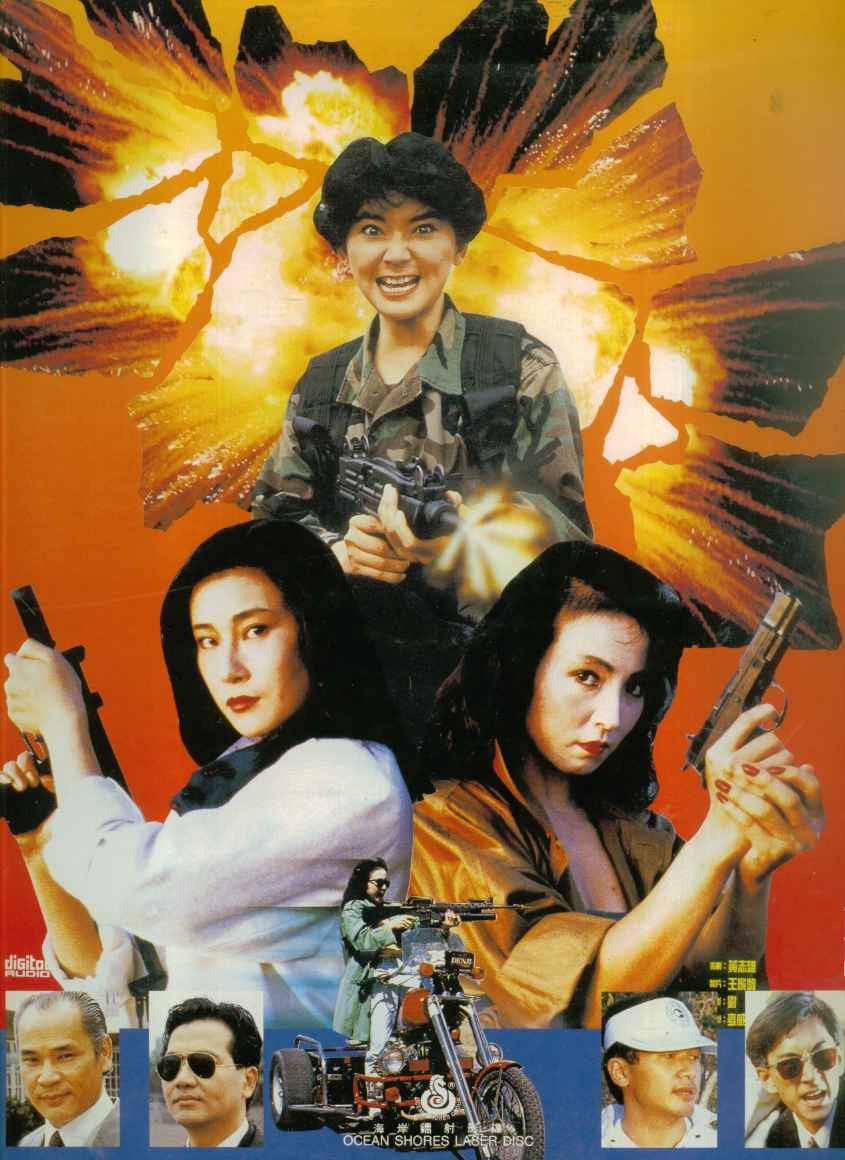 The action is even more copious than the nudity however, and not bad, though one suspects a fair amount of doubling for the main actresses is going on. Despite Ho’s reputation as a complete hack [some of his films consist entirely of footage spliced together from other movies], he knows the right buttons for action heroine fans, and how to push most of them. On what I strongly suspect was a poverty-row budget – you don’t go to the Phillippines for the scenery – the movie delivers an impressive quantity of action, mixing firearm-toting and martial-arts battles to decent enough effect. All of the actresses get their moments to remember: a massacre in a restaurant and a supermarket shoot-out stand out in particular, as well as the roof-top fight between Hu and Yuen.
Y’know I just mentioned the poverty-row budget? Perhaps the area this stands out in most is the soundtrack, which appears to be a combination of stock music, and cues ripped wholesale off from other movies. Ho is far from the first Hong Kong director to do this [I still remember my jaw dropping when a chunk of the Heathers soundtrack showed up in Flying Dagger], but you really wonder, at what point did it seem a good idea to lob John Carpenter’s theme from Halloween into the mix for one scene? And, no, the moment in question does not involve a masked maniac stalking sexually-active teens – albeit probably only because Godfrey Ho didn’t think of the idea. Or, more likely, stored it away for an entire feature on this theme.
It would be easy to dismiss this as exploitative crap. Very easy, and you wouldn’t necessarily be wrong, either. But it kept us entertained, even if a good chunk of the amusement was to be found in the steady stream of sarcasm directed at the screen by Chris and I, as the more ludicrous aspects unfolded. Still, Ho clearly possesses absolutely no pretensions to be anything above what he is, and delivers a B-movie experience that we likely will remember for some time, especially when we head past the milk in the supermarket.
Dir: Godfrey Ho
Stars: Yoko Miyamoto, Maria Yuen (as Maria Jo), Sibelle Hu, Alex Fong
a.k.a. Deadly China Dolls
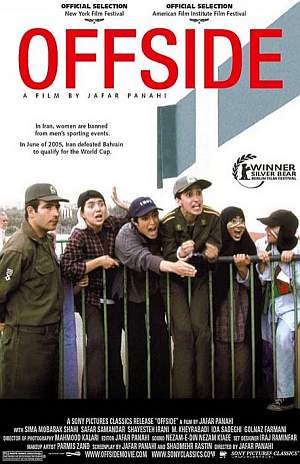 Being an action heroine is a rebellious, possibly revolutionary, act against society: what counts, depends entirely on how your society views women. Going to a soccer game, for example, would not qualify you in the Western world – but as in Ancient Greece, sporting events in Iran are strictly male-only, and a woman who attends one and gets caught, will find herself handed over to the Vice Squad. It redefines requirements somewhat, to say the least. The film tells the story of a number of women, who dress as men to sneak into a crucial 2005 World Cup qualifier between Iran and Bahrain, only to find their disguises imperfect. They’re held in an area, just out of sight of the game, by a group of soldiers, who really have better things to do themselves.
 Particularly outstanding is Irani’s tomboy, who becomes the de facto leader of the group, and continually hassles the guards. The film has a surprising amount of straight-faced humour, such as her riposte when asked if she’s a boy or a girl: “Which do you prefer?” Or one girl’s response when told they can’t go in because the men will be cursing: “We promise not to listen.” Similarly, when another needs to use the bathroom, this poses problems, since naturally there are no women’s facilities. The solution involves the impromptu conversion of a poster into a mask, though this hardly resolves things. Obviously, it’s not a traditional genre piece, and it’s this
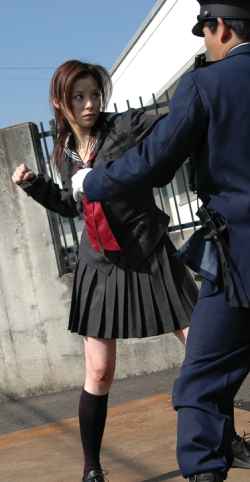 “Yo-yo. Girl. Cop,” said Chris, burdening those three words with sarcasm, as only she can, and giving me one of those sidelong glances, heavy with additional meaning. Hey, what can I say. This was an unexpected revival of the series, from 2006, with the lead played by pop singer Matsura. She is a wild-child coerced into undercover work by Kazutoshi Kira (Takeuchi, from Takashi Miike’s Dead or Alive trilogy), to save her mother who is being held on espionage charges in the US [in a nice touch, Mom is played by Yuki Saito, who was the first live-action Sukeban Deka, in the original TV series]. Her mission – should she choose to accept it – is to go into a high-school and uncover those behind the threatening Enola Gay website, a neo-terrorist URL that now has a counter on it, with less than 72 hours remaining. She befriends Konno Tae (Okada), the meek victim of relentless bullying, and also encounters the school’s queen bee, Reika Akiyama (Rika Ishikawa – shown right, and another pop singer, like Okada part of the v-u-den group) and her clique. Can she work out what’s going down, and pull the plug on it?
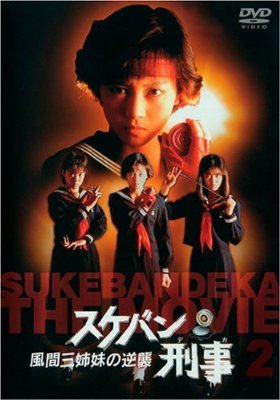 Perhaps the most startling thing here is the amount of political subtext, albeit likely somewhat unintentional. Saki Asamiya (Asaka) is part of the student police force, but feels they are overly brutal, beating anyone who “isn’t a straight arrow”, to quote Asamiya. This leads her to quit, heading off for a spot of slow-motion horse-riding more befitting a feminine hygiene commercial. However, she returns, teaming up with her sisters, when she discovers that her erstwhile colleagues are staging terrorist attacks, and blaming them on a group called the Outcast League, a with the aim of strengthening their position and gaining even greater powers. Asamiya joins the League, only to find the full force of the law now turned on her.
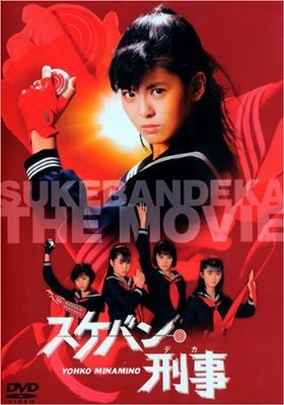 This film was made between season two and season three of the television series, and represents a passing of the torch from Saki, SD #2 (Minamino) to SD #3 (Asaka), in preparation for the upcoming TV show. Saki has just about given up her life as a detective, but finds herself dragged in when she, literally, bumps into someone on the street. He turns out to be an escapee from Hell Castle, a reform school for wayward kids on an island near Tokyo, and she discovers that Principal Hattori (Ibu) is training the pupils to be a brainwashed army for an upcoming coup d’etat [the word is exactly the same in Japanese, incidentally]. She goes to her bosses with the information, but the investigation is quickly killed from above, for reasons I’m sure you can guess. So, it’s up to Saki to put together a team, sneak onto the island, rescue the inmates and stop Hattori. He turns out to be a nemesis from the TV show, though that back-story will, for obvious reasons, be lost on the vast majority of Western viewers.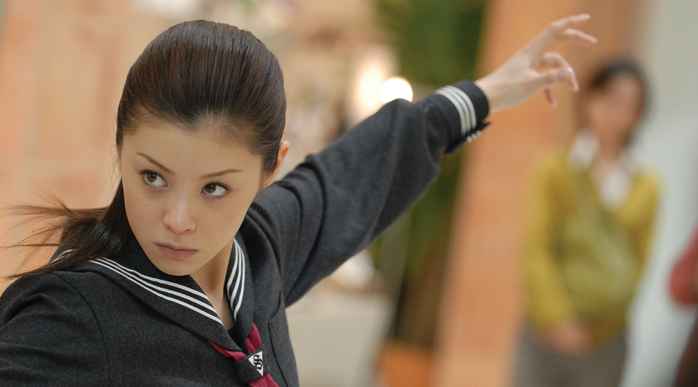
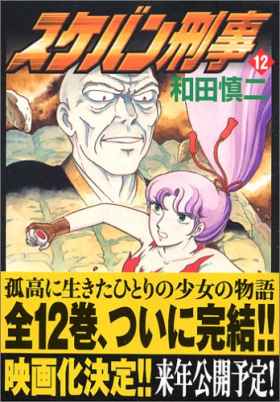 Rarely has the phrase, “Only in Japan,” ever been more appropriate. It’s not just the notion of a delinquent schoolgirl, taken in by the government and turned into a secret-agent of sorts. That, alone, is odd, but not particularly memorable. No, it’s that her weapon of choice is a
 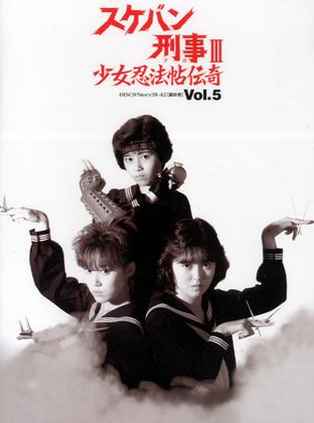 This appears to be episodes 34-36 of the second series, and having watched them, I feel I can convincingly state, with little fear of contradiction, that I have little or no idea what is going on. #34 takes place mostly in the woods, with Saki apparently possessed by something that causes her to attack her friends. Also roaming the woods is a samurai, and another schoolgirl, who possesses fangs, and leaps to the attack accompanied by cat noises. There is a fair amount of largely-unconvincing fighting, ending when Saki has her memory jogged by a small trinket, apparently breaking the curse placed upon her. To say any more would probably be…unwise.
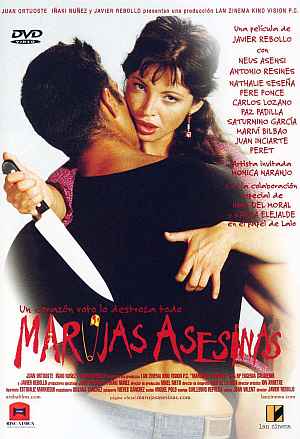 This tale of a Hispanic wife whose sanity disintegrates, beginning with the murder of her husband and ending with…well, you have to see it, had me shifting somewhat nervously, as
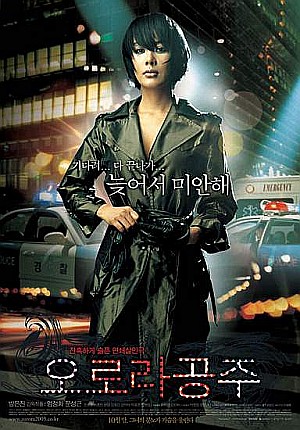 After inflicting Forbidden Warrior on Chris, my stock with her had slumped like Morgan Stanley. Fortunately, this Korean serial-killer flick provided a good measure of redemption. It stars in a department store, where Sun-Jung (Uhm) sees a mother abusing her young daughter, before leaving her and going into a stall. Sun-Jung shepherds the girl outside, breaks into the stall and stabs the mother repeatedly. The case is investigated by Detective Oh (Mun), who spots his ex-wife in the store security video. When bodies keep turning up, though killed in different ways, the police link the cases due to the cartoon stickers found on each scene. Oh gradually comes to suspect his wife is taking revenge on those holds she responsible – directly, or otherwise – for the death of their child, killed in a brutal kidnapping previously. Is that really the case, and if so, does he have the moral fortitude to turn in a woman he still loves as a murderer?