


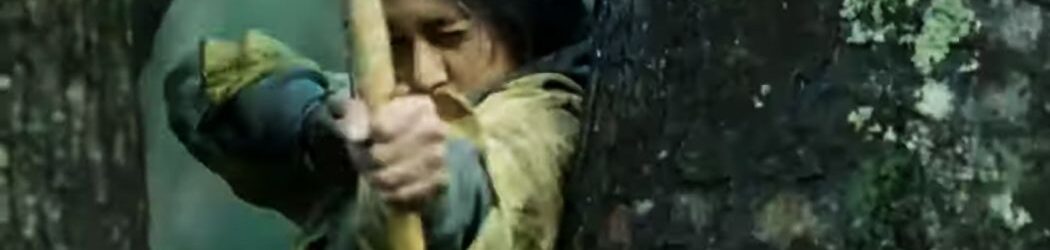

Zoe Saldana plays a young woman who, after witnessing her parents’ murder as a child in Bogota, grows up to be a stone-cold assassin. She works for her uncle as a hitman by day, but her personal time is spent engaging in vigilante murders that she hopes will lead her to her ultimate target: the mobster responsible for her parents’ death. This Luc Besson production is directed by Olivier Megaton, best known for The Transporter 3. It’s due to be released on August 26th.
Author: Jim McLennan
Sweet Justice (1993)
★½
“Well, that’s 1 Gb of disk-space I won’t get ba… [Delete] Oh, never mind.”
 Sunny Justice (Carter) is a former soldier, who is somewhat estranged from her sister, but who returns to town when the sibling – who also happens to be the mayor – dies under mysterious circumstances [savaged by a dog]. Turns out she was about to blow the whistle on developer Billy Joe Rivas (Gorshin), who has both designs on the town, and who has been using his mine as a dump for toxic-waste. The local sheriff (Singer) had bedded both sisters, but he refuses to act, and federal authorities prove no willing, so Sunny calls up some of her old pals, who were part of an all-female Special Forces unit, to take matters into their own hands. Rivas doesn’t take kindly to having his money-making scheme interfered with, and calls in reinforcements of his own, using his East-coast mob connections.
Awful. Mind-numbingly awful. Carter is best known as the female lead in Tremors, one of our all-time favourites, but this is a terrible combination of bad acting, poor scripting and terrible action sequences. It can’t even make up its mind what it wants to be, with a couple of sex scenes that don’t even have any nudity. Meanwhile, the largest-breasted ex-Special Forces girl (Michelle McCormick) is working as a go-go dancer. Not that she shows any flesh either, though I was amused by the way the inevitable training montage is interrupted for an entirely gratuitous hot-tub scene.
None of the actresses are convincing as ex-soldiers, having arms like twigs, though there is sporadically some half-decent martial-arts action. My interest was briefly piqued when Sunny uttered the immortal line, “I want to put the squad back together,” but there are just too many moments worthy of scorn for this to last. The two dog-attack sequences could hardly have been less credible if they’d just lobbed a Chihuahua at the victims using a catapult, and the final battle consists almost entirely of stuntmen falling off roofs out of shot. I’m left to presume Cynthia Rothrock must have rejected this one, and she was entirely right to do so.
Dir: Allen Plone
Star: Finn Carter, Frank Gorshin, Marc Singer, Kathleen Kinmont
Nikita: season one
 ★★★★
★★★★
“TV Sinners”
 Most action-heroine fans will know that this was not the first TV series inspired by Luc Besson’s classic GWG film. Between 1997 and 2001, La Femme Nikita ran for four full seasons, plus a shorter fifth one, with Peta Wilson playing Nikita. In early 2010, the CW Network announced it was developing a pilot to try out a new version of the show, and this was picked up for a series in May. The CW seemed a bit of an odd choice: their idea of an action heroine tends more towards shows like Gossip Girl and the 90210 reboot, with a target demographic of 18-34 year-old women. So was this version going to showcase a kinder, gentler Nikita?
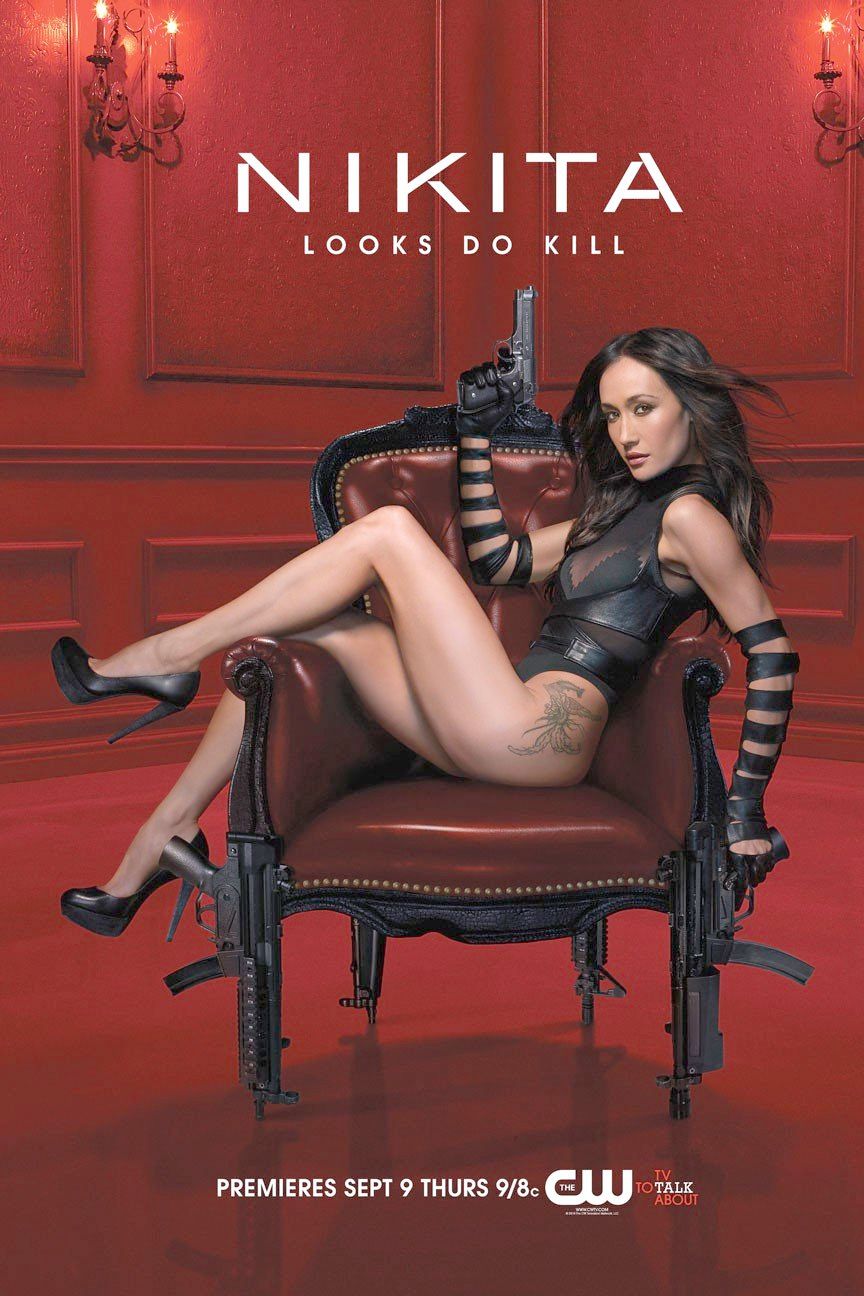
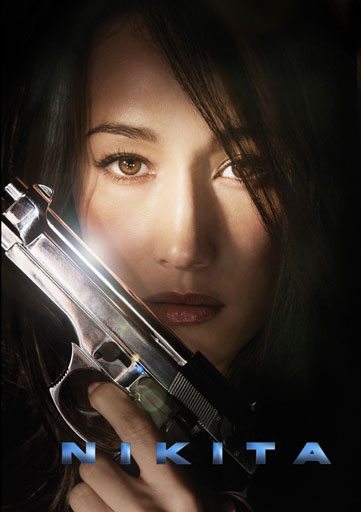 I was reassured by the casting of Maggie Q as the lead, who has a solid action pedigree, both in Hong Kong (Naked Weapon) and the West (Live Free or Die Hard and M-I:3). While its source material was clear, it took a different approach. Instead of telling Nikita’s story from the beginning, with her recruitment into a shadowy semi-official organization and training as an assassin, it starts later, after she has mutinied and left them. Now, she is working to bring down the organization known as Division, its leader, Percy (Berkeley), and his right-hand man, Michael (West), who trained Nikita before she went rogue. Her ‘secret weapon’ is Alex (Fonseca), a new recruit going through training, while acting as Nikita’s mole and feeding her information, allowing her to sabotage and obstruct Division’s missions.
The results have generally been pretty impressive, probably the closest thing to a true kick-ass heroine on network TV since the demise of Alias [which may have have happened some time before the end of Alias, if you get my drift]. If not quite as dark as the Wilson incarnation, it is certainly satisfactory on this level, with death, torture and treachery lurking in just about every episode. The characters arcs certainly have their twists and turns: the alignment of loyalties at the end of the series is radically different from where they started, with people on both sides crossing over. It’s easy for a show like this to get into a rut – Division sets up an operation, Nikita foils it, or whatever – and the generally avoided this pitfall.
In what one suspects was a nod to the target demographic, this was as much about Alex as Nikita, who has her own past to contend with. There is, probably inevitably, the love interest, in the form of a blandly attractive next-door neighbour, who is basically the first man she meets after Alex completes her training and goes into the outside world. There was something similar for Nikita, though this first looked to be heading in one direction, then swerved in another during the second half of the show. That was one of a number of changes made mid-season: it seemed as if the makers needed to fine-tune things on the fly; I was concerned where this might lead, but it didn’t hurt the show.
One particular improvement was the appearance of Amanda (Melinda Clarke). Initially Division’s psych evaluator, she took a much more prominent role, and the relationship between her and Alex made for an interesting dynamic, not unlike Sidney Bristow/Irina Derevko [hmmm…]. We also enjoyed Berkeley’s portrayal of Percy: remembering him as the heroic, if inept George Mason in 24, this was a real change. The final couple of episodes had some epic twists, though I was a bit peeved with the “deaths”, which proved not to be terminal. I find it a cheat: as we saw with Buffy, once a character has come back from the grave, death tends to lose its sting, though the execution here was not as clunky or contrived.
 They even crammed in nice nods to the original movie and its TV predecessor too, with a dive down a chute to escape, and a cameo from Alberta Watson, one of La Femme Nikita‘s actors, as part of the intelligence committee supposedly in charge of Division. By the time the dust has settled, Nikita was driving off into the sunset with a surprising ally, and Alex was also teamed up in a new way, setting things up nicely for the second series. Whether it was going to get one or not seemed in doubt for a while, as the rating did sag mid-season, dropping the show onto the ‘bubble’. However, it was announced in May that the CW would pick it up for another series, moving the show to Friday nights to play along with Supernatural.
However, all the plot is perhaps secondary; we want to see ass being kicked. I have largely to agree with Maggie Q, who said, “In terms of action, I don’t see our quality of action on any other show right now. I’m sorry. They may have bigger explosions, but our fights are genius.” For TV work, it’s certainly well above average, and she was apparently instrumental in getting the original co-ordinator fired: “This is my genre, what I’ve been doing for 14 years. I know it well. There’s a level of quality I will not let dip, ever, when it comes to the action… I said, he’s gotta go. It’s dipping. It hasn’t dipped enough in a way that audiences have recognized yet, but it will. I know his style. He’s not innovative. He doesn’t have what it takes to take the show to the next level. And we’re done. We’re done here. We need to bring someone else in.”
What stands out in particular is how much of her own work Q is doing [and, to a lesser extent, Fonseca]. As she also pointed out how much things have changed: “I remember seeing bad wigs on doubles. Then they cut to a close-up, then there’s a wide shot and you know the actress is not doing it. When I fight, you’re right there in our faces – very Bourne. You expect that from that calibre [of film], so why wouldn’t you expect it on TV?” That’s what I think probably impressed me most about the show: at its best, you could stand it beside Salt, and it would not suffer in the comparison. Here’s an example:
Player loading
Yep. I think it’s safe to say that the series has delivered copious amounts of high-quality action, combined with mostly interesting characters, and sufficient plot twists to keep us thoroughly entertained. Overall, it ranks among our favourite five shows of the year to date, of any genre, and comfortably leads the pack as far as action heroines go. We’re already looking forward eagerly to its return, so we can find out what lies in store for Nikita, Alex and Amanda. Oh, and some of the non-heroines too. I guess. :-)
Star: Maggie Q, Shane West, Lyndsy Fonseca, Xander Berkeley
Bail Enforcers trailer
Seven times WWW Women’s Champion Trish Stratus makes her feature-film debut as Jules Taylor, who leads a team of bounty hunters, Their latest capture offers them $100,000 bounty for his release – but the mob boss he was running from also makes them an offer – one they find rather difficult to refuse. Now, being WWE Women’s Champion is a minor honour as far as action goes, but Stratus knew her stuff more than many of the “divas”. Going by the trailer below, and reviews which generally speak positively about its no-nonsense, low-budget effectiveness, it may end up being better than most of the dreck coming out of WWE Films.
The Hunger Games, by Suzanne Collins
★★★½
“A first-person version of Battle Royale! With a love interest!”
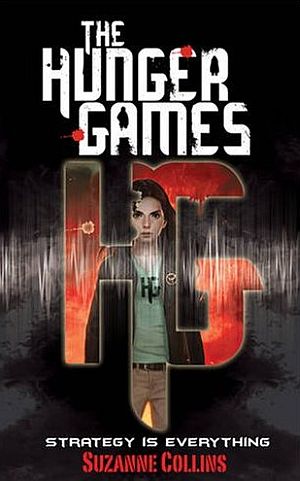 I don’t “do” literature much here: I used to read a ferocious amount, but time and opportunity have waned since I stop commuting by train to work. However, I got a Kindle for my birthday, and that spurred me to finish the first novel I’ve read in a long time. While I enjoyed Hunger, and am keen to see the movie version, I was not blown away by this as much I hoped. It’s certainly a provocative premise. In a dystopian future, the former US has been divided up into districts. To discourage rebellion, each year every district sends two teenagers, selected at random, to the capital. They are placed in a large, multi-terrain arena for a nationally-televised tournament to the death: last one alive wins glory and a life of ease. When her younger sister is selected in their District 12, Katniss Everdeen volunteers to replace her: she has been using her hunting skills to support her family, so feels she has a much better chance of survival. But it’s still one against twenty-three…
As noted above, it has often been compared to Japanese cult classic Battle Royale, even if Collins claims the legend of Theseus as her inspiration. Here, the “reality show” elements are definitely more amped-up, with contestant makeovers, interviews, etc. Once the competition is under way, is when the book is at its strongest. Collins does not soft-pedal things at all, as the field is quickly whittled down through a mix of brutality and subterfuge, and it becomes inescapably addictive, to see what curve is going to be thrown at Katniss next, and how she’ll cope with it. For cope she will, since she’s a resourceful, smart and physically adept heroine, a marvellous counterpoint to many alleged “heroines” offered up to young adults.
Unfortunately, there’s also the obligatory love triangle, with Team Gale [the hunting partner Katniss leaves behind] and Team Peeta [the baker’s son chosen as the other District 12 tribute]. How can she choose between them? For the early part of the book, this doesn’t intrude too much, but it eventually becomes the elephant in the corner, overshadowing all else. The pacing also blows: the finale should be the climax of the games, as the last few contestants battle it out, with a brief coda thereafter. But, instead, Collins ramps up the teen angst, and the novel peters out into an uncertain conclusion, ending not with a bang, but a whimper. I really hope I’m not in for more of the same in part two.
Author: Suzanne Collins
Publisher: Scholastic
True Grit
★★★½
“Forty years later, the Duke has become the Dude, with a small Duchess.”
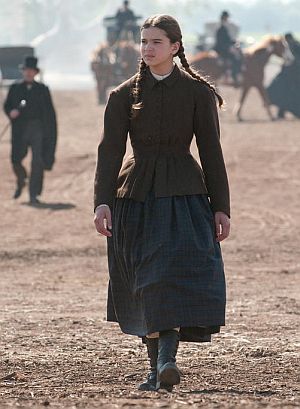 Based on the original source material – which was very much focused on John Wayne – and the trailers, you’d be forgiven for thinking of this as just another macho Western. However, I read some pieces which suggested that wasn’t the case, with the story [as in the original novel] told from the viewpoint of teenage girl Mattie Ross (Steinfeld), who hires drunken Marshal Rooster Cogburn (Bridges) to hunt down the outlaw (Brolin), who killed her father. That is indeed the case – despite Steinfeld getting an Oscar nomination for Best Supporting Actress, while Bridges was listed for Best Actor. Go figure.
For Ross is one of the most impressive teenage girl characters to appear in a recent Hollywood film, being resolute, smart, brave and resourceful: that’s clear from the scene where she completely out-haggles the businessman with whom her father had been dealing. You can almost imagine Mattie growing up to become Marge Gunderson in the Coen’s Fargo: there’s much the same dogged determination, in a form which causes those who oppose Mattie to severely underestimate her. More in tune with her age, I was also reminded of Lyra Belacqua from The Golden Compass, whose heroine also found herself with an unenviable task, and had to man girl up and get through it. Here, from the moment Mattie plunges into the river on her horse, while Cogburn and Texas Ranger LeBoeuf (Damon) watch from the far side, she’s in a completely different, alien world.
I was much less impressed with Bridges’ performance. Fair enough that he chose not to try and reproduce Wayne’s iconic role: however, the route in which he chose to do so is unfortunate, not least because it’s largely inaudible. He mumbles every line so badly, you’re largely reduced to picking words out where you can, and trying to work out what he said by the other characters’ replies. It’s only right at the end that he comes across as being much more than a drunken buffoon, and it’s difficult to fathom why Ross picked him rather than LeBoeuf, who projects a far more compelling air of confidence. With Wayne, there was a sense of faded, decrepit glory: Bridges’ version of Cogburn is less a has-been than a never-was.
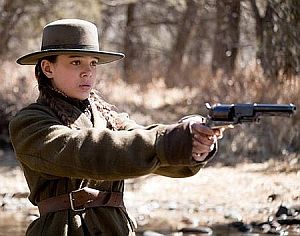 That said, there’s something refreshing about the way this is…well, not refreshing. By that, I mean there is little or no attempt to re-invent or “reboot” the Western genre: it’s lasted for approaching a century, so the basic tenets don’t really need changing. So while there are some understated moments of humour, e.g. the last words of the men about to be hanged, the focus is clear: Mattie and her goal of extracting justice on the man who killed her father. It’s a simple story, well told.
Dir: The Coen Brothers
Star: Hailee Steinfeld, Jeff Bridges, Matt Damon, Josh Brolin
Hanna
★★★★
“Jason Bourne: The Next Generation.”
 “What did your mother die of?”
“Three bullets.”
That matter-of-fact answer, provided by Hanna (Ronan) over dinner with a friend and her family, sums up the character perfectly. While Bourne was seeking to recover his identity, this 16-year old girl never had one to begin with. She was brought up in the wilds of Finland, hunting deer, learning languages and training in hand-to-hand combat with her father, Erik Heller (Bana); she knows nothing of music, for example. Eventually, she is deemed ready, and the switch is flipped on a transmitter, revealing their location to Marissa Wiegler (Blanchett), Heller’s former CIA handler, and putting the pieces into play. Turns out Wiegler and Heller go back to before Hanna’s birth, and he has been waiting all this time to unleash his daughter against the woman who played a very important part in her development. Wiegler captures Hanna, but she escapes, and makes her way from Morocco to Berlin, and the intended rendezvous with her father, Wiegler and her minions in hot pursuit.
I liked this a good deal. As well as Bourne, it blended in a lot of elements from traditional fairy tales. Wiegler is Hanna’s wicked stepmother (the dynamic between the pair is particularly interesting), and Bana like the hunter in Snow White who disobeys orders, refusing to kill her. Regrettably, at no point does Hanna hang out with any midgets, even cool ones like the Half-Pint Brawlers. But she certainly proves more than capable of handling herself physically, as is shown in her escape from custody: dealing with the rest of humanity…well, maybe not so much. There’s also more than a touch of Run Lola Run, with the heroine galloping round Berlin, accompanied by a banging techno score (here, by The Chemical Brothers).
It might have benefited from showing Hanna’s skills a bit more; there’s nothing quite as cool for her as the sequence where, in a single camera-shot, her father comes out of the station, goes into a Berlin subway and wipes the floor with four minions. However, it easily qualifies for inclusion here, and Ronan’s performance grounds this and gives it an emotional heart in a way not often found in the genre.
Dir: Joe Wright
Star: Saoirse Ronan, Eric Bana, Cate Blanchett, Tom Hollander
Sukeban Hunters
★★★½
“Love that alternate title: Yakuza-Busting Girls: Final Death-Ride Battle.“
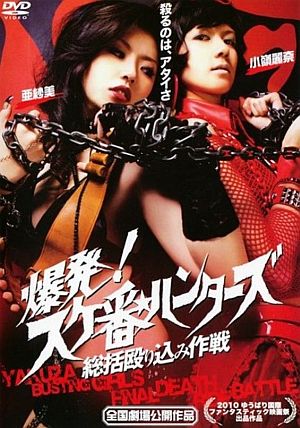 This teetered on the edge of a seal of approval, but didn’t quite make it. While there are some lovely moments, two great leads and the recreation of the pinky violence genre from the sixties and seventies, there’s just too much dead wood and pacing flaws, that leave it just short. Still certainly worth a look, with Asami (Asami) and Junko (Rena) going head-to-head as they battle each other for supremacy in the girl-gang world. Junko seems to have got the upper hand, leaving her rival buried for dead in the desert [or whatever passes for a desert in Japan]. But Asami is just warming up: she claws her way, literally, back from the grave, teams up with her old gang-members, and sets about extracting revengs on Junko and her crew.
The two leads are great, with Rena outstanding as a completely-warped boss. To give you some idea, when two underlings screw up, she doesn’t just make them cut off a finger. She pits them head-to-head against each other in digit removal – and the first one to refuse or hesitate, earns a bullet in the head. That’s what I call an incentive to avoid screwing up. She’s also a part-time dominatrix, who enjoys whipping a topless Asami with roses till she bleeds. That’s probably about as sleazy as this gets, and most of the time is more interested in the violence than the pinky, if you see what I mean; there’s a couple of decent extended brawls, as Asumi and her “sisters” take on Junko’s minions [I was initially confused by the sisterhood thing, until I worked out it seems to be a gang term, rather than blood relations].
On the other hand, as noted. some sequences brings things to a halt, most obviously a night-clun sequence which appears as much to be a promo for some band (probably a friend of the director), before going over to the always-popular, unconvincing transvestite assassins. The ending, too, goes on beyond what is necessary or effective, and the digital muzzle flashes are somewhat overdone. But don’t let that dissuade you from what’s a fun entry in the gang-girl genre, and I look forward to the promised second installment.
Dir: Nakadaira Kazushi
Star: Asami, Komine Rena, Motomiya Kenji, Sato Jiro
Geisha Assassin
★★★½
“Surprisingly decent, and much more assassin than geisha.”
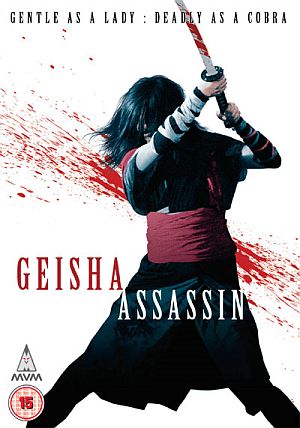 Taking a minimalist approach to its plot, particularly for the first hour, it’s about Kotomi (Tsukui), who is on a quest to find the man (Kanai) who was responsible for killing her father (Nomura), a samurai who wanted to leave his sklls to her. To reach the killer, she has to battle her way through a series of lower-level minions, such as a pack of ninjas, a monk and Pocahontas [ok, that might be a stretch, but honestly, that was my first thought on seeing her]. However, after she has fought her way past these henchmen and henchwomen, to reach the boss level, she discovers that things might not quite be the way she always perceived them.
After a series of Japanese films where it seems the experience most required by the lead actress involved modeling bikinis, rather than combat, it was pleasant to discover Tsukui appeared to know her stuff. This is apparent, because Ohara, for the most part, also knows his, keeping the camera an adequate distance from the action, and allowing the battle to flow across the screen without excessive edits. It’s particularly impressive in the fight between Kotomi and the monk, where one shot in particular is remarkable for its length, approaching early Jackie Chan levels. It makes sense that Ohara also worked on the action in Onechanbara, another solid genre entry.
It’s not without mis-steps: the lighting is occasionally crappy, and the film grinds to a halt at the end for a massive glob of exposition, just when it should be rolling out of control. This is significantly better when it keeps the whole “plot” and “acting” thing to a minimum, and concentrates on what it does best: Tsukui kicking ass in a wide variety of ways, ranging from surreal battles with zombie-like creatures who can detach their heads for use as weapons, or rolling around in the mud with Pocahontas. Which gives me an idea for an entirely new series of ‘Disney Princess’ movies, but I digress. Anyway, at a brisk 78 minutes, this doesn’t waste much time, and was certainly of unexpected quality and volume, as far as the action goes.
Dir: Go Ohara
Star: Minami Tsukui, Shigeru Kanai, Masaki Nomura, Nao Nagasawa
a.k.a. Geisha vs. Ninja
Lethal Angels
★★
“I preferred this the first time, when it was called Naked Killer.”
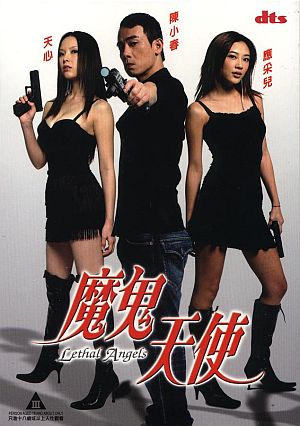 Winnie (Lee) has a grudge: against gang boss Bowen (Yuan) in particular, but also against just about any man who abuses women. She puts together a team of four underlings, such as Yoyo (Sum), whose family was killed by thugs, and uses them to take out anyone whose lustful desires overwhelm their common sense. Now, it’s time for the big one: Bowen. Winnie sends Yoyo in as an undercover nanny, to scope things out and obtain evidence of Bowen’s illegal dealings. However, once in, she finds out that Bowen is now largely reformed, and Yoyo also objects to Winnie’s plan to wipe out all of Bowen’s family, including his six-year old daughter. Meanwhile, she’s also being investigated by Jet (On), a cop who knew and almost dated her at college, and is on the case of the mysterious deaths of mob bosses at the hands of beautiful ladies.
This is just too restrained to work. There’s a striptease routine by one of the minor underlings at the start, but after that, it conspicuously fails to live up to its alternate title, of Naked Avengers. Lee is good value as the overlord, but if you think you’ve seen it all before, you probably have. Even the scene where one of the girls has to take on a chained pervert for training purposes is lifted, wholesale, from Naked Killer – except, rather than in a dungeon, it appears here to take part in a car-park or something. [There’s a prominent “keep left” sign in the background, whose looming presence reminded me of nothing more than the ending to a Monty Python sketch]
The action occasionally has its moments, but rarely gets above competent, and it’s only in the final battle, where the schisms in the group fracture and send it on a path of self-destruction, that things become somewhat interesting, and it’s a case of too little, too late. Instead, there’s too much time spent on Jet, who is a waste of space and screen-time, and his lacks of charisma means his relationship with Yoyo has as much chemistry as…as… a thing that doesn’t contain any chemistry. Man, I hate it when a simile falls apart, half-way through. Or is it a metaphor? That I was pondering such grammatical issues during the viewing, probably tells you more about the film than anything else. If there’s a single way in which Naked Killer isn’t clearly better, I think I missed it.
Dir: Steve Cheng
Star: Tin Sum, Andy On, Jewel Lee, Yuan Yuan