



★★★
“Not as good as the book. There. I said it.”
 Ok, it has become the biggest-grossing action heroine film ever at the US box-office. So there’s that. But truth be told, it’s not actually all that good. Sure, it’s impressively-staged, and Lawrence does very well with a role. But there are a number of problems, even as it follows the great majority of the novel. If you’re not aware of the plot (and didn’t read our book review!), I’ll summarize. In a future dystopia, every year the 12 districts in the US submit a teenage girl and boy to the capital, where they battle to the death in a televised spectacle. This time, the resourceful hunter Katniss (Lawrence) volunteers, after her younger sister is selected; she and her male counterpart, baker’s son Peeta (Hutcherson), have to go into battle with the other 22 contestants knowing only one can survive.
At 142 minutes, it’s likely too long, especially as almost the first half is taken up with the pre-game activity, which is distinctly low in thrills. Even once the games start, the action quotient is fairly low, with Katniss seeming do a lot more creeping around on her own. That’s fine in a book, which can fill things up with internal monologue, but it’s not the case in a movie. And what action there is, is badly-shot to the point of utter confusion. There were also a couple of changes from the book that weakened it: the rule change in the middle seemed more of a convenient deus ex machine than in the novel, where it flowed naturally from the Katniss/Peeta alliance, and the genetically-engineered creatures which appear at the end originally were described as being created to look like the fallen competitors, a marvellously horrific touch. In contrast, the movie doesn’t add all that much, in style or content.
On the plus side, I did enjoy Lawrence, who creates exactly the sort of strong, resourceful heroine we need more of, in all media. Unlike certain young adult book series I could mention, she doesn’t seek or need male approval or assistance. In fact, Peeta is basically a wuss, who would be dead without someone stronger to whom he can attach himself – it’s a beautiful bit of role-reversal. I also enjoyed a lot of the supporting characters, particularly Harrelson as the former winner turned alcoholic mentor, and Stanley Tucci as the TV interviewer who, I suspect, is much smarter than he seems. We should also remember that this is the first part of a trilogy, so probably needs to engage in more scene-setting. We’ll see whether the rest of the series can deliver a better handle on the action, while sustaining strong elements, such as the excellent lead.
Dir: Garry Ross
Star: Jennifer Lawrence, Josh Hutcherson, Liam Hemsworth, Woody Harrelson
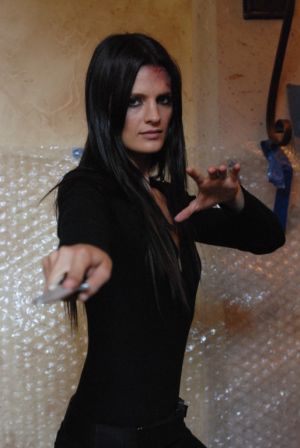 Two gangsters are having a discussion in a sauna, when they are brutally attacked by Raina (Katic), the former girlfriend of one. The Mexican is almost decapitated; the other, Greek mob boss Virgil Vadalos (Berenger) is gutted, but survives. He vows to track down his ex-squeeze and unleashes his forces to do so. They include the near-psychotic Lee (Biehn), who has just returend from London with an even more insane sidekick, plus dirty cop Beck (Sloan), who owes Vadalos a favour, and is involved in the investigation from the inside. Keeping those aspects separate becomes more difficult, as the waters become increasingly muddied as more bodies show up, murdered with the titular weapon, the Mexican’s colleagues plot their own revenge, and there’s also the tricky matter of several million dollars in cash which has gone missing.
 Cherry (Julin – yep, that appears to be her surname) is a stripper, whose life takes a turn for the worse when she is assaulted by five customers in a private room at the club where she works. The cops aren’t able to do anything, so she takes the law into her own hands, with the help of her brother (Rodriguez), who accidentally kills one of the perpetrators when he goes to demand help with Cherry’s medical bills – no prizes for guessing how that request goes. As the others realize someone is out to get them, and who that someone ins, they hire Bull (Hackley), a gigantic hitman, to stop Cherry before she gets to them.
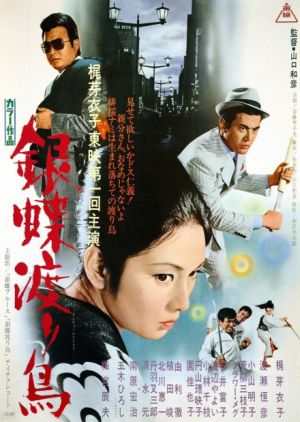 Nami is sent to jail for killing a Yakuza boss, and when she is released, returns to the Ginza district of Tokyo to live with her uncle, who runs a pool hall. She gets a job as a hostess in a bar, with the help of her new friend Ryuji (Watase), but the quiet life doesn’t last for long, even as she tries to help the widow of the man she killed – whose petition on behalf of Nami is what helped lead to her early release. For the local mob, in the shape of Okada (Nanbara) and his gang, are sniffing around the bar, seeking to take it over. To settle things, Nami offers to take on Okada’s champion at billiards, a challenge the gangster readily accepts, not realizing he has just been hustled, and that Nami is no mean player herself. Can she win – and even if she does, will Okada live up to his side of the bet?
 Cassie Naylor (Wareing) is struggling to keep her head above water on the farm she’s now running almost single-handed, eight months after her husband vanished. What the locals don’t know is that she buried him in a remote spot on the Derbyshire moors, with the help of part-time farmhand Cooper (Bradley), for reasons not initially clear. The arrival of a transient, Aden (Regan, looking not unlike a rougher version of Gerard Butler), seems like a godsend, and they agree he can work in exchange for food and lodgings. However, it’s not long before Aden’s less-desirable tendencies start to show through. While he’s fiercely loyal – dispatching anyone whom he perceives as a threat – he seems to regard Cassie and her two daughters as “his” family, and seems to know rather too much about them.
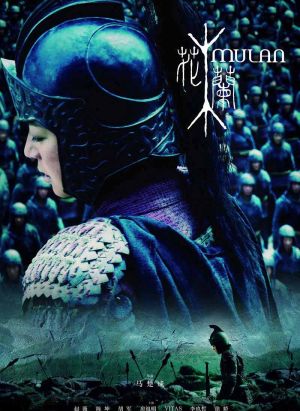 Inspired by the same poem as Disney’s much-loved feature, this has the same basic idea – a young woman impersonates a man in order to save her father from being drafted in the army. However, this takes a rather different approach, being much darker in tone, not that’s this is much of a surprise, I guess. It’s also a lot longer in scope, with Mulan (Zhao, whom you may recognize as the heroine/goalkeeper from Shaolin Soccer), rather than fighting a single campaign, becoming a career soldier and rising through the ranks as a result of her bravery in battle, eventually becoming a general, tasked with defending the Wei nation from the villainous Mendu (Hu). He has killed his own father in order to take control, and has united the nomadic tribes of the Rouran, amassing an army of 200,000 to invade Mulan’s home territory. She comes up with a plan to lure him into a trap, but when she is betrayed by a cowardly commander, things look bleak indeed for Mulan and Wentai (Chen), one of the few who know her secret.
 Five mountaineers are exploring the remote Scottish highlands, when they stumble across an underground box containing a terrified, near-dead young girl who speaks no English. Two of the party are sent, by the most direct but not child-friendly route, back to civilization to get help, but it’s not long before they discover the parties who buried the girl are not too happy with her removal. For they are two kidnappers, Mr. Kidd (Harris, who also plays a psychotic killer in The Borgias) and Mr. McRae who are negotiating with her father’s emissary, Darko (Roden) to pay the ransom, not aware that Darko has hired some ex-soldiers to resolve the matter. Having lost the child, the pair set out to recapture her, and don’t care how many bodies are left in their wake.
 In the near-future, Japan is plagued by “engineers” – criminals who have voluntarily undergone genetic modifications, which not only mutate their bodies in bizarre ways, but give them near superpowers and the ability to sprout weapons from their wounds. To combat this, the privatized Japanese police force under their chief (Benny) has an absolutely no-holds barred policy of shoot first, ask questions… Well, don’t bother asking questions. Their top “engineer hunter” is Ruka (Shiina, whom you may recognize from Audition), the daughter of a police officer who was killed in the line of duty while she was just a young girl. She is tracking down the scientist behind the engineers, known as “Key Man” (Itao) because of the key-shaped tumours which trigger the mutations. But when they meet, he infects her – and also reveals the truth behind the deaths of both their fathers.
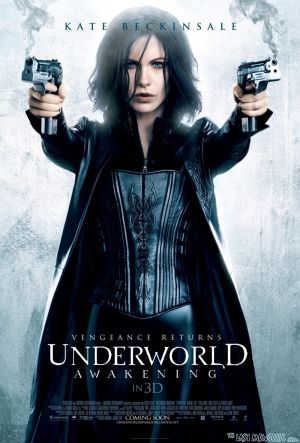 Actually, we quite enjoyed the third part, but we’re Bill Nighy marks. Still, nice to get back to the basics mentioned above, and the storyline here was a good one, even if more than a tad reminscent of Ultraviolet. After the revelation that vampires and lycans exist, humanity goes on a pogrom against the two species, driving them underground. Selene is captured, and wakes up to find herself, a dozen years later, in a wrecked research lab. Initially, she suspects Michael Corvin, but discovers a young girl, Eve (Eisley) to whom she has a connection; turns out to be another vampycan hybrid. Research company Antigen, under Dr. Jacob Lane (Rea) were using the two of them to make a vaccine, until Eve escaped, freeing Selene, and are now desperate to get their subjects back. But are their motives quite as altruistic as they appear?