




★★★
“High-quality torture porn”
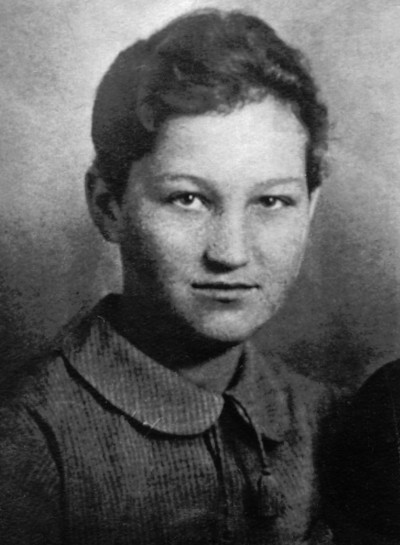 This was originally made under the working title of The Passion of Zoya, and the Joan of Arc reference is on point. Both were young warriors fighting against the occupation of their native land, captured by the enemy and tortured before being executed. But they became a rallying point for their country as it succeeded in expelling the invaders, and are now revered as national heroines. The real Zoya Kosmodemyanskaya (pictured) was an 18-year-old teenager in 1941, who signed up to be dropped behind the front-line as the Germans invaded Russia, and carry out missions of sabotage intended to make life difficult for the Nazi army. It did not end well, but she became the first woman Hero of the Soviet Union in WW2, less than three months after her death.
Unsurprisingly, the facts are a bit murky, with the regime at the time intent on making a heroine of her, who could be used for propaganda purposes. [There was another film of the same name made in 1944, to that end. It’s on YouTube; I need to find subtitles before I can review it] This was criticized on its release for historical inaccuracies, but most of the events match the Wikipedia page, at least. There is perhaps artistic license over her motivation, signing up after her fiancé was killed in action. Whether her capture was triggered by the betrayal of a colleague in the sabotage cell, Vasily Klubkov (Kologrivy), or the betrayal was after her capture, as depicted here, I don’t know.
As ever, I’m here for the cinematic experience, not a documentary. As such, it’s well made, though concentrates to such an extent on her post-capture experience that it seemed to border on the exploitative. The lengthy sequence where Zoya is stripped and whipped, is the most obvious example, and her stoicism as she refuses to give up any useful information makes things worse. Perhaps the most interesting character beside Zoya is Hauptmann Erich Sommer (Cerny), who seems to feel for his captive, explicitly ordering the troops under his command to refrain from abuse. Not that they necessarily obey. I likely was more impressed by the earlier stages, depicting Zoya’s training and her activities behind enemy lines, which are tense and well-assembled.
There’s no doubt she was being positioned as a heroine, from the first reports of her death in state newspaper Pravda [which included a gnarly, NSFW photo of her corpse]. This feels like it’s trying to do the same thing, right up to her defiant speech on the scaffold: “Comrades, beat the Nazis. Burn them! Poison them! There’s 200 million of us, you can’t hang us all.” I imagine that would have had the intended effect in 1942, of inflaming patriotic anger and willingness to fight. But I can’t say I was particularly moved, with my main reaction to Zoya’s death being relief that her torment was over. More depth and less torture would have been preferable, I’d say.
Dir: Maksim Brius + Leonid Plyaskin
Star: Anastasia Mishina, Nikita Kologrivy, Wolfgang Cerny, Darya Jurgens