




★★★
“No business like snow business.”
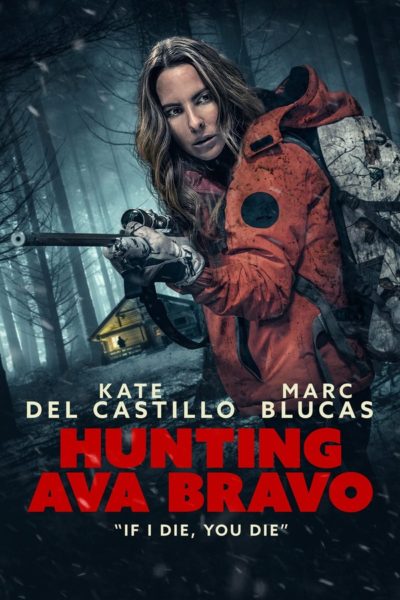 I do admire a film which does not hang about, and this certainly qualifies. We begin with Ava Bravo (del Castillo) removing a hood to find herself in a very remote, snowbound mountain cabin. A cassette player nearby has a message. She has been abducted by Buddy King (Blucas), a millionaire with a fondness for kidnapping trauma survivors and hunting them through the wilderness. There’s a snowmobile parked five miles North, if she can make it across the winter terrain there. To make it fairer, Buddy has only three bullets for his gun. Oh, and he’s going to be coming up from the basement in ten seconds. Safe to say, this is the kind of start that grabbed my attention.
It does have some trouble living up to it, with rather too much slack in what follows, even if the running time is under 80 minutes. Things do unfold largely as you’d expect, in what’s another variation on the ever popular Most Dangerous Game concept. Seriously, there have been so many now, I feel I should add a tag for that subgenre. So, we get Eva getting the drop on Buddy, only to find his cassette message was not entirely truthful, and she needs to keep him alive if she wants out. The rest of the film is a struggle between the two of them for dominance, and we learn a little of their histories and what makes them tick.
It probably needs some tighter plotting, e.g. a third party (Medina) turns up when needed by the plot. Though this does get explained, it wasn’t entirely convincing. I have… questions. Let’s leave it at that. This also applies to the ending, where Eva’s geographic knowledge suddenly seems considerably better than it was. However, this is made up for with a decent pair of lead performances, and some sequences which are effective and tense. Del Castillo should be known in these parts as the star of La Reina Del Sur and Ingobernable. This is a bilingual performance, with a chunk of unsubbed Spanish, though it’s mostly cursing. [Sometimes having a wife of Cuban extraction has its benefits. I’m now fairly fluent in certain phrases you won’t learn on DuoLingo…]
This does come to play in what’s likely the tensest scene. Ava and Buddy stumble across two Hispanic hunters, leading to them both trying to convince the hunters that the other is the dangerous psycho. He has the bruises to support his case, and she is carrying the gun. However, she has the language advantage. It’s a well-written, performed and staged sequence, and shows where the film could perhaps have gone. Moments like this were enough to get me over the less interesting bits of chit-chat, though Ava’s matter-of-fact description of her previous abduction and escape is chilling in its understated nature. If it’s all too uneven to be wholeheartedly recommended, I felt there was enough here to justify its existence.
Dir: Gary Auerbach
Star: Kate del Castillo, Marc Blucas, Halem Medina
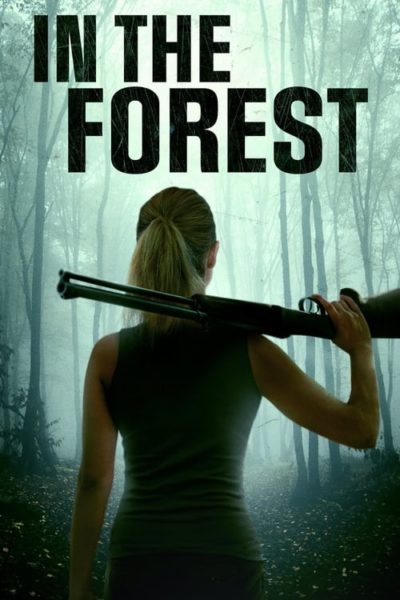 Three generations of a family take a trip into the woods in their mobile home. There’s grandfather Stan (Ward), his somewhat neurotic daughter Helen (Ayer), whose life has been falling apart around her, and Helen’s teenage daughter, Emily (Spruell), for whom a weekend in a forest with old people is
 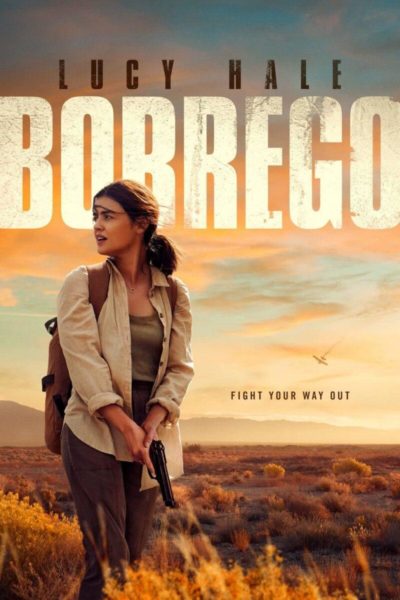 Sorry, couldn’t resist it. For the recent string of suboptimal Netflix movies continues with this tedious bit of work, which feels like the first journey across the South Californian desert filmed in real time. It begins with Ellie (Hale), a botanist carrying out a survey near the Mexican border. She meets a teenage girl, Alex (Trujillo), who is skipping school and the two have an awkward conversation. I initially thought its stilted nature was intended to tell us something about the two characters, but nope. All the conversations here are awkward. Writer-director Harris just has no ear for dialogue, which may explain why so much of this is people wandering about instead.
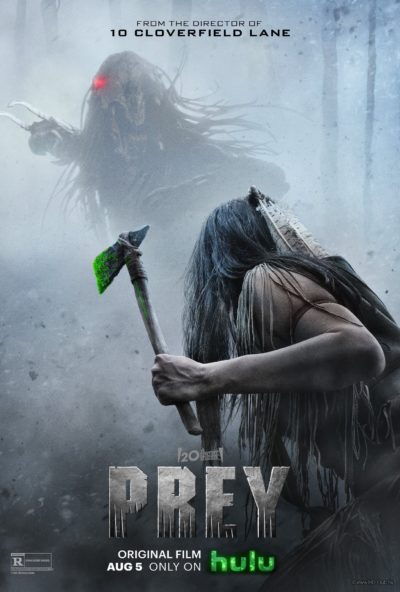 The latest entry in the Predator franchise has resulted in sharply divided opinions, partly for reasons that I’m not even going to get into. And, for roughly the 11th millionth time, the reality lies somewhere in the middle. It is probably the best entry in the franchise since Predator 2. However, let’s be clear: Sharktopus vs. Whalewolf would also satisfy that criteria. So, let’s dig in. The year is 1719, and the Northern Plains see a new arrival, in the form of an extraterrestrial visitor, looking to test its mettle against any species unlucky enough to cross its path. They could be animal, or human – the latter include both French trappers and the local Comanches.
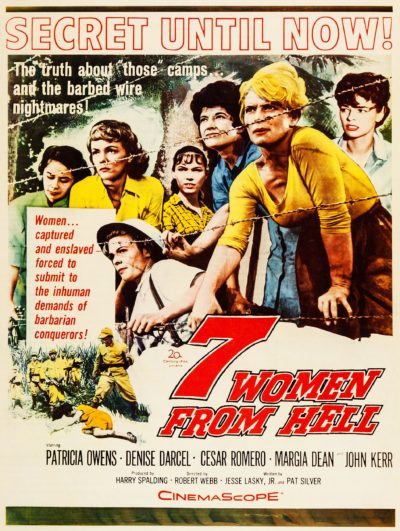 About the only review online I found for this, said it “may be the worst movie released in 1961.” I can only presume the writer of that statement has never seen The Beast of Yucca Flats. Even if I admit its weaknesses, Seven is nowhere near the same league of badness. Indeed, it starts off well, depicting the sudden invasion of Papua New Guinea by Japanese forces in 1942, with “enemy” civilians being herded into interment camps. The ones on the women’s side are a multi-national bunch, including Australian Grace Ingram (Owens), several Americans including Janet Cook (Craig), a German widow Ann Van Laer (Sylvia Daneel), Frenchwoman Claire Oudry (Darcel), and mixed-race nurse Mai-Lu Ferguson (Pilar Seurat).
 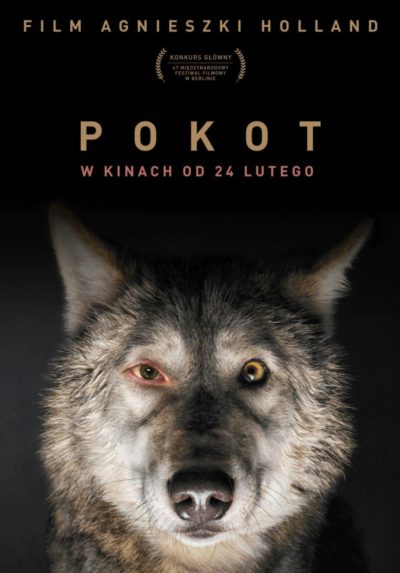 Janina Duszejko (Mandat) is a former engineer, who now lives in a small rural Polish town. She has a deep love of nature and animals. This is a belief not shared by many of the local population, who treat animals as a resource, put there for their benefit – an attitude which brings them into conflict with Duszejko. After her two dogs disappear, she goes to the authorities, but they blow her off. However, the man she suspects most, turns up dead – just the first in a series of mysterious deaths, that may be related to Jaroslav Wnetzak, a local businessman with a finger in a number of shady pies. Subsequent corpses include the police chief, who owes Wnetzak money.
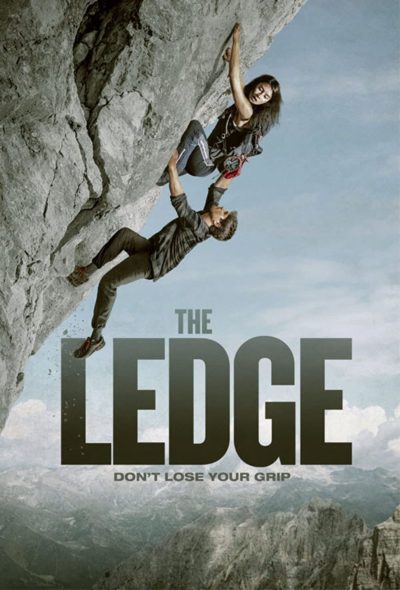 Despite the above, there are some strong positives to be found here. First off, the Serbian mountain landscapes are beautiful, and the cinematography does them justice. Free climbing, the focus here, is an innately tense pastime, with the risk of serious injury or death present at any second. Again, the photography gets this over well, with some of the shots capturing the heights involved, to the point of almost inducing vertigo in the viewer. Finally, Ashworth is entirely convincing in her portrayal of free climber Kelly. She has the right, well-defined physique, muscled particularly around the shoulders, and exudes a quiet confidence in her own abilities, which is what you would expect. That’s the good news.
 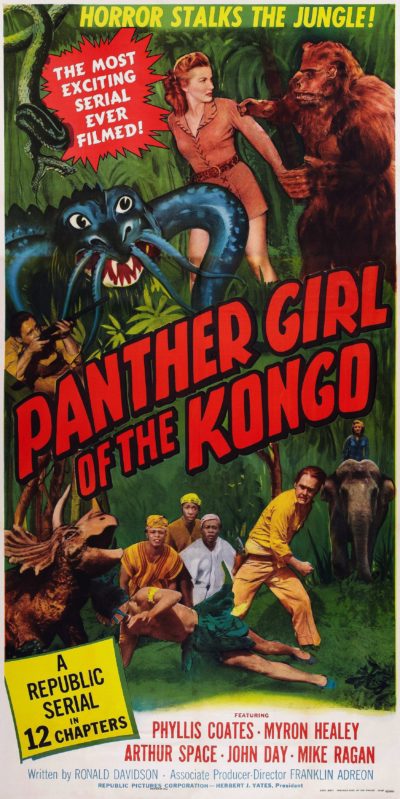 This was the second-to-last of Republic’s sixty-six serials and, to be honest, it shows. Having watched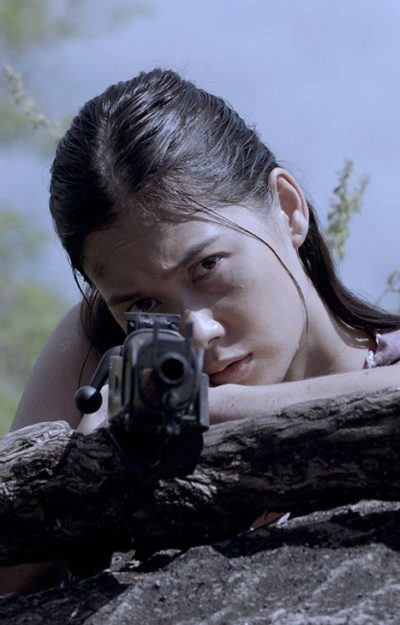
 The heroine here, Mariano (Salvador), has to count as the baddest bitch I’ve seen in quite a long time. In terms of being a sheer, unstoppable force, she’s right up there with Jen from
 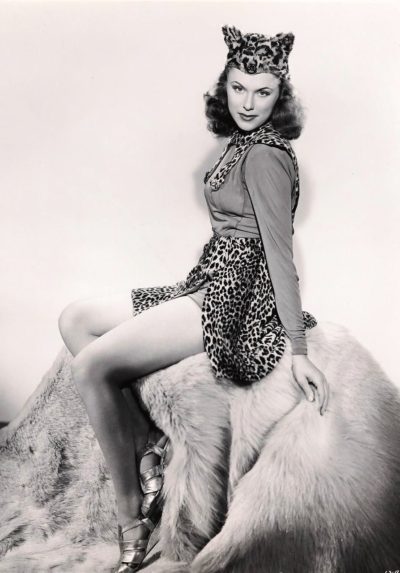 As mentioned, we’re in South America, where two competing oil companies are seeking to establish their territory. The Inter Ocean Oil Company are the current occupants, and have been working in association with the indigenous population, under their white queen (Stirling), known as the Tiger Woman. But if they don’t strike oil soon, their franchise will expire. A predatory, far less friendly (but unnamed) company, is standing by, to make sure that doesn’t happen, allowing them to take over. But Inter Ocean has sent top troubleshooter, Allen Saunders (Rock Lane), to work with the Tiger Queen and block their enemy’s attempts. Those get more desperate as the deadline approaches and Inter Ocean appear to be succeeding. Complicating matters is the Tiger Queen’s original identity as missing heiress, Rita Arnold, something her enemies want to use to their advantage.