
Fountaine and the Vengeful Nun Who Wouldn’t Die

★★
“Jack of all trades, master of nun…”
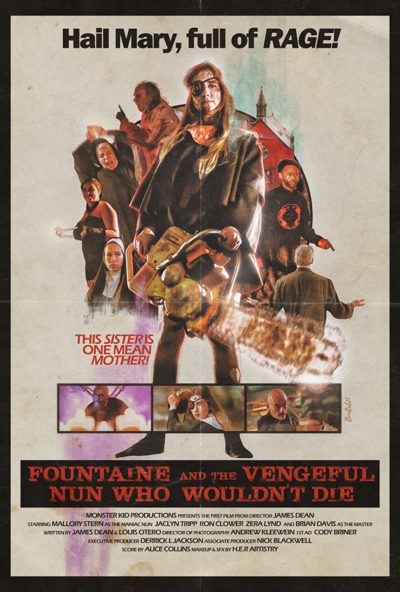
You will probably understand why the title more or less rocketed to the top of my watch-list, especially when accompanied by the poster (right). Naturally, it was almost inevitable that it could not possibly live up to either: the question was mostly, how far short it would fall. The answer is, “a fair bit, yet not irredeemably so,” even if the first half if considerably duller than I wanted. Indeed, it’s also rather confusing, in terms of what’s going on. As well as I can piece things together, Mary (Stern) is a nun who gets sent to an asylum after losing her sister, though it turns out to be less a mental-care facility than you’d expect.

There, she meets and falls for another nun, Lee (Tripp), and the pair escape. Mary eventually falls in with a vigilante group, intent on taking down the criminal empire of Fountaine, while Lee is abducted by the same group. With the help of trusty sidekick Sam (Clower), who was also Lee’s adopted brother, Mary acquires the set of special skills necessary, in addition to a fetching zebra-striped eye-patch and a very pointy Samurai sword This leads to storming Fountaine’s headquarters, in order to rescue her love. I think that hits most of the main points, though I accept no responsibility if I’m wrong. To be honest though, this is not really plot-oriented, being a collage of elements from exploitation cinema over the last fifty years.

The most obvious influence is probably Kill Bill, which was itself a patchwork assembly, so we’ve got to the point where exploitation cinema truly is eating itself. The other angle is clearly the nunsploitation genre of sinful sisters, though it has to be said, this is remarkably chaste in comparison. I think there is only one pair of breasts and zero full nudity in the whole thing, a tally at which Jess Franco would laugh patronisingly. It isn’t even close to being the first “retro grindhouse” entry that harks back to the style, trailing a decade behind both Nude Nuns With Big Guns and the recently reviewed Sister Wrath (a.k.a. Nun of That), the latter in particular doing a better job at being more than a third-gen photocopy of the genre.

Instead, it concentrates on the violence, though to mixed results. When it concentrates on practical effects, it’s not bad and occasionally reaches impressive. However, bad CGI is something you would never have seen in the seventies, and its presence here is equally unwelcome and unsatisfactory. The other problem is the lead actress falling short of the charismatic heroines in the films which inspired this. Pam Grier. Tura Satana. Dyanne Thorne. Meiko Kaji. Christina Lindberg. Stern will not be joining them in the pantheon of greats any time soon. And good retro grindhouse is capable of being entertaining, even if you have no knowledge of the genre’s history. I’m rather less than certain that’s the case here.

Dir: James Dean
Star: Mallory Stern, Ron Clower, Jaclyn Tripp, Zera Lynd
Sister Wrath

★★★½
“Nun-conformist”

I think it’s safe to say you’ll probably be able to decide within a few minutes, whether or not this is your cup of tea. The opening scene is set in a strip-club where the next act on the main stage is dressed as a nun. After a couple of minutes, she pulls out an unfeasibly large weapon from under her clerical garb, and guns down the mobsters present, in gory fashion. Thereafter, you can expect more of the same, along with extremely savage jabs at organized religion. Catholicism is the main target, but Judaism and Hinduism get their share of jabs: for example, Gandhi is a martial arts teacher. Or there’s a Yiddish hitman, Viper Goldstein (Lavallee), who practices the art of “Jew Jitsu”. If you just roll your eyes at that, this is likely not for you. However, if you roll your eyes and also laugh, then you, like me, may be the intended target audience.
The heroine is Kelly (Nicklin) an aspiring nun with a bad temper, who ends up enrolled, not entirely willingly, in the Order of the Black Habit – though surely Order of the Bad Habit would have been an even better name? Whatever… They are a group of fighting nuns, each named after one of the seven deadly sins. Unsurprisingly, Kelly becomes Sister Wrath, and joins her colleagues, such as Sister Pride (Cipolla), in taking down the criminal empire of Momma Rizzo (Tretheway, shamelessly channeling Shelley Winters in Bloody Mama). Momma isn’t going to sit back and let that happen, however. After her own goons prove not up to the task of taking on the Black Habit, she brings in Goldstein and his Ninja Throwing Stars of David, to escalate the war. With the help of a mole inside the church, he kidnaps Sister Pride, in order to lure Wrath and the rest of the nuns into a trap.

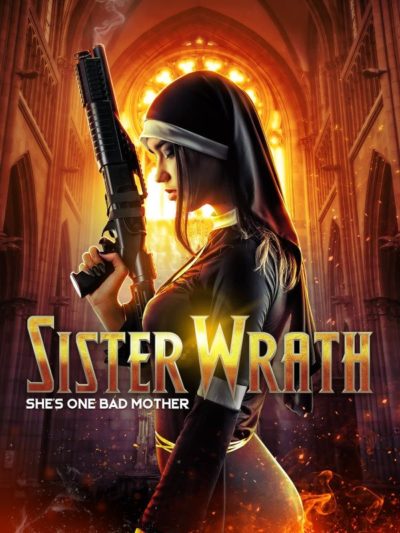
There’s a lot of glorious invention here, not least the remarkably catchy musical number in heaven, which rivals the one at the end of Monty Python’s The Meaning of Life. [In one of the film’s rare subtle moments, the same actor is here playing both Jesus Christ and the Devil] It’s gory and foul-mouthed, though for whatever reason, remains remarkably chaste: the stripper in the opening scene is wearing pasties. Likely only a lack of the necessary gratuitous nudity prevented this from getting a seal of approval, because the rest of it is right in my wheel-house of poor taste. Cameos from Debbie Rochon and Lloyd Kaufman – again, if you don’t know who they are… – only add to the sense of fun. The latter plays the Pope, who shows up late to absolve everyone of their sins. If not quite reaching the dizzy heights of post-grindhouse classics like Hobo With a Shotgun, it’s one of the rare cases where a B-movie genuinely lives up to the promise of its poster.

Dir: Richard Griffin
Star: Sarah Nicklin, Alexandra Cipolla, Rich Tretheway, David Lavallee Jr.
a.k.a. Nun of That

Go For Broke

★★½
“The Seven Schoolgirl Samurai”

I have so many questions about the Japanese education system after watching this. It takes place in a high school whose student council is repeatedly being squeezed for extortion money by the Yagyu, a local biker gang. They ride up to the place, beating up and terrorizing the students, and generally making a nuisance of themselves. Where, exactly, is the principal when all this is going on? Teachers? Concerned parents? There is a throwaway line about how reporting things to the police would only make the gang attack harder. But you’d think some adult might notice and want to get involved? Mind you, outside of their chosen mode of transport, the gang themselves are largely indistinguishable from pupils, except for perhaps having slightly longer hair. Apparently in Japan, collar-length hair is like wearing a jacket with a Hell’s Angels patch.
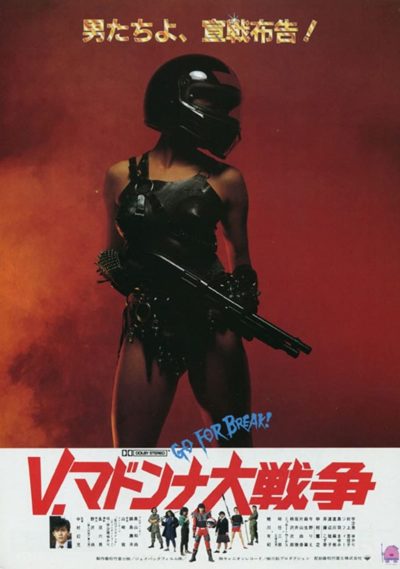
Fed up with all this, the council hire a yojimbo or bodyguard – explicitly referencing The Seven Samurai as they do so. To the council president’s surprise, this is Saeka Agawa (Usami), a bit of a delinquent herself. She recruits a number of her female friends, including a joshi pro wrestler and a stunt-woman. Under the guise of a “music club,” they train the pupils in the fine art of school self-defense, and successfully repel the Yagyu. However, the gang don’t take defeat easily, and this is where things get complicated, because it turns out that Saeka has previous history with Leopard (Ninagawa), the woman who runs them. They retaliate with a kidnapping, demanding both money and that Saeka stay out of their business, pushing the council’s resolve close to breaking point. However, Saeka insists they stay the course, setting the stage for a final battle, as both sides marshal all their resources into a winner-takes-all conflict. I should mention this includes the pupils driving around campus in a van converted to use both artillery and a flamethrower. Once again, where are the adults?

Sadly, it’s not nearly as much fun as the above scenario may sound. It’s the kind of thing which echoes the classic pinky violence scenarios. Yet despite what the poster may suggest, instead of being uncompromisingly for mature viewers, there’s hardly anything in here which would push it above a PG rating. That’s when you can see anything at all, with Nakamura being far too fond of backlighting and smoke for the film’s good, though he does manage a number of stylish shots. Also of note, both the dialogue and a canonically eighties pop song on the soundtrack echo the poster by saying “Go for break”, which annoyed me much more than it realistically should. At north of 105 minutes, it definitely drags at point, and few of the “samurai” beyond Saeka are given even the slightest bit of development. It’s the kind of film I’d love to see remade by someone like Takashi Miike or Sion Sono, who could bring out the undeniable potential, which this version mostly leaves on the table.

Dir: Genji Nakamura
Star: Yukari Usami, Kozue Saito, Yuki Ninagawa, Rikako Murakami
a.k.a. V Madonna: War

Take Back the Night

★★★
“A girl walks home at night…”

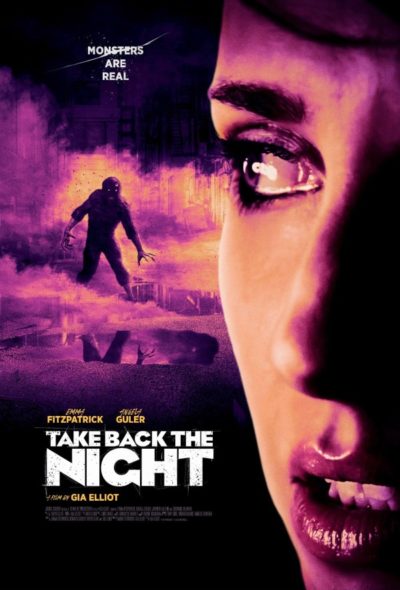
This is not exactly subtle in terms of its messaging, or the underling metaphor. But to be honest, I kinda respect that. I’d probably rather know what I’m in for, from the get-go, rather than experiencing a film which thinks it’s going to be “clever”, and pull a bait and switch. Here, even the title makes it obvious enough. The ‘monster’ here is sexual violence, and should you somehow make it through the film oblivious to that, you’ll get a set of crisis helplines before the end-credits role. However, it manages to do its job without becoming misanthropic, largely by having very few male speaking characters, and is adequately entertaining on its own merits, not letting the movie drown in the message.
Up-and-coming artist Jane Doe (Fitzpatrick) is savagely attacked one night outside the warehouse where she’s having her show. Though she reports it to the police, the investigating detective (Lafleur) comes increasingly to the conclusion that Jane is making up the story. This is partly because of her history of petty crime, substance abuse and hereditary mental illness; partly because what Jane describes, rather than a conventional attacker, is a monstrous, smoky and fly-blown apparition. Nor is Jane’s sister (Gulner) exactly supportive, even after the creature returns, looking to finish what it started. Jane discovers an underground network of survivors, and lore stating that only a bronze dagger, forged by a hunter, can hurt it. Fortunately, as an artist, she has a very particular set of skills…

The makers have made some interesting, and rather brave choices. Jane is the only character with a name, and she’s not exactly relatable in a conventional sense. I found it easy to dislike her influencer ways – she seems happiest when telling her sister of an upcoming TV interview about her ordeal – or the random sex she has minutes before the attack. One element of the message is very much that none of this makes Jane ‘deserve’ what happens to her, though the film ignores the counter-argument that when our actions have negative consequences, we can’t deny entirely our own responsibility. You go swimming with sharks, you might end up losing a limb.

There are points which do require the audience to stretch their disbelief more than the grounded tone of this should need. I’d also have liked to hear more about the network. Indeed, the film feels like it finishes just when it should be starting. An entity more interested in entertainment might have compressed what we get here into the front thirty minutes, and developed the notion of a crypto-cult of female vigilante warriors battling these creatures, with their bronze daggers from the shadows. That would, however, likely have diluted the message here and, make no mistake, that is what matters most to the film-makers. Regular readers will be well aware of my problems with cinematic soapboxes. While this does not avoid the resulting pitfalls entirely, nor is it a complete failure like some I’ve endured, and is certainly watchable. 

Dir: Gia Elliot
Star: Emma Fitzpatrick, Angela Gulner, Jennifer Lafleur, Sibongile Mlambo

Spoor

★★★
“Call of the wild”

Janina Duszejko (Mandat) is a former engineer, who now lives in a small rural Polish town. She has a deep love of nature and animals. This is a belief not shared by many of the local population, who treat animals as a resource, put there for their benefit – an attitude which brings them into conflict with Duszejko. After her two dogs disappear, she goes to the authorities, but they blow her off. However, the man she suspects most, turns up dead – just the first in a series of mysterious deaths, that may be related to Jaroslav Wnetzak, a local businessman with a finger in a number of shady pies. Subsequent corpses include the police chief, who owes Wnetzak money.

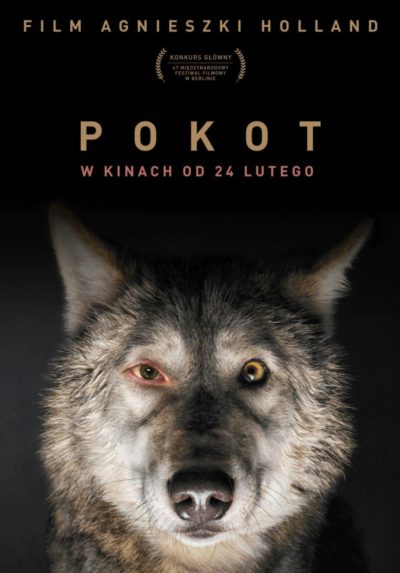
With the help of Dyzio (Gierszal), an IT consultant working for the police, Duszejko is able to investigate things. She also begins a romantic relationship with visiting Czech entomologist Boros Schneider (Krobot), after he discovers Wnetzak’s body in the forest, months after the businessman had disappeared. Things come to a head when Duszejko is arrested following the death of the mayor, having been the last to have seen him alive. But what exactly is going on? Is this those shady business dealings gone wrong? Or are the animals taking revenge on those who have hunted them? While I can’t say much more, you can probably get some kind of hint to the situation, simply from the fact that it’s being reviewed here. And perhaps the poster.

Holland is a veteran director, with over 40 years of features in her native Poland, plus episodes of US shows including The Wire, The Killing and House of Cards. You can tell, since this is confident and assured, as well as providing some truly beautiful and atmospheric shots of the countryside, imbuing it with a mystical quality. Animals loom out of the mist, almost like prehistoric creatures [hey, wild boar were driven extinct in Britain during the 1600’s], and the humans may not be that much more evolved. The lines are deliberately blurred at a couple of points, such as in Wnetzak’s brothel, where the women are dressed as cats, bunnies, etc. or at a costume ball which Duszejko attends as the big, bad wolf.

She makes an interesting character: clearly smart, yet her fierce devotion is certainly a weakness, and perhaps her undoing, especially when the police, etc. blow her concerns off.  However, at 128 minutes, there feels too much slack. The subplot involving the entomologist in particular, seems to bring things lurching to a halt in the middle, just when the mysterious deaths ramp up, and should begin driving things forward. I’d have moved this element towards the beginning, part of establishing Duszejko’s character. It doesn’t serve any essential part in the main plot, requiring it to be in the position where it takes place. However, the majority of the film still works, and represents a thought-provoking and well-crafted entity for the majority of its length, that does a decent job of mixing in its message.

Dir: Agnieszka Holland
Star: Agnieszka Mandat, Patricia Volny, Jakub Gierszał, Miroslav Krobot

Mistress Killer

★★★
“Mistresses cannot be exterminated!”

To my surprise, when I begin researching this film, it appears actually to be based – at least, somewhat – in reality. I give you this story from 2016. “Zhang Yufen, 58, is known in Henan province, as the “Mistress Killer” for her unusual hobby, which involves spying on her clients’ partners before confronting their lovers in public with vicious and humiliating attacks. She set up her agency, the Alliance Against Mistresses, in 2003 after her own husband admitted to having to having an affair in the 90s and left her and her son for his lover, clearing their joint bank account after 16 years of marriage… She receives around 100 calls a week in her mission to “ruthlessly exterminate those men” — and says police turn a blind eye to her assaulting other women in public.”
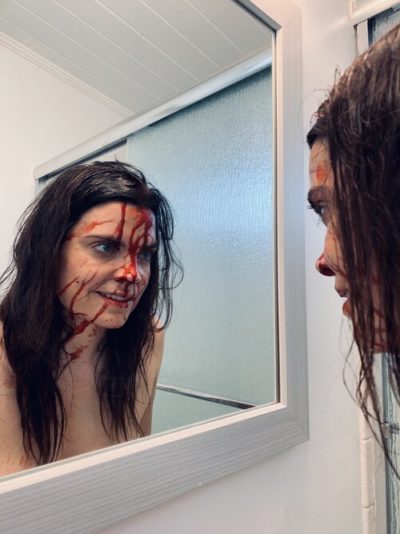
Unsurprisingly, the local film industry pounded on the idea, quickly popping out the Chinese equivalent of a quota quickie, running a brisk 67 minutes before the credits roll. Naturally, the film version of the vigilante, Lv Xia (Li Mengmeng), is considerably more photogenic, but the concept is the same – she busts in on men having extra-marital affairs and humiliates them and their lovers, for the benefit of their wives. The story here has the “Scandal Chaser” being seen and photographed by journalist Chen Dong (Qi). But after discovering her mission, he agrees to withhold the proof of her identity, and work with her instead. However, Liu, a businessman who had been one of Lv’s targets, doesn’t take kindly to her actions, and sends his assassin (Chen) to put a stop to her brand of justice.

It’s not a bad idea, though the way it’s developed is largely predictable, such as how Lv and Chen fall for each other. The fighting is mid-tier at best – and not often at that – but there are some quirky moments which helped sustain my interest above the Lifetime movie to which this largely aspires. I liked how Lv wears a V for Vendetta mask while in action, and was amused to hear Liu berating his minion, “Do you really think you are Leon in that movie?” The businessman has a point: “Leon” is indeed a bit crap, as company hitmen go, Lv typically disposing of him with ease.

Things did perk up in the final twenty minutes, when someone formulates a plan to capture Lv and take revenge. At first, I thought this was the humiliated mistresses getting together; it turns out to be for rather more prosaic, capitalist reasons, involving the hostile takeover of a corporation by female tycoon, Wu Yan-Mei (Li Man-Yi). She’s good as the evil villainess: she has a great laugh a slew of henchwomen, and some details of her scheme to turn the tables on Lv, are elegantly malicious. If only she’d shown up sooner. The tables end up turning, albeit in a somewhat clunky fashion and a slo-mo mass cat-fight, before one final twist. Still, I’d not be averse to a sequel, or a remake with more punch.

Dir: Geng Lei
Star: Li Mengmeng, Qi Ling, Li Man-Yi, Chen Xing-Yu,

A Killer Rising

★★½
“FBI Agent Jekyll and Hyde”

At least a star of the above rating is purely for the concept, which is one just brimming with potential. The problem here is entirely down to execution that isn’t just lacklustre, it’s entirely devoid of all lustre. First and foremost, there is absolutely no reason for this to have a running time of 122 minutes, especially when the first half makes its point inside about ten, and then sits there, as if waiting for a bus. It’s a particular issue, because it’s only the second half where things get adequately interesting. You will need a great deal of patience – or, probably more likely, some household chores to take care of – in order to reach that point.

The heroine is Kacee Rhona (Beckly), an irascible FBI agent with a long history of disciplinary issues, going back to her days at Quantico. It’s perhaps not surprising, considering her childhood was a hellish landscape of abuse, from which she barely escaped at all, only after defending herself against her biological father. You do wonder how someone with such obvious psychological issues was accepted into the FBI, but whatevs. Seems she’s quite good at her job, and is now hot on the trail of a serial killer, Montague (Anderson) who has been kidnapping, raping and murdering (not necessarily in that order) a slew of women. It’s largely your standard “loose cannon with issues” thriller, with which we’re all (overly) familiar. While Beckly is… okay, the rest of the cast are well short of convincing, and the production’s resources are insufficient for what it’s trying to do.

Then, however, the killer brutally attacks Agent Rhona, leaving her literally dead for several minutes, and causing something inside her to snap. She becomes a vigilante while officially on sick leave, targetting those whom the law has not been able to punish. And who better to become a serial killer of serial killers, than someone trained to catch serial killers? It’s a bit like an unhinged, female version of Dexter, and is an awesome concept. Her colleagues are… well, for obvious reasons, somewhat ambivalent about this, when their suspicions are drawn towards one of their own kind. On the other hand, Rhona’s operation outside the law has its advantages, especially with Montague still on the loose.

I’d love to see this given the production it deserves, with a better supporting cast, and elements that accurately reflect the supposed FBI setting, which never reaches even “unconvincing”. It feels like a nicely twisted take on Silence of the Lambs, and I could imagine a young Jodie Foster or Angelina Jolie in the role of the heroine. But any remake would also need to go at the script with a pair of garden shears, removing all the extraneous nonsense which drags the front hour down to an uninteresting crawl. There was eventually marginally enough here to keep me going, yet I’d not blame anyone if they chose to cut their losses before that point.

Dir: Michael Fredianelli
Star: Stacy Beckly, Derek Crowe, Kevin Karrick, Jaren Anderson

Streets of Vengeance

★½
“Porn stars vs. Incels”

This poorly-conceived and even less effectively executed cheapo, starts off looking like a home-video recording of a movie, taken off late night TV. There’s a bikini-clad hostess, who introduces the film, and it might not have been a bad idea, had they actually run with it. Cut into the movie for spoof adverts, bad infomercials, further host segments, etc. Yeah, could have been fun. Instead, it’s completely forgotten until almost the end, when she pops back up… purely to showcase a trailer for the directors’ next film, Slash-lorette Party. Verily, the level of cringe is strong in this one. If it had even embraced the eighties aesthetic for which it is clearly aiming, that would have been a credible substitute. But outside of the synthwave score by the very wonderfully named “Vestron Vulture,” there’s hardly any effort put in there either.

Instead, what you get is porn star Mila Lynn  (McKinney), who is about to quit the profession. Her boss, disgruntled by the news, delivers her up to a member of The Sword, a “men’s rights” group who have been abducting and torturing other adult entertainment stars, blaming them for causing addiction to porn. Mila manages to escape, beating her captor to death with a baseball bat, and sets up a vigilante squad, who will take the fight to the members of The Sword, and show them the error of their ways.

The above sounds considerably more interesting than the reality. I will say, that most of the actresses make thoroughly convincing porn stars – unfortunately, this is mostly in the way they can’t act their way out of a paper-bag. The pacing is also terrible. At 101 minutes, it’s at least twenty too long, and takes far too long to get to the meat of the matter. As a result, it commits the cardinal sin of grindhouse cinema: being boring. This is in part because it insists on being didactic, pushing its moral viewpoint to an obvious and rather painful degree. That’s another sin in which you never see good grindhouse flix indulge. I Spit on Your Grave didn’t need to spell out any obvious messages.

There’s a certain hypocrisy here, given the female nudity on view, frequently combined with things like the owners having their throat slit, New York Ripper style. None of the main actresses indulge, implying they are in some way “better” than that. It also fails to make a coherent argument against The Sword’s proposition – basically that, without porn, there’d be no porn addiction, and those who profit are no better than pushers. It’s just taken as “bad,” m’kay? Of course, the brutality with which Mila and her pals react, is morally little if any different from The Sword: an uncomfortable truth the film never dares address. All of which I could probably tolerate, if this was anything like fun to watch. It isn’t, and I couldn’t.

Dir: Paul Ragsdale, Angelica De Alba
Star: Delawna McKinney, Anthony Iava To’omata, Paige Le Ney, Daniel James Moody

Restless (2020)

★★
“Mom on a mission”

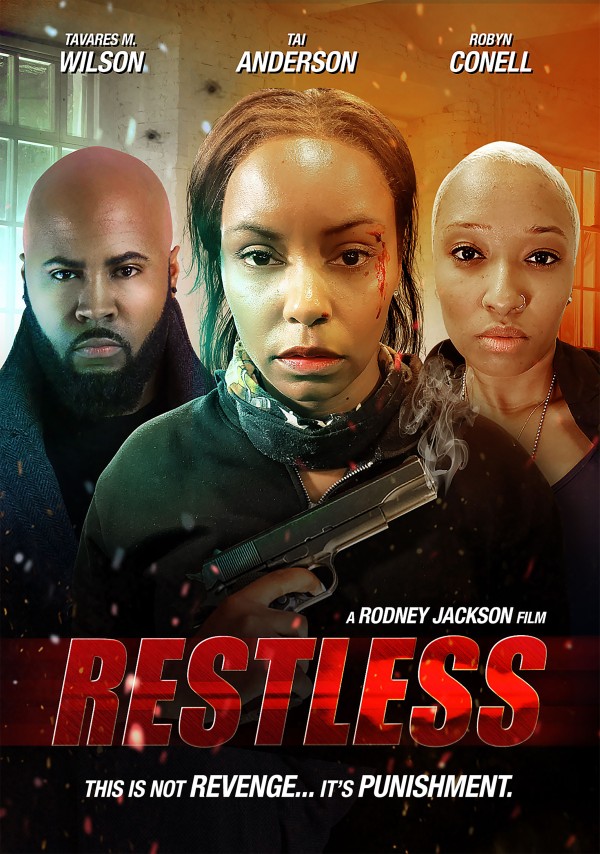
Single mother Naomi Harper (Anderson) is devoted to her son, and he to her. In an effort to help Mom make ends meet, he gets a job working for notorious local “businessman”, Noah Oliver (Wilson). When her child turns up dead, Naomi is sure that Oliver had something to do with it. The police, in particular Detectives Emory Kota (Conell) and August Hayes ( Jeziorski), don’t necessarily disagree, but their hands are tied. This is partly due to a shortage of actionable evidence, partly because Oliver’s connections run deep into the local political and judicial establishment in Conyers, Georgia, making it impossible to take action against him. Well, at least officially. Naomi has no such limitations, and this apparently mild-mannered loan officer has a background that may prove of help.

The script here isn’t bad. There are a number of interesting angles, such as the parallel actions of a vigilante, working in same area as Naomi, and targetting those who consider themselves above the law. Naomi isn’t the only strong female character either, with Det. Kota frustrated by the restrictions of her position. Then there’s Sophia (Rachel Burger), Oliver’s right-hand ma… er, woman, who proves capable of handling herself physically as well. Though I probably would have been more impressed had Naomi not done that crappy, gangsta “holding the gun at an angle” thing, as she headed towards her final confrontation with Oliver. Nobody with experience and an interest in being taken seriously would be caught dead doing that.

However, the problems here are most readily apparent in the resources here. Or, to be more accurate, the lack thereof. Even though the film tries to work within the budgetary limitations, these are so severe, they can’t be hidden. For instance, scenes which are supposed to take place in a police station, very clearly don’t. Indeed, there’s very little effort to make it look like anything, except a bare, empty room. The same goes for a number of other locations, where the bare minimum appears to have been done in terms of set dressing. Hardly less glaring are the plugs for local venue, Triplz Lounge. I’m sure it’s a lovely place.

Another weakness is that most of the actors don’t appear to fit their characters. Wilson is probably the worst offender, never being convincing as a mob boss – he’s just not intimidating or threatening enough. But to a lesser extent, the same goes for Anderson. Despite copious flashbacks to a time when her son was alive, she rarely seemed like a distraught mother, pushed into unthinkable acts by the callous and indifferent hand of fate.  She’s not a bad actress, competent enough from a technical point of view. There just wasn’t any reason for the viewer to pay the emotional buy-in to her portrayal. I’d not mind seeing what Jackson and his team could do with more money, and I’ve certainly seen worse. Here though, the challenges prove just too much for them to overcome.

Dir: Rodney Jackson
Star: Tai Anderson, Tavares M. Wilson, Robyn Conell, Will Jeziorski

Hellfire


“Hell would, on the whole, be preferable.”

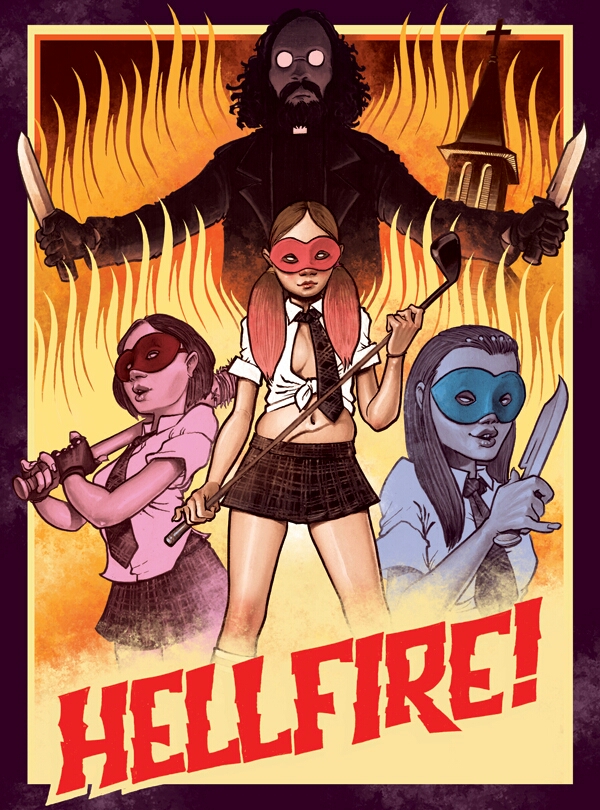
Ir’s not often that I feel my life has become a tiny bit worse for having seen a film, but Hellfire may just about qualify. It’s such a mean-spirited and unpleasant experience, weighed down further by technical ineptitude and actresses who can’t act. Any potential in the somewhat interesting idea – which makes for a good synopsis, at least – is entirely wasted. Someone is killing young women, apparently in an attempt to protect Father McKenzie, a priest under investigation for alleged sexual abuses of pupils at a Catholic school. Chucky (Mercedes) rounds up two of the girls from her class, tattooist Athena (Peach) and stripper Lilly (Divine). After surviving some attacks from a man in glasses (Hoffman), and a betrayal from a former teacher, they decide to go on the offense and track down the pedopriest.

The first fifteen minutes kinda live up to that, albeit in an obviously cheap way – and Lilly is the worst stripper ever, failing to remove even a single item of clothing. I think the point at which this jumped the shark was the extended scene of the trio smoking weed and dropping acid. Watching other people take drugs is among the worst cinematic sins. Would anyone pay to watch me sink a six-pack of beer? Exactly. It is, admittedly, a drug trip necessary to the plot, since it allows the women to recall their abuse at the hands (literally) of McKenzie. But, especially in a film which runs barely 70 minutes including credits, it’s a waste of time. Things only go downhill from there, with the movie basically killing time as they develop their Catholic schoolgirl vigilante personas. Which isn’t anything like as interesting as it should be, attention being diverted by faux pas like the claim the previous victim’s deaths were made to look like natural causes. Oh, so the woman we see in the opening scene, getting hung from a rope in her shower, tripped on the soap or something?

Then there’s the final attack on their former school, where they face the man in glasses, in what may be the worst fight scene in cinematic history, despite the director’s efforts to jazz things up by throwing bad digital FX and screechy sound on top of it. The three then take their revenge on Father McKenzie, and I guess I have to thank the film for introducing me to a genuinely new experience: feeling sorry for a pedophile. Because the former victims’ behaviour is so vile, and carried out with such an abundance of glee, as to make me lose all sympathy for them. It doesn’t help that, of the lead actresses, only Peach knows how to deliver a line with anything inhabiting the same continental landmass as authenticity. The brief running time turns out to be a merciful release, as I don’t think I could have stood a full 90 minutes of this. Let us never speak of it again.

Dir: Moses
Star: Mercedes the Muse, Knotty Peach, Irie Divine, Shawn Hoffman