



★★
“Two girls, one gun.”
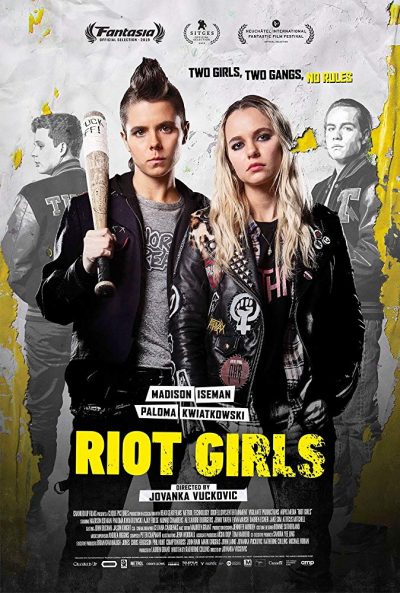 After a disease has wiped out all adults, the town of Potters Bluff has divided into two camps, delineated by the river running through the town. On the west are the Titans, a quasi-fascist order of jocks operating out of the old high school and led by Jeremy, whose motto is “Strength, power, respect.” On the east are the free-spirited remainder, living under and protected by Jack (Bourgeois). However, after hijacking the contents of a Titan truck, Jack is abducted by them and held hostage. A three-person party sets out on a rescue mission: Jack’s sister Nat (Iseman), her best friend – and painfully obvious lesbian, right down to the mohawk – Scratch (Kwiatkowski), and Sony (Friese), a former Titan who recently defected to the East, and whose inside knowledge is essential to their survival and the success of the mission.
This provides a slightly different twist on the usual post-apocalyptic scenario, though the idea dates back at least to Roger Corman’s 1970 film Gas-s-s-s, in which a deadly gas wiped out everyone over the age of 25. Canadian show Between also explored similar territory, and the conflict-driven nature here brings us almost into Battle Royale territory. Though it’s more of a team sport than an individual pursuit, and natural division instead of artificial construct. But I have to wonder, how did Potters Bluff reach this point? What’s the back story which saw, for example, Jack and Jeremy become leaders of their factions and implacable enemies? I suspect this may have been more entertaining than what we actually get. And why is the soundtrack apparently fascinated with hair metal songs from a long bygone era? [I’m pretty sure it shares one with the 35-year-old Return of the Living Dead…]
After a bright, comic-book styled opening sequence to set the scene, at first it seems this may be building and then subverting expectations. For example, when on a foraging expedition, Scratch is delighted to come across a vibrator… But in a twist, her interest is purely for the batteries it contains. However, the further on it goes, the safer and more predictable everything seems to become. The hurdles Nat, Scratch and Sony have to overcome on their journey, are precisely the ones you’d expect (although there is one eye-poppingly brutal head-shot), and it all inevitably leads to a confrontation with Jeremy and his troops in their high-school gymnasium.
Most irritatingly, it ends up getting too bogged down in class and gender politics. The Titans are largely defined as the bad guys almost purely because they are white, straight and male. Meanwhile, it’s “diversity = good” for the Eastsiders – even if its tenets like affirmative action are a civilized conceit, which wouldn’t last two days in a proper apocalypse. Consequently, it’s absolutely no surprise Nat and Scratch end up as An Item – not minutes after the former has spurned a heterosexual advance, and while Nat’s brother is still in the clutches of his enemies. I guess, for some, the line between free love utopia and devastated dystopia is severely blurred.
Dir: Jovanka Vuckovic
Star: Paloma Kwiatkowski, Madison Iseman, Alexandre Bourgeois, Ajay Friese
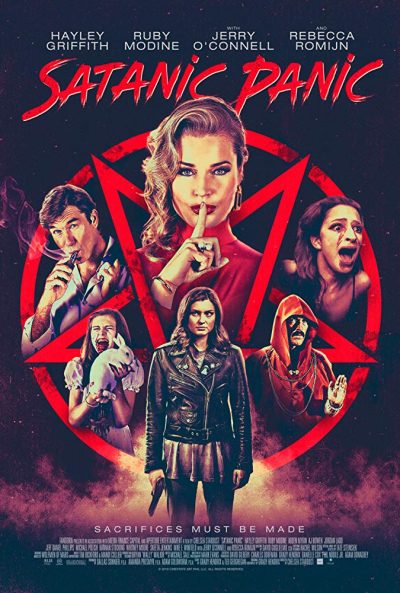 It’s the first day as a pizza delivery gal for Samantha Craft (Griffith), and things aren’t going well, with no tips being received. When given the chance of a delivery to a rich neighbourhood, she pounces – only to find herself getting stiffed again. This time, she sneaks in to demand her gratuity, which drops her in the middle of a satanic ceremony overseen by coven head, Danica Ross (Romijn). They’re attempting to summon Baphonet, but have hit a snag. Their intended vessel, Danica’s daughter Judy (Modine), no longer qualifies as a virgin, so Sam’s presence is highly convenient. For Sam? Not so much. Though perhaps to her benefit, there’s a bit of a power struggle in the coven, with Gypsy (Myrin) fed up of playing the second satanic banana to Danica.
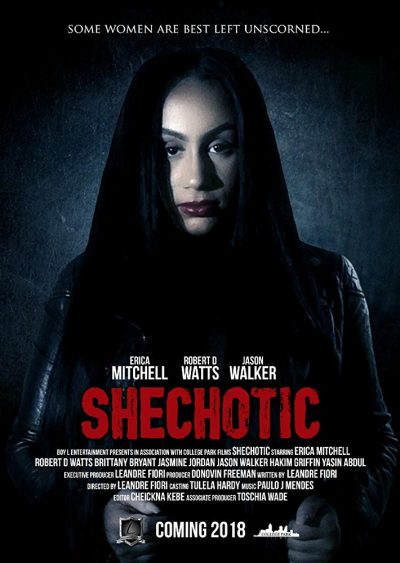 Within about two minutes of starting this, I realized I had made a terrible mistake, and was watching something barely reaching the amateur level of film production. Still, I soldiered on – albeit for some loose definition of “soldiered” – until the bitter end, mostly so I could issue an informed warning about this to any prospective viewers. Maxine (Mitchell) is rather upset when she discovers her boyfriend, music video producer Lance (Watts) has been cheating on her with Lana (Bryant). Mind you, she’s clearly a bit unhinged already: for example, telling him she’s pregnant when she isn’t. So it’s not much of a surprise when her reaction to his two-timing is to kidnap Lance, tie him up in her basement and submit him to various indignities, along with seeking revenge on Lana. Which, apparently, includes sleeping with her father (Walker).
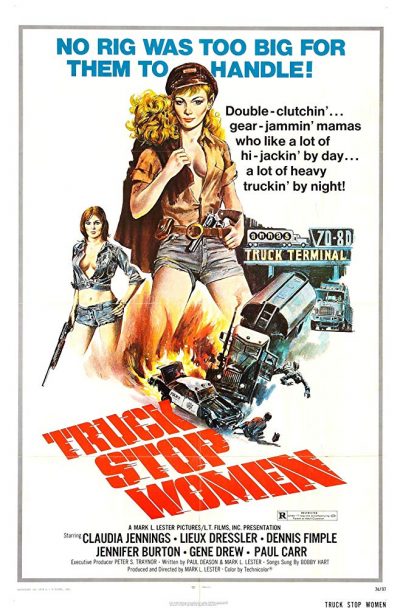 Ostensibly, Anna (Dressler) runs a New Mexico truck-stop, catering to drivers and ensuring they are kept fed and watered as they run their rigs across country. However, she has several more lucrative businesses. It seems that a majority of her waitresses, for example, moonlight as hookers in the brothel Anna runs. But the key side-line of work is sending her gals out to lure in unsuspecting truckers, typically with an alluring combination of fake breakdowns and tight shorts. When the truckers stop, their vehicles are hijacked, the contents stolen and the trucks themselves repainted and sold on.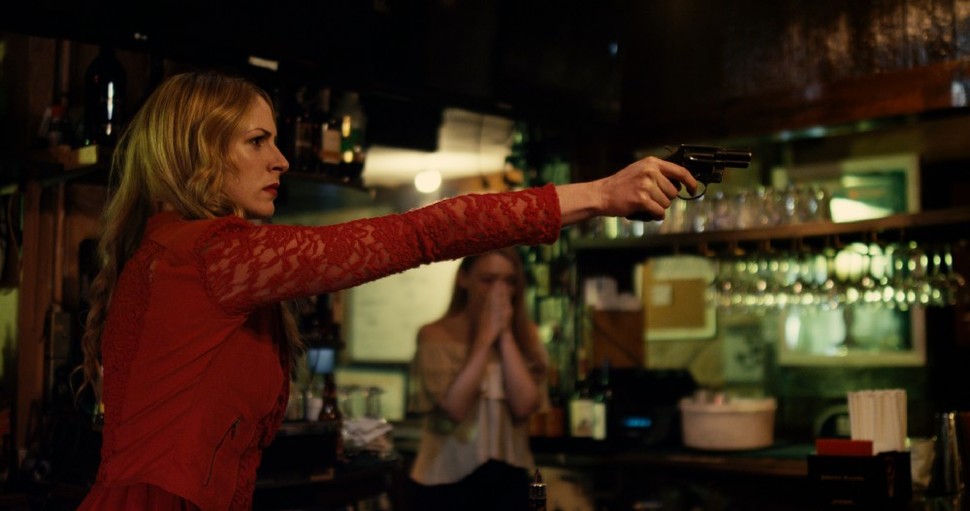
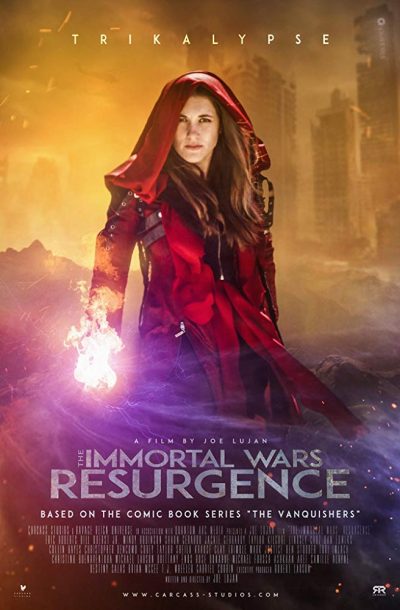 First, the good news. Whatever the issue was with
 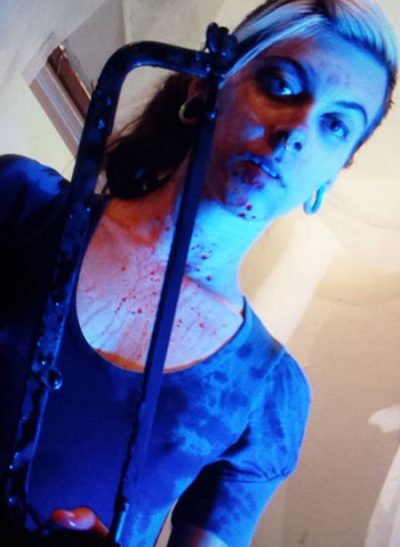 There are times when I feel I need a ★¾ rating. Two stars here would suggest a degree of genuine competence, which this undeniably lacks. But on the other hand, ★½ suggests something which is largely unmemorable, and that isn’t the case either. You won’t forget this. In particular, you won’t forget the scene where the heroine yanks some (suspiciously sausagey) intestines out of a victim, rubs them over her face and then – there’s no other way to describe this – masturbates the intestines. That’s three words I never thought I would write in a row. On that basis (and that basis alone), I’ll err on the side of generous.
 For whatever reason – presumably misguided stylistic reasons – the great bulk of the film is buried in darkness. Seriously, three-quarters of the film feels like it’s illuminated solely by natural lighting. And given it mostly takes place underground, in rooms with no windows, this is a major problem. The movie reaches its literally darkest moment during an early scene where the camera pans over an underlit set to an even more underlit door where someone has entered to deliver a message. You cannot see who it is. You just hear a disembodied voice, before the camera pans back. It’s a horrible mis-step, whether due to poor shooting, a poor transfer, or a bit of both. It largely dooms the movie, to the point where even an energetic final third is unable to rescue proceedings. For how can you begin to enjoy something you can’t see?
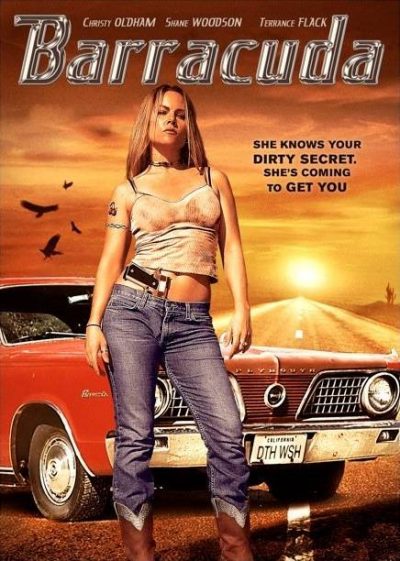 Struggling artist Summer (Oldham) takes on a temporary job as a phone-sex operator to make ends meet. It gives her a very jaundiced view of men, having had to plunge into the worst and most sordid depths of their fantasies. After realizing that some pose a more direct threat, and funded by hush money from one of her customers, she buys the car of the title. and takes their information, along with the tapes she has recorded of them, on a little road-trip across the South and West of America. She’s heading towards her sister (Hinchley), bringing the perverts to justice as she goes, and seeking closure for her own past.
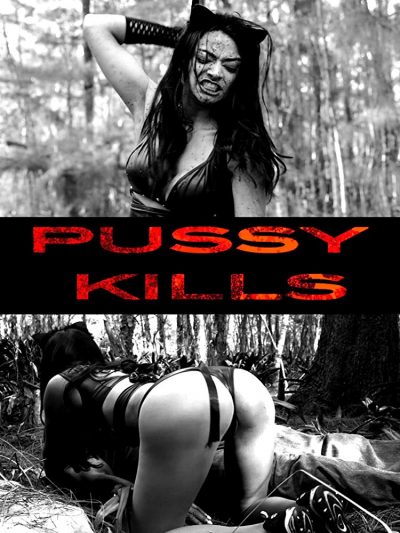 Despite a startling cover, this isn’t as sleazy as it seems. Indeed, even the title appears to be erring on the side of restraint, having apparently avoided the more obvious (and arguably, accurate) one of Killer Pussy. While the heroine certainly has an… interesting choice of costume, that’s as far as the film wants to go. It’s an odd approach: a sleeve like that sets up certain sets of expectations, which the movie has no apparent interest in matching. It’s not as if anyone of a sensitive nature is going to have got past the cover, so it seems odd to exercise such self-discipline when it comes to the content.