


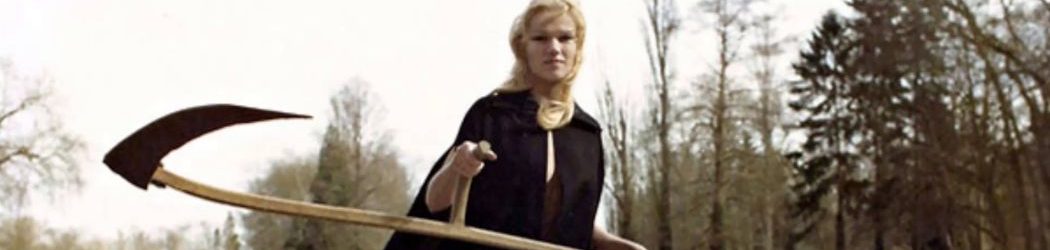

Gone by Dawn ★★★½
Gone by Dawn 2: Dead by Dusk ★★½
“Stripped to kill.”
 I decided I might as well combine these two into a single review. Having watched them back-to-back, even though made and set three years apart, they felt very much like the continuation of a single story about the same characters. The main one is Roxy (Mele), who is a dancer at a Wisconsin strip-club run by the sleazy Stag (Therrien), mostly as a money-laundering front for local organized crime. When he and his pal rape an employee, Alana (Pearce), Roxy along with the victim and another dancer, Crystal (Fierman), decide to take revenge by robbing Stag. That means getting into the safe in his office where the money is, and he’s not exactly going to give up the combination freely. Still, nothing that a piano-wire garrotte round the testicles can’t solve, surely? Except, as usual in this genre, the heist doesn’t go smoothly. Stag’s office quickly begins to resemble a mortuary, as unwelcome guests need to be handled.
This was, to be honest, better than I expected. There is, of course, the usual tension in grindhouse-style films about strippers – wanting them to be seen as more than T&A… while simultaneously being required to depict them as T&A. But the movie manages to strike a good balance here: while certainly not short on nudity, the lead actresses deliver performances which manage to make their characters feel like real people. The script also avoids people having to act like idiots too much, and the issue of the safe’s combination is solved in a way which is actually kinda clever. The low budget is a bit obvious in the limited locations and cast – we don’t get much outside of the club and an apartment – although in some ways, that works as much for the feature as against it. For example, it’s likely a factor in story-telling which certainly doesn’t hang around; maybe 65 minutes between opening and closing credits. And while there may be honour among thieves, there doesn’t appear to be much among strippers.
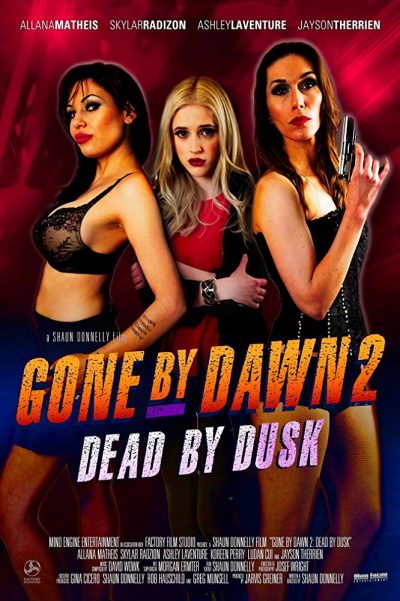 I didn’t think the sequel worked as well. While Roxy returns, she has been recast, being now played by Matheis – I’m not sure what happened to Mele. Still, I did laugh when one supporting character greets her with, “You look different!” Oddly, while the first film started with Roxy skipping town, the second sees her back, working at the same venue where she was involved in a multiple homicide. I know strippers are renowned for making poor decisions, but still… It turns out, having absconded with nine hundred grand of the mob’s money isn’t a good idea. They want it back, and to this end, have sent a trio of hired killers, named the Three Bears by Roxy. They’re prepared to do anything, up to and including both kidnapping and murder. But Roxy, along with Jesse (Radzion), a friend of Alana’s, and another dancer, Alura (Laventure), plots to turn the tables on the Three Bears, by robbing their boss.
Quite why the mob waited three years to take any action isn’t clear, and it’s just one of the problems with the story. Remember how I said the small-scale worked for the first film? That feels less true here, with the expanded script resulting in a bunch of loose ends and an unnecessarily stretched running-time of 107 minutes. For instance, we are introduced to a pair of cops, but they’re effectively unnecessary, and the same goes for a subplot which has Roxy visiting Stag in prison (one of the few players to return from the first film). Generally, I think I preferred Roxy 1.0 as well; I was just never quite convinced by Matheis in the role of an exotic dancer. The bits that work e.g. the ‘snake in the grass’ are mostly borrowed from its predecessor, though again, the movie does a good job with its characters.
Together, they make for a decent double-bill, though if you’re short on time, you might as well watch only the opener, since the sequel adds little in the way of development. It’s perhaps telling that I must confess to getting distracted in the middle of GBD 2 by a lengthy article on location Club Pierre, one of the oldest strip-clubs in Edmonton. So, not Wisconsin at all. :) But it probably says something when a movie’s location is more interesting that the film.
Dir: Shaun Donnelly
Star: Gone by Dawn – Saleste Mele, Hannah Fierman, Katelyn Pearce, Jayson Therrien
Gone by Dawn 2: Dead by Dusk – Allana Matheis, Skylar Radzion, Ashley Laventure, Koreen Perry
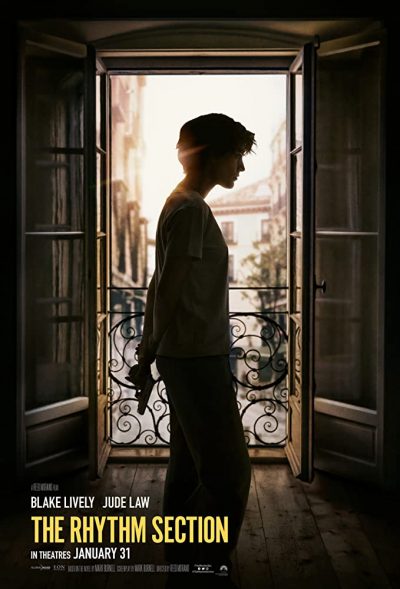 The action-heroine genre has seen its share of high-profile flops in the past. But this long-delayed entry, originally due out in February 2019, is among the worst, setting a record for the lowest ever opening at the North American box-office for a wide release. It took in only $2.8 million from 3,049 theaters when it opened in January, and ended with a worldwide gross below $6 million, against a budget of $50 million. While smaller in scale, that’s a
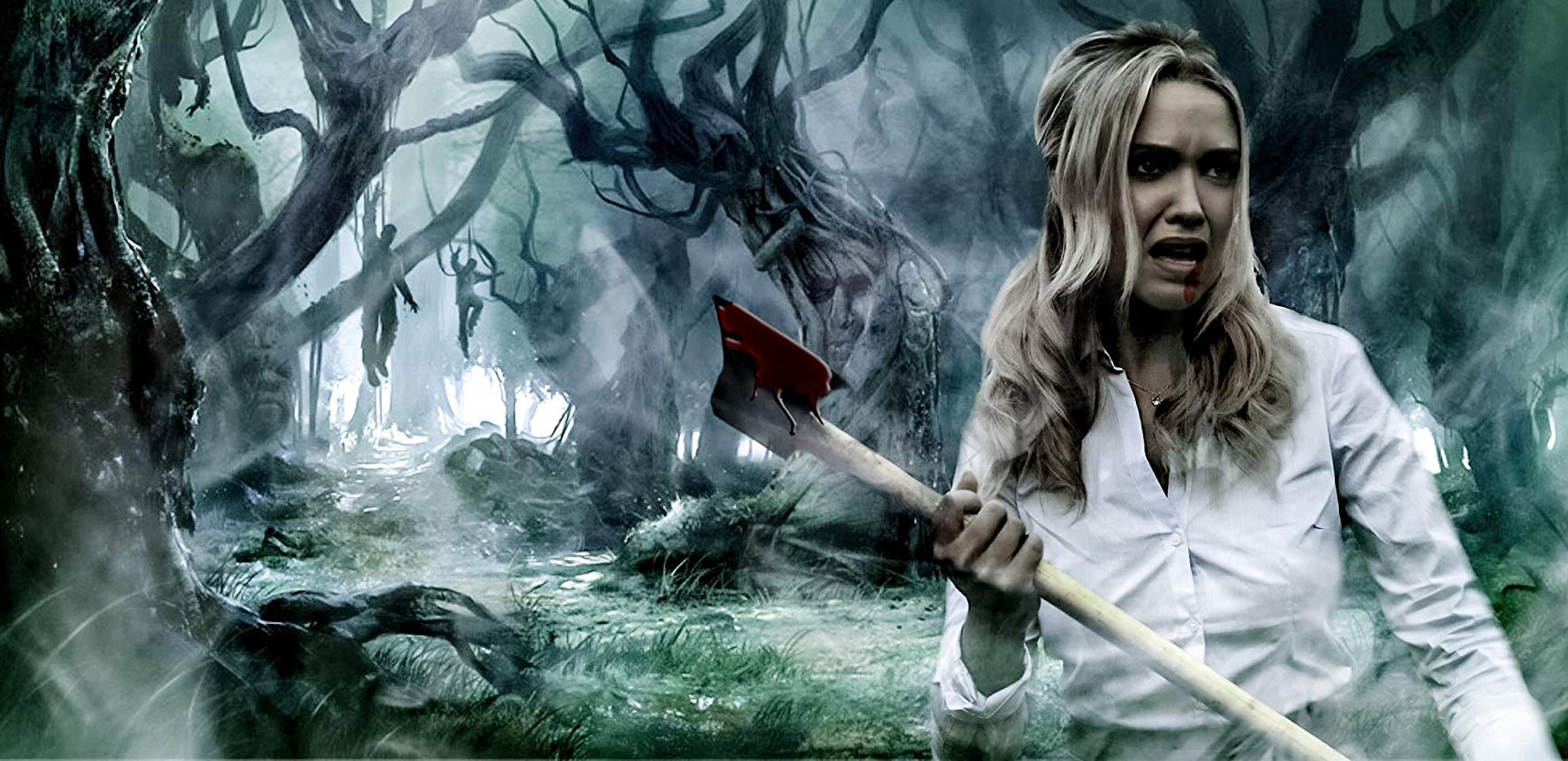
 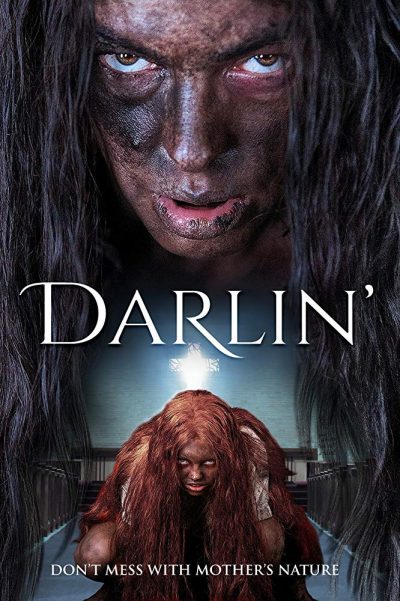 This strange little film probably makes more sense if you’ve seen The Woman, in which a feral cannibalistic woman, played by McIntosh, was captured and kept in the basement of a dysfunctional family. While this features McIntosh in the same role, it does work as a standalone film: its predecessor may help explain some of the background. Here, the woman drops off her equally uncivilized teenage daughter (Canny) at a hospital. Unsure of quite how such an unusual child should be handled, Darlin’ – called that, because of a bracelet spelling that out which she is wearing – is handed over to the Catholic church.
 Even if the film doesn’t quite live up to the title and poster, it turned out to be better than I expected… from the title and poster, to be honest. It has been my experience that, the more lurid the advertising, the more disappointed I’m likely to be. Films like this often don’t just fail to deliver on what they promise, they also struggle with basic aspects of film-making, like plot and characterization, providing a double-whammy of failure. While the former is true here (no-one, at any point, is
  ★★
★★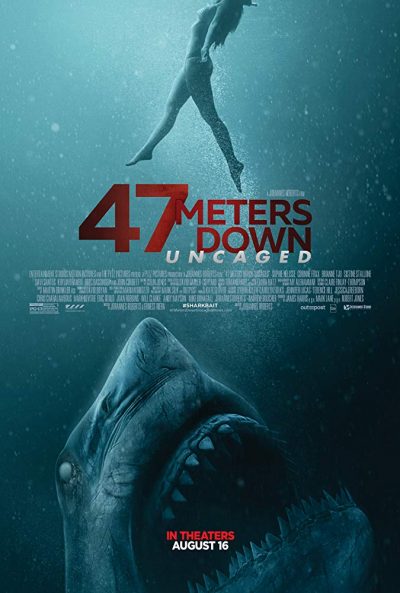 Director Roberts returns for a sequel to
  While a serviceable entry in the beloved genre of “Charlize Theron kicks ass”, this does have to be classed as disappointing in comparison to the epic awesomeness which were
  After a boat-wreck, Jennifer Remming (Clemons) washes ashore on a deserted tropical island, and has to make do with what she can find and forage. While there are no other people on the island, she’s not alone. It becomes increasingly clear that a “something” is predating for food at night there. She eventually finds out what it is: a large, amphibious and very hungry creature, walking on two legs, and capable of dragging its prey back into its lair beneath the water. Needless to say, she’s delighted when two other survivors wash up in a lifeboat: her boyfriend Lucas (Cohen) and friend Mia (Mangan-Lawrence). But convincing them of the threat, and the need to get off the island immediately, is a little tricky, because it turns out Jennifer has a little history of making things up. However, “being eaten” turns out to be fairly convincing proof, as evidence goes…
 Having enjoyed the previous
 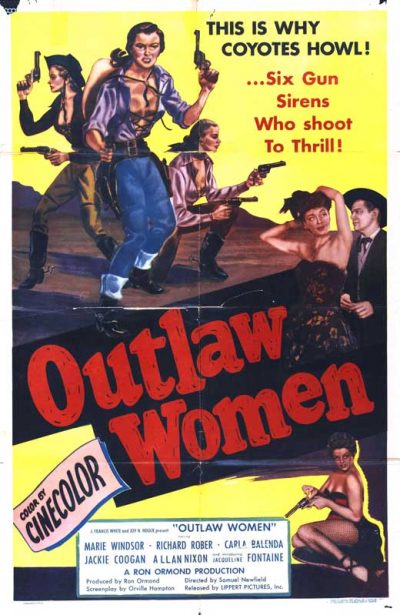 The city of Silver Creek is on the way out, and many of its inhabitants are leaving, including town doctor Bob Ridgeway (Nixon). Originally heading to Kansas City, he is convinced at gunpoint to take up a position instead in “Las Mujeres.” That’s Spanish for “The women,” and is an appropriate name since the place is a gynocratic society, where the ladies are in charge. Top of the heap is Iron Mae McLeod (Windsor), who runs the local saloon and ensures that the the other women in the town are kept safe from exploitation. She does, however, have to navigate the straits between aspirational gambler Woody Callaway (Rober) and outlaw Frank Slater. Ridgeway, meanwhile, because the target of affection for both Beth Larrabee (Balenda), one of Mae’s enforcers, and her big sister and star of the saloon’s show, Ellen. But when all of Mae’s money is about to be transferred out of Silver Creek, and becomes a target for Slater and his gang, romance has to take a back seat.