
Stone Cold Fox

★★
“For Fox’s sake…”

I think, if you’re going to try and recreate the eighties, it might help if you were there. I was. Co-writer/director Tabet? Not so much. She seems repeatedly to confuse the look and feel of the decade with the seventies. The repeated needle-drop of Sweet song “Fox on the Run” – actually released in 1974 – is the most blatant example. It explains why the results are a bit of a mess. A well-intentioned mess, to be fair, and you can usually see what they are aiming for. However, throwing a character in solely so they can refer to eighties films like Commando and Cobra, is painfully clunky, and is a more accurate reflection of the approach in which this indulges.

It takes place, as noted, in some vaguely historical period, where troubled teenager Fox (Shipka) runs away from junkie single mother, and younger sister Spooky. She’s taken under the wing and becomes the lover of Goldie (Ritter), a criminal entrepreneur. But after she catches an apparent glimpse of Spooky, Fox feels guilty at abandoning her sibling. She lifts a large duffel-bag of drugs, stolen by Goldie in association with her corrupt cop partner, Billy Breaker (Sutherland) and goes on the lam, looking for Spooky. Naturally, neither Goldie nor Breaker are pleased by this development, and set out to recover their ill-gotten gains. However, Fox has allies on her side too, including ex-combat medic Frankie, who has a Lebanese almost but not quite brother (the film fan mentioned).

While in pre-production on this, Tabet said, “I plan on genre-bending: gut-punching, pulpy, queer stories told with a habibi flare.” Well, apart from having to look up what “habibi” means – and I’m still confused what was intended there, in relation to movies – I guess this kinda works? It’s not very genre-bending, with a random, one-off breaking of the fourth wall at the start the closest we get. And I didn’t feel like it provided any punches to the gut, beyond a gentle tap regarding something regarding Spooky. Pulpy and queer? More so: indeed, it does seem at times like the script is more intent on ticking diversity boxes – not something exactly common in the eighties – than telling a story. This is my unsurprised face, that the film ended up on Netflix. 

It was a little ironic watching Sutherland playing a lawman, the day after his arrest for allegedly assaulting an Uber driver. Such things aside, there are some positives. Ritter makes for a decent villainess, and Mishel Prada is so much fun as Frankie, I’d perhaps have preferred the film to have focused on her story (the synchronised nunchaking was my personal highlight). But for every step forward, there are two back: Chung’s newly-transferred cop character serves no real purpose, and is just a cliché on legs; the same goes for Goldie’s henchwomen. There was more to the eighties (and to eighties action movies as well) than training montages. I should know.

Dir: Sophie Tabet
Star: Kiernan Shipka, Krysten Ritter, Kiefer Sutherland, Jamie Chung
Rogue Angel

★★
“Time is not on its side.”

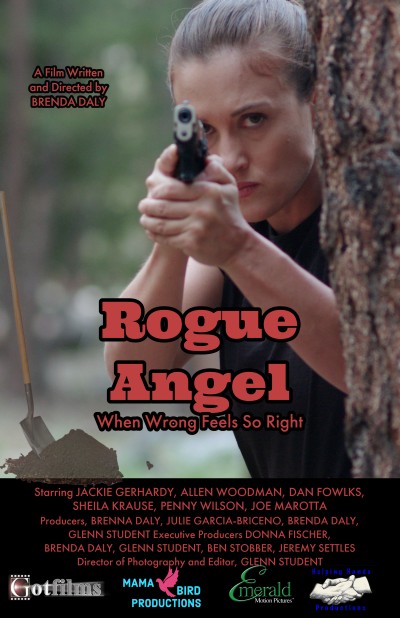
There is certainly something laudable taking on the challenge of making a feature film in seven days, and on a budget of seven thousand dollars. Doing so, and coming out the far end with anything remotely watchable, requires discipline and commitment. However, it also comes with certain penalties. The end consumer isn’t going to care about any of those constraints. They’re going to look at the screen and see takes which are “good enough,” rather than good, and particularly among the supporting cast, performances by people selected more for availability than talent. I tend to suggest it might be better to put the time and resources into making the best movie you can, rather than the cheapest and/or quickest one. 
Here, we have Angie Baker (Gerhardy), former member of an all-women platoon in the Middle East, who has returned to the town where she was brought up, as her grandmother nears death. There’s a lot of baggage here, including the younger sister she left behind, Lexi (Krause), and the family mine, owned by the grandmother and coveted by certain other relations. Most significantly though, is her fraught to the point of non-existent relationship with her father, Jake (Woodman). There was an incident – we find out the details right at the end – which is why Angie left. And is why Jake ends up buried alive in the woods. Hey, his coffin does have a breathing tube: Angie is not a monster… 

This was Daly’s first feature, according to the IndieGoGo page, and while I have certainly seen a lot worse, you can tell that’s the case, along with the limitations of the schedule and budget. The highly unconvincing attempt to be Afghanistan should have been canned, for instance, and there is an inconsistency of tone in Angie’s character. Particularly at the end, she goes full Rambo, gouging out eyes and slicing off body parts, in a way that seems out of place. Admittedly, at that point we aren’t aware of the full truth – which may or may not justify such nastiness: I’d have preferred to know from the start, bringing us along on her journey of revenge. Trimming 15-20 minutes would have made for a tighter and leaner product too.

It’s interesting to note this was written and directed by a woman: not often the case in the movies we review. Although it’s not often the case in action film-making generally: without being prejudiced, the fact is that women tend to gravitate to other genres. Perhaps as a result, Daly does bring a different perspective to this, though it’s one which paints with a broad brush: about the only man here who isn’t a Neanderthal is the local sheriff (Fowlks). As a starting point, this is okay – it is obviously a start, however, and is likely more successful as a learning experience than as a feature, only occasionally achieving any genuine emotional connection. I would be curious to see what Daly could do, when she takes her time. 

Dir: Brenda Daly
Star: Jackie Gerhardy, Sheila Krause, Dan Fowlks, Allen Woodman

The Cost of Something Priceless

★½
“The Price of Something Worthless”

I think it was the start of the closing credits where I realized why I disliked this so intensely. The film describes itself as, “A Flick by Adam ‘Ace’ Silva.” There’s hardly a part of that which does not make me cringe. Having the nickname “Ace” is one thing: it should only apply if you’re a sixties test-pilot. But putting it in your film is… yeah. Then there’s calling your movie a “flick”. No. Just no. It’s an attitude which, in hindsight, infuses the entire production. But what do you expect, when Silva didn’t just direct it. He also wrote it, edited it, did the cinematography and composed the music. All one hundred and eleven minutes of it. 

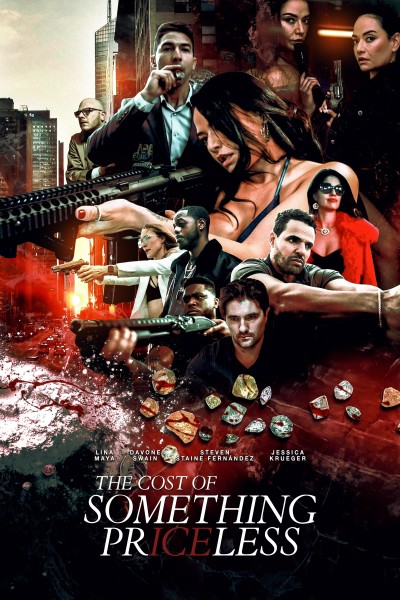
The story is about as much of a mess as the movie poster, with a lot of ideas, and woefully little idea of how to put them into a coherent structure. The heroine is Carmen (Maya), whom we first meet ripping off a former boyfriend for some drugs and money, leaving him for dead in the street. Key words, “leaving him for”. He’s not actually dead, and nor is he happy about it. Naturally, retribution is on his mind, and from this spirals off a slew of violent incidents and kooky characters, such as a weird, bald assassin with a foot fetish. Meanwhile, Maya attempts to make her way through the carnage and be re-united with her long-lost daughter, alongside somewhat faithful sidekick Tobias Anderson (Swain).

It’s not so much a question of being unable to figure out what’s going on, and more a case of finding myself unable to give a damn. Carmen isn’t a nice person to begin with. Had we, for example, been given an indication of her maternal leanings early on, that would have been something on which we might have been able to hang our empathy. Instead, we are repeatedly told how she doesn’t care for anyone else, although this is painfully apparent from the get-go. Rather than developing other characters, the film flings them at us, quickly getting bored and moving on the next. Some do have potential, such as the double-act who refer to themselves as Jack and Jill. Don’t expect much more.

I will say, there is plenty of the old ultraviolence. But the execution leaves a lot to be desired, with some of the worst digital muzzle-flashes I’ve ever seen. The last 20 minutes are a parade of completely unconvincing gun battles, with no noticeable damage to property at all. The fisticuffs are better, simply because they don’t need to have digital garbage pasted on top. Carmen does kinda look like the sort of person who would kick your butt: both she and Jill (Krueger) seem to do a fair amount of wandering around in their bras, which is not unpleasant. However, it all becomes a chore, long before an ending which came as more a relief than anything else.

Dir: Adam Silva
Star: Lina Maya, Davone Swain, Steven Staine Fernandez, Jessica Krueger

Paradise

★★★
“Death in Paradise”

Despite coming in as a “Tubi Original” – a badge which has previously been as much a warning as an incentive – this isn’t bad at all. It doesn’t especially push any envelopes, yet what it does, it does well enough, and with sufficient variations on the theme to keep me interested. Ella Patchet (Allison) is the daughter of Dan, the local police chief on the island of Paradise (it was shot in Hawaii). She’s rather hot-headed and a big fan of guns, to the concern of her father, who prefers to do his job without being armed. He gets tipped off about the return to Paradise of the gang led by Lee Paige, whom he ran off the island years previously. Shortly after, Dan turns up dead.

Needless to say, Ella is not happy, and vows to bring Paige to justice, despite the warnings of local mayor Calvin Whitney (Donovan), who does not want her going all vigilante. His concerns are not Ella’s concerns, to put it mildly, and she begins working her way up the chain of crime to the reclusive and mysterious Paige. However, you likely won’t be surprised to learn there are surprises for her on the way, and things aren’t exactly as they initially appear. From the opening credits, it’s clear that Isaacson is going for an “ocean Western”, for want of a better word. He largely succeeds: you could relocate this to 1860’s Texas without too much effort, though it’s beach-centric.

Patchet makes for an interesting heroine, whom we first meet getting thrown out of a bar. In some ways, she acts like she is about fifteen, but in others comes across as very mature. Certainly, she’s an unstoppable force, who’s both intelligent and driven. It’s definitely a case where firearms act as a great equalizer. You don’t have to suspend your disbelief about a smaller woman taking down larger men, because she simply shoots them in the head. This is undeniably violent, Ella racking up a fair body-count, and it works both ways, with a couple of unexpected, almost shocking deaths. There’s a scene-stealing turn from Tia Carrere, while I  enjoyed the villain’s lead henchmen basically saying “Screw this” and walking away.

In general though, the plotting is nothing special: the twists come as far more of a shock to the characters than the viewers. It’s also a little implausible how Ella can leave a trail of corpses, including state police, without becoming the subject of a massive manhunt. [Also, in reality, Hawaii has some of the strictest gun laws in the whole country] It feels as if the script would have benefited from a further revision or two, and if you are paying attention, you’ll work out where the final confrontation is going, a long way before it happens. But between Ella’s charisma and the style with which Isaacson delivers things, it held my attention without these issues becoming problematic. 

Dir: Max Isaacson
Star: Patricia Allison, Tate Donovan, Myles Evans, Adam Lustick

1 More Round

★★★
“I am Jim’s Complete Lack of Surprise.”

Reading the comments on YouTube, there’s an awful lot of “inspirational” and “motivational” to be found there, and these are not wrong. This is as template-based a sports movie as you can imagine, to the point that it feels almost more like a Victorian melodrama, in terms of its saintly heroine, fighting (literally) for what she believes in. This sort of thing would normally be completely ludicrous, and isn’t helped by James Schafer’s soundtrack, which leaves no orchestral cliché uncued. However… I found a genuine sincerity on display here, helped by a very good performance from Stone, and this really sells the sub-Hallmark conceit at its core. Her character believes, so you do. 
She plays up-and-coming amateur MMA fighter Jackie DeSpain, whose life has issues. She lives with her junkie sister Marie, whose little daughter Grace (Darling), is simply as adorable as a boxful of kittens. This situation preys on Jackie’s mind, causing her to lose a fight against Kate ‘The Killer’ Kinsella, much to the concern of her trainer, Hank (Wade). For when I say “lose”, we’re deep in “beaten to a pulp” territory. Though a positive is, this brings her into contact with hunky doctor Oliver (Akers). After Marie overdoses, Grace is taken away by the authorities, but if Jackie can just win enough fights to turn pro, then maybe she can convince a judge that she should have custody of her niece, while Marie rehabs. 

You should easily be able to figure out from the above, where everything is going to go the rest of the way, and the film does not deviate from that template an iota. Will there be training montages? Could there be an injury threatening to derail Jackie’s plans? Might there be – oh, I’m just speculating here – blossoming romance between Jackie and Oliver? I’ll never tell. But despite the resolute predictability of proceedings, I remained engaged to a greater degree than you would imagine. Lyde has directed a number of films we’ve reviewed here, most recently Scarlett, also starring Stone, and the action here is good. If the MMA fights are somewhat stylized, they’re still credible, and have more impact than I was expecting.

There is, however, a curious lack of any antagonist here: just about everybody is nice: even the social worker who whisks Grace away into the care of the state is quite apologetic about it. Kinsella is likely the closest, yet she is more of an obstacle than an enemy, vanishing completely from the film between her fights against Despain. Despite the lack of dramatic conflict, and a large dose of the review tagline (top) as things wound there way forward, I bought into Jackie’s situation, and unquestionably found myself cheering her on. While this may be the simplest of stories, I found it executed well enough to overcome the limitations of its plot.

Dir: John Lyde
Star: Melanie Stone, Jasen Wade, Isaac Akers, Rosie Darling
[The film is available now on YouTube and is embedded below]

The Stolen Valley

★★½
“Topples over into earnestness”

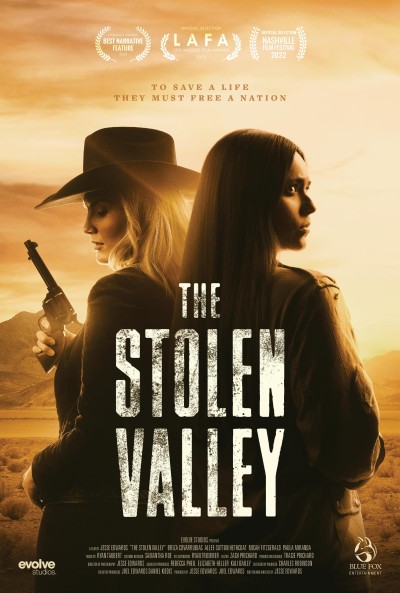
This feels like a modern Western. I think it was shot up on the borders of Utah and Arizona, since I recognized scenes shot at the Buckskin Tavern, in that area. While contemporary, with relatively minor tweaks, it could easily take place a century or more ago, back when robber land barons were a thing in the Old West. Lupe (Covarrubias) is in desperate straits, with her mother Adamina (Miranda) in need of money to pay for medical treatment she can’t afford. There’s another shock: the father, Carl (Fitzgerald), who Lupe long believed dead, is actually alive, and might be the last chance of getting the necessary funds. So she decides to make the journey to see him.

Barely is she under way – she’s seeking to pawn jewellery to raise a little cash – when she encounters Maddie (Hethcoat). And when I say “encounters”, she comes out of the back of the pawn-shop, guns blazing. For Maddie has a sizable debt too, to some unpleasant people, and now they perceive Lupe as her accomplice. The two young women decide Carl could solve both of their problems, only to find him engaged in a dubious scheme to sell off land, which actually belongs to Adamina, to an oil company, having convinced them Adamina is dead. It’s a move which will result in the indigenous people being thrown off the property, and Lupe’s unexpected presence clearly represents a threat to  the deal. 

This does a lot of things right. Most obviously, it takes place in some gorgeous locations, and the photography does them justice. The performances are generally effective as well, with Hethcoat in particular a lot of fun to watch. She cuts a striking figure with her blonde hair, cowboy hat, and a take no prisoners attitude. Maddie is in sharp contrast to Lupe, who has been brought up “the right way”, and they make for an amusing pairing as they play off each other. Although scenes like the gratuitous flamenco dancing may not move the plot forward, they are still amusing to watch, and they build the character. Indeed, they might be fun precisely because they are separate from the plot. 

Because that’s the film’s problem. It’s a script where far too much happens because the story needs it. Why did Adamina leave without taking the property deed, clearly her most precious asset? Why did Carl hang on, not just to the deed, but also the letter Adamina wrote to her own mother, for over twenty years? And don’t even start me on the remarkable coincidence of Maddie’s background. Add in a not-so subtle subtext of “Men are bad, and white men – they’re the worst“, and it all begins to topple over under the weight of its own moral superiority. I’ve no doubt Edwards’ heart is in the right place. However, the message here too often gets in the way of the movie. 

Dir: Jesse Edwards
Star: Briza Covarrubias, Allee Sutton Hethcoat, Micah Fitzgerald, Paula Miranda

Redhead

★★
“Better dead than redhead.”

Written, directed by, and starring husband and wife team Sam and Johnna Hodge, this is the kind of film it would be easy to deride as poverty-row garbage from the bottom drawer. There’s precious little plot, some of the performances are painfully amateur, and it seems to exist mostly as a show-reel for spraying around corn syrup with red food colouring in it. And yet… If Chris and I made a movie – something we have discussed – it might well end up being not too dissimilar to this. On the other hand, if we had a spare $55,000 lying around – the budget here, according to the IMDb – we’d probably go on a nice holiday instead. 
Autumn Blacksmith (Hodge) survived being abducted and tortured by infamous psychopath Oscar Sawyer (Stinnett), finally escaping after killing him. However, the experience left her severely traumatized, and the slightest unfortunate interaction with any man is sufficient to push her over the edge into a murderous rage. Cue the corn syrup. Rinse, repeat for 90-odd minutes, until the end credits roll. Occasional hallucinations of Sawyer returning from the grave to haunt her, and a brief attempt by her therapist (Holland) to check in, offer a small touch of variety. The West Virginia cops, led by Detective Rogers (Robinson), are not exactly Sherlock Holmes. Then again, locals are remarkably chill about Autumn’s spree. The bartender where she kills her first victim says of him, “He was always an asshole.”

I was reminded of Michael and Anne Paul, another husband and wife film-making duo. They made Roman’s Bride, where the red-headed wife also goes on a killing spree. I think that worked a bit better, because its lead actress had an innocence about her, that provided an interesting contrast to her savagery. Here, Autumn is more blatantly mad, to the point you wonder why any man would try to chat her up. As a viewer, you’re never brought along on the journey into insanity. The way some of the local community end up assisting with, or even active participants in, her murders could have been used to provide another twist to the narrative. Nah. Open another bottle of Karo instead. 

Technically, it’s okay: the camera gets pointed in the right direction, it doesn’t succumb to underlit scenes, and the audio is fine. The soundtrack, also by Sam Hodge (not a surprise), has a nice throwback vibe, sounding like it was ripped off an eighties video nasty. But there is no real sense of progression or development, and the ending feels particularly sudden, going to the end credits immediately after she has disembowelled her final victim, a peeping Tom. We’re very little forward from where we were after her first murder. A sequel is in production though, so it appears there was enough of a market for this kind of thing. Will I watch it? [Sighs heavily] Yeah. I suspect I probably will.

Dir:Johnna Hodge, Sam Hodge
Star: Johnna Hodge, Ashley Stinnett, Will A. Holland, Travis Robinson

Dead of Winter

★★★½
“Old, bold and cold.”

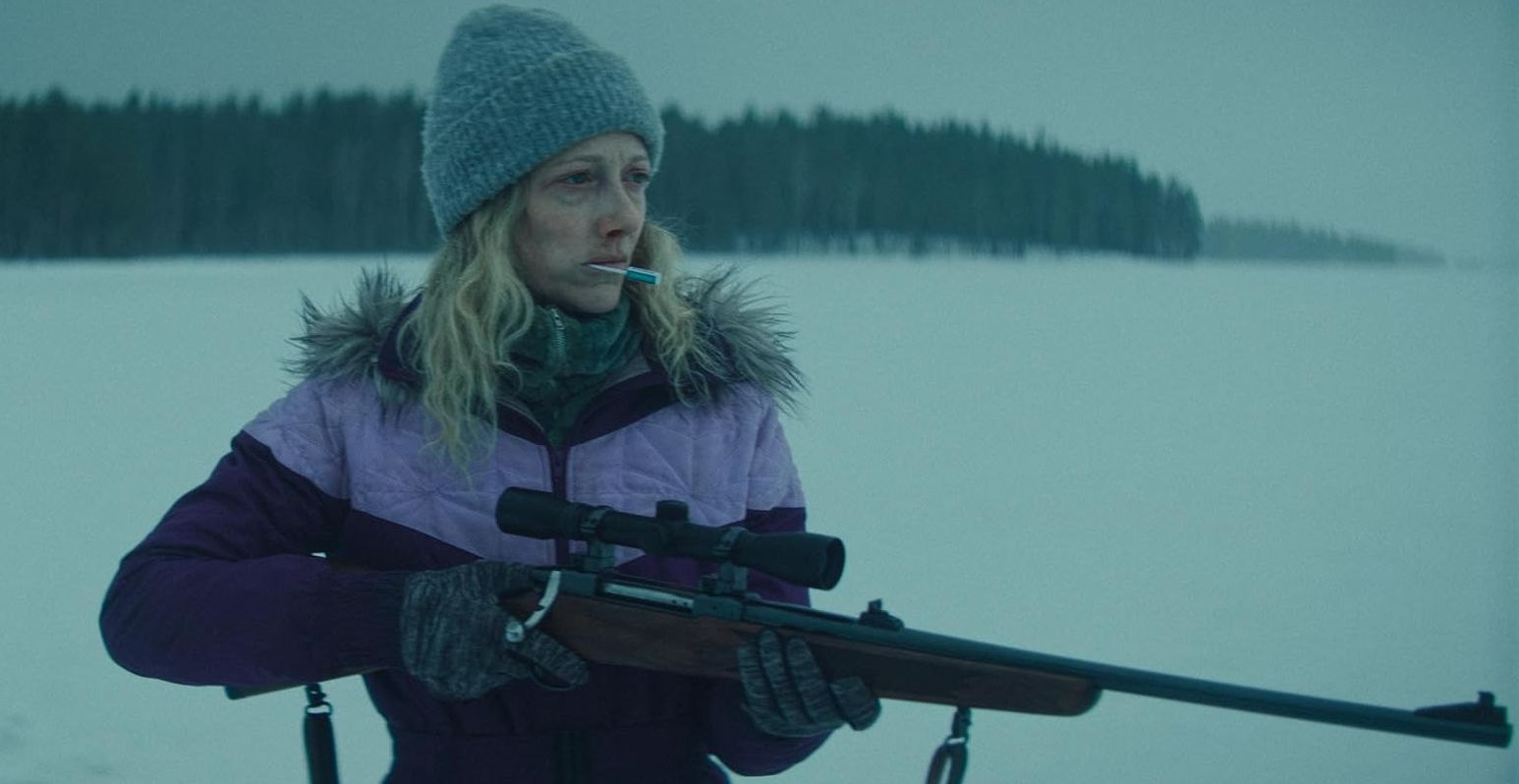
Thompson seems to be having a second wind, making her first appearance on this site at the age of sixty-six. That’s a decade more than Liam Neeson was when he became an action star with Taken, and probably makes Thompson the oldest debutante here. This comes on the heels of series Down Cemetery Road which, while not quite qualifying here, certainly was more brisk than expected. At this rate, I might even have to forgive her for throwing shade at Audrey Hepburn. No question about the credentials of Winter for this site, since it plays like a cross between Fargo and Taken. There’s not a lot of fat here, certainly. Things kick off just a few minutes in, and barely stop thereafter.

Barb (Thompson) is on the way to a lake in Minnesota – a part played by Finland – for some ice fishing. She gets turned around, and stops at a remote cabin to ask for directions. There she meets an odd man (Menchaca), and notices some blood on the ground. Then, at the lake, she sees the man chasing after and recapturing a young woman (Marsden), so realizes she has stumbled into the middle of a kidnapping plot. After the obligatory “no signal” scene, Barb realizes she is the victim’s only hope. But the man may not be her biggest problem. His wife (Greer) is the real brains behind the operation, very highly motivated, and prepared to go to any lengths to stop Barb from interfering in the grim plan.

I will say, it does take a bit of getting used to, hearing Thompson going full Marge Gunderson, eh? This is no comment on the accuracy of the accent, a topic on which I am not qualified to speak. It’s just odd. However, this is not a particularly dialogue-heavy movie, with Barb spending much of it alone and in the wilderness. We never find out either of the antagonists’ names, incidentally, the end credits just calling them Purple Lady and Camo Jacket. The film focuses increasingly on the two women. Purple has nothing left to lose, generally having the edge in firepower and ruthlessness – as is demonstrated after Barb is able to reach help through a CB radio. But Barb has motivation of her own. 

This comes out in rather clunky flashbacks to the early days of her relationship with her husband. Truth be told, I didn’t feel these added particularly much; the same information could have been provided more efficiently, and in ways which didn’t derail the tension of the current situation. Though I did like how the young Barb is played by Thompson’s real-life daughter, Gaia Wise, I found myself impatient for the film to return to the one-on-one battle, which you know is going to end badly for someone. Or someones. The film doesn’t disappoint there, with a brutal struggle in the middle of a frozen lake, good enough to make me forget the combatants have a combined age of 116. 

Dir: Brian Kirk
Star: Emma Thompson, Judy Greer, Marc Menchaca, Laurel Marsden

Paradox Effect

★★½
“Not much effect on me.”

I’m always down for an Olga Kurylenko film. She’s been in some good entries on the site previously, including Sentinelle and High Heat. Her track record gets her the benefit of the doubt, for an entry like this, which might be a bit marginal if it starred another actress. Though American, it takes place in Bari, Italy where recovering junkie Karina (Kurylenko) is putting her life back together, and looking forward to the arrival of her young daughter, Lucy (Astons).  However, on the way home from a late-night shift at the bakery where she works, she stumbles into a murder commited by mob courier Covek (Trevena), which becomes a car-chase, ending in a fiery crash.
The problem is, this  burned up the drugs Covek was supposed to be delivering to Silvio (Keitel). He “recruits” – quotes used advisedly – Karina to acquire a replacement stash, a process which drags them both through the Italian underworld over the course of the night. Matters are not helped by a couple of factors. Silvio has Covek’s son as a hostage, so noncompliance is not an option. Oh, and did I mention that Covek is actually an Interpol agent, who will go to any lengths to make sure Silvio faces justice? On the other side, Karina will go to any lengths to make sure her own daughter is not harmed. But the trail of destruction being left in the wake of her and Covek’s hunt for heroin is not exactly subtle. 

I wanted to like this more than I ended up doing. It feels as if Karina needs to be more central than she is. She ends up spending too much time either doing Covek’s bidding, or following him around, and that’s not what I wanted to see. Kurylenko > Trevena, except the film doesn’t seem to realize it.  Keitel, another actor I like, is also underused. To the point where, up until the very end, I half-wondered if he filmed all his scenes somewhere else, and was then spliced into the movie during the editing stage. That turns out not to be the case. But the mere fact it seems possible is another illustration of the wobbly execution. 

Even basic stuff like the film’s title, which is both strikingly generic and never explained, is maddening. Opening with a quote from Nietzche sets intellectual aspirations the rest of the movie isn’t able to sustain. I will say, it is technically decent: I appreciated little things, like them deciding to blow up a genuine car, rather than faking it with CGI. When given the chance, Kurylenko does well in the action, though quite why Karina has these skills is never explained. It would have been improved by being the film depicted in the poster (I must have missed Kurylenko’s pleather suit), simply having Karina trying to get the replacement drugs herself. In that scenario, Covek becomes surplus to the film’s requirements. A win-win, I’d say. 

Dir: Scott Weintrob
Star: Olga Kurylenko, Oliver Trevena, Harvey Keitel, Alice Astons

Killing Mary Sue

★½
“Death becomes her.”

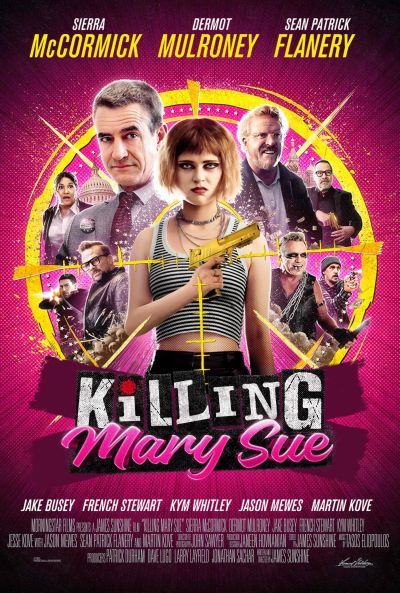
Is there anything worse than a comedy which doesn’t land? I get that humour is subjective, but this action-comedy manages to be spectacularly unfunny, to a degree I have to wonder how it got made. There are some well-known people in the cast: actors who I know have talent (to the list below, you can add Martin Kove and Jake Busey), and whose work I have previously enjoyed. What did they see in the script here, which made them think, “Yes, this is something I want to do”? For this is the cinematic equivalent of nails being dragged across a chalkboard for an hour and a half. You don’t watch this, so much as endure it.  

To be fair, I think the characters being so repellent is a conscious, deliberate choice. You have sleazy politician Bradley Weiner (Mulroney), and his problematic step-daughter, Mary Sue (McCormick). She’s an utter brat, with no interest in anything except partying hard. With a key election looming, and Weiner trailing in the polls, he and his campaign adviser (Busey) decide to bump Mary Sue off, both to end her scandals, and for a sympathy bump in the polls. However, she proves remarkably hard to terminate: there is eventually an explanation for this, though it’s more of the “Wait a minute…” variety, than anything convincing. Still, Mary Sue’s survival forces her father to up the ante, and repeatedly send nastier assassins to try and finish the job. 

The first chunk of this is energetically devoted to demonstrating how terrible everyone is. The problem might be, it’s too damn successful. They never recover: for Weiner, it’s fair enough, since he is the nominal “bad guy.” But for Mary Sue, this is a problem, since you want your heroine to have some redeeming qualities. I genuinely couldn’t find any. Indeed, I was beginning to sympathize with her father, since in her position, putting her down like the mad dog she is, feels almost like responsible parenting. [Our teenage daughter wasn’t exactly a saint; yet she’s Mother freakin’ Teresa beside Mary Sue] This is all lazily blamed on daddy issues, her biological father being murdered in front of her, when he was robbing a convenience store. 

The concept of her being a real-life Mary Sue is potentially amusing, except that’s as far as it goes. Simply repeating a cliché of bad writing, doesn’t stop it from being a cliché, and writer-director Sunshine does nothing more. Have her slowly and gracelessly roll away from a hail of bullets, or mentioning video-game auto-aiming capabilities, simply isn’t enough. Especially when Mary Sue shows no sign of a character arc, and remains resolutely unlikable until her sudden, thoroughly unconvincing and revelatory change at the end. Sort of. I’m not even going to get into the lumpen and turgid whacks at unsubtle political satire: guys, the Russian are interfering in ‘Merican politics! If you find that intrinsically amusing, you know where to find this film. 

Dir: James Sunshine
Star: Sierra McCormick, Dermot Mulroney, Sean Patrick Flanery, Jason Mewes