



★★★
“Nothing to offer but blood, toil, tears and breasts. In other words: quite a bit”
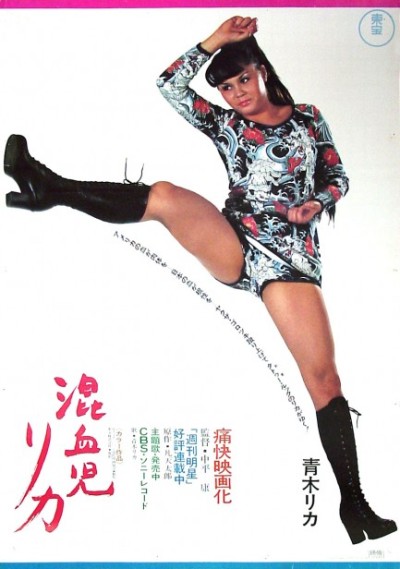 Aoki appears to have streaked like a star across the pinky violence firmament, appearing only in the trilogy of which this is the first, and one other film, Gakusei yakuza, before returning to the streets whence she came. Or I like to think that was her origin, anyway, and this is less a dramatic work, than a documentary depicting her life. Sharing the same name, Rika is the child of rape, a GI impregnating her mother before being deployed to Korea, and it’s not long before one of her mother’s boyfriends/customers [the film is sketchy on this detail] has taken a similar approach to Rika. She ends up heading an all-girl gang, but is sent to a reformatory after an opposing, male gang leader accidentally dies during a fight with her. But it’s not long before our heroine escapes, only to find some rivals have taken advantage of her absence, and the rest of the gang has been abducted and are about to be sold off to Vietnam. The boss offers to sell them to her instead, and Rika blackmails her father into paying up, only for the women to be sold anyway.
There’s another plot thread where she witnesses a pickpocket stealing documents about a waterfront reclamation project. Then there’s one about her going back to the reformatory, being involved in another fight which leads to the death of the warden, Rika’s escape, and her search for the real murderer. Or a friend, Hanako, who has fallen for a GI, about to be shipped out to Vietnam. These storylines drift in and out without much regard to logic or coherence, generally being discarded without apparent further thought, whenever the makers turn their attention to the next gaudy bauble. That’s the main problem here: it is less a film, than a collection of scenes, with a severe lack of narrative flow, to the extent this feels almost like a four-hour movie edited into 90 minutes.
However, Aoki brings the necessary earnestness to proceedings: while a little short of the true mistresses of the pinky world, like Reiko Ike, she is not bad, especially considering her apparently limited (spelled “non-existent”) acting experience. Helping things out, some of the violence is spectacularly excessive, even for a time, place and genre that specialized in spectacular excess. For instance one bullet to the back of the skull results in arterial spray out of the victim’s forehead, like a novelty soda syphon. Rika also carves off one enemy’s forearm, marches up to his boss, and if not quite slapping him across the face repeatedly with the detached limb, comes damn close. This kind of madness keeps the film consistently entertaining, even allowing for its faults and flaws, which are no less obvious. By the end – which has Rika crashing a wedding and lobbing fireworks around, before whizzing off on her Electra Glide [or some similarly cool bike, I’ve no idea] – I was kinda sad to see the character go, if not the lazy screenwriting. Parts 2 + 3 will stray across my eyeballs onto this site in due course, I’ve no doubt.
Dir: Kō Nakahira
Star: Rika Aoki, Masane Tsukayama, Yoshihiro Nakadai, Masami Souda
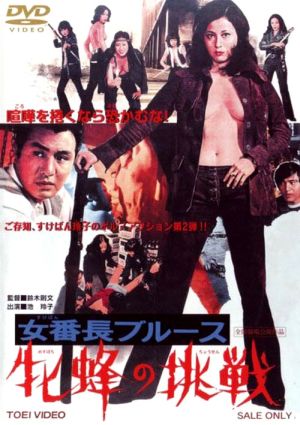 If the first Queen Bee movie was a fairly effective romp through the genre, that’s a lot less the case fot the follow-up, with Ike largely floundering around, as Maki, the leader of the Pearl Gang, who finds herself embroiled in a battle with another crew, the Black Lilies and their leader, Yuri (Kazama). Their spat is interrupted, when the Kuroji clan of yakuza throw their weight behind the Black Lilies. However, the triumph of the Lilies is short-lived, as they find out that they are about to be forced into life as prostitutes, for the benefit of their new allies, ending their life of freedom in the ‘hood. There are also subplots in which Yuri’s former boyfriend, Eizo wants to be a top racing driver, bringing him into conflict with the yakuza as well, and a suitcase filled with stolen guns.
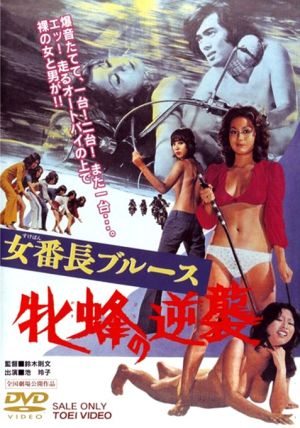 Reiko (Ike) is leader of the Athens Gang, a low-level all-girl gang, who specialize in car thefts and rolling naive salarymen with the lure of hot sex. They’re part of a hierarchy, which includes a male gang under whom they loosely operate, who are in turn on the fringes of a Yakuza group. There’s also a motor-cycle gang and its leader (Taki) who don’t obey anyone, and that independence is really what Reiko wants, even though her group is obliged to follow certain rules, such as not getting attached to any man. Things are disrupted by the return of former leader Jun (Kagawa) from reform school: will Reiko be able to hold on to her position? It’s just one of a large number of plot threads here: you also get the blackmail of a pop star; a hitman agreeing to one last mission; a gangster estranged from his wife and daughter; sex on motorcycles for no apparent reason; a journalist with a nose for scandal; and, of course Reiko failing to follow her own rule about no attachments.
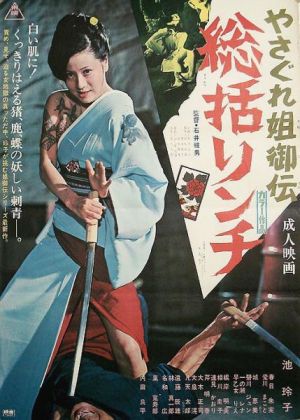 This starts with a memorable sequence in which Inoshika Ocho (Ike) fights off a number of attackers, armed only with her umbrella; albeit, an umbrella that is rather more heavily-armed than most. While she succeeds, she ends up losing all of her clothes in the process, leading to some artful staging in which the discarded umbrella is used to hide her naughties bits. Unfortunately, the rest of the film, while occasionally reaching the same levels of unsanity is largely crude and unpleasant. Even the central concept – a gang smuggling drugs in the vaginas of junkies – falls firmly into that category.
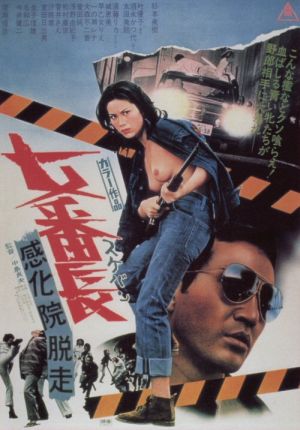 Serial escaper Ruriko (Sugimoto) is more persistent than good, and is dragged back to reform school after her seventh escape attempt ends the same way as her previous six. After whizzing through most of the standards of the women-in-prison genre in about 30 minutes or so e.g. corrupt staff, gratuitous nudity, solitary confinement, etc. she and a few of her colleagues (supposedly teenagers, but that clearly ain’t the case) break out as a group. Splitting up to avoid detection, they arrange a rendezvous at a deserted building by the sea, from where they plan to hijack a ship and escape Japan for good. Truth be told, a sense of urgency isn’t exactly top of the their skill-set, and as they meander their way there, various escapades happen, of which the only significant one is Ruriko meeting, by chance, a male criminal (Watase), who is also trying to out-run the law. But the police are also keen to ensure that they run their record in terms of Ruriko to a perfect 8-for-8…
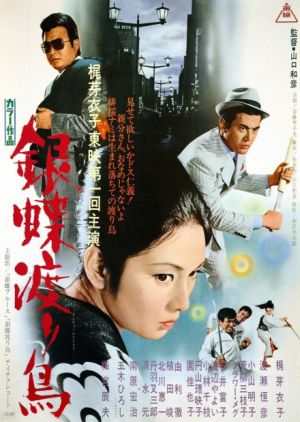 Nami is sent to jail for killing a Yakuza boss, and when she is released, returns to the Ginza district of Tokyo to live with her uncle, who runs a pool hall. She gets a job as a hostess in a bar, with the help of her new friend Ryuji (Watase), but the quiet life doesn’t last for long, even as she tries to help the widow of the man she killed – whose petition on behalf of Nami is what helped lead to her early release. For the local mob, in the shape of Okada (Nanbara) and his gang, are sniffing around the bar, seeking to take it over. To settle things, Nami offers to take on Okada’s champion at billiards, a challenge the gangster readily accepts, not realizing he has just been hustled, and that Nami is no mean player herself. Can she win – and even if she does, will Okada live up to his side of the bet?
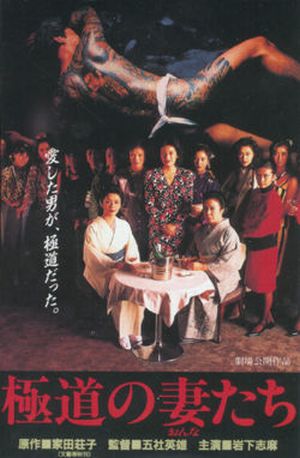 Perhaps a better title, however, would be Yakuza Sister, since this is a tale of two siblings. Tamaki (Iwashita) is an actual mid-level Yakuza wife, who is running their branch of the gang in the jailed absence of her husband, and doing quite well at it, enhancing its size and reputation. She is largely estranged from both her sister Makoto (Kitase) and their father – she’s a bartender, he works in his machine shop, but it’s clear from the get-go that his time is limited [this isn’t much of a spoiler when you see him coughing his lungs out while simultaneously chain-smoking]. Two things upset their semi-orderly lives. The overall head of Tamaki’s clan dies, opening up a power vacuum which sets off a struggle between rival factions, and Tamaki attempts to arrange a ‘suitable’ marriage for her sister. Makoto rebels, taking up instead with Kiyoshi Sugita (Sera) – which is unfortunate, because he’s a loyal member of the faction now battling Tamaki’s group for control.
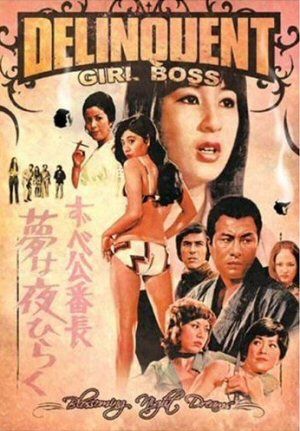 This was my first true vintage “pinky violence” movie, though I had bumped against some fringe entries in the genre before e.g. Female Convict Scorpion: Jailhouse 41, which I enjoyed and really must get round to reviewing for here some time. This one…not so much. It focuses on Rika (Oshida), who gets out of reform school, and gets a job as a ‘companion’ at a bar, where most of the girls have a similarly troubled background. The local Yakuza boss is sniffing around, and his path crosses Rika’s after she (semi-unwittingly) helps a colleague steal some drugs from them. As a result, the house mother/bar owner, is on the hook for three million yen, plus interest.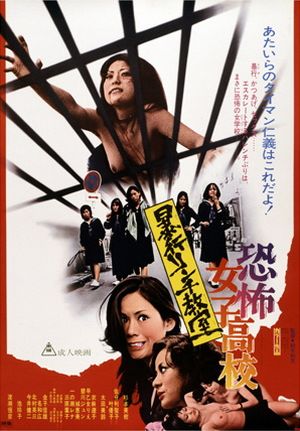
 This was the title that finally ‘broke’ Chris, and she wondered what the hell I was Googling to come across this movie. Shame she missed it, as despite some rather nasty sexual sadism, it’s among the best of the genre. Girl gang leader Noriko (Sugimoto) is assigned to the “School of Hope”, a morally-bankrupt educational establishment for delinquent girls. It’s principal is entirely ineffectual, and it’s actually run by the vice-principal (Imai), with the collaboration of the “Disciplinary Committee,” a group of the girls he allows to dish out punishment. Noriko isn’t going to stand for that, and teams up with a sleazy journalist (Watase) to bring down both the Committee and those in charge.
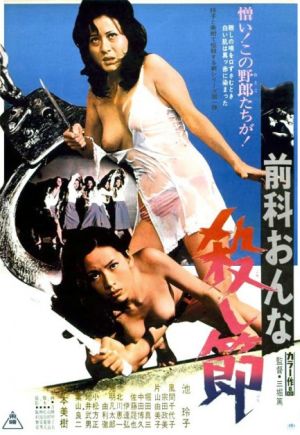 With a bit more of an intricate plot than most entries, this is the tale of revenge served cold. The Oba Yakuza gang shoot one of their flunkies up with drugs and dump his dead body in a ditch. His daughter, Maki (Ike), tries to stab the boss responsible (Hayama) in a nightclub, but she is, frankly, a bit crap with a blade; the attack fails, and she ends up in prison. There, after proving her toughness in a jail “I quit” match, she is accepted by the other girls, including the heavily-tattooed Masayo (Sugimoto). A few years pass, and Maki gets out of jail; her friends are waiting, and they agree to help in her plan for vengeance. This involves Tetsu, the psycho scion of the Hamayasu clan, who used to rule things before the Oba group came in and kicked their asses. Maki will use him as the scapegoat, to trigger war between the groups, then step in to take out Oba once he has been weakened. That’s the plan, anyway, with Maki whoring herself out, to (gasp!) foreigners and even (shock!) a black airman to get resources. However, a large spanner in the works is that Masayo is also Oba’s wife…