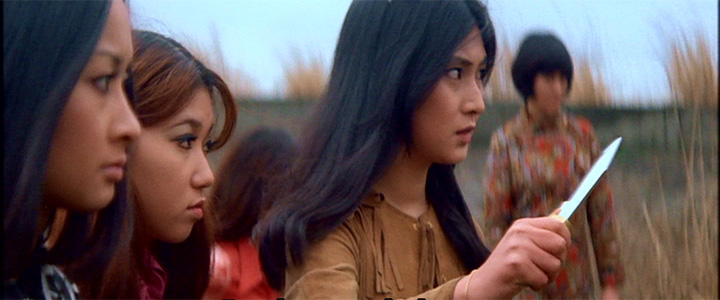

★★★½
“Faster pussycats who kill, kill.”
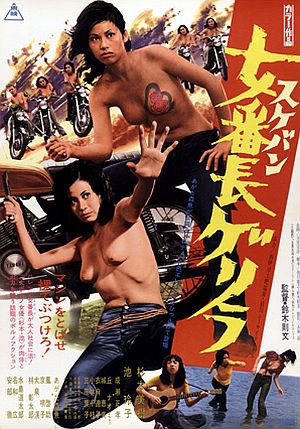 After my disappointing first foray, this is more like it, right from the moment Sachiko (Sugimoto) rips open her top, revealing a heavily-tattooed breast, before she and her Red Helmet Gang of biker chicks kick the asses of another, male gang who are hassling them. It’s clear that Sachiko deserves the title far more that the ‘Delinquent Girl Boss’. She and her crew from Tokyo head off to Kyoto, where they face off against, and end up taking control of, the local girl gang – some of whom are none to happy by this invasion [Kyoto being the former capital, its residents seems to hold a grudge against those from Tokyo]. Sachiko ends up on the wrong side of the local Yakuza, one of whom has a sister, Nami (Ike), who is an independent free-agent girl gangster, affiliated with none, but kinda over-seeing all. Sachiko meets and falls for a boxer, Ichiro (Mizushimi), after he helps her girls out of a tough spot with the Yakuza, and follows him to a seaside resort where he is training. Needless to say, love does not quite conquer all.
I really like the two heroines here, who are just about everything I expected from the genre, combining toughness and beauty, savagery and tenderness. Both actresses are excellent, fleshing out (pun not intended…) what could easily have been no more than shallow stereotypes. What doesn’t sit so well is the strange lurches in tone. Oh, look: here’s a (supposedly) hilarious sequence where one of the girls catches VD from a priest, then deliberately passes it on to the Yakuza! Oh, hold my aching sides… Then, there’s a bit of unintentional hilarity where a Japanese hippie sings a mournful lament to a dead friend, accompanied by his guitar – but the soundtrack is very clearly a piano. Barely have you finished rolling around the floor laughing hysterically at that, then there’s a genuinely nasty torture sequence involving rather a lot of topless whipping, which appears to have strayed in from a very different movie entirely.
This inconsistency of approach makes for a rather jarring experience, as it switches gears like a badly-maintained Model T, and seems at odds with the female empowerment present in much of the film. However, this still remains a pleasing slab of exploitation for the not-easily offended. Below, you’ll find what Youtube calls a ‘trailer’ but is really more a random selection of clippage; however, it’ll still give you an idea of what to expect.
Dir: Norifumi Suzuki
Star: Miki Sugimoto, Reiko Ike, Michitaro Mizushimi
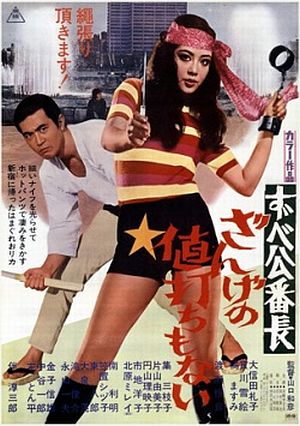 When Rika (Oshida) gets out of reform school, she goes to visit her friend Midori (Katayama), and gets a job working in the garage belonging to Midori’s father Muraki (Ban), even though Midori is estranged from him – except when she needs money to pay off her boyfriend’s gambling debts to the local Yakuza under Boss Ohya (Nobuo Kaneko). Another friend of Rika’s is working in an “art studio”, doing nude modelling to support her sick husband, and still others are hostesses at the Ginza Girls cabaret, a dance-hall which Ohya’s gang are also extorting for protection money. After Muraki has to take a loan using the garage as collateral to pay Ohya, Rika tries to offer herself as an alternative to the boss. This goes about as well as you’d expect, though there’s a genuinely cool twist in which we find someone isn’t quite who we seem. There’s a tragic fatality, which sets the scene for all the girls to get together and take on Ohya’s gang.