
Ouija Japan

★★
“Battle Royale, with cheese.”

This is a film with a really interesting idea; unfortunately, it’s one where the execution (and, indeed, the executionS) is not good enough to do it justice. There are just too many missteps to consider it successful, in more than intermittent spurts. These begin with having a heroine called Karen (Sekiya). I’m not sure if writer/director Kato is aware of the implications that name now has in the West, but I did spend much of the film waiting for her to ask to speak to the manager. Here, she has moved to Japan with her husband (Abe), and six months in, is having trouble fitting in. She’s struggling between her limited knowledge of the local language, and the bitchy behaviour of the other local wives, led by Akiyo (Kodaka).

She does have one friend, Satsuki (Chiba), who has her back. Still, it’s with some trepidation that Karen agrees to go on an overnight trip with the group. She has good reason to be concerned, as a session with Kokkuri-san, the Japanese version of the ouija board, brings down the wrath of a local fox spirit. In an rather odd development, the spirit pits the 16 people present against each other, in a Battle Royale style hunt from which only one can survive. As an added, technological twist, each gets an app on their phone, where they can, in effect, trade their own life-energy for power-ups, such as weapons or the ability to see what other players are doing.

In the right hands, with the right actors, and the right budget, this could have been immensely satisfying, perhaps along the lines of the glorious slaughter which was Tag. I’m unsure Kato is the right hands, am certain these aren’t the right actors, and it definitely needs more money to deliver on the concept. The story unfolds in an awkward mix of English and Japanese, and a lot of the time, the actors seem to be reciting their lines phonetically. Sekiya is the main problem: it says something that Chiba delivers a more convincing performance in English, her second language, than Sekiya manages in her native tongue. Even discounting the knee-jerk reaction to her name, you’re given little reason to root for Karen.

I would have been happy to forgive much of the above, had the carnage been up to much. There are no shortage of actresses in Japan who know their way around a fight sequence. I guess they were all otherwise engaged the weekend this was shot. Even at the lower end of the budgetary spectrum, the likes of Hard Revenge Milly or High Kick Angels show what can be accomplished. This rarely reaches the level of competent, and the whole app mechanism feels more like an excuse for lazy plotting. Quite what the fox spirit – which is, incidentally, just someone in a mask – gets out of this is equally vague. For a first draft of a script, this is excellent. For a finished movie, not so much.

Dir: Masaya Kato
Star: Ariel Sekiya, Miharu Chiba, Eigi Kodaka, Takeaki Abe

Offside (2019)

★½
“As dull as a 0-0 draw.”

Football is known as “The beautiful game,” but you wouldn’t know it based on this documentary, which seems perversely intended to remove anything like that from its topic. It focuses on Olimpia Szczecin, a women’s soccer team in Poland, as they prepare for the coming season. There’s your first problem. Team sports like this are inherently about conflict: there are winners and losers, but these are not determined on the practice field, and that’s where the film spends the bulk of its time. It’s simply not very interesting, unless you have a thing for watching women amble around a park, kicking balls at each other, jumping over low hurdles or being yelled at by their coach (Baginska).

There’s simply no narrative here which can attract interest. There are any number of threads which could have been used, if the film had bothered to explore or even explain them. For example, you’re never told – I had to Google this – that these players are actually amateurs rather than pros, so there’s the potential issue of striking a balance between their day jobs and their passion. Though we never see much “passion”. The only time the film reaches any genuine enthusiasm is when we see a coaching session for young girls, about the only ones in the entire documentary, who appear to be enjoying themselves. The coach also speaks about the importance of dealing with her players’ personal problems and keeping them off the pitch. Yet we never see this happening in any meaningful way.

A football season is inherently dramatic, fortunes ebbing and flowing over the course of meaningful competitive games. Yet this peters out before the campaign begins, robbing us of that tension. The entire season is instead described in a short series of terse captions. What little footage of actual play we see, is disjointed and impossible to get excited about. For example, they reach the final of an indoor tournament, where we’re told they are wearing white shirts, while their opponents are in blue. Except, the entire film is, for no good reason, shot in black-and-white and consequently, you can’t tell which side is which.

Outside of Baginska yelling at people, there’s no sense of any of the players having personalities or lives off the pitch. Why do they play? What are their goals? [Pun not intended] The film seems supremely disinterested in… Well, anything, to be quite honest. Rather than turning up with a story to tell, or even looking to find one, it feels as if they simply showed up for eight weeks in the off-season, due to an error in scheduling, but shrugged and made their film anyway. The irony is that, certainly in the UK, the women’s game has never been bigger, thanks largely to the English team winning the 2022 European Championships. If you told me this film was made by some American dude, to prove the validity of his belief that soccer is the dullest sport on Earth, I would believe you.

Dir: Miguel Gaudêncio
Star: Natalia Baginska, Roksana Ratajczyk, Kinga Szymanska, Weronika Szymaszek

Once Upon a River

★★½
“Initially hits the bull, ends up firing blanks.”

Margo Crane (DelaCerna) has been brought up by her native American father, since her mother walked out on them several years ago. Under his guidance, they have become self-sufficient, and Margo has become a crack shot. However, her creepy uncle ends up having sex with the teenager, an incident for which she gets blamed, ruining her life. She resolves to apply her shooting skills on him, only for the resulting incident to become a tragedy. Margo strikes out on her own up the Stark river, in search of her absent mother. Doing so, she meets a variety of people, then has to try and reconnect with a woman who now has her own life, one not necessarily helped by the unexpected arrival of a teenager.

The set-up here is remarkably engrossing, creating an interesting selection of characters that achieve depth in only a few minutes. Well, except for Creepy Uncle, who is almost entirely obvious, from the moment he invites Margo on a “hunting trip”, and certainly well before he offers to teach her how to “skin deer”. The period up to the unfortunate turn of events could well have been expanded to an entire movie, rather than compacted into a terse 25 minutes. That’s all the more so, because once Margo hits the river, the film loses much in the way of narrative thrust. Certainly, her talents with a firearm become all but irrelevant, and the film instead gets bogged down in its own drama.

It instead goes further down the character-driven path, such as the old geezer whom Margo helps, or the young man she encounters who is rather more in touch with (read: gives a damn about) his Native American heritage. Though it’s hard to tell with Margo, due to her subdued nature: it’s not often that she says more than a sentence, and seems particularly adept (out of necessity?) at keeping her emotions in check. Which makes for an increasingly frustrating viewing experience, the equivalent of deciding whether to buy a house, without being allowed to enter it. Then there’s an abortion subplot, awkwardly shoehorned in, without any particular effect on Margo’s character arc.

It’s all especially annoying, since Margo is initially set up as being a decisive character. The encounter with her uncle could have been depicted in a way that turned her into a victim. Instead, it’s more the repercussions thereafter which are the problem, and cause her to resort to violent action. After finding her mother (Pulsipher), in particular, she never seems to find a purpose to replace her maternal quest. She’s like a dog that has finally caught the car it was chasing. “Now what?” is the resulting question, and the movie doesn’t provide enough of an answer. It ends up falling awkwardly between a number of stools, being not-quite a coming of age film, nor a social drama, and there’s no sense of resolution. If your reaction when the end credits roll is greater than “Huh”, you were more affected than I was.

Dir: Haroula Rose
Star: Kenadi DelaCerna, John Ashton, Tatanka Means, Lindsay Pulsipher

Omega1

★½
“Motion without emotion. “

It probably didn’t help that I watched this the same day as I finished off the slick, well-animated and occasionally downright beautiful Arcane. This is… not any of those. Well, that’s a bit unfair. The artwork in this “motion comic” is actually not bad (the cover, right, is certainly striking, if not exactly representative!). But being taken off the printed page diminishes the impact considerably, especially when combined with some genuinely terrible voice acting. The setting here is… let’s be honest, it’s Johnny Mnemonic, a good cyberpunk novel by William Gibson that became a not-so-good Keanu Reeves movie. In both worlds, data is now transferred in the heads of human couriers, this being deemed safer than online methods which are vulnerable to hackers. Megan is one such courier, capable of defending her cargo with extreme prejudice.

Except, it turns out there’s considerably more to her past than even she knows, as becomes clear after a client tries to assassinate her. Thereafter, things get increasingly complex, with a host of friends, enemies, enemies pretending to be friends, and a slew of Alphas, which are clones based on the DNA of Meg, a.k.a. Omega. It’s all a) rather confusing, and b) not very interesting. Though it’s a bit of a vicious cycle. b) triggers an attention deficit, which acts as a force multiplier on a), then this feeds back into b). I actually did give up about two-thirds of the way through. But much like Battered, the short running time (53 mins here) was its saving grace. Realizing there were barely 15 mins left, I put it back on. Though I will not be taking questions on plot developments in that final section. 

The structure here is also off-putting, with the story separated into episodes, no longer than five minutes, which interrupts the flow in an annoying and pointless fashion. Just tell the damn story. But my biggest gripe was the voices, though Andrei as Omega isn’t the problem. It’s a supporting cast who could, almost universally, be replaced by a speech-to-text program, with positive results. And that’s not even mentioning the bad, fake foreign accents, e.g. Russian (or maybe it was French. Hard to tell) and Spanish. Considering there’s not even lip-synching to consider, in this unanimated format, it’s a poor effort indeed.

Maybe it’s just me. Perhaps I need to watch one of these every few years, to be reminded of how crappy the motion comic concept is. For on the basis of this, it seems to combine the worst elements of both comic books and animation. However, it may not be fair to judge the whole medium, on the basis of what seems a badly executed example. There were a couple of moments where the conversion process was reasonabe, and the effect of the comic panels came through as adequately realized. But overall, this was a poor excuse for entertainment. The “To be continued” caption at the end, seemed more like a threat than a promise. 

Dir: Mark Edward Lewis
Star (voice): Alina Andrei, Mark Edward Lewis, Jan Shiva, Teresa Noreen

Okay Madam

★★★
“Okay enough to work”

This probably falls into the category of lightly amusing, rather than anything more. But I can’t say I was ever bored, and it’s assembled well enough technically that I can’t complain. The heroine is Mi-Young (Uhm), a former North Korean agent, who defected, changed her looks through plastic surgery, and now lives a quiet existence, with a part-time job selling pastries in the local market. She’s married to Seok-Hwan (Park), a computer repairman, and their life is frugal as far as wealth goes. Seok-Hwan, however, is wins a promotion run by a soft-drink company, getting them and their young daughter a trip to Hawaii.
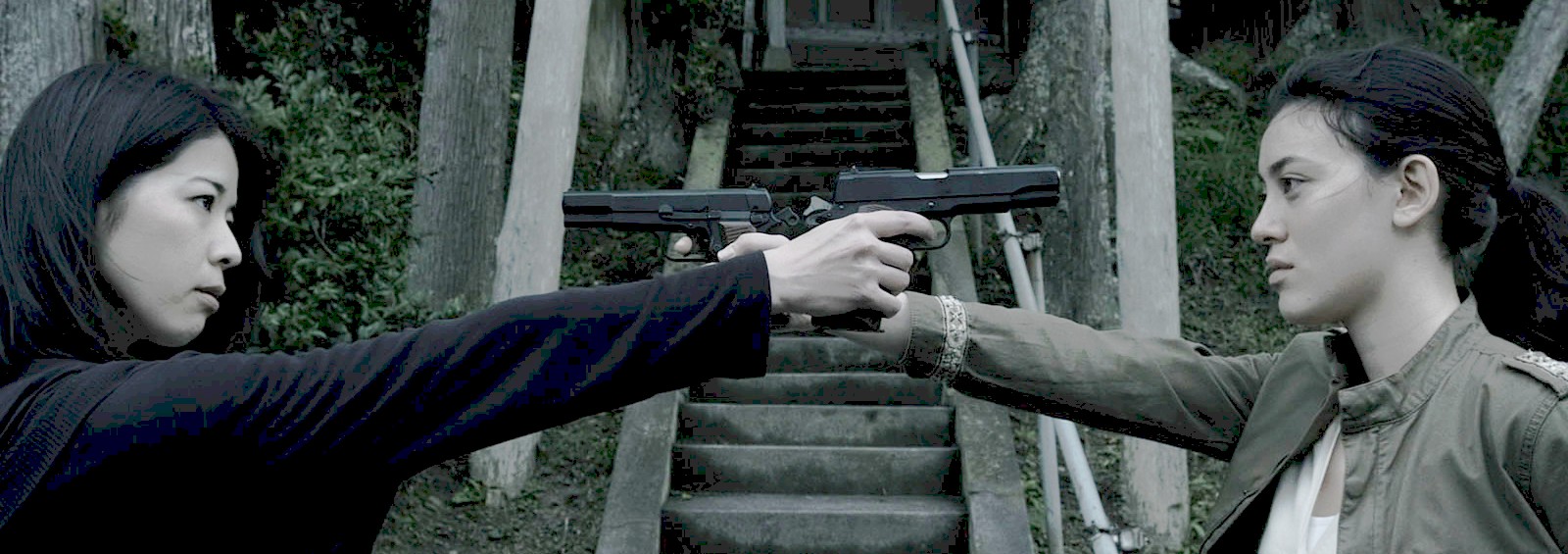
It turns out the North Koreans still have an interest in ‘Magnolia’, as Mi-Young was formerly known, and need her (specifically, her iris) to unlock some nuclear protocols. They learn she will be on the plane to Honolulu, yet are just not sure which passenger she is. So they hatch a plan for former partner Cheol-Seung (Lee) to hijack the craft, identify and abduct Magnolia, and parachute out, blowing up the aircraft in their wake. Mi-Young is fortunate enough to be in the bathroom when things kick off, so is able to avoid immediate detection. On the other hand, she’s now separated from her husband and child. Both she and Seok-Kwan will need to rely on their skills – long-dormant in the case of Magnolia – to defeat the hijacks before they can execute their explosive intentions.

This one initially slid past me entirely; looking at the poster, it’s very easy to overlook the gun held by the heroine. And, to be honest, this is as much a comedy as hard-hitting action. In that mix, it’s a bit reminiscent of My Wife is Gangster [damn, that came out 20 years ago?], with a reliance on culture clashes or inappropriate actions and speech for its humour. However, it did work pretty well, helped by a good number of interesting side characters. For example, there’s a paranoid air steward who wants to be a hero; an irritable congressman; and an actress who is initially suspected of being Magnolia, due in part to her action movie filmography. Though some of the cultural stuff definitely flew above my head, a decent amount is sufficiently global to work.

The cramped surroundings of the aircraft – even if Business Class is like the African savanna in comparison to the economy spaces we occupy – make a interesting setting for hand-to-hand combat, and help excuse the lack of guns. We’ve seen former singer Uhm before here, starring in Princess Aurora, and she acquits herself well in this. While I suspect some doubling for the more athletic moments, it’s done competently enough to pass muster. I would prefer to have seen more action, in fact, and a little less of the dramatic elements, though that’s more likely my problem than that of the intended audience. I will likely never watch it again, yet don’t feel it was a waste of 100 mins.

Dir: Cheol-ha Lee
Star: Uhm Jung-Hwa, Park Sung-Woong, Lee Sang-Yoon, Bae Jeong-Nam 

On The Edge

★★★½
“Makes a good point”

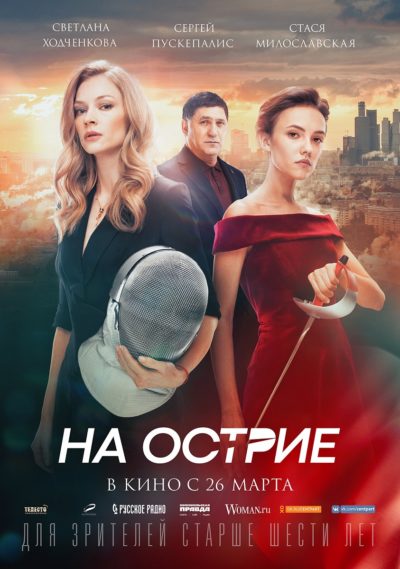
Whenever the Olympics are on, we love watching the weird sports that never get covered the rest of the time. That means things like handball, archery and fencing, so I was particularly interested by this Russian film, based around the quest for gold in the women’s sabre event. While it does struggle to move past the usual cliches of sports films, it’s done with enough energy to work. The two protagonists are Aleksandra Pokrovskaya (Khodchenkova), a veteran coming to the end of a long, successful career, and Kira Egorova (Miloslavskaya), a brash teenager who arrives on the scene with a blast, and whose unconventional style causes fits among other fencers. Aleksandra has one final crack at the prize which has eluded her – an Olympic gold – but Kira poses an unprecedented threat to that ambition. 

Yeah, like I said: it’s pretty much Sportsball Movie #4. You know from the start that Aleks and Kira are going to bash heads, but eventually come to a mutual respect for each other’s talents and abilities. Nor is it any surprise when Kira suffers a potentially career-ending injury, and Aleks overcomes her concerns to nurse her back to health [in fairness, she was partly responsible for the incident]. And could the two fencers possibly end up facing each other in the final match at the Olympics? Wild horses could not drag that answer to that question from my lips. 

Oh, who am I kidding. Of course they do. But it is to the film’s credit that I genuinely did not know how that was going to turn out. For the makers do a very good job of giving us two well-developed characters. Rather than protagonist/antagonist in the Rocky mould, we get two protagonists, each with their own set of motivations and ambitions. Initially, Kira seems the less likable of the pair, but the more we learn about her background, such as the fraught relationship with her father, the more I came to understand her abrasive personality and don’t give a damn attitude. [Khodchenkova may be familiar, as she has appeared in some Western movies, including The Wolverine and Tinker, Tailor, Soldier, Spy]

It is an issue that fencing at the top level is astonishingly fast. It’s not like cinematic sword fighting, where battles go on for minutes. Here, if your first attack doesn’t hit the mark, you’re likely to find yourself on the receiving, pointy end of your opponent’s weapon. But Bordukov does a good job of capturing the speed, and making it work for the film’s benefit, rather than its detriment. While there may be precious little about the storyline that’s original, it still makes for an engaging couple of hours. If you weren’t a fencing fan before, this might change your mind. So, that’s fencing out of the way, and we already had our Olympic archery movie. and handball film. I just need to find a synchronized swimming movie – and, don’t be fooled, they are hardcore – then I’ll be happy.

Dir: Eduard Bordukov
Star: Svetlana Khodchenkova, Stasya Miloslavskaya, Sergei Puskepalis, Alexey Barabash

The Obsidian Curse

★★
“Cursed or worse.”

Blair (Brauns) gets out of prison, after a year inside for drug offenses, and is shocked to find her boyfriend (Caraccioli) has married Yvonne (Cameron), who has become the step-mother of her young child. Worse follows, for visitation is contingent on Blair finding and maintaining regular employment – not easy given her rap sheet. Her boyfriend’s new wife, very kindly, points her in the direction of a job as a tour guide at a local cavern. So far, this sounds more like some kind of Lifetime TVM – and not even the good Lifetime TVM – to the point I was wondering why I had this one on my ‘to-do’ list.

Ah, here we go. For, it turns out, the cave system is home to a witch who has been infected with a curse. Blair has become the patsy who is going to take the curse off. And it’s a particularly nasty curse, which basically turns her into a magnet for evil creatures of all kinds, from zombies to vampires. If she’s going to see her daughter again, “maintaining regular employment” has just become a relatively minor problem. I love this idea. It’s like a more feisty and action-oriented version of Night of the Demon [the fifties movie, rather than the eighties one], with the concept of a curse which cannot be dispelled, it has to be passed on to someone else to get rid of it. The concept of Blair having to figure out how to do that, while simultaneously fending off a selection-pack of night creatures, is one with great potential.

Unfortunately, it’s not what we get, at all. To begin with, there’s the ending [spoilers follow]… Well, it doesn’t have one. There’s absolutely no sense of closure. Blair is still cursed, little or no closer to finding a solution, and separated from her kids. I’ve grown used to this kind of thing in books, where you’re given the first volume free, then left dangling to try and get you to buy future volumes. It doesn’t work there, and here, the movie doesn’t even have the grace to inject a cliff-hanger ending into things. It just… finishes, lying there like last night’s empty beer-cans. [spoilers end] Nor is there any escalation: you’d expect things to ramp up, towards a battle against a particularly Big Bad. Nope.

On the positive side, the monsters are surprisingly well-realized for the budget, with some particularly effective mask work. And despite a strange accent, Brauns (from Sweden, reaching Los Angeles via England, New Zealand & Australia – which explains the accent far better than the movie does!) is a decent heroine, driven by her strong maternal love. There is some good camerawork, not least a sequence in which Blair has to battle her way across some heathland, through a small army of zombies. However, neither this, nor even a cameo from horror icon Bannister (star of the Phantasm franchise), can come close to countering the thoroughly underwhelming effort, put into what’s little more than half a story, and missing any final climax entirely.

Dir: Rene Perez
Star: Karin Brauns, Cody Renee Cameron, John Caraccioli, Reggie Bannister

The Old Guard

★★★
“Who wants to live forever?”

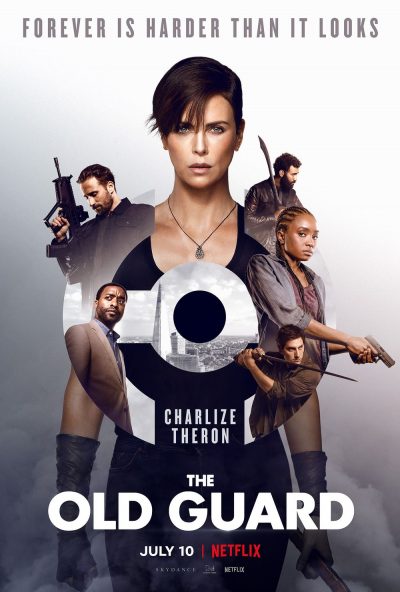
While a serviceable entry in the beloved genre of “Charlize Theron kicks ass”, this does have to be classed as disappointing in comparison to the epic awesomeness which were Atomic Blonde or Mad Max: Fury Road. This is considerably more obviously a comic-book adaptation than Blonde, and more restrained than Fury Road, resulting in a film which plays more like X-Men: The Highlander Years. Andromache of Scythia (Theron), for obvious reasons known to her mates as Andy, is a neo-immortal bad-ass who has been roaming the Earth since pre-Christian times. But she’s beginning to wonder what the point of it all is, endlessly doing jobs somewhere between mercenary and humanitarian.
Two things disrupt the playing field. The first is the “birth” of a new neo-immortal, Nile Freeman (Layne), a US marine who survives having her throat slit, and is brought on board the team, despite her severe initial doubts. The other is less pleasant: the Merrick pharmaceutical company is out to find what makes them tick, and will happily trample Andy and her friends’ rights, in the name of “the greater good.” This involves them kidnapping two members of the group for scientific experimentation, and they are intent on completing the set. Needless to say, Andy isn’t having any of that, along with some help from Nile, as well as a Merrick employee and former CIA agent who is now having second thoughts (an underused Chiwetel Ejiofor). However, it turns out Andy is approaching the “neo-” phase of her neo-immortality…

That is a bit of a cheat: they’re basically immortal, except when necessary for the plot or dramatic reasons. It’s a double-standard which also seems to permeate the film more generally, The film wants to deliver the mayhem audiences want to see, while having characters who loudly express being tired of exactly that, borne down by world-weary ennui. It’s a mindless action movie which doesn’t like being a mindless action movie, and I suspect would rather be something else. That may be the only way to explain the contrived shoehorning in of two characters’ sexuality, in a scene of no relevance that couldn’t be more clunkily woke if it tried.

It is better when letting go of the angst, and instead embracing its inner John Wick. Theron proves why she is still the top action heroine working in Hollywood, getting valuable support from Layne. There’s a lovely hand-to-hand battle between the two of them on a transport plane, for example, and Andy busting out of the church which is under attack by Merrick thugs is also a pleasure to watch. As seems almost required, there’s a scene at the end, setting up The Old Guard 2 with the apparent promise of an insane neo-immortal for the big bad there. It’s perhaps telling that it’s a prospect which may be more exciting than the humdrum stock genre plot rolled out here. Not even the best Netflix original action movie of the year (that’d be Extraction), yet entertaining enough, if your copy of Fury Road isn’t to hand.

Dir: Gina Prince-Bythewood
Star: Charlize Theron, KiKi Layne, Matthias Schoenaerts, Marwan Kenzari

Outlaw Women

★★½
“In which Iron Mae eventually breaks.”

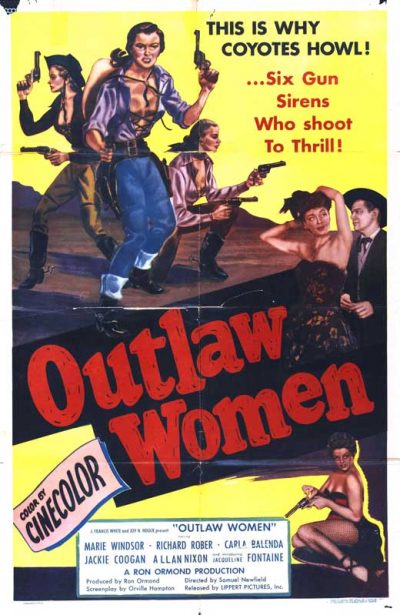
The city of Silver Creek is on the way out, and many of its inhabitants are leaving, including town doctor Bob Ridgeway (Nixon). Originally heading to Kansas City, he is convinced at gunpoint to take up a position instead in “Las Mujeres.” That’s Spanish for “The women,” and is an appropriate name since the place is a gynocratic society, where the ladies are in charge. Top of the heap is Iron Mae McLeod (Windsor), who runs the local saloon and ensures that the the other women in the town are kept safe from exploitation. She does, however, have to navigate the straits between aspirational gambler Woody Callaway (Rober) and outlaw Frank Slater. Ridgeway, meanwhile, because the target of affection for both Beth Larrabee (Balenda), one of Mae’s enforcers, and her big sister and star of the saloon’s show, Ellen. But when all of Mae’s money is about to be transferred out of Silver Creek, and becomes a target for Slater and his gang, romance has to take a back seat.
This was shot in Cinecolor, at a time (1952) when many more expensive productions were still in black and white. That helps up the production value, though it otherwise remains an obviously low budget approach. It’s a shame the makers didn’t quite use that freedom to make something truly subversive. The ending instead manages to be almost cringeworthily patriarchal – particularly following, as it does, a gun-battle in which we see, again, that firearms are the great equalizer, allowing Mae and her gals to play their part in holding off the outlaws. Up until this disappointing coda, it has been a fairly decent romp, with Windsor holding things together effectively. She gets good support from Balenda, as well as Maria Hart, playing bouncer Dora. She casually manages to judo-flip the fastest gun in Silver Creek, after he refuses to give up his gun, while simultaneously disarming him. Dora can also strike a match on her teeth, an impressive party trick for either sex.

Coming in at a brisk 75 minutes, it still manages to waste some precious time, on things like musical numbers by a barbershop quartet called The Four Dandies. tnd The film doesn’t delve into the implications of its idea as far it might. Despite the noble intentions of Mae, Las Mujeres seems little if any different from any other town in the wild West. Though that could be the point, I suppose. I did like the pointed way in which the system – in the form of male-only suffrage – is the tool used by Callway to dismantle Mae’s gynocracy. Though as noted, the ending manages to embarrass the entire film, effectively dismantling the strong portrayal of Mae which we had enjoyed to that point. That aside, there’s no denying the movie remains well ahead of its time, paving the way for probably better entries, such as Johnny Guitar and Woman They Almost Lynched, later in the decade.

Dir: Sam Newfield, Ron Ormond
Star: Marie Windsor, Richard Rober, Allan Nixon, Carla Balenda

The Odds

★★
“Odds against.”

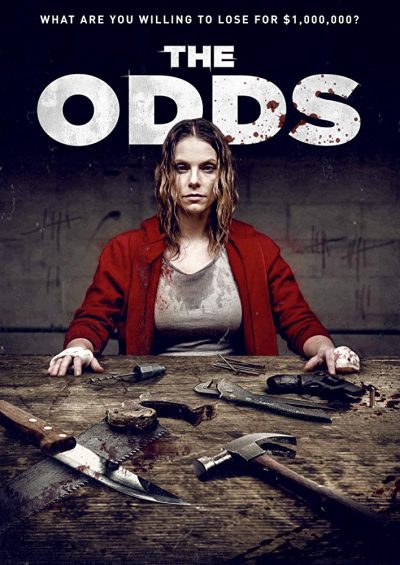
A woman (Butler) agrees to take part in a contest. live-streamed for betting purposes, where 20 players are put through a series of tests, designed to push them to the physical and mental breaking point, with the (literally) last person standing getting a million dollars. Her only associate is the Game Master (Fuertes), who oversees the challenges and relays the results from the other location to her. Initially, it seems like he is on her side, cheerleading and encouraging her. But the further into the event she proceeds, the more questionable his actions become, to the point where she begins to doubt everything he tells her.

It’s a not-exactly subtle metaphor for abusive relationships: once you’ve realized this, the impact is like being repeatedly whacked across the nose with a newspaper. I get it. I GET IT. I GET IT!!! Which is why it starts off with the man being super-nice and friendly, only to become completely controlling, and potentially “gaslighting” the woman with false information, playing his own game of manipulation in an effort to keep her obeying him. All far too obvious: a pity, since a straightforward rendition without the undertones, could have been perfectly fine. The unnamed woman is apparently taking part to make up for past transgressions involving her child, which is plenty to have driven the story, yet this aspect is largely forgotten as we move on.

The structure of the game doesn’t make sense either. After the five preliminary rounds (involving fire, rats, drilling, drowning and de-digitification, should you want to know), it turns into a game of Russian Roulette. Whose outcome is entirely determined by luck, rather than being any particular measure of endurance. Might as well have watched the heroine playing a slot-machine for a bit. Even the film eventually seems to realize the limited interest of repeatedly watching someone pulling a trigger and it going click. For it opts to skip through the rounds with increasing speed, in order to reach the final denouement, where everything you’ve learned might or might not be wrong.

This is clearly one of those films which were written to be cheap, with two speaking roles and a single location. I don’t fault it for that: it’s wise for any film-maker to build something which fits the available resources, and the main thing is that both leads here are decent. Butler, in particular, has an intensity about her which goes a long way to making you understand why someone might sign on for something like this. But my level of interest was far from consistent. It started off high enough, lured in by the interesting concept. However, it dropped off due to the unimaginative nature of the challenges. Things perked up for a bit when I realized the metaphor aspect. At least until I realized it was going to grind the whole thing into the ground, which also made it too easy to predict what would happen next. That’s where enthusiasm settled, and I’m willing to bet you can find more effective uses for your viewing time.

Dir: Bob Giordano
Star: Abbi Butler, James J. Fuertes