
Strong Girl Bong-soon

★★★
“A not unpleasant Korean stew.”
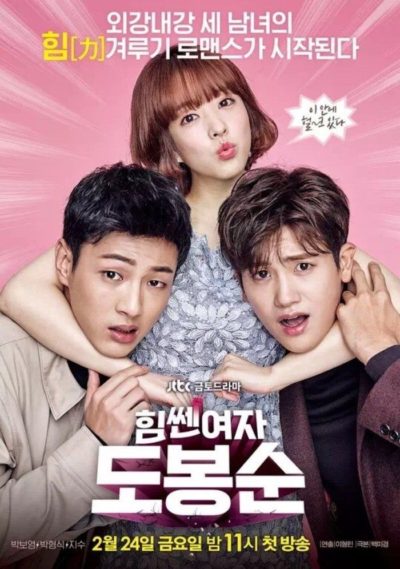
The 16-part series proved an unexpected sleeper hit in its native land, more than doubling the audience from debut to finale. This is all over the place in terms of genre, with comedy, thriller, romance and action threads. While they aren’t equally successful, it does a pretty decent job of managing most of them, and is surprisingly accessible for a Western audience. The heroine is Do Bong-soon (Park B-Y), the latest in a matriarchal line of very strong women. She has been brought up to keep her power suppressed, due to the potential issues it can cause; Bong-soon has also been warned that if she misuses them, and hurts an undeserving person, they will go away. [Let’s not worry too much about how this presents an easy solution: slap one innocent, and she would become just like everyone else…]

Additionally hampered by low self-esteem, she has so far largely flown under the radar, but that ends when she stops someone from being bullied by an organized crime gang. The incident is witnessed by Ahn Min-hyuk (Park H-S), head of a game company, who is dealing with a stalker and hires Bong-soon as his bodyguard. She starts to fall for her boss, but is conflicted due to having feelings for long-time friend, In Guk-doo (Ji). He’s now a local cop, investigating a series of kidnappings which have terrorised the local area.

All these threads and more, intermingle and develop over the course of the series. The crime gang, who are trying to redevelop the area, seek revenge on Bong-soon, only to become semi-permanent residents in hospital. A group of young local wannabe gangsters turn to Bong-soon as their leader. Her parents go through relationship difficulties. The psycho kidnapper’s attentions target a victim too close to our heroine for comfort. She tries to leverage her bodyguard position into achieving her ambition, which is to design video games. She has a gay supervisor, who has a crush on their boss. Yeah, there’s a lot going on here: everything from a soppy post-teenage love-triangle to something which borders on Silence of the Lambs.

Credit is due, therefore, that the end result is even watchable, given this scattergun approach, though obviously some elements are not very interesting from my perspective. It’s hard to see quite who might enjoy all the angles; on the other hand, perhaps this is a case of there being something for everyone? Park B-Y is admirably deadpan as Bong-soon, dealing with the bizarre hand life has dealt her, and the action scenes, although less frequent than I’d like, are decently handled: the highlight is probably her duel with the entire crime syndicate in a warehouse. It works better for me in the first half, when the various elements gel into a more coherent whole: later on, it becomes almost entirely about the kidnapper or the love triangle, and the switches in tone feel more jarring. I can’t say I’m eagerly anticipating a second series, yet didn’t mind what’s certainly a different take on the genre of super-powers.

Dir: Lee Hyung-min
Star: Park Bo-young, Park Hyung-sik, Ji Soo, Jang Mi-kwan
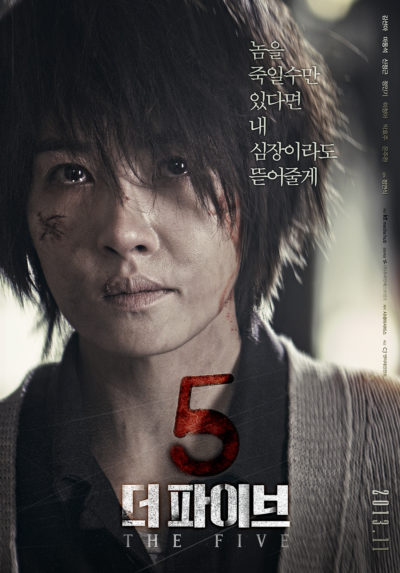
The Five

★★★½
“Live organ donor.”

A chance encounter in a convenience store destroys the life of Go Eun-ah (Kim). For her young daughter accidentally sees serial killer Oh Jae-wook (On) abducting his next victim. Realizing he has been spotted, Jae-wook carries out a brutal home invasion, killing both the daughter and Eun-ah’s husband, and leaving her permanently paralyzed. But he has reckoned without Eun-ah’s fortitude. She devotes the rest of her life to tracking down her attacker, and puts together a team of four to help her. All need transplants, for them or their family. So Eun-ah has promised that once Jae-wook has been captured, delivered to her and killed, she will give them her organs. Damn. That’s what I call “fully committed”… But when Jae-Wook realizes he is being hunted, he turns his attentions on the hunters.
Revenge seems to have been a strong theme in the Korean cinema we’ve covered here – Lady Vengeance, Princess Aurora and perhaps most closely, Monster. This perhaps falls a little short of the best of those, but is by no means a bad movie: it’s executed with plenty of style, and the twists and turns keep coming from beginning to end. This was Jeong’s first feature, not that you’d know it, and is based on his own web-comic. This has a very strong concept, and though it may seem implausible, the set-up is done with great care, putting together the elements in a way that it all seems credible. And even though confined to a wheel-chair, Eyn-Ah’s place here is secure, from the scene where she believes she spots Jae-Wook in the street, and wheels herself after him frantically, a long knife in her hand.

The first half is particularly good, explaining why Eyn-Ah came to such a desperate place, and how she linked up with others who are equally desperate in a different direction. It’s certainly consistent in tone, and if you’re looking for some frothy entertainment, you should stay well away: there isn’t much light to be found in this darkness [though I did laugh at the guy Eyn-Ah captures during her investigation who protests, dead-pan, “Madame, two Tasers in one day!” Ok, you probably had to be there…]. This is especially true of the ending, which I must admit, I found the weakest part of the film. It could have been considerably more satisfying, both in the consummation of Eyn-Ah’s revenge and her eventual fate.  At one point it feels as if her old skills – early on, we see her creating a wonderful Rube Goldberg machine for her daughter’s birthday – are going to prove gloriously relevant, and it’s a shame they aren’t.

However, perhaps this is the point. As Eyn-Ah is told by the (very Christian) caregiver, who initially takes care of her on release from hospital, “Revenge may feel sweet before you do it, but he’ll haunt you forever.” Maybe Eyn-Ah’s entire scheme is a way of avoiding this guilt. If so, I can’t deny its ultimate success.

Dir: Jeong Yeon-shik
Star: Kim Sun-ah, On Joo-wan, Ma Dong-seok, Shin Jung-geun

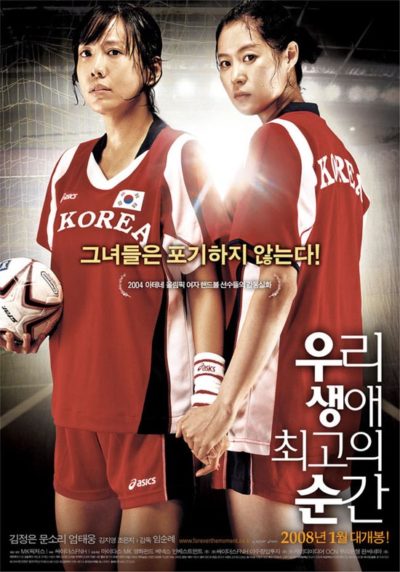
Forever the Moment

★★★
“Women with balls.”

Every four years, when the Olympics arrive, we fall in love with handball. What is handball, you might be asking. Basically, think seven-a-side soccer, except (obviously), played with the hands rather than feet. It’s an amazing sport, all but unknown in the UK and US, and deserving a far wider audience – a YouTube search for “Olympics handball” will get you sorted. Which is why we were fascinated by the idea of a film focusing on it, specially, the story of the 2004 South Korean women’s team. What they did was roughly that country’s equivalent of the 1980 ‘Miracle on Ice’. The once-dominant Korean team had fallen far from grace, and barely qualified for the Athens Olympics. But they reached the final, against the Danish side, which went into double overtime, and then a penalty shootout.
Yeah, much of this is a compendium of sports cliches, right down to the requisite training montage. The fact it’s largely based on true events does not exonerate the movie from criticism here, though I was impressed how closely the depiction of the final match did mirror the real thing, still regarded as an all-time classic contest. Thus, you get tropes such as the veterans, brought back for one last crack at glory, such as Han Mi-sook (Moon), who is now working in a grocery store to try and make ends meet, after her husband is defrauded by his business partner. They inevitably butt heads, both with the younger players, and new coach Ahn Seung-pil (Uhm), who is not only the replacement for interim coach Kim Hye-gyung (Kim J-e), but also her ex. There may eventually be bonding. I won’t spoil that.

It would be very easy for this to topple over into sentimental cliche, yet the strength of the performances generally help it stay just in bounds. Director Im seems particularly interested in developing her characters, and they come across as especially real, as they progress from a sparsely-attended opening game to the cauldron of the Olympic gold medal match. Especially memorable is the feisty Song Jung-nan (Kim J-y), who won’t back down from any confrontation, most notably when some of the other athletes at the Korean training complex try to bully some of her team-mates. Weightlifters or judokas, all learn quickly not to get in her way.

I should mention, you don’t need to know much about handball, since it’s largely self-explanatory. Though even our relatively untrained eye could detect the difference between the actresses playing the game, and their opponents who are the real thing, being actual professionals from a Danish handball club. For the Korean audience, there won’t be any surprises in the eventual outcome; that’s an area where the movie perhaps had a greater impact on us. Im handles the final moments particularly deftly, not even showing the final shot, just the reactions to it, and finishing with archive post-game interviews from the real participants. These do an excellent job of bringing home the reality of what happened.

At a length of over two hours, we could likely have done with more handball and less personal drama (not to mention the unfounded suggestion of biased officiating). Yet I’d be hard-pushed to consider the time wasted, and it was nice not to have to wait until 2020 to have our love of the game rekindled once more.

Dir: Im Soon-rye
Star: Moon So-ri, Kim Jung-eun, Kim Ji-young, Uhm Tae-woong

The Villainess

★★★½
“Action cinema levels up in Korea.”

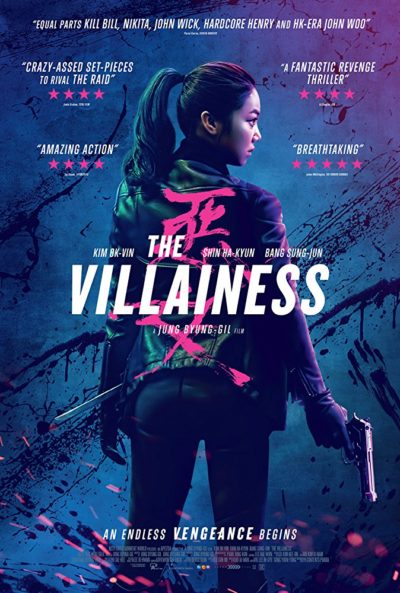
This opens with a blistering seven minutes of action which starts off in first-person perspective, looking like the most deranged video game ever, as the protagonist slices, dices and shoots their way through a building to a confrontation with the final boss. After being slammed head-first into a mirror, the point of view changes and we see the attacker is a young woman, Sook-hee (Kim Ok-bin). Finishing her slaughter, she calmly accepts arrest, but the Korean intelligence services recruit her, hoping to channel her skills to their own ends, after a spot of plastic surgery to ensure a fresh start. When training is completed, under Chief Kwon (Kim Seo-hyung), she’s given an apartment, unaware that the man next door, Jung Hyun-soo (Sung), is actually her handler. However, he’s not the only person with something to hide. Because Sook-hee is out to leverage her new position, and is still after long-awaited revenge on the man who killed her father.
With a storyline that’s little more than equal parts of Nikita and Kill Bill, deep-fried in a crimson vat, the only way this is going to survive is to be all about the style. Fortunately, it delivers on that aspect by the bucket. I watched that opening sequence three times before I could bring myself to proceed, and other set-pieces are almost as spectacular (and slightly less motion sickness inducing!), such as the sword-fight on speeding motorbikes. Or the final battle on a bus. Or… Yeah, let’s just say, when this is in motion, it’s utterly glorious, demented and bloody beyond belief. The problems are when it isn’t, with a horribly muddled narrative structure which also seems cribbed from Tarantino. So it’s extremely heavy on the flashbacks, and leaps around the heroine’s time-line like an amphetamine crazed mountain-goat. The payoff, when it arrives, certainly isn’t worth the effort: I’d figured it out, well before the dramatic revelation arrives on-screen.

So convoluted and murky is the story, that I found myself increasingly tuning out, and was more or less disinterested in the characters’ fates, most damningly that of Sook-hee. About the only person I cared about was her little, moon-faced daughter, whose serious expressions provoked more emotion in me than all the contortions performed by the plotting. Director Jung, like David Leitch of Atomic Blonde, has a background as a stuntman before moving into direction, and perhaps that explains why it feels as if the attention and effort here have gone into those elements. In comparison, the script is something which could well have been cobbled together on the back of a beer-mat, after an all-night video session, and then run through a shredder in an attempt to instill it with some artistic merit. Jung is certainly an action director to watch, and I’ll be very interested to see where he can possibly go from here. Is there a setting for cinematic violence above eleven?

Dir: Jung Byung-gil
Star: Kim Ok-bin, Shin Ha-kyun, Sung Joon, Kim Seo-hyung

Memories of the Sword

★★★
“Looks lovely, yet literally loses the plot.”

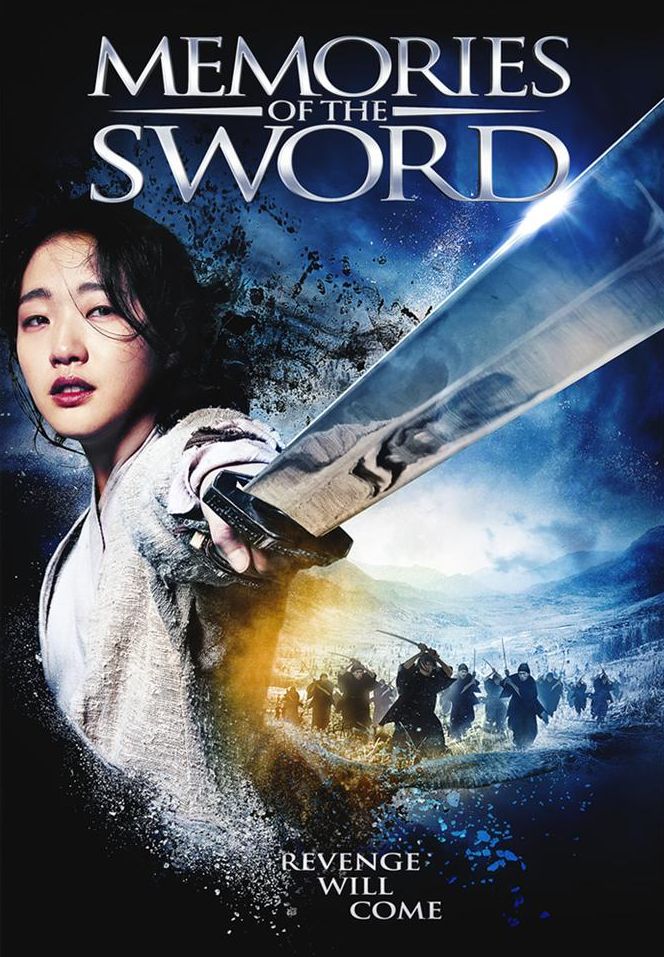
memoriesoftheswordThe first 30 minutes of this are truly splendid: it’s got wonderful visuals, along the lines of Hero or House of Flying Daggers. But then, it’s as if the makers completely forgot about the story-line. The remainder of the two hours consists of semi-random scenes, half in flashback, featuring characters who apparently change names at random. While it still looks awesome, unless you have a detailed synopsis printed out in advance, you’re going to be reduced to going “Ooh!” and “Eh?” in roughly equal proportions.

As best as I can tell, the story is this. Hong-ee (Kim), also known as Seoi-hee, is a young martial arts prodigy, trained since birth by her blind foster mother, Seol-rang (Jeon), a.k.a Wallso. After Hong-ee’s talents become public knowledge, Wallso reveals the motive for the training. A long time ago, as Seol-rang, she was one of three rebel group leaders. The group were betrayed to the authorities by another leader, Deok-gi (Lee BH), who was rewarded with a position as the ruler’s right-hand man, and is now known as Yoo-Baek. He once loved Seol-rang, and realizes that Hong-ee is the daughter of the third leader, Poong-Cheon. [Fortunately, he was killed by Deok-gi, so does not complicate the plot further, under that or any other name] She has been brought up to act as an instrument of revenge, driven by the knowledge that Yoo-Baek killed her parents.

There is, it appears, a bit more than that going on, particularly in the middle hour where… other stuff happens. For example, there’s the inevitable romance between Seoi-hee and another young fighter, Yoo-Baek’s champion, Yull (Lee JH). This seems to have been added purely for cynically commercial purposes, though since it largely tanked at the Korean box-office… The action scenes are generally well-staged, though some of the CGI looks more than a little unconvincing. Some moments reminded me of Shaolin Soccer, and there has been close to 15 years of technological advances since then. It’s on more solid footing when using wire-fu, and both female leads are convincing enough in their skills.

The high level of confusion likely generated, however, means this isn’t going to be much more than empty emotional experience. You’re left so busy trying to figure out who’s doing what to whom, and why, you don’t have time to care about the participants. That’s why it falls so significantly short of the films it’s clearly trying to imitate, particularly Crouching Tiger. Instead, what you have here is purely cinema as spectacle. Not that there’s anything inherently wrong with this approach, of course. It’s just that when so much effort has been put into the technical aspects, you’re inevitably left wishing for more. If only the film’s heart and soul had been as diligently worked on as its cinematography.

Dir: Park Heung-sik
Star: Kim Go-eun. Jeon Do-yeon, Lee Byung-hun, Lee Jun-ho

Mother

★★★½
“The truth? You can’t handle the truth!”

motherBong is best known in the West for recent SF film, Snowpiercer, and also for monster movie The Host, but this, which came between those two, is somewhat less of a genre piece. A woman, known only as “Mother” (Kim), lives with her… intellectually-challenged, shall we say, shy son Do-joon (Won) in a small Korean town, making her living as a seller of medicinal herbs and grey-market acupuncturist. When a local schoolgirl is found dead, with one of Do-joon’s golf-balls next to her, he’s immediately the prime suspect, and the police investigation doesn’t bother looking much further. His lawyer is no help, and when the easily-fooled Do-Joon is browbeaten into signing a confession, it appears the case is closed. The only one still convinced of his incident is his Mom, who begins a quest, along with her son’s semi-delinquent friend, Jin-Tae (Jin), to find the truth behind the murder.

Be careful what you wish for, could be the moral of the story here, for the results of Mother’s investigation might not necessarily be what she wants to find. The film deliberately keeps the question of Do-Joon’s guilt or otherwise unresolved, almost until the very end. I suspect any Hollywood version of the same story would not have the guts to walk that tight-rope for as long, and it’s that tension between the audience’s uncertainty and Mother’s absolute, unwavering commitment to, and belief in, her son’s innocence, which largely keeps this interesting as things move forward. You desperately want her faith to be justified; I’ve been in a similar situation, someone I know having been arrested and charged with multiple murders, and denial is an entirely natural reaction. I can only imagine what it’s like for a mother, but in this case, her relentless and fearless pursuit of the real killer is what moves the film into our territory.

It’s not perfect, with neither the opening nor the end being as strong as the middle section deserves, and the resonance of Kim’s history as an actress is largely lost – I wasn’t aware she had spent much of her career in Korea playing the motherly type. There are also moments of strange irrelevance, such as when the cops taking Do-Joon away, are involved in a car crash, for absolutely no reason; it’s not referred to at any other point in the film, and seems a pointless diversion in a film that’s probably overlong, at 129 minutes. However, there’s enough meat here, and a very good central performance, to overcome the weaknesses, and make for an interesting and uniquely independent twist on the female detective sub-genre.

Dir: Bong Joon-ho
Star: Kim Hye-ja, Won Bin, Jin Goo, Yoon Je-moon

Monster (2014)

★★★½
“Bravery is just not understanding the peril of your situation.”

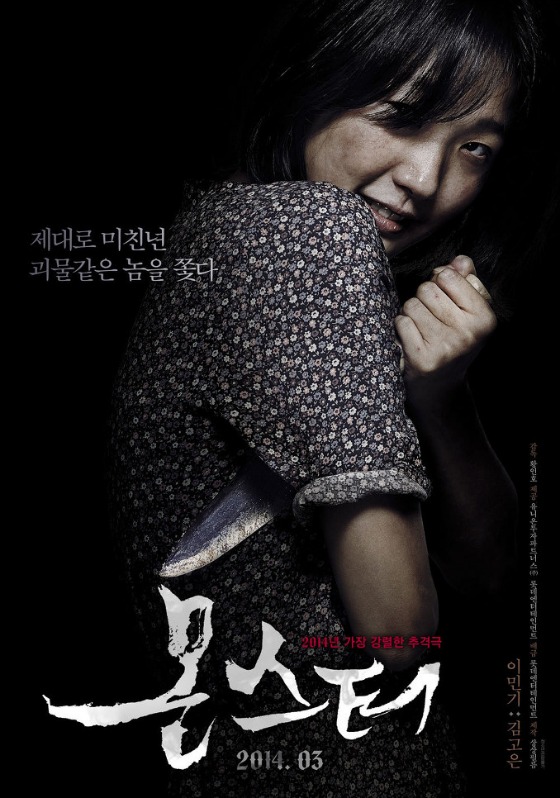
MonsteNot to be confused with the Charlize Theron movie, this Korean film is truly an odd beast: unlike some, it’s difficult to imagine a Western remake. For the heroine here, Bok-Soon (Kim Go-eun) is what could politely be called “developmentally challenged.” She can just about function, running a vegetable stand, but is largely dependent on her smarter younger sister to keep Bok-Soon out of trouble caused by her quick temper. Tragedy strikes when the pair cross paths with a vicious serial killer, Tae-So (Lee), who uses his pottery kiln to destroy the bodies of his victims. This results from a chain of events which involves a blackmail plot using a mobile phone; Tae-So’s brother (Kim), who tries to turn Tae-So’s psychotic tendencies to his own ends; and Na-Ri (Ahn), a young girl who knows the location of the crucial phone. Tae-So kills Bok-Soon’s sister, leaving her to fend for Na-Ri, while also grabbing a knife and setting out to take revenge on Tae-So. But how can someone like her, who is no match for the killer, physically or intellectually, possibly hope to prevail or even survive the encounter?

My first guess was that Tae-So’s brother was going to play a part; perhaps, realizing the creature he had unleashed could not be reined in or controlled. That absolutely nothing along those lines happens, gives you an idea both of the film’s main strength and its most obvious weakness. It’s far from predictable, yet some of the changes in direction and approach end up being more disconcerting than surprising. At times, it feels like the director couldn’t decide whether to make the film about Tae-So, his brother, or Bok-Soon, and the division of attention feels like it consequently sells all three of them short. If a film can’t commit to a single character, why should the audience? On the other hand, Hwang has a good eye for visuals, and the contrast between the villain and heroine is one of the most striking in recent history. There’s no denying the final encounter between them, in a restaurant already strewn with broken bodies, is a hardcore brawl of ferocious intensity.

Generally, I’m a big fan of intelligent characters, yet Bok-Soon is such a total contrast, it’s a refreshing change: instead of being smart, she has incredible loyalty, indefatigable perseverance to her cause, and absolutely no semblance of fear. Though is it still being brave when you genuinely don’t appreciate the severity of the danger into which you are deliberately placing yourself? That’s the question here, and part of which makes this one both appealing and incomplete. It’s a curious mix of genres, styles and approaches, perhaps making more sense to a Korean eye, But, as Kay Cox wrote, “I love the courage and freedom that comes with being a crazy old lady… no holds, no barriers, no fear.” Apart from the “old” part, that’s true for Bok-Soon: just as with the film, her weakness is also her strength, and makes for a heroine unlike any other I’ve seen.

Dir: Hwang In-ho
Star: Kim Go-eun, Lee Min-ki, Kim Roi-ha, Ahn Seo-Hyun

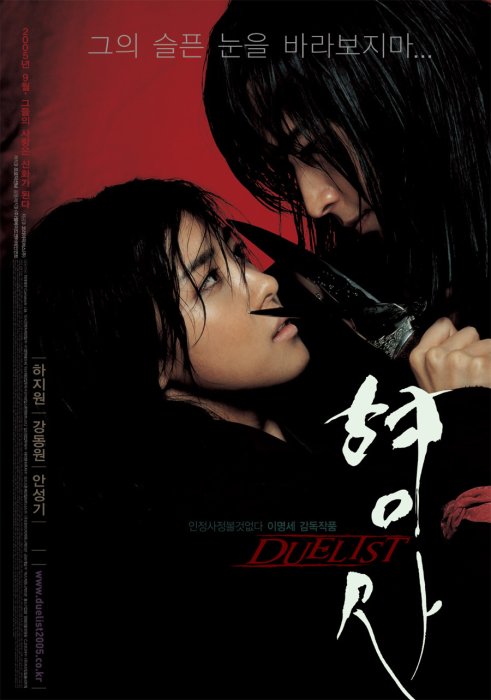
Duelist

★★★
“A triumph of style over content”

DuelistposterNamsoon (Ha) is a hard as nails detective in medieval Korea. While working undercover at a market on a counterfeiting case, she encounters a masked man (Kang), and battles him before he vanishes, though not before she manages to cut away a fragment of his mask revealing his ‘Sad Eyes’ – the name by which he is known for the rest of the film. What is his tie to the forged money? And why has be been seen going into the house of a powerful government Minister Song (Song)? Namsoon and her mentor, Ahn (Ahn) investigate, though the closer they get to the truth, the more perilous things become, not least because she begins to fall for Sad Eyes, especially after infiltrating Song’s mansion as a courtesan – a task for which she is singularly unsuited. After a public incident, while Ahn has to fire Namsoon from the police force, this is merely a ruse, allowing her to go after the final piece of evidence they need to raid Song’s mansion and bring down his operation.

Rarely have I seen a more beautifully-shot film. Truly, this picture is as pretty as a… er, picture. The cinematography is top-notch, offering a sumptuous feast of visuals that mixes styles and techniques to great effect, and freeing the movie from bothering with banal chores like dialogue for extended periods. Unfortunately, neither the story nor the characters are a match for the look and feel, leaving the viewer largely to admire the film, rather than being engaged by or liking it. As I recall, the director’s previous film, Nowhere to Hide, had much the same issue, pitting two (male, there) adversaries against each other, in a rain-drenched landscape that was emotionally distant – but, boy, did it look good. Here, the action is extremely stylized, resembling a modern dance routine more than a fight in some cases, or even, as one character puts it, “It was like they were making love under the moonlight.” I also sense there are creative anachronisms at work: did they even have cops, never mind lady ones, at this time? However, the biggest weakness is likely the sudden way Namsoon falls for Sad Eyes; she doesn’t seem at all like the kind of person who would do that, and since this supposed relationship is at the film’s emotional heart, it’s a flaw that may explain why this feels so uninvolving.

Under other circumstances, this could well be a fatal flaw, yet there’s still enough for your enjoyment in the eye candy department to make this worth watching, even at a fairly long 111 minutes. One senses that Lee is much more interested in the technical aspects of cinema, rather than the emotional one of connecting with the audience. I can appreciate that side, certainly, yet for a film to be truly successful, there needs to be some yin to go along with the yang, or what results will seems frustratingly incomplete.

Dir: Lee Myung-se
Star: Ha Ji-won, Kang Dong-won, Ahn Sung-ki, Song Young-chang

The Huntresses

★★★
“Charlie’s Korean, Medieval Angels”

During the Joseon era in Korea, a trio of bounty hunters, Jin-Ok (Ha Ji-Won), Hong-Dan (Gang Ye-Won) and Ga-Bi (Son Ga-In), work with their agent, Moo-Myung (Ko Chang-Seok), capturing wanted bandits. But they get a different task, after a King’s envoy carrying an encoded message is the latest courier to go missing, and are charged with bringing him in. Needless to say, it’s not a simple task, and they find themselves facing a host of players opposed to the King receiving the message, which would threaten the fragile relationship with the Chinese emperor. But there’s also a personal angle, as Jin-Ok finds herself face-to-face with the man she remembers as having killed her father.

Huntresses-Poster-5Huntresses-Poster-1Huntresses-Poster-4

Early on, it becomes abundantly clear that this is not intended to be taken entirely seriously, probably from the time one of the heroines whips out her yo-yo, and takes out an entire platoon of enemies, Sukeban Deka style. Indeed, it’s probably the comedic elements that work best, such as the constable who follows him around, convinced his camo skills will stop him being seen – in a rarity for the humour often seen in Eastern films, it’s a joke which could have been used more, rather than being driven into the ground as normal. However, it feels that this lack of seriousness was taken by the makers as a reason to slap together the story, which lurches from set-piece to set-piece without any sense of logic or narrative flow – and don’t even get me started on the whole “dramatic amnesia” suffered by Jin-Ok.

It’s also fairly obvious the actresses aren’t doing very much of their own action, putting them behind Drew Barrymore et al, and in another galaxy, far, far away, from the participants in another cinematic cousin, The Heroic Trio. Ha probably comes off the best of the three, but there’s an awful lot of scenes which consist largely of close-ups of the actresses flailing wildly, intercut with wide shots from behind of someone competent. However, it still passes the time easily, particularly after all the parties involved end up in the port city of Byeokrando – or, at least, a convincing CGI imitation thereof. This allows plenty of scope for some impressive bits of combat, regardless of who’s actually doing them, as well as exploding pagodas, and other chunks of mass destruction. It also helps that the performances are solid from just about everyone concerned, which shores up the flimsy constructs of the storyline.  I’m informed that the Korean title translates as “Three Beautiful Musketeers of Joseon,” and that’s probably an accurate an overall summary as the preceding 400 words.

Dir: Park Je-Hyun
Star: Ha Ji-Won, Gang Ye-Won, Son Ga-In, Ko Chang-Seok

Miss Conspirator

★★
“A tale – and heroine – of two halves.”

miss conspiratorChun Soo-ro (Go) is a painfully shy, introverted young woman, who is a little more than a bundle of neuroses. At the airport to see off her sister, she encounters a nun, who asks Soo-ro to deliver a package to her boyfriend – a concept which, personally, would set my alarm bells ringing! However, on her arrival, Soo-ro finds the intended recipient dead, and ends up fleeing the scene, in possession of both a large quantity of drugs, and the cash that was intended to pay for them. For obvious reasons, both the White Tiger and Sa gangs, the participants in the deal gone very, very wrong, are rather upset, and go on the hunt for her. For they believe Soo-ro to be the nun, who is unable to disagree, having been killed in a traffic accident. Fortunately, a cop working undercover takes pity and agrees to protect Soo-ro, although his resulting actions lead to exposure – and, meanwhile, the prospect of getting his hands on so much cash leads his boss to stray from the path of true justice. Fortunately, some unexpected hydro-shock therapy leads to a startling transformation in our heroine’s character, and she arranges a meeting between all the interested parties.

Maybe it’s a cultural thing, but this left me almost entirely cold. Or maybe not, since this wasn’t particularly well-received in its native Korea either, I’m not averse to the “fish out of water” idea – one of my favorite book growing up was Robert Scheckley’s Game of X, about a complete novice who finds himself embroiled in espionage, and I was hoping for something similar here. Unfortunately, this is certainly not funny, only sporadically exciting, ridiculously implausible, and the transition from shrinking violet to ice-cool superwoman is so abrupt as to be entirely disconcerting, almost as if someone switched out movies on you at the 80 minute mark.

From what I’ve read, it seems to have been intended as a showcase for Go, making her feature debut after becoming one of Korea’s best-known TV actresses – mostly for playing roles closer to her later character here. She isn’t bad in the role, and considering how irritating the performance here could have been, the fact that it isn’t deserves some credit. However, “not being irritating” is hardly what you’d call a ringing endorsement for any movie. Things do perk up a little after Soo-ro blossoms into her femme fatale version, and you can’t help thinking this would have been a much better version had the change happened about an hour earlier. Or better still, if it had taken place immediately after the animated opening credit sequence which is one of the movie’s few memorable sequences.

Dir: Park Chul-kwan
Star: Go Hyun-jung, Yoo Hae-jin. Sung Dong-il. Lee Moon-sik