
Angel Terminators 2

★★★★
“Angels of death”

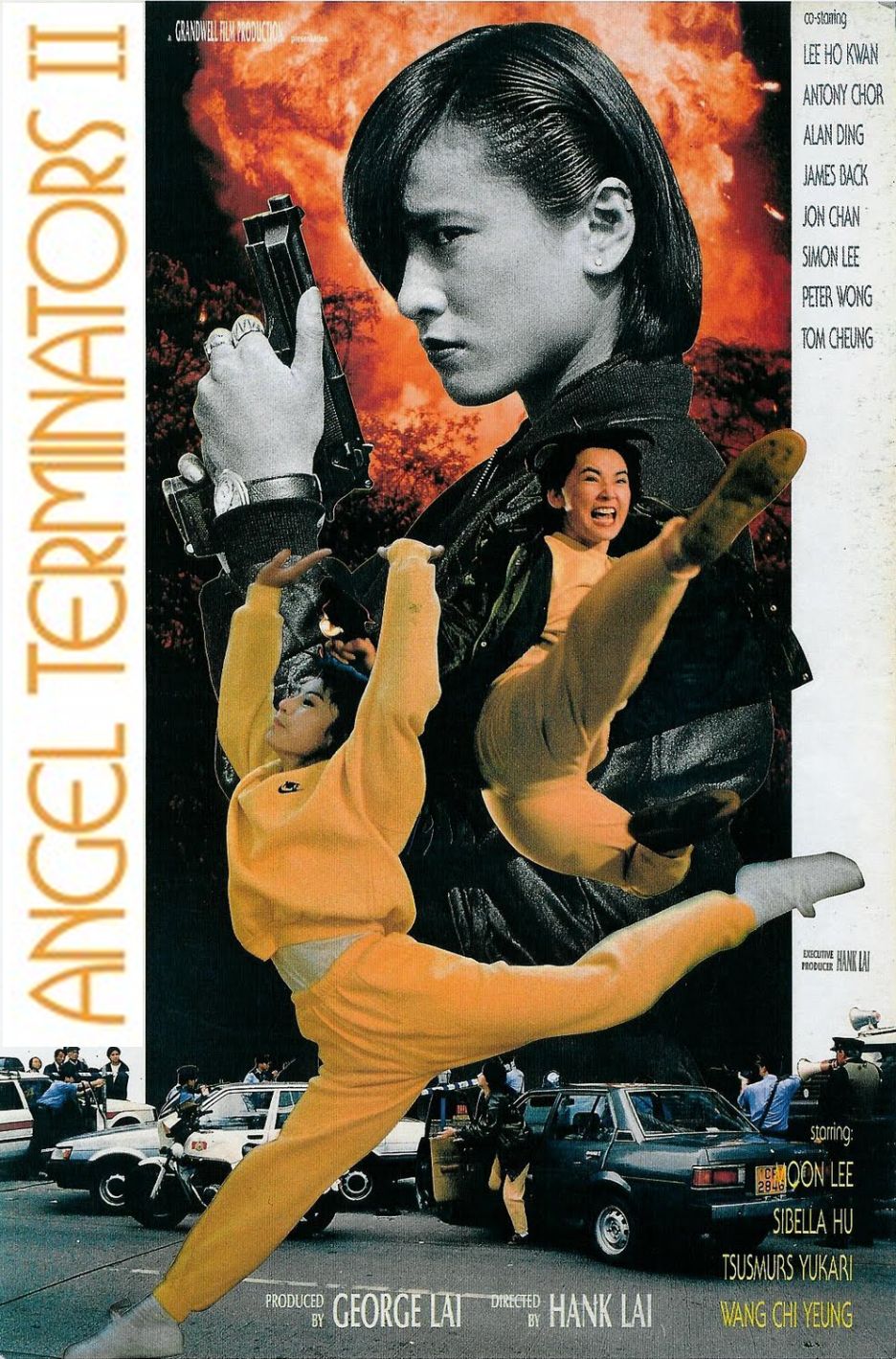
angelterm2I have not seen Angel Terminators, so cannot comment on its merits or flaws. However, it does not appear that this impacted my thorough enjoyment of this slice of early 90’s Hong Kong goodness, and nor did the mangled subs which leave me a little vague on some details. The two heroines are Chitty (Lee) and Bullet (Oshima), who are… Cousins? Sisters? Not sure. Bullet has just got out of prison, having turned to delinquency after blaming her policeman father for the death of her mother. He and his partner (Hu) – who adds to the confusion because everyone calls her Big Auntie – try to achieve a reconciliation, but Bullet is unimpressed. She goes to her former gang boss for money, having taken the fall and gone to jail for him, but he just wants Chitty to become a hostess. The fight than ensues, kicks off a chain of events which leads to Bullet stealing some jewels belonging to the boss, who unleashes the accurately-named Brother Mad (Wong).

Will there be mayhem? Yes. Will there by fisticuffs and much gunplay? Yes. Will there be people strung up from lamp-posts like some kind of novelty Chinese lanterns? I’m not saying: I’ll let the film retain some element of surprise. But for all its broad strokes of characterization, it manages to deliver a relatively-even tone, without any of the slapstick and comic interludes which sometimes plague other entries. Indeed, it does become progressively darker, with a kidnapping forcing action that then goes horribly wrong, setting up even further death and violence. This is all accompanied by high-quality action, right from the get-go, starting with Hu leading an assault on criminals holed up in a restaurant, before quickly bringing you a battle between Lee and the leaders of another training squads in a gym, then escalating from there through to a bloody finale.

It’s easy to become somewhat jaded, particularly when you’re watching films because of their genre, without applying any quality control. But then you find a movie like like this, which looks like just another generic action heroine flick, yet instead delivers everything you could want from low-budget action, easily making up for in energy what it may lack in polish. With Lee, Oshima and Hu, you have a hand of three aces, and the film is only a couple of Khans (Cynthia and Michelle, a.k.a. Michelle Yeoh) from having the best cast ever in a HK action heroine film. Unlike some (hello, Avenging Quartet), it lives up to that.

Dir: Lau Chan + Chin-Ku Lu
Star: Moon Lee, Yukari Oshima, Chi Yeung Wong, Sibelle Hu
When Taekwondo Strikes

★★★½
“The Angela Strikes Back”

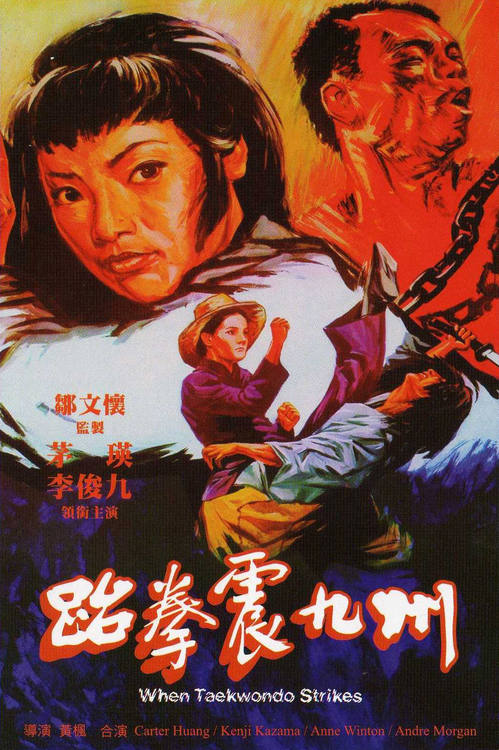
7242870.3There’s more than a hint of Hapkido here, with many of the same cast, and more less the same thirties setting, with Korea again laboring under the yoke of Japanese occupation, etc. Things kick off when Jin (Wong) seeks sanctuary from the occupying forces in a local Catholic church. The Japanese soldiers rush in, but get demolished by Uncle Li (Rhee), a rebel topping their wanted list who has been hiding out as the priest’s gardener. Jin and Li depart, along with the priest’s niece (Winton), but the priest himself remains, and is captured and tortured for information about Li’s whereabouts. Wang Lin Ching (Mao) is drawn in when Li asks her to check on the cleric, causing her to become targeted by the Japanese too. An attempt to rescue the priest goes wrong, ending with Li being captured, and the others having to flee Korea for mainland China. However, that may not be far enough, and when the Japanese figure out where they are, they us Li as bait to lure Wang and the others out of hiding.

Despite being considered the father of American Tae Kwon Do, and a good friend of Bruce Lee, this was Rhee’s only released film (rumors of another have been heard). Seems a bit of a shame, as he makes his presence felt here, particularly toward the end. For action heroine fans, the focus will naturally be on Mao, and we’ll get to her shortly. However, we shouldn’t forget Winton, also in her only film role, who makes an immediate impression as an martial arts trained nun  Going by her clothing, anyway; the film is kinda loose on Catholic ritual. Man, The Sound of Music would have been so much cooler, if Julie Andrews had only known kung-fu…

As for Mao, she has a couple of absolutely stellar fight scenes, including a church brawl [after the soldiers realize she isn’t Catholic, because she didn’t cross herself on entering!], a battle in a forest, and the final fight. However, in terms of her action, things perhaps peak when she returns to her family restaurant to find a long-haired Sammo Hung, playing a Japanese henchman, roughing up her mother, along with his goons. The last is embedded below – it should start at the correct time, but if not, 39:20 is where you want to be. I just love the way she casually flicks her pigtail round the back just before things kick off, as if to say, “I am serious Angela Mao. This is serious business.”

The one thing that stops the film from getting a seal of approval is a disappointing slump in the middle, after the (fairly lame) effort to rescue the priest. Nothing much happens for what feels like a good half-hour, and that’s a shame, since the action elsewhere is both copious and often excellent. Many fights are virtually the equal of any Bruce Lee film, not least because there are half a dozen excellent martial artists involved here, rather than Bruce being far and away the best. This adds a real sense of balance to proceedings, and if you’re looking for an introduction to the movies of Angela Mao, this is certainly recommended.

Dir: Huang Feng
Star: Angela Mao, Jhoon Rhee, Carter Wong, Anne Winton

Kickboxer’s Tears

★★½
“Tears are not enough.”

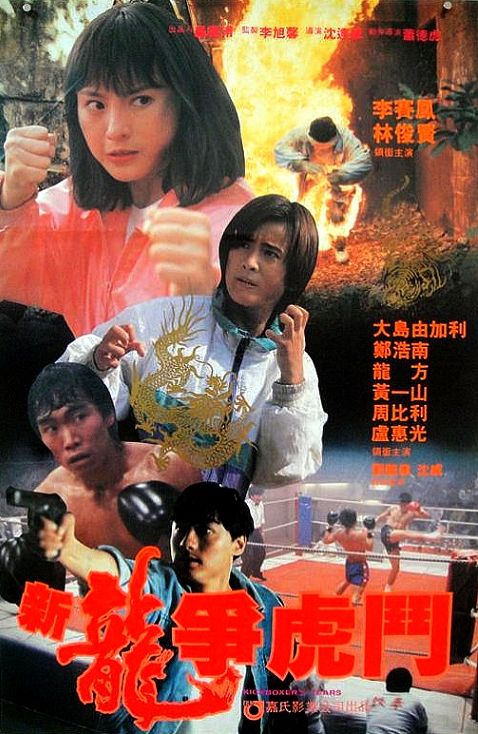
kickboxersA truly crappy plot here, used to link fight scenes that range from the boring – that would be the actual kickboxing, which greatly outstays its welcome – to the impressive. Li Feng (Lee) is visiting her kickboxer brother in Hong Kong, when he is killed by a cheating opponent, after refusing to take a dive on the orders of Mr Wong (Lung). The death also throws into jeopardy the family training gym/healthcare establishemnt [a crossover at which no-one blinks an eye], which was already financially shaky. To both get revenge, and earn enough money to stabilize things, Li goes to Wong, and demands an underground rematch against his fighter. When that happens, but leaves her opponent permanently paralyzed, Mrs. Wong (Yukari Oshima), who is the victim’s brother, as well as the promoter’s wife, demands a winner-take-all match to the death. And she kidnaps Li’s semi-boyfriend (Lam) to make sure Li  turns up for the contest.

This 1992 Hong Kong film has the same jarring shifts in tone present in many of that time and place. Given the sombre nature of the core situation, there really shouldn’t be any room for slapstick humor – yet there are at least two comic relief characters too many here, and I found myself cringing in just about every one of their scenes. The early action is more than a bit ropey too: while it may be ‘authentic’ kick-boxing, it’s pretty dull to watch, and it’s only when the film moves outside the ring that things become interesting, especially when Lee gets going. She has one great street-fight against a group of thugs, another in a restaurant when she’s proving her worth to Wong as an opponent, and of course, the all too brief duel which pits her – literally, since they’re in a pit – against Oshima. All three are a great combination of inventiveness and hard-nosed action, also showcasing Lee’s great flexibility [there’s also an eye-popping training scene, where her character casually does what is best described as the vertical splits].

However, to appreciate these sequences, you are going to have to sit through story-telling of the most cliched sort, plus acting from her supporting cast that would be rejected as lacking in subtlety by Adam Sandler. Particularly irritating is the finale which has three fight scenes going on at once, cross-cutting between them to the detriment of all three, then robs Li of being able to take her thoroughly-deserved revenge personally, before ending so abruptly, I was left wondering if the final ten pages of script had fallen into a shredder, and the makers decided just to do without them. All these other aspect are significantly sub-optimal, and ten good minutes of action do not sufficiently outweigh them. Especially not when those ten minutes are embedded below, saving you an hour and twenty. You’re welcome!

Dir: Da Wei Shen
Star: Moon Lee, Wilson Lam, Mark Cheng, Lung Fong

The Bod Squad

★★★
“Several virgins short of a six-pack.”

7seasIn the 1970’s legendary Hong Kong studio Shaw Brothers sought to broaden their market with a series of co-productions. The results included the likes of Legend of the 7 Golden Vampires, from a partnership with Britain’s Hammer Studios, plus Cleopatra Jones and the Casino of Gold. But perhaps the most bizarre such product is this, which crosses martial arts with the softcore sex films from the time, the best-known of which is probably Hofbauer’s Schulmadchen Report (Schoolgirl Report). The results are… Well, I’d be hard-pushed to call them great cinema, but I would have to confess to being rather more entertained than I expected.

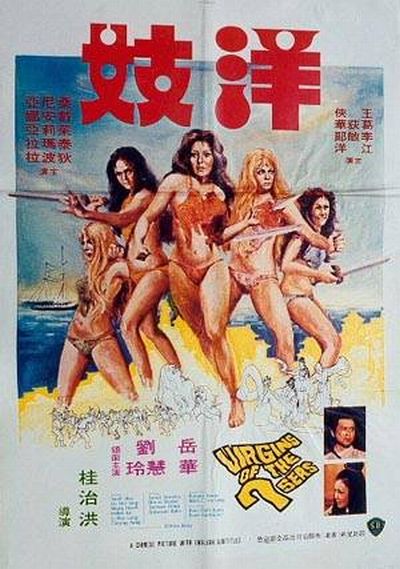
Contrary to one of the alternate titles, Enter the Seven Virgins, there are actually only five women here, and some of those aren’t exactly virgins. They are captured by pirates, and brought to their island lair, where buccaneer boss Chao (Hsieh) leers at them and puts them through a training course designed to get them ready to be sold into white slavery. Except, he doesn’t know that one of his minions, Ko Mei Me (Liu), is actually working, along with her brother, to take him down, and trains the captives in martial arts, as well as the ancient Chinese art of spitting olive pits at such high-velocity, they can punch a hole through a vase. After copious amounts of gratuitous nudity, the women eventually break free, get recaptured, escape again, and take on Chao and the rest of his henchmen in a battle which makes up for in duration, what it may lack in quality.

Actually, that’s a little unfair: considering the Western cast were more used to films with titles such as Campus Pussycats, they perform credibly enough. There’s not as much stunt doubling as I expected, and they’re clearly giving it all they have, occasionally impressively. Bray stands out in particular – and I mean that literally, since it seems she’s taller than most of the men in the cast. Liu, however, clearly has the most experience, and its understandable why she gets given most of the action. In some ways, this can be seen as a primitive ancestor of Category III films such as Naked Killer: while lacking quite the same lurid insanity, and featuring a degree of casual racism that’s fairly off-putting [apparently, the sight of Western flesh is enough to send most Chinese men into drooling imbeciles], it’s still fun for the undemandingly open-minded. Admittedly, a fondness for Benny Hill may help, and providing you can get past hearing Chinese people dubbed into German, as well as subtitles that may have lost their way a bit in translation. I’m still trying to figure out the meaning of, “It’s a bank holiday, it’s Mothers’ Day in Africa.”

Dir: Kuei Chih-Hung + Ernst Hofbauer
Star: Liu Hui-Ling, Wang Hsieh, Sonja Jeannine, Gillian Bray
a.k.a. Virgins of the Seven Seas
a.k.a. Enter the Seven Virgins
a.k.a. Karate, Küsse, blonde Katze [Karate, kisses, blonde cats]

Deaf Mute Heroine

★★★½
“Silent but deadly.”

deafmuteheroineThe physically disabled hero has long been a staple of martial arts, to the extent that is is sometimes referred to, tongue-in-cheek, as “cripsploitation”. The One-armed Boxer, The Crippled Masters, Zatoichi – it’s a genre that survives more recently than you may think, with Mat Fraser, recently seen in American Horror Story: Freak Show, starring in 2009’s Kung Fu Flid. While this is rarer for heroines, they are not immune, with Japan giving us the Crimson Bat series, reviewed elsewhere on this site. This is another entry, Wong playing the titular heroine, Ya Ba, who is unable to speak or hear, but can still fight a mean battle, assisted by reflective wristbands that let her see who’s sneaking up from behind, in lieu of hearing them.

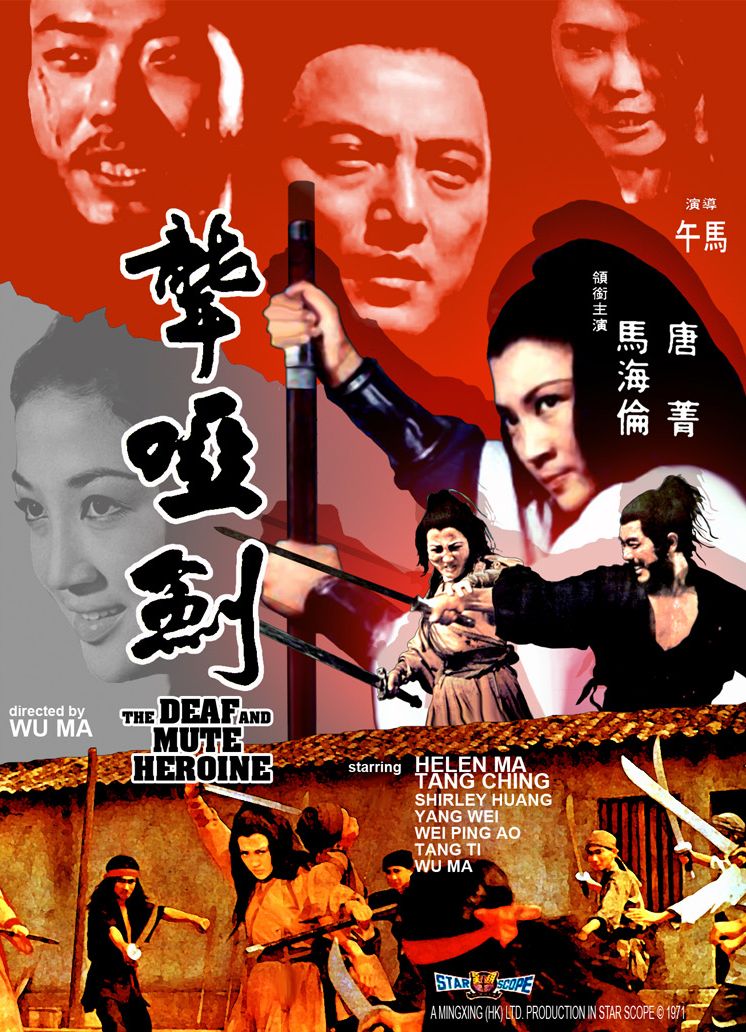
She comes into possession of a set of pearls, taking them off some robbers with extreme prejudice. However, this brings down the wrath of Miss Liu (Huang), leader of her own gang, and whose brother was one of the robbers. While her first attempt to kill Ya is unsuccessful, Lui’s poisoned flying daggers do injure her. Ya is found and nursed back to health by kindly cloth-dyer Yang Shun (Ching); romance blossoms, and the pair marry, with Ya figuratively hanging up her wristbands;  she actually puts them away in a box. That’s relevant, because her husband ends up entrapped into responsibility for a friend’s gambling debt by Liu, and she demands he steal Ya’s wristbands as payback. That opens the way for Liu and about five billion henchmen (count may be approximate) to launch their attack. But that’s not the only threat she faces, since lurking in the wings is another talented master, with a previously relationship to Ya and who was left with a nasty facial scar for his pains.

The fights are good. Really good. As in, the final battle between Ya and Lui (below) may be the best of the era I’ve seen between two women – like most of the action here, it’s fast, hard-hitting and imaginative, weakened only by some unsubtle wirework. The film is also bloodily messy, to a somewhat surprising extent, and both Wong and Huang make for highly-effective characters, the latter making up for the former’s silence.  However, the movie grinds to a halt in the middle, as the focus shifts off Ya to her husband, who is both a great deal less interesting and almost unlikeable. The film is also hampered by poor availability: while the version I watched was as close to complete as possible, that required a combination from three different sources, including one print dubbed into German(!) and another which was sub-VHS quality with a large logo in one corner. That helps leave this short of getting our “seal of approval,” but if a good copy ever becomes available, we might re-visit it. For as I said to Chris, what’s not to love about a wife who never says a word?

Y’know, our couch really isn’t so bad, when you get used to it. :)

Dir: Wu Ma
Star: Sally Wong (a.k.a. Helen Ma), Shirley Huang, Ching Tang, Wu Ma

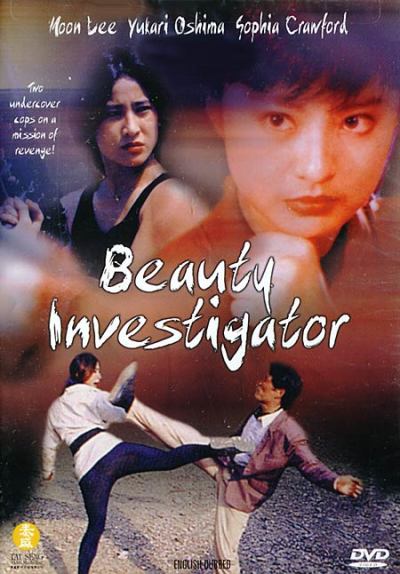
Beauty Investigator

★★
“Beauties and the beasts.”

beautyinvestigatorEllen (Lee) and Grace (Kim) are police officers, who are first on to arrive when the latest victim of a serial sexual predator is found in a dumpster. After a brief diversion to catch a purse snatcher – really, how dumb must you be to do that at a murder scene? – they are sent undercover as nightclub hostesses, since that’s the profession of all the victims. While fending off both lecherous customers and employers, they stumble across an arms smuggling outfit, whose leader Bill (Tsui) has pulled a fast one over his Yakuza partners, with the help of a hired hitwoman (Oshima, whose character in the end credits is named as, I kid you not, “Japanese Jap”!). Rather than letting their superiors know, they decided to investigate themselves. Probably not the wisest of moves: as they’ll discover by the end of the movie, discretion is indeed the better part of valour…
Very quickly, the bar for this one is set low, with the creators’ idea of comedy gold being to have Grace throw up over the corpse on seeing it: oh, hold my sides, for I fear they may split. If you’d be thinking the only way to go from there is up, the next hour seems to take a sadistic pleasure in proving otherwise, with Ellen and Grace doing the “mismatched cop” thing, which was already about 20 years past its sell-by date, when this came out in 1993. Then, with about 20 minutes to go, the film inexplicably takes a far darker turn (especially considering how lightly the previous carnage has been played), with the mission become one of personal revenge rather than law enforcement. In cinematic terms, it’s like putting a sprig of parsley on a cow-pat, and calling it a salad: I was left wondering if someone had sloppily spliced on the final reel of an entirely different movie.

The only redeeming aspect – and even this falls well short of making it recommendable – is the action, which is quite frequent and high in intensity. Lee and Oshima are both in fine form, and watching the pair of them go toe-to-toe with each other is a joy, as always: that’s particularly so for the end battle, in which all the previously mentioned participants are involved, along with Sophia Crawford, who plays the villain’s mistress (she also takes an entirely gratuitous shower in some versions of the film). However, the truth is, you can see Lee and Oshima in any number of other movies, without having to endure the feeble efforts at buddy comedy attempted here. And you’d be well advised to do just that.

Dir: Tso Nam Lee
Star: Moon Lee, Kim Je Kee, Tsui Zen Aie, Yukari Oshima

Lady Whirlwind

★★½
“Because Lady Moderate Breeze wouldn’t sell as many copies.”

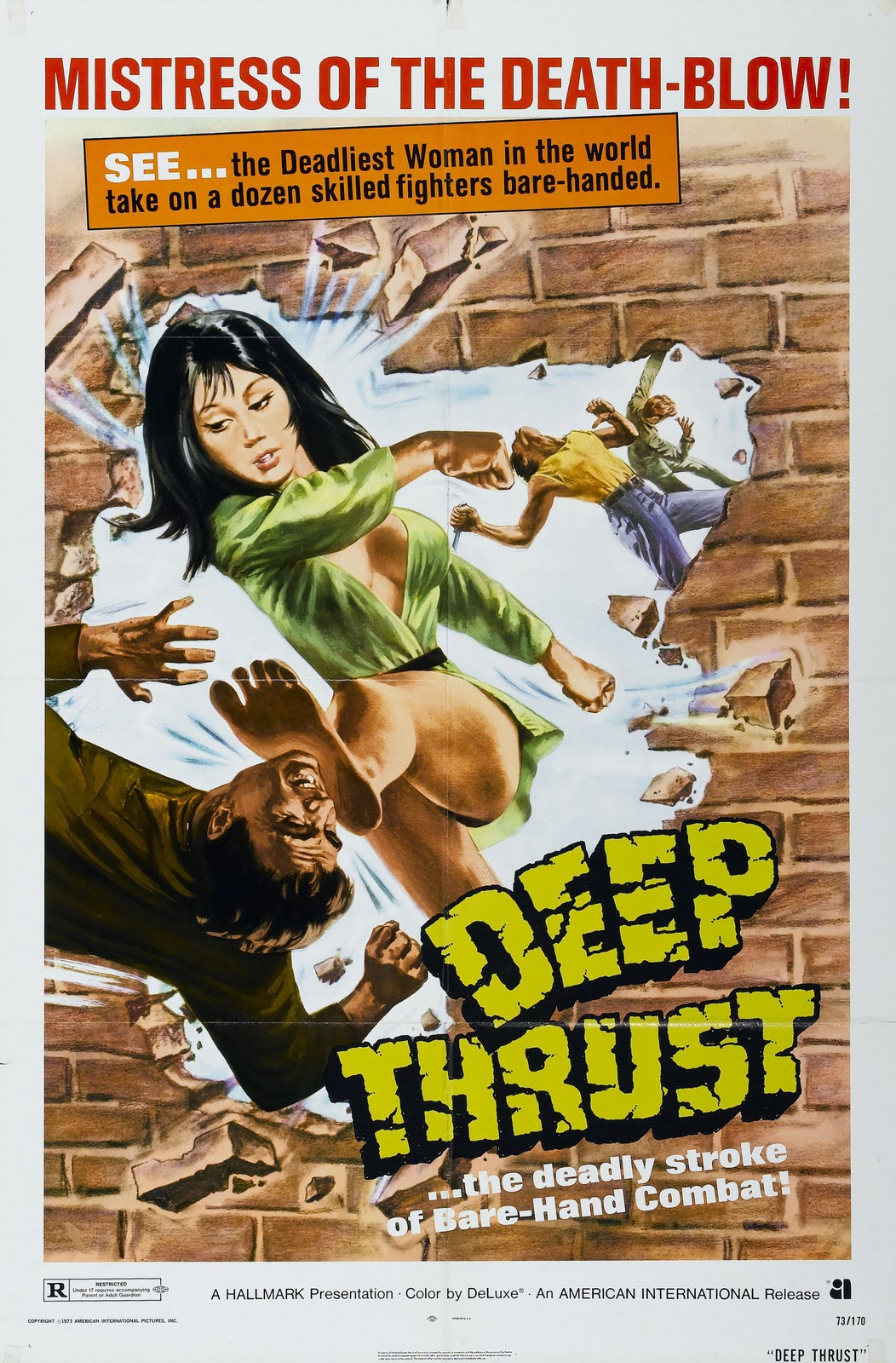
deepthrustI’m not saying this is a bad film. But when I watch one called Lady Whirlwind (though here is as good a place as any to acknowledge the wonderfully tacky alternate title featured on the poster at the right), I expect a good deal more lady whirlwinding. The focus is instead on Ling Shi-Hao (Chang), beaten and left for dead after trying to leave a gang. Wisely, he decides to continue with his death, hiding out in the country for three years with girlfriend Hsuang Hsuang (We). This anonymity is shattered by the arrival of Tien Li-Chun (Mao), who wants a word with Ling, along with ripping the beating heart out of his chest. For it turns out, he was a bit of a bastard who jilted Tien’s sister, leading to her suicide. Hence, when he thanks Tien for saving him, she replies, “I just didn’t want somebody else to kill you.”

Ling admits he deserves his fate, but asks for a stay of execution, so he can first take revenge on his former colleagues (who include Sammo Hung in an early role). Tien is clearly pretty laid-back about the whole vengeance thing, since she’s nowhere to be seen during the lengthy training montage that follows, after Ling helps a Korean herbalist, bitten by a snake, and is taught the deadly Tai Chi Palm style. Will that help him beat the bad guys? And will Tien then stop lurking off-screen and goddamn do something?

There’s certainly no shortage of action, though in comparison to some other Mao films I’ve seen recently, the fight scenes doesn’t seem as smoothly choreographed and frankly, get a bit boring – it also suffers too much from the “we’ll attack you one at a time, while everyone else circles about aimlessly” trope, common to many movies of the time. Indeed, I must admit, there was one of Ling’s battles in the middle where I actually fell asleep: never a good sign where a martial-arts films is concerned. The frequent use of musical cues definitely not composed for the film is also rather distracting: one, in particular, will be particularly familiar if you’ve watched James Bond movies, but other sources say the pillaging also includes the works of Ennio Morricone and Bernard Herrmann. Hey, if you’re going to steal, do it from the best, I suppose.

Mao does have some good fight scenes, particularly going one-on-many with a copious line of henchmen. But you wonder why she’s so apparently disinterested in her revenge, particularly at the end, which is entirely ludicrous, and all but negates everything that happened over the previous 80 minutes. Not one of her best, with not enough going on beyond her usual graceful performance, to merit your attention.

Dir: Huang Feng
Star: Chang Yi, Angela Mao, Pai Ying, June Wu
a.k.a. Deep Thrust

Beach Spike

★★
“Shaolin Volleyball.”

beachspikeSharon (Chau) and Rachel (Fu) have a pretty idyllic life, spending their days mostly on the beach playing volleyball, with occasional bouts of clubbing and very occasional work. But this relaxed approach to things is threatened by the Brewer family, who plan to turn the entire seafront into a megaresort, displacing all the happy local beach-bums. Leading the charge is family daughter Natalie (C, whom I can only presume was named by the same model-actress-whatever department to give us Maggie Q), who has a hatred for the “little people” and, along with her sister, kicks the arse of Sharon and Rachel in an early contest.

Through a series of frankly implausible events, and clouded by the blossoming relationship between Sharon and Brewer scion Tim (Law), the future of the resort project hangs on a rematch, the two teams making their way through a tournament to face each other in the final. However, anyone familiar with kung-fu movies will not be surprised to hear the good girls have been getting training from relatives well-versed in martial arts, and they won’t be such a pushover in the second battle.

It’s hard to work out exactly who the audience for this mess is supposed to be. Beach volleyball fans will hate the dreadful CGI, used to portray any protracted rallies, in lieu of actual skill, and likely find the heroines implausibly unmuscled (one in particular looks like she will shatter if dropped). Action fans will find little to remember here either, despite the presence of veteran heroine Yeung Pan Pan as Mrs Tao, and despite an obvious influence being Shaolin Soccer, there isn’t a trace of Stephen Chow’s wit. Even those looking for pleasures of a more exploitative nature will likely get bored, sitting through the lengthy comedic and romantic interludes.

I suppose those fascinated by Acting Performances In A Second Language might get a kick out of the Brewer family, who deliver lines in English about as well as I could in Cantonese. But I think the main intended market for this is a fetish one, and fairly specific at that. If you like seeing women hit in the face by balls, this is the movie for you. No, really. particularly during a competitive montage at the end, where it becomes a virtual barrage of ball-to-face action, including in slow-mo. Otherwise, the idiocy of the plot and blandness of the lead characters overpower much of whatever potential this had, and Wanted: DOA did a much better job with the sport. Probably, this needed either to be taken completely seriously or go over-the-top entirely and head into total parody (like Soccer did). Instead, this does neither, and the end results just sit in front of you like a beached whale for 95 minutes.

Dir: Tony Tang
Star: Chrissie Chau, Theresa Fu, Him Law, Jessica C

Hapkido

★★★
“Forbearance. It’s vastly over-rated…”

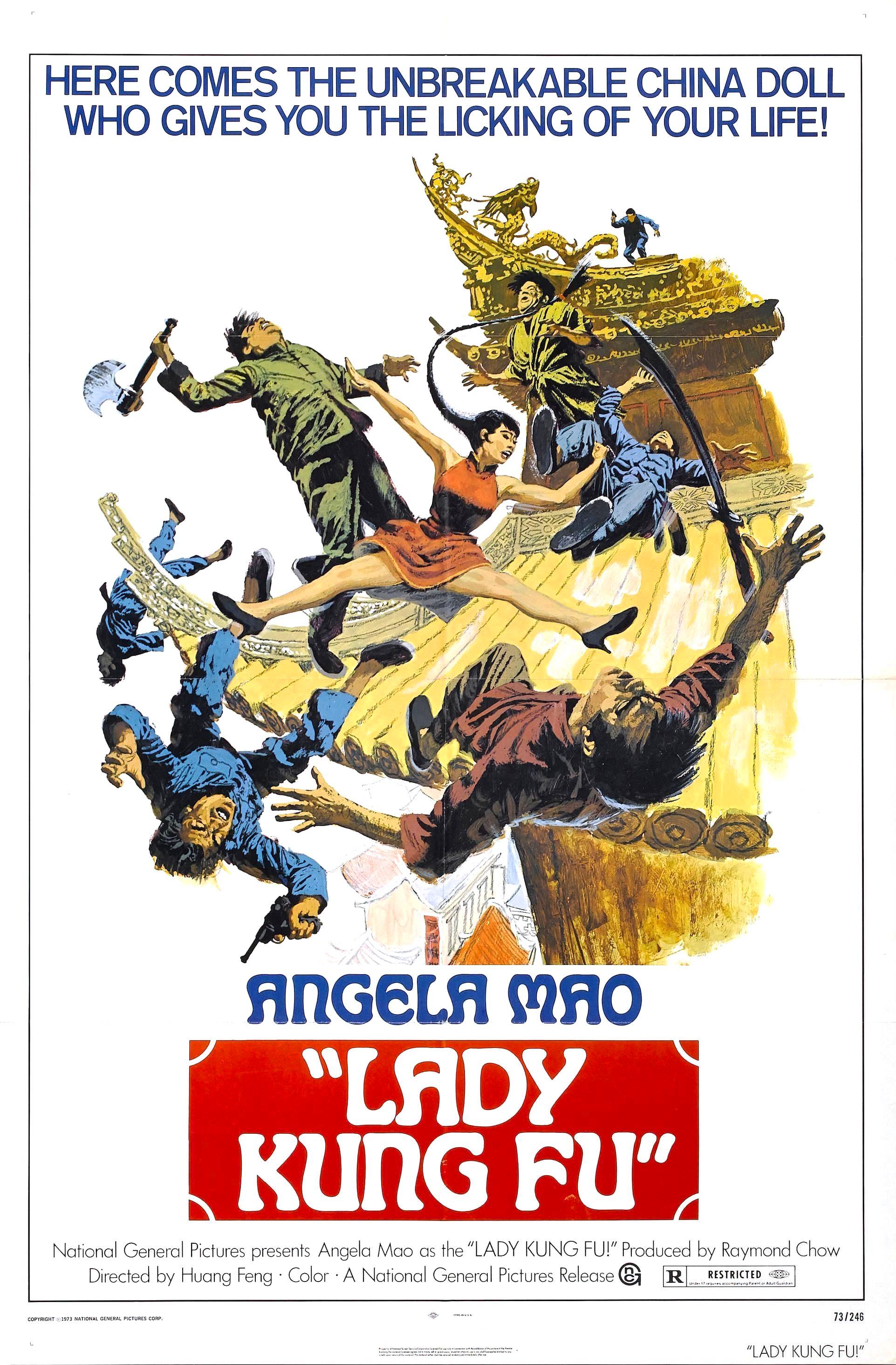
lady_kung_fu_poster_011934 Korea is under the yoke of Japanese occupation. At the hapkido school of martial arts, Yu Ying (Mao), Kao Chang (Wong) and Fan Wei (Hung) are learning the form. On graduation, they return to China and open an establishment of their own, only to fall foul of the Japanese Black Bear group, who bully both local residents and other schools, and try to run the hapkido practitioners out of town. Despite their teacher’s mantra of “Forbearance,” of which Ying has frequently to remind her colleagues, hot-headed Wei is eventually baited into fighting and killing some of the Black Bear students, and has to go into hiding. Chang’s efforts at diplomacy fare no better, leaving him beaten within an inch of his life, and the Bears seize the opportunity to tell Ying they’ll be incorporating her school into theirs. She finally realizes that turning the other cheek can only go so far before you have stand up for what’s right. Which, in this case, is some kicking of asses belong to the Japanese and their minions.

The film certainly loses points for obviously cloning Bruce Lee’s Fist of Fury, also released in 1972 and similarly based on a conflict between Japanese and Chinese martial arts schools. The strong anti-Japanese sentiment is no less shrill and strident here, and the style adopted for the fights is also largely similar, with one or other of our hero(in)es taking on a large group of rival students, before finally battling the big boss (or The Big Boss, if you prefer…).  Still, this is remarkable for the future output of those involved in the film. As well as being an early entry in the careers of Mao, Wong and Hung, there are minor roles for Billy Chan, Lam Ching-Ying (Mr. Vampire), Yuen Biao, Corey Yuen (director of Yes, Madam, She Shoots Straight and DOA: Dead or Alive) and Jackie Chan, who plays one of the Black Bear students.

But it’s mainly a showcase for the leads, and the action demonstrates why they’d all go on, to varying extents, and become stars in their own right. Mao is, obviously, of most interest here. After an early demonstration in Korea, which shows her as the smartest and sharpest of the trio, she largely takes a back seat in the middle, trying to keep the peace and practice that whole “forbearance” thing, before exploding into action again at the end. Particularly cool is the use of her weighted braids as a weapon, to whip her opponent about the face – you never saw Bruce Lee do that! And this is probably what defines the film. When it’s trying to be no more than a Lee-mitator, it comes off as second best, for obvious reasons. However, when the creators go their own way, it’s inventive and much more entertaining as a result. Shame the ratio isn’t tilted more heavily towards the latter.

Dir: Huang Feng
Star: Angela Mao, Carter Wong, Sammo Hung, Bai Ying
a.k.a. Lady Kung Fu

Lady Punisher

★★
“Lan, our relation is abnormal.”

lady punisherThis obscurist Hong Kong revenge flick is a little different, mainly because the couple at the heart of the film are lesbians. Admittedly, this is largely for crass, exploitative purposes: the dialogue quoted above, pretty much confirms the makers want to tut-tut disapprovingly at the love that dare not speak its name, while simultaneously depicting it in salacious detail. Such is the nature of Cat III in the mid-90’s, this seems to want to be something like Naked Killer, released two years earlier to this in 1992, but just doesn’t have the desire to go for the full delirious insanity, necessary to pull the concept off. Particularly in the middle section, it drags horribly, with the story diverting off into the usual triad drug-smuggling, betrayal and cop investigations that we’ve seen a million times before.

Quite what our heroine (Yi – some sources call the actress Tsui Man Wah, who may or may not be the same person!) is doing during this time isn’t clear. She initially seems all gung-ho for it, after her girlfriend is raped and murdered during a holiday in Thailand, and even takes out a pimp, whom she sees smacking around one of his employees. But then, she seems to forget all about her vengeance, until one of the perps comes strolling into the dress shop she runs – looking to make a bulk purchase, bizarrely. She lures him back to her apartment with the promise of dressmaking tips or something (okay, it’s more the something), and kills him. To help with the rest of the gang, she enlists the services of a female neighbour, who has been courting her with flowers, creepy phone messages and generally behaving more like a problem than a solution. But, whatever. This is a Cat III movie, and people exercising common sense is not something to expect. Especially where lesbians are concerned.

Down the stretch, this does finally manage to generate some energy, with a final confrontation which is not unimpressive. However, it’s definitely a case of too little, too late, and this is one of those “forgotten films,” where you can understand exactly why it ended up on the discard pile. I’m in agreement with history on this one.

Dir: Tony Liu
Star: Sophia Yi, Tommy Wong, Gong Hiu-Hung, Shing Fui-On