
Women on the Run

★★★
“Letting the Cat III out of the bag.”
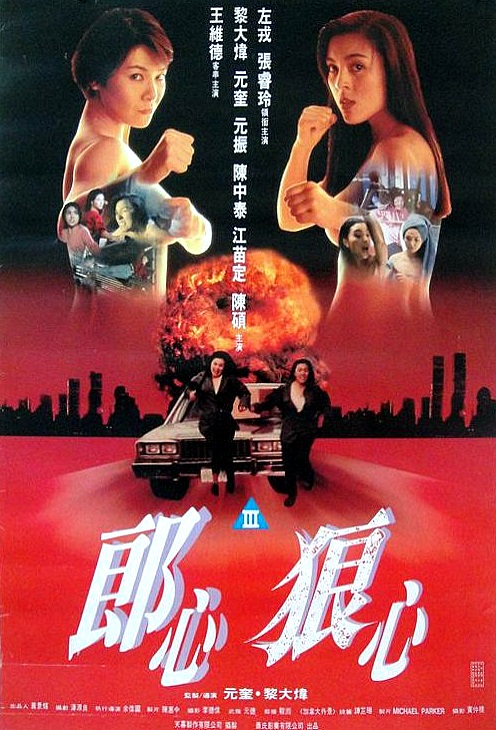
womenChinese teenage martial-arts champ Li Siu-Yin (Guo) is seduced into a life of prostitution by her boyfriend, but eventually snaps and kills him. She escapes to Hong Kong, only to be arrested there, and given a stark choice: help ensnare crime boss King Kong (Kim) or be deported back to China. Unwillingly, she takes the former and goes back over the border with undercover cop Hung (Cheung), who is also having an affair with colleague David (Lai). However, it turns out that David is in cahoots with King Kong, and the pair end up in Canada and in jail. It’s a long way back from there, before the two can take their revenge on the men who betrayed them.

It appears my memories of this were conflated with another “Cat III” (the Hong Kong adults-only film classification) kung-fu film, the considerably more sleazy Escape From Brothel. Aside from some nekkid kung-fu and a couple of scenes of sexual violence, this is mostly mainstream. And it’s kinda hard to take the gang-rape sequence seriously when the perpetrators are set up as being Really Bad People by punting a clearly stuffed dog, as they make their way into the warehouse where our heroines are hiding out. Elements like these deflate entirely apparently serious attempts at drama; see also a flashback to an apparently kinder, gentler era of airport security when you could not just take your stun-gun onto a plane, you could apply it to other passengers without anyone rushing you with a drinks trolley. Ah, those were the days, eh? There are also bad subtitles which translate the line “smoke some weed” in English as, “get some sweet meat,” and a really nasty portrayal of Canadian law-enforcement, that left me wondering if the directors got a traffic ticket in Vancouver or something.

Fortunately, salvaging proceedings are some decent to solid action, as you’d expect from Yuen, who has a long track record of such things. Both Guo and Cheung are more than credible; the former, in particular, to an extent where it’s a surprise that she never appeared in anything of significance again. As a villain, Kim lets his feet in particular do his talking, and he makes for a formidable opponent, particularly at the end. There are a number of solid sequences before that, that let both leads show their skills – though I could perhaps have done without the comedic drug addiction, Liu doing her best kung-fu after a little H. I guess it’s a variant on Jackie Chan’s Drunken Master? All told, this is more or less your typical Cat III film, containing both the good and bad the classification implies. Action, exploitation, comedy, brutality and nonsensical aspects all rub shoulders, with the end product being… Well, while I could point out any number of other flaws, let’s accentuate the positive instead, and just say. this is certainly never dull.

Dir: David Lai and Corey Yuen
Star: Tamara Guo, Farini Cheung, David Lai, Kim Won-Jin
The Fate of Lee Khan

★★★½
“Out of the frying-pan, inn to the fire…”

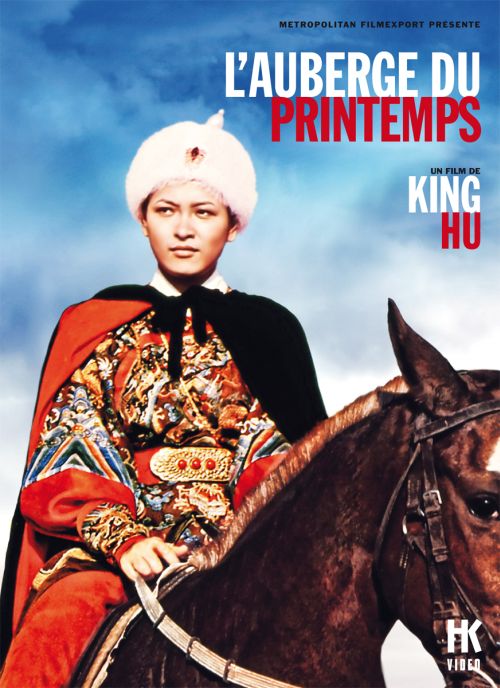
leekhanProbably best to start with a quick history lesson. In the fourteenth century, part of China was under Mongol rule, but there was a growing movement to oust the occupiers. Leading the battle against the rebels is the titular general, and it appears he has a mole inside their headquarters, who has arranged to pass Khan a crucial map that could derail the rebellion entirely. Learning in advance that Khan will be staying at the Spring Inn, a venue owned by one of their own, Wendy (Li), the freedom fighters set in motion a daring plan to steal back the map, and assassinate Khan before he can take advantage of the information. However, it turns out – as usual! – that there are others at the inn who have agendas of their own, operating undercover on both sides. So when Khan and his sister finally show up, they may be  well-aware of what lies in wait for them…

A lot to enjoy here, not least Wendy’s newly-recruited four-pack of waitresses, who all have shady pasts of their own, including a bandit, a pickpocket, a street performer and a con artist, and who are no less adept than Wendy with their fists and feet. The pickpocket, who swipes a pearl off the front of a customer’s hat as he plays dice, is played by Angela Mao in a small but significant role, as it’s her attempt to steal the map out of Khan’s locked case that triggers the climactic outburst of violence. There’s also Khan’s sister, Wan’er (right), played by another King Hu regular, Xu Feng, though this is Hu’s only work to be so heavily femme centered. The first half reminds me of Dragon Inn, made by Hu six years previously (and remade in the nineties), with its tale of shenanigans at a remote inn, on which a motley crew of heroes and villains descend. While generally entertaining, it’s somewhat hard to keep track of who’s doing what and for whose side.

When Khan shows up, the entire dynamic changes, with this movie developing a much clearer focus. Wendy and her allies try to regain control of the key map, while unsure how much Khan and Wan’er know about their plans, and who is on their side. Eventually, one of the rebels is caught in an untenable position and is summarily executed – though Wan’er “charitably” donates a hundred taels of silver “in order to bury her properly.” Such an obvious act of provocation will not go unpunished, and it’s time for all martial arts hell to break lose (or, at least, as close as it could given the era – this was just before Bruce Lee blew the doors off the genre). All of the women here have a strict zero-tolerance policy for nonsense, and are entirely capable of handling themselves. To have one such character would be impressive, but the full half-dozen we have here, indeed pushes this into the stratosphere for its time.

Dir: King Hu
Star: Li Lihua, Han Ying Chieh, Roy Chiao, Angela Mao

The 14 Amazons

★★★
“Never mind the quality, count the heroines!”

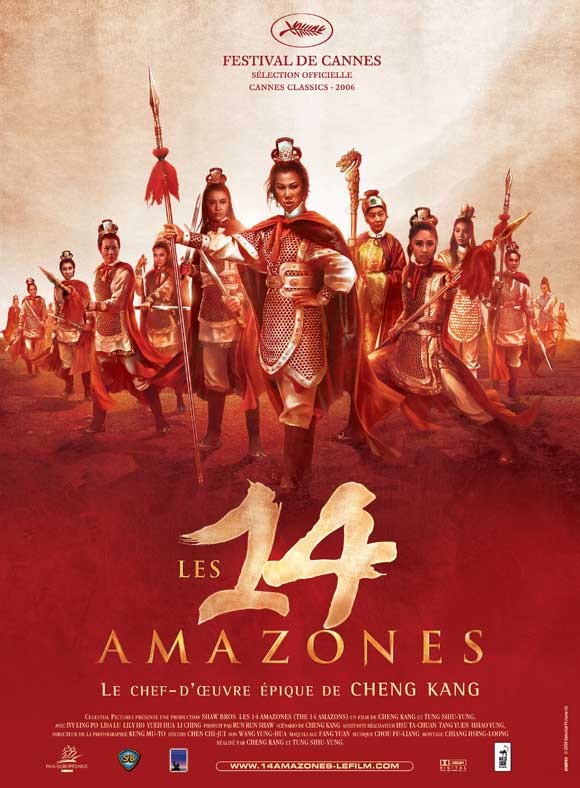
14amazonsYes, you certainly can’t argue about the quantity here, with four generations of a family being represented, from “Grand Dame” matriarch (Lu), through widow Mu Kuei-ying (Po) all the way down to her great-granddaughter. They are forced into action after the Mu’s husband is killed on the border of the Chinese empire, trying to repel an attack by Mongolian hordes. The government wants to sue for peace, but Mu and the rest of her family have vengeance on their mind, and march off to the front, in direct disobedience of official orders. The journey is fraught with danger, as they are ambushed going through a narrow pass and their supplies lost, forcing them to eat tree bark, but Mu and her forces press on, raiding their enemies’ camp to bring back food, as they battle their way towards the inevitable final showdown with the the leader of the Mongols, Wang Wen (Tien).

It’s more than a little confusing, not least because the “male” heir Yang Wen Kuang is played by Lily Ho, and they don’t make even the slightest effort to make her look other than female. That took me a while to work out. It’s also true that, with such a high number of characters, the great majority are severely under-developed, with less than a handful getting enough screen time that you give a damn when they are killed. Must confess, if they had worn jerseys with numbers on the back, it would have helped to differentiate them, because they all look kinda the same, especially when dressed in their military garb. The film’s plot also has moments of utter implausibility, with the “human bridge” sequence among the most “I’m so sure…” I’ve seen in some time. And last but not least, the Mongols’ uniforms looks unfortunately festive – red hats with white fur trim – giving the impression China is being invaded by a horde of Santa’s little helpers.

Yet despite the significant flaws, this is an entertaining epic, with a good sense of spectacle, and it’s nice to see a film from this era where the characters’ sex is virtually a non-factor (once they’ve escaped official jurisdiction, at least).  For the most part, everyone behaves with surprising smarts – even the Mongols aren’t portrayed as dumb barbarians, though their savagery is certainly not underplayed. Cheng delivers the battle sequences impressively enough, and you can see why this was one of the top box-office hits in Hong Kong for the year it was made, 1972. The same source material was mined again almost 40 years later, as Legendary Amazons  (from our review of which, I confess, I recycled the tagline above!), and I would just have to give the edge to the original, because of its intelligent approach to the story. Whatever the remake gains in whizzy CGI and arguably superior cast, the plot makes a good deal more sense here, and I’ll take that any day.

Dir: Cheng Gang + Charles Tung
Star: Ivy Ling Po, Lisa Lu, Lily Ho, Tien Feng

Fox Hunter

★★★½
“For Fox’s sake…”

foxhunterGrittily disturbing, only some misplaced and failed stabs at comedy prevent this from likely being Leung’s best work ever. She plays rookie Hong Kong cop Jenny, following in the footsteps of her late father, who takes on an undercover mission aimed at trapping gangster Tung (Fung). While it succeeds, Tung escapes, and takes vengeance on Jenny, killing her uncle in brutal fashion. This, in turn, pushes her over the edge, and she teams up with his pimp-turned-informant (Chan), who is feeling aggrieved after having not received his promised reward from the authorities. The pair head to China, where Tung is hiding out, only for Jenny to rapidly wear out her welcome with the local cops and their commander (Guang). Worse is to follow, when Tung finds out they are on his tail, he begins a campaign of terrorism, culminating in wiring an entire shopping mall with explosives. He’s very fond of explosives…

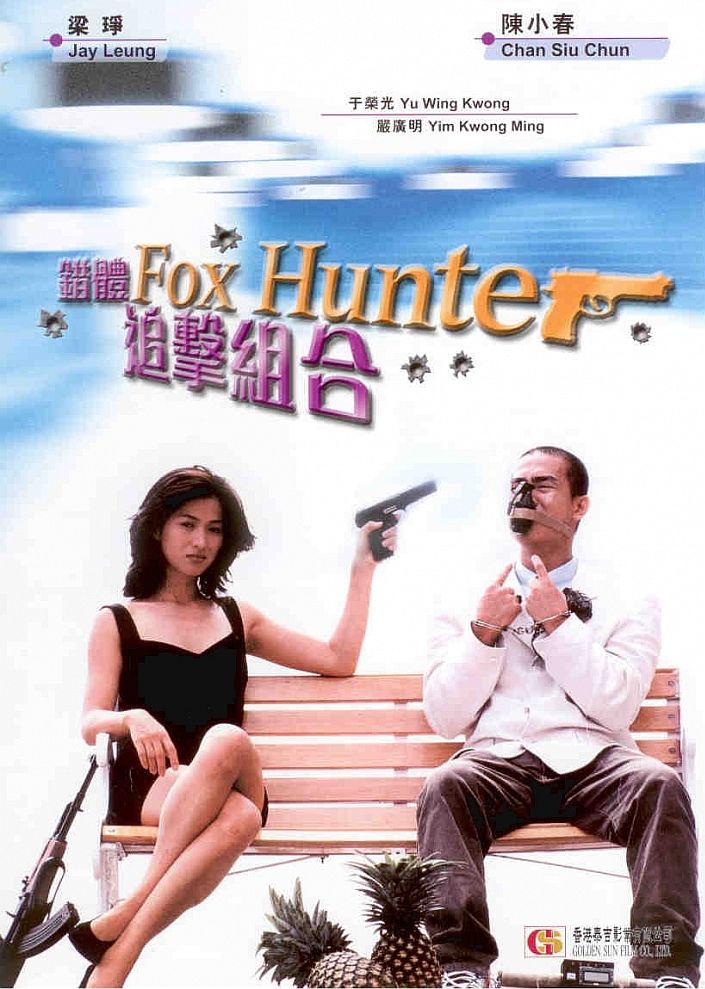
The cover (right) is surely among the least accurate I’ve seen, depicting a frothy concoction mercifully not present – and the movie contains absolutely no pineapples at all, in case you were wondering. In particular, they really shouldn’t have tried to make Chan’s character any kind of comedic foil, because it just doesn’t work. During the early going, I was praying for his rapid, painful demise, though he does become more sympathetic in the second half. Fortunately, the other aspects outweigh the ill-considered negatives. Though this is one of only four films directed by Tung Wai (including an all time HK favorite, Magic Cop), he has a long pedigree as an action director – among his works previously covered here are Mulan, Reign of Assassins and The Assassin – and that’s when this movie shines. Particular standouts are a sequence in which Tung shows up at the apartment complex where our pair are hiding out, and the final battle up and down the insides of the mall.

It’s clear throughout that Leung is doing most, if not all, her own stunts; the sequence where she uses a sofa to escape a grenade blast is so realistic, you can virtually smell her singed eyebrows. It also helps that she isn’t portrayed as all at some kind of superwoman. Indeed, Tung is depicted as stronger, and far more brutal than the heroine, resulting in a genuine sense of peril for her – Jenny has to dig deep into her reservoir of tenacity simply in order to survive his onslaught, never mind prevailing over her nemesis. As well as the cover, the English-language title doesn’t do this justice, conjuring up a rather different set of images. While I get the sense of her going after a predator, something like Wolf Hunter might have been more appropriate, in terms of getting the hard-edged tone for which this aims.

Dir: Stephen Tung Wai
Star: Jade Leung, Jordan Chan, Ching Fung, Yu Rong Guang

My Young Auntie

★★★½
“Serious kung fu, light gags.”

youngauntieHui won the Best Actress award at the first ever Hong Kong Film Awards for her role in this 1981 film, in which she plays Cheng Tai-nun, a young martial-arts expert who marries an elderly landowner so that his unscrupulous brother won’t be able to take the landowner’s assets upon his death. Instead, title passes to Tai-nun, who heads off to Canton to stay with her (much older) nephew, Yu Cheng-chuan (Lau), and his son Yu Tao (Ho), whose hip, young ways clash badly with Tai-nun much more traditionalist views. But the brother plans to steal the dead to what he considers “his” estate, and it’s up to Tao and Tai-nun to prevent that – with the help of a roster of elder relatives and Cheng-chuan, who must also be coached in the ways of kung-fu.

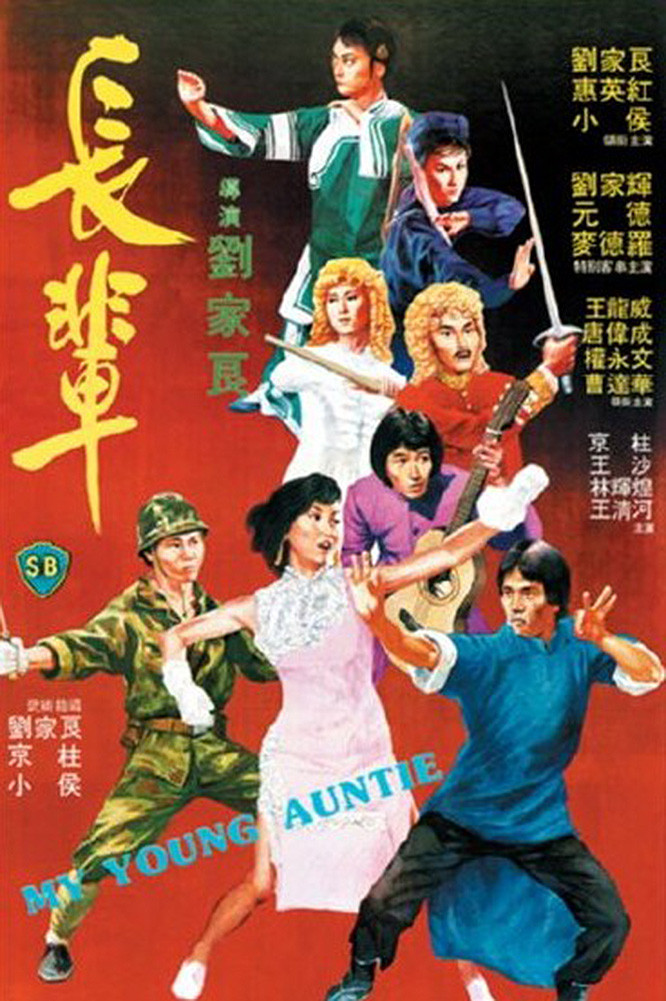
There’s three-quarters of a very good film here, and Hui is amazing; not someone to whom I’d paid any attention before, she was both lithe and graceful. This isn’t limited to her fighting skills. Perhaps the peak of the film is a masked ball which Tai-nun is tricked into attending by Tao, and her lack of dance skills are embarrassingly exposed, in a range of genres from tango to swing. It’s brilliant, because you get a real appreciation for the coordination required in making yourself look incredibly uncoordinated. That this turns into a massive and well choreographed sword-fight, with Tai-nun dressed as Marie Antoinette [at a guess] is merely a very pleasant bonus. Director Lau went on to helm Drunken Master II and this has much the same approach, combining comedy and action to good effect; the laughter flows naturally from the characters, rather than (as so often) appearing forced; the caption from the trailer, quoted at the top, gets it about right.

The main problem is a final third which unceremoniously shunts Tai-nun off to one side, with the climax pitting Tao and his older uncles against their thieving relative, as they try to get the property deed back to its rightful owner. If decent enough, there’s nothing at all to separate it from a plethora of other films of its kind and type from the era, and you just wish they had given Hui – perhaps with Ho – a final chance to shine, instead of all but eliminating her from the movie that bears her character’s name. Still, if you can keep your brain around the blizzard of generational family loyalties (or, alternatively, ignore them completely), you’re in for a fun time. If it could fairly be accused of throwing everything but the kitchen sink at the wall, more than enough sticks to justify it, and Hui makes for a striking heroine, whose other films I am clearly going to have to chase down.

Dir: Lau Kar Leung
Star: Kara Hui, Hsiao Ho, Lau Kar Leung, Wang Lung Wei, Gordon Liu

Deadly China Dolls 2

★½
“Deadly china dulls.”

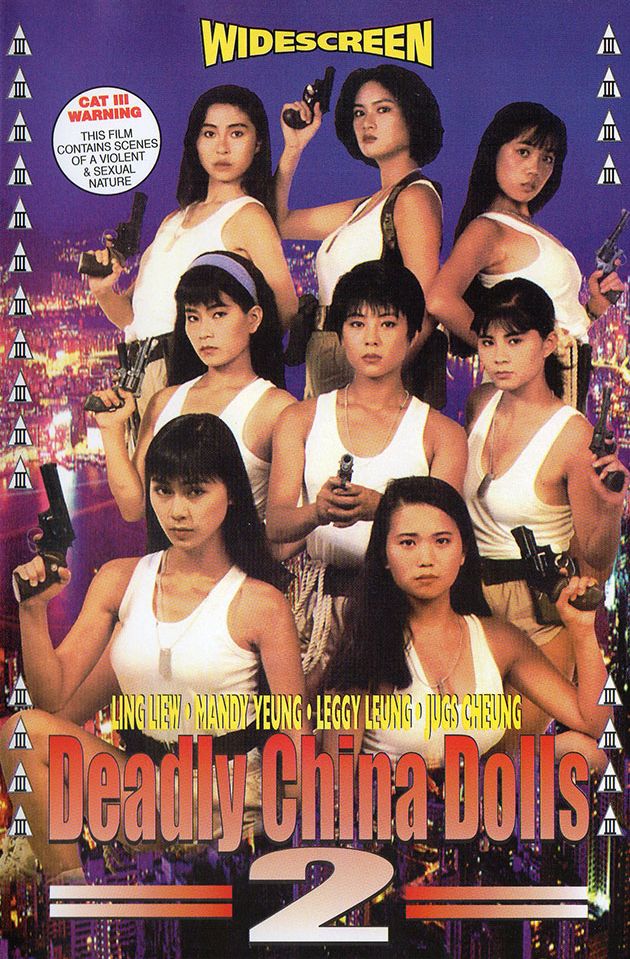
deadlychinadolls2Dear god. So much to dislike here, from the completely spurious warning label on the sleeve – no, it does not contain any “scenes of a violent or sexual nature”, unless you apply some extremely 1950’s definition of “violent” and “sexual” – through the fact that it consists of well over an hour of little more than training montages. That occupies the vast, rotten bulk of the running time, after Sister Po rescues a bevy of individual women, all being menaced by various men from a criminal syndicate, with the inexplicable aim of turning them into a unit capable of taking on said syndicate. Much, much, much training later, with about 10 minutes left in the film, they are suddenly rushed into their mission.

Despite the best efforts of Sister Po and the nameless actress portraying her – I do not believe a word the sleeve says about casting, considering the presence of names like “Leggy Leung” and, even less credibly, “Jugs Cheung” – this is utterly impossible to take seriously. Which would be okay, if the efforts at comedy were not so strained as to feel more like somebody dealing with a bout of constipation, and make Benny Hill look like Noel Coward in terms of wit. The nadir of its humourous stylings comes when a svelte trainee falls over, and gets up to reveal her bosom has dug two round holes in the ground. If your sides are splitting hysterically at the mere description of that, then this film’s for you. Also: keep banging the rocks together, guys.

The action is pitiful in the extreme, but I must confess, I do have to award an extra half-star for the sheer, bat-shit crazy nature of the song which accompanies more than one of the training montages. This is likely enhanced by the low quality of subtitles which on multiple occasions, use “Get in the car!” when they actually mean, “Climb on the back of my motorcycle!” Hard to say whether the resulting song lyrics count as lost in, or enhanced by, translation. Either way, I made the effort to transcribe the entire thing for your pleasure: I guess even if it’s memorable for all the wrong reasons, that may be better than not being memorable at all. Punctuation has been lightly polished for clarity; otherwise, all typos and grammatical gaffes are entirely as presented.

Big-breast girls come from everywhere
Mature, beautiful, attractive.
Big-breast girls are sexy and open
Great figure praised everyone.

Long hair reach to shoulders
Big expressive eyes.
Cherry red lips
Flirt like butterflies.

Big-breast girls are beatueiful
Brave and courageous heroines.
Too perfect to be true
Big-brease girls are coming to you…

Dir: Tommy Liu (Chen-Kuo Chao)
Star: Ling Lieu, Mandy Yeung, Leggy Leung, Jugs Cheung
a.k.a. Ladies in Operations
Original title: Bo ba zong dong yuan

The Invincible Eight

★★½
“Clearly one-up on The Magnificent Seven.”

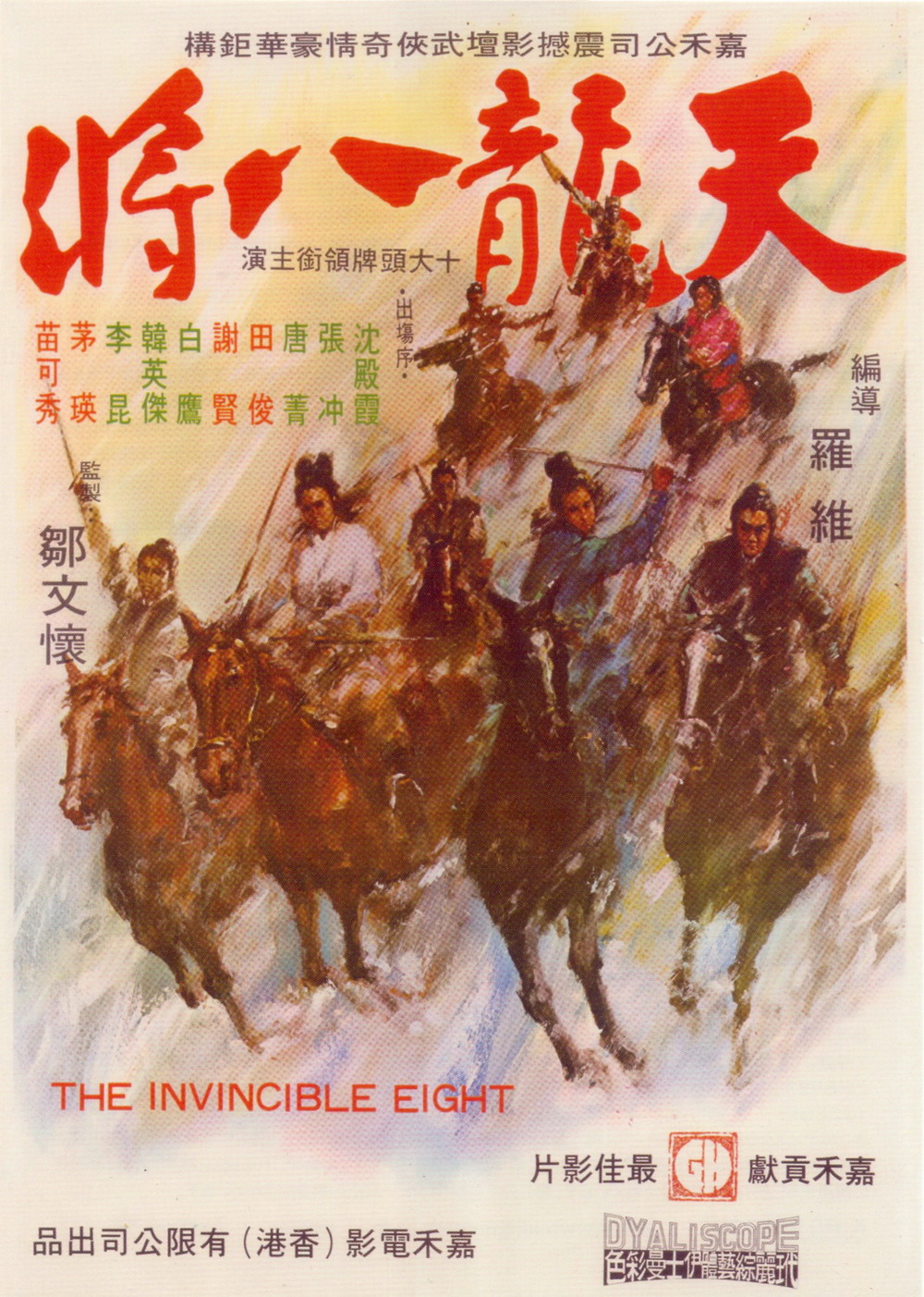
TheInvincibleEight+1971-85-bThis early Golden Harvest ensemble piece focuses on a plot for communal revenge against the evil General Hsiao (Han Ying Chieh), who was responsible for killing the fathers of the titular octet during his rise to power. However, he’s not all bad, as he raised a couple of his victims’ children as his own, who are now on his side, unaware of his involvement in their status as orphans. Three of the eight are women, a solidly respectable ratio given the 1971 provenance. They include both relative newcomer Mao as Kuei Chien Chin, who disguises herself as a man – as thoroughly unconvincingly as these things usually are in Hong Kong movies! – to infiltrate Hsiao’s camp, and the more established Miao as Chiang Yin, one of the previously mentioned surrogate offspring adopted by the general. The third is Lydia Shum, who is perhaps actually the most memorable, being loud, abrasive and larger than life in a very physical way.

While clearly not as gifted, she reminded me of Sammo Hung, which is interesting, since he was one of the action directors on this file; he and another well-known future face of Hong Kong cinema, Lam Ching-Ying of Mr. Vampire fame, are among the general’s nine whip-wielding bodyguards. This does at least allow for a touch of variety among the fights, since it makes a nice change to see whip vs. sword rather than an endless parade of sword vs. sword. However, it is still fairly limited in its own way, even if does force our heroes and heroines to come up with a special pair of double swords, which can be used to counter the menace. Hsiao is, as villains go, a bit less cartoonish than you’d expect, his killing having been for purely pragmatic reasons, and his desire to take care of some of the children indicates the acts were not entirely guilt-free. There’s a case his right-hand man, Wan Shun (Pai) is worse, though by the time the eight get past him and fight their way into his chambers, Hsiao is not exactly pleading for mercy.

It is a bit of a mixed bag, both in terms of action and in characters; this kind of thing has a tendency to feel over-stuffed, as if the makers are touting the quantity of characters more than their quality. This also has a negative impact on some of the fight sequences, particularly later on, when you have, literally, eight fights going on simultaneously, and as an early Golden Harvest film, they are still clearly finding their feet artistically. Lo Wei would go on to help more memorable movies such as The Big Boss and Fist of Fury, though how much of their success was down to him is, naturally, open to question. Certainly, they had something this film unquestionably lacks; a central star who can command the audience’s attention for the entire length, even if it’s passable enough, as a kung-fu version of Ocean’s 11.

Dir: Lo Wei
Star: Nora Miao, Tang Ching, Angela Mao, Pai Ying

Temptress of a Thousand Faces

★★★
“Face-off?”

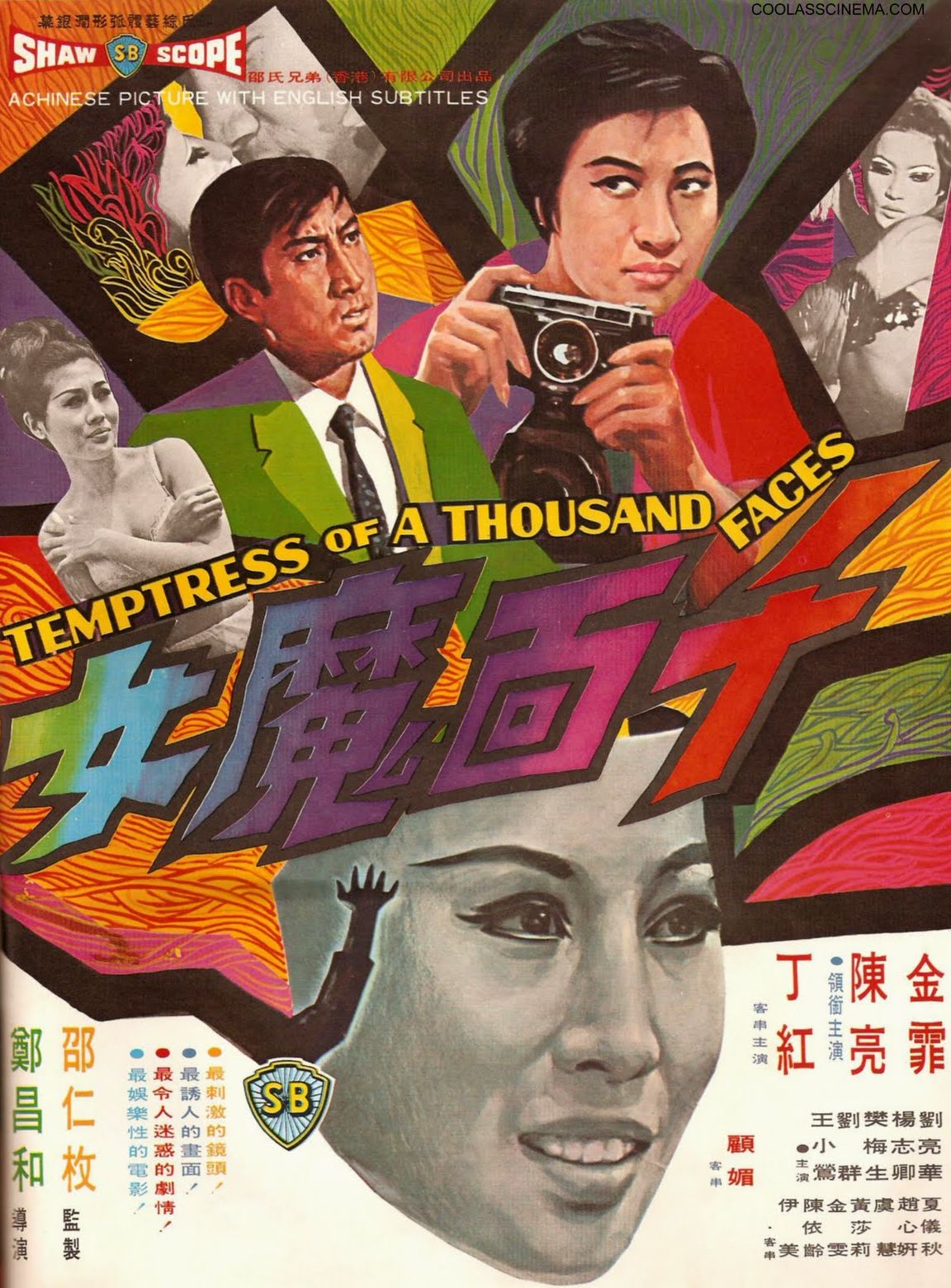
temptressThis loopy slice of sixties Shaw Brothers nonsense is best described as a bizarre combination of martial arts, 007 and Danger: Diabolik. The titular supervillainess has Hong Kong at her mercy, robbing at will due to her extraordinary disguise capabilities. The police, in particular detective Ji Ying (Chin-Fei), are aggravated, and matters are not helped by the local media sensationalizing things, realizing news about the Temptress sells a lot of newspapers. They are led by Molly (Ting Hung), who goes as far as fabricating stories entirely, which brings down on her the wrath of Ji Ying. The Temptress is similarly upset by Ji Ying’s public pronouncements condemning her as a threat to society and kidnaps the policewoman, bringing her to a secret lair purely to explain how the Temptress is doing to destroy Ji Ying’s life. This she proceeds to do, by carrying out subsequent robberies while wearing Ji Ying’s face, causing her to be arrested for those crimes. The cop escapes custody, and it seems the only way to prove her innocence is to capture the real Temptress.

There are so many aspects here that are utterly ludicrous; my favourite was likely the Temptress’s lair, which is exactly what I would build, if ever I become an evil overlord. It’s all dry ice, pillars and needlessly complex torture devices, though does at least have a pool, in which the Temptress occasionally lounges, being soaped down by pastie-wearing minions. I also enjoyed the way said henchmen, on the numerous occasions when they are sent to capture Ji Ying, will inevitably first try to defeat her in hand-to-hand combat, and only after failing, then resort to pulling out their guns. To offer an honest assessment, the Temptress needs to have spent more money on her recruitment policy and rather less on the facilities. And I haven’t even got to the glorious fight between Ji Ying and “Ji Ying”, when the cop bursts in on the Temptress, wearing her face and snogging her boyfriend. Coincidentally, they’re both wearing the same outfits, and the poor man has no clue which one is the real deal, adding to the scene’s utterly surreal quality.

But, it should be stressed, these hardly detract from the entertainment value to be had here, even if many of them were apparently intended to be taken far more seriously at the time (which would be 1969) than they deserve. The heroine and villainness make for a fine pair, and given the era, it’s especially refreshing that just about all the men involved are incompetent and/or background figures. Accept that you will probably be laughing at the film as much as with it, and you’ll find an enjoyable 76 minutes of nonsense to be had here. [Tip of the hat to Dieter for pointing me in the direction of this one!]

Dir: Chang-hwa Jeong
Star: Tina Chin-Fei, Liang Chen, Pat Ting Hung

The Lady Assassin (1983)

★★½
“Fairly whizzes past – though not necessarily in a good way.”

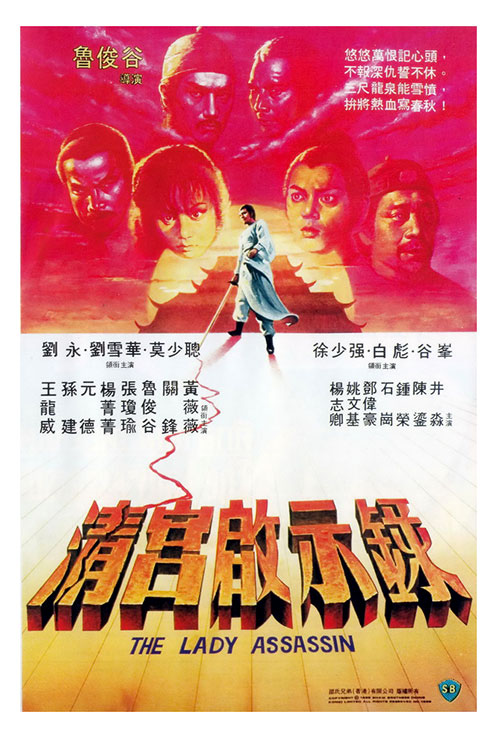
lassThe running time here is 86 minutes, but would probably be closer to two hours if they’d filmed the fights at normal speed. Because the undercranking – filming at a slower than normal frame-rate, so action looks quicker when played back at the normal speed – in this one is both copious in volume and excessive to its degree; I kept hearing the Benny Hill theme in my mind during the fight sequences. That’s a shame, because the performers here are talented enough they don’t need it, and the technique detracts from, rather than enhances, their skills. On the other hand, perhaps they needed to hurry things up to make room for the plot, because there’s quite a lot of that to fit into the film too. Let me try to summarize it.

There are two heirs vying for the imperial throne, Fourth Prince (Tony Lui) and Fourteenth Prince (fortunately, princes #1-3, 5-13 and 15+ are not apparently interested). To tip the balance his way, Fourth gets the assistance of dissident Lui Liu Liang (Ku), whose niece Si Niang (Leanne Liu) helps retrieve the emperor’s will, so #4 can doctor it and make himself the heir instead of #14. After taking over, Fourth exiles Fourteenth and “forgets” all his promises to Lui about not being so harsh an overlord. When Lui keeps showing up at court to remind Fourth of his broken oath, Fourth opts to silence his former ally permanently. But in so doing, he makes a mortal enemy of Si Niang, who joins forces with Fourteenth’s bodyguard, Tsang Jing (Chu) to take care of the usurper, who has hired some additional help of his own, in the form of a Japanese martial-arts master.

Despite the title, this is probably more of an ensemble piece, with Si Niang just one of many pieces to the jigsaw puzzle which is the plot, albeit one pivotal to proceedings. In particular, she’s the one who breaks into the Imperial Palace, locates the will’s secret hiding-place, and extracts it so Fourth can make himself the declared heir to the throne, thereby kicking off the events that follow. However, she is among a number of interesting female characters, also including Jade and Pearl, who assist Tsang Jing, and Lui’s daughter. While I have my previously-noted and significant qualms about the style of filming, which feels a good 15 years older than its actual 1983 date, I certainly cannot complain about the quantity of action, which is copious, and the people involved clearly know what they’re doing. The script is a bit of a mess though, with elements that just peter out, such as Fourteenth Prince, who must have had another engagement elsewhere. And the ending has to be among the most abrupt of all time, coming, literally, before the final body has even hit the floor. It occupies an uncomfortable position between old- and new-school Hong Kong cinema, and you can understand why the Shaw Brothers’ star was on the wane, and increasingly eclipsed by Golden Harvest.

Dir: Chin-Ku Lu
Star: Leanne Liu, Norman Chu, Tony Liu, Ku Feng

The Angry River

★★½
“A bridge too far.”

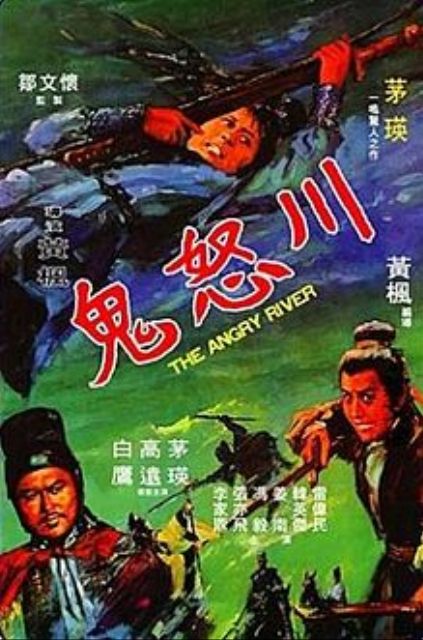
angry riverNot just Angela Mao’s feature debut, it was also the first film produced by then-fledgling studio Golden Harvest, who would go on to become arguably the premier name in Hong Kong Film production, up until the colony’s handover back to China in 1999. Even discounting their work with Bruce Lee, Jackie Chan, Sammo Hung, Tsui Hark, Stephen Chow, Donnie Yen, etc. and sticking purely to the action heroine field, Golden Harvest were the company behind She Shoots Straight, the Inspector Wears Skirts series and Naked Killer. Their commitment to our field is apparent right from this inaugural movie, where Mao plays dutiful daughter Lan Feng, whose father becomes one of the victims of ‘Poison Dart’, whose name pretty much explains what he does. Cursed to a long lingering death, the only cure is a rare herb.

Lan sets off to find it, crossing the fiery Angry River, going through the Merciless Pass, and encountering another couple of dangers without names, but we might as well call them the Cave of Really Bad Optical Effects, and the Giant Gecko That Knows Kung-Fu. The latter actually defeats our heroine (though she does save 15% on her car insurance), but impressed by her filial piety, she is given the herb, albeit at the cost of losing her kung-fu skills. She then has to make her way back home, which is even more perilous now she can’t fight, and has to rely on the kindness of strangers to protect her, because there are a lot of other people who are also very keen to get their hands on the mystical plant, whose powers extend beyond being merely an antidote to poison. And when she finally returns to her home, a nastier shock awaits.

Maybe it is just me: I kept being reminded of Homer’s Odyssey, with Mao playing the hero, whose objective, simply to get back home is endlessly diverted and derailed by external forces. I suspect any such similarity is, as they say, purely coincidental, and they just share the same basic plot of the hero’s journey, as introduced by Joseph Campbell in The Hero with a Thousand Faces. But there are elements where you can tell it was a debut film, such as the rubber-suited lizard which, it’s charitable to say, presumably worked better on the page than the screen. It’s also a mis-step to rob the heroine of her powers for almost the entire second-half, leaving her a spectator to her own story – even Odysseus only spent a bit of time tied to the mast. Particularly early on, Mao’s fights feel stilted – punch-pause-block-pause-kick – though there actually is a storyline reason for why she has to be reined in to start with, in order that Mao can go full-throttle at the end [like I said, the herb has other uses…] You can see where they were aiming – slightly to the side of the then-dominant Shaw Brothers studio – yet overall, there’s certainly a lot of room for improvement here. As a first effort, I guess it’s okay.

Dir: Feng Huang
Star: Angela Mao, Kao Yuan, Pai Ying, Han Ying Chieh