




★★★
“…and lots of boy fighters.”
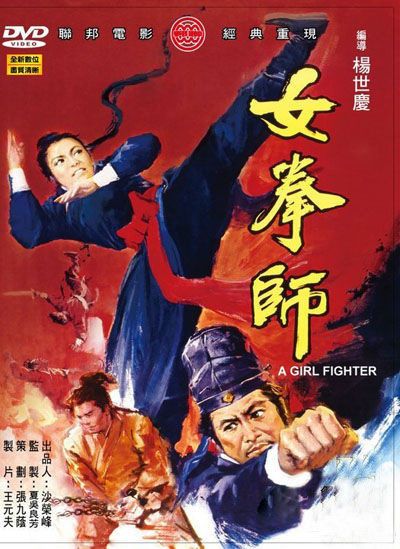 Suma Moyung (Kwan) rides into town, offering to rid the locals of a pesky warlord’s son, who is making a nuisance of himself, not least by being a bit rapey. After proving herself by slicing off the shoe-tips of the local police force (!), Suma is given the job, and proceeds to deliver, capturing the scion and bringing him back to face justice. Except, that’s only the start of the problem, because his father is none too happy with Suma, and unleashes his forces to rescue his son, by any means necessary. That covers bribery, threats and then full-on violence as it becomes clear Suma will not be easily cowed. Fortunately, she has help, in the shape of a man (Tien) who lost his entire family to the man she is now guarding. And she’ll need all the assistance she can get, if she’s successfully to transport her captive through the countryside to the state capitol, under siege from the warlord’s forces just about every step of the way.
As that summary perhaps implies, there’s certainly no shortage of action here, with a new fight sequence popping up almost every five minutes. The main problem is that titling your film A Girl Fighter does create certain expectations in your audience – among which would be, that your heroine will be depicted as the most prolific and/or the best martial artist in the movie. Neither are true, with Tien doing most of the heavy lifting for the good guys, against an apparently endless stream of minions in small groups (if the warlord ever actually committed to rescuing his son, he’d easily have the numbers to overpower the hero and heroine!). While not exactly missing in action, too often Suma is reduced to a supporting role, or worse still, left in a situation where she needs the help of her colleague. That’s a shame: while Kwan’s style is a little too theatrical for my tastes (all her punches and kicks appear to start from the next time-zone over), it’s also graceful and flowing, especially impressive when the moves are combined into an extended sequence.
However, the overall sense is of a film more interested in the volume of action, than doing anything particularly new or interesting with it. It seems particularly old-fashioned, considering that this came out the same year (1972) as Bruce Lee’s Fist of Fury. As a taste from the tail end of what that hard-hitting style was about to replace, this isn’t bad, and it certainly doesn’t dawdle. But it feels about a decade older than it actually is.
Dir: Yeung Sai Hing
Star: Polly Shang-Kwan, Tien Peng, Law Bun, Cho Kin
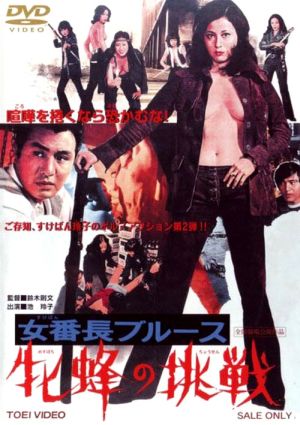 If the first Queen Bee movie was a fairly effective romp through the genre, that’s a lot less the case fot the follow-up, with Ike largely floundering around, as Maki, the leader of the Pearl Gang, who finds herself embroiled in a battle with another crew, the Black Lilies and their leader, Yuri (Kazama). Their spat is interrupted, when the Kuroji clan of yakuza throw their weight behind the Black Lilies. However, the triumph of the Lilies is short-lived, as they find out that they are about to be forced into life as prostitutes, for the benefit of their new allies, ending their life of freedom in the ‘hood. There are also subplots in which Yuri’s former boyfriend, Eizo wants to be a top racing driver, bringing him into conflict with the yakuza as well, and a suitcase filled with stolen guns.
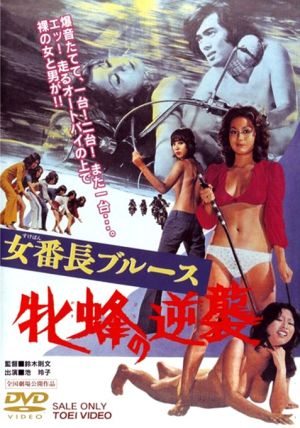 Reiko (Ike) is leader of the Athens Gang, a low-level all-girl gang, who specialize in car thefts and rolling naive salarymen with the lure of hot sex. They’re part of a hierarchy, which includes a male gang under whom they loosely operate, who are in turn on the fringes of a Yakuza group. There’s also a motor-cycle gang and its leader (Taki) who don’t obey anyone, and that independence is really what Reiko wants, even though her group is obliged to follow certain rules, such as not getting attached to any man. Things are disrupted by the return of former leader Jun (Kagawa) from reform school: will Reiko be able to hold on to her position? It’s just one of a large number of plot threads here: you also get the blackmail of a pop star; a hitman agreeing to one last mission; a gangster estranged from his wife and daughter; sex on motorcycles for no apparent reason; a journalist with a nose for scandal; and, of course Reiko failing to follow her own rule about no attachments.
 It has now been almost a quarter-century since GLOW was cancelled in 1990, and there still hasn’t been anything quite like it on television in the Western world: a pro wrestling federation entirely populated by women wrestlers. The brainchild of David McLane, and funded by Pia Zadora’s husband, the owner of the Riviera casino in Las Vegas, GLOW was a marvel of eighties low-budget television, mixing self-effacing comedy (it depicted McLane as having his office in a phone booth) with larger-than-life characters such as Matilda the Hun, and of course, wrestling matches. This documentary tells the story of the federation’s rise and fall – largely through the eyes of the women, as McLane and Matt Cimber, the show’s director, both declined to be formally interviewed (which is a shame, as it would definitely have provided another dimension for the film).
 Shae (Panabaker) is not having the best luck with men. Her older boyfriend just dumped her, to try to get back with his wife, and a night where she drinks to forget ends up with her being raped in the stairwell of her apartment building. Fortunately, there to lend a helping hand is Lu (LaLiberte), a barmaid who turns out to have a dark side. A really dark side. As in, when Shae is reporting her rape. Lu takes the desk sergeant to a motel, handcuffs to the bed, sticks a gun into his crotch and pulls the trigger. When the authorities prove about as useful as they usually are in this situation, Lu helps Shae take revenge on the bastard who raped her. Then his friends. Then the ex-boyfriend. But when Shae finds a guy who might actually not be a total douche-bag, Lu is still thoroughly unimpressed.
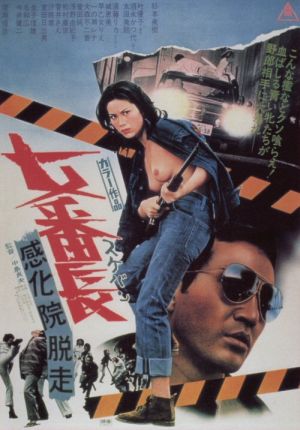 Serial escaper Ruriko (Sugimoto) is more persistent than good, and is dragged back to reform school after her seventh escape attempt ends the same way as her previous six. After whizzing through most of the standards of the women-in-prison genre in about 30 minutes or so e.g. corrupt staff, gratuitous nudity, solitary confinement, etc. she and a few of her colleagues (supposedly teenagers, but that clearly ain’t the case) break out as a group. Splitting up to avoid detection, they arrange a rendezvous at a deserted building by the sea, from where they plan to hijack a ship and escape Japan for good. Truth be told, a sense of urgency isn’t exactly top of the their skill-set, and as they meander their way there, various escapades happen, of which the only significant one is Ruriko meeting, by chance, a male criminal (Watase), who is also trying to out-run the law. But the police are also keen to ensure that they run their record in terms of Ruriko to a perfect 8-for-8…
 There are films which get a sequel because they’re successful. There are films which get a sequel because they are good. And then there’s a sequel to a film which was sub-mediocre, and appeared to vanish without causing even a ripple after its straight to video release in 2003. As a measure, nine years later, it hasn’t even reached 750 votes on the IMDB. Yet, we get this: a sequel that is neither needed, nor demanded by the public, and which manages to be even more boring and badly-constructed than its predecessor. Most movie-makers acquire at least a measure of technical skill as their career progresses, bur La Marre seems to have forgotten what little he knew a decade ago.
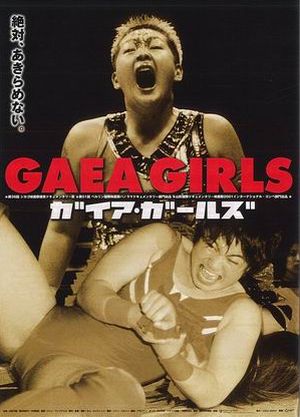 Out in the middle of the Japanese countryside is a square, unremarkable building that is the headquarters and training center for GAEA, one of the country’s leading women’s wrestling federations. Into this comes Takeuchi, making her second attempt to become a pro wrestler – the brutal training, under the glare of GAEA’s top wrestler Nagaua, caused her to give up last time. Will her second attempt prove any more successful? Can she get through to the final exam, and pass it to become a full member of GAEA?
 I could hear Chris’s eyes rolling when the title came up – I can’t blame her, as the viewing immediately followed Virgin Commandos, whose mere name sent her scurrying off to Facebook poker. This, however, was not the soft-porn flick she anticipated. Instead, it’s a comedy, somewhat spoofing Gladiator, but its closest cousin is likely Carry On Cleo. That said, it’s undeniably gynocentric, with the three heroines about the only competent characters on either side.
 The action is undeniably limited, being played more for laughs than excitement – the much-fabled ‘Celtic Kick’, turns out to be not quite what you think. Of course, this being British humour, there are also fart and willie jokes, but works because the characters have foibles and quirks to render them human. Smirgut has lost her inner warrior since motherhood; Dwyfuc is thoroughly unimpressed by the men available to her, and Worthaboutapig has long-standing self-esteem issues – unsurprisingly, really, given her name. The results are heroines who are likeable, as well as being brave and resourceful. I found the results very refreshing, with better-drawn characters than many bigger budget movies. That was definitely
 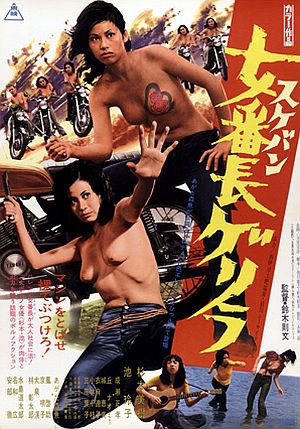 After my disappointing first foray, this is more like it, right from the moment Sachiko (Sugimoto) rips open her top, revealing a heavily-tattooed breast, before she and her Red Helmet Gang of biker chicks kick the asses of another, male gang who are hassling them. It’s clear that Sachiko deserves the title far more that the ‘Delinquent Girl Boss’. She and her crew from Tokyo head off to Kyoto, where they face off against, and end up taking control of, the local girl gang – some of whom are none to happy by this invasion [Kyoto being the former capital, its residents seems to hold a grudge against those from Tokyo]. Sachiko ends up on the wrong side of the local Yakuza, one of whom has a sister, Nami (Ike), who is an independent free-agent girl gangster, affiliated with none, but kinda over-seeing all. Sachiko meets and falls for a boxer, Ichiro (Mizushimi), after he helps her girls out of a tough spot with the Yakuza, and follows him to a seaside resort where he is training. Needless to say, love does