
Lilli, a Girl From the Big City

★★★
“The original Barbie”

The subtitle is not a joke. Lilli began her life as a comic – just a single drawing, with a line of her saying something funny – in the German newspaper Bild. Drawn by German artist Reinhard Beuthien, it ran from 1952-1961. With her child-like face, perfect slim figure, and long blond hair that she carried as a ponytail, Lilli was an attractive young woman. Also, she was saucy, sexy, independent and single: not at all as you would imagine young women to be in 1950’s Germany. It’s unsurprising that “Bild-Lilli” had her fans, and that dolls in her image would be produced from 1955 on. Though these were originally meant not as toys, but for marketing purposes.

When Mattel co-founder Ruth Handler went to Germany on holiday in 1956, she discovered the dolls and wanted to bring them to the American market. She had her designers create a new doll based on Lilli, and released her under the name “Barbie” in 1959. It seems Handler was afraid of copyright claims by the original producers. For Wikipedia tells us: “Mattel acquired the rights to Lilli in 1964, and all the promotional and merchandising activities related to the character were discontinued after then.” So, yes: while Mattel changed details here and there, Barbie was originally indeed a German girl named Lilli. Though looking at the All-American girl Barbie embodies today (also her animated movies, as well as the recent live-action one), it’s hard to recognize Lilli in Barbie nowadays.

However, long before the sale of rights, in 1958, Lilli had her own live-action movie. [I wonder if Mattel buying Lilli is why I haven’t seen this movie on TV for 30 years or more. It has never been released on videotape, DVD or Blu-ray.] This starred Danish actress Ann Smyrner, who won the role in a contest. Smyrner spoke only a little German, so was dubbed by German voice actress Margot Leonard. She would go on to fame for also dubbing Marilyn Monroe, Brigitte Bardot, Honor Blackman and Diana Rigg – basically, everyone young, female and sexy in 1950s and 60s cinema. I mention her especially, because I think that without her voice, Lilli might not have worked so well as a film character.
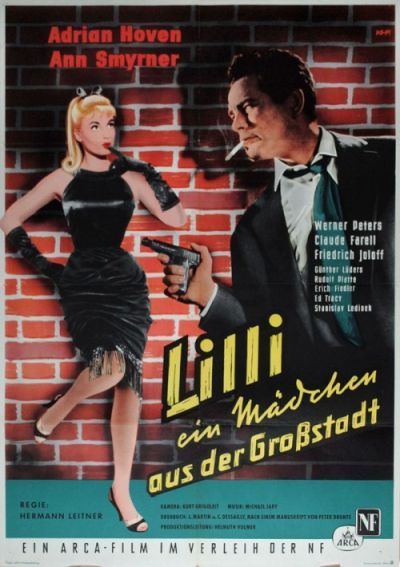
In this story, Lilli works as a reporter for a newspaper. Her introduction is already notable, driving an elegant sports car at high speed into a parked vehicle. When a policeman tries to fine her, she flatters and confuses him, kisses him on the cheek and leaves. In the newspaper office, she resists the flirtation of her boss with a move – is it early martial arts? – that leaves him on the ground. Really, we had not seen a female character like that in a German movie. It might have been slightly different in America, with some female characters in westerns and swashbucklers, but here, this was new. Although things were about to change, as I remember Lieselotte Pulver, whose Spessart Inn series of films began the same year.

Lilli is sent to report on a missionary congress in Sicily, getting there by ship. Honestly, I sincerely doubt this movie was filmed there, because we hardly see any Italian landscapes here. You see signs in Italian painted on walls indicating this is a hotel, a restaurant and so on. It’s meant to convince you that you are there because… well… it’s written in Italian language, so it must be Italy, right? Most of the scenes are inside on sets, and all of these might well have been in a German film studio. Also, some characters speak German with a fake Italian accent. It might have been convincing for a German audience in the 50s, but these feel kind of hilarious nowadays. (Although we still get German actors playing Italian characters, at least they leave out the fake accents now!) The opening credits say “Produced in the Arca studios, Berlin”, a facility which also produced a movie set partly in Africa!

But let’s be fair. For a 50s movie, Lilli’s adventure is quite exciting. She meets an old man (Siegfried Schürenberg) onboard the ship, who asks her for a favor and soon turns up dead in his cabin. She finds money printing plates in her room. Her investigations in Sicily lead her to a car garage where a traitor from a gang (Friedrich Joloff) is killed. As one of the murderers tries to abuse Lilli, he accidentally tears off her dress, leading to Lilli running away in her lingerie, causing a commotion in the streets until friendly sailors bring her back to the hotel. 

Another body appears, this time in her hotel room, and she gets friendly with potential love interest Mr. Morton (Hoven). He turns out to be up to no good, offering the gangsters a hand in getting the printing plates – most of these gangsters (including the gangster lady, below) are obviously not smart enough to deal with Lilli. When her little Italian friend is kidnapped, the big bad turns out to be the priest who accompanied her already on the ship (Peters). Lilli escapes, and has her sailor friends beat up the criminals in their own pub. The movie ends with the gangsters arrested, and Morton turns out to be Lieutenant Collins of Interpol, working undercover to help capture the villain. As Lilli already had Collins tied to a chair, she leaves her love interest struggling to free himself – a bit of revenge on her part.

Thinking about it, Lilli seems to spend most of the movie’s runtime escaping from some dangerous place or situation. She shoots with a gun at a vase, and engages in a – for the 50s – acceptable car chase. She even drives backwards, and fakes her own death by tossing the car down a slope​, Dr. No style. Though probably not acceptable for today anymore, she does it all in high-heels. But that trope is ironically subverted, when after that big chase, one of her high-heels breaks. This seems to be a bigger nuisance for her than the chase! But I have to say: for a German production, in a time when there were virtually no local crime films and no one would have understood the meaning of an “action movie” here, this film is almost ground-breaking.

However, that doesn’t mean it is “good”. Lilli survives more due to luck than intelligence, and her enemies aren’t too bright either. Characters often don’t react as would be appropriate or logical. Why the chief of police (Rudolf Platte) feels the need to chase Lilli, because a body was found in her room, escapes me; she is hardly a danger to the public. Morton walking into the gangsters’ den and immediately being accepted by them is implausible. Lilli and Morton kissing, when they have barely met or exchanged more than three words, is even more so. The revelation of the priest being the villain has no punch at all, despite clearly being intended as a big twist. Another problem is dialogue which doesn’t give enough information for scenes to work or have impact. But then, this is close to the first attempt at a German crime movie after WWII, and doesn’t take itself too seriously. Lilli is adequately sassy, some of the gangsters are quite simple minded, and everyone falls head over heels for Lilli, as if they had never seen a beautiful girl before.

The cast is almost a “Who’s Who” of German actors at the time. Schürenberg (the German dubbing voice of Clark Gable and Shere Khan in The Jungle Book) would become very well-known due to his “Sir John” character in the Edgar Wallace movies. They also often featured Peters prominently, who made a career out of playing secondary villains. He would later appear in Dario Argento’s first giallo and could be seen next to Sean Connery in A Fine Madness (1966). Platte was a very well-known actor who started in films in 1929 and would work into the 1970s. Joloff was part of SF-TV series Raumpatrouille Orion (“Space Command Orion“, 1966), a German equivalent to Star Trek, and the German voice of James Mason and Dr. No. The Austrian Hoven had a big run in 50s and 60s German genre cinema, then became a director of horror and erotic movies at the end of the sixties. But perhaps the biggest name appears at the end. Udo Jürgens was a huge star in the German music scene, with hit after hit until his death in 2014. Here, he sings the title and end songs, and plays one of the sailors.

After this movie Smyrner made a career in German and Italian movies of the Sixties, appearing in German krimis, romances, adventure movies, westerns and even the early wave of erotic comedies at the end of the decade. She could also be seen in two early American SF movies. According to another well-known actress, Smyrner was interested in both men and women, though struggled with her image as an early “sex bomb”. After she left the film scene, when German film production effectively stopped in the early 70s, she started to write articles for Danish newspapers, mostly about theological themes. 

The Lilli movie, though almost forgotten today, paved the way for things to come. One year later, crime-comedy Nick Knatterton, based on another beloved comic strip, from magazine Quick, made it to the big screen with a similarly impressive cast. 1959 also saw the release of the first Edgar Wallace movie Der Frosch mit der Maske (“Face of the Frog”). That crime film focused more on horror, and was a major hit with audiences, leading to a series of 32 Edgar Wallace movies through 1972. Obviously, the less serious approach of Lilli, didn’t quite click with audiences at the time. But without this kind of pioneering work, would we have seen what came after? This little flick is amusing fluff, doesn’t harm anyone, and might have been a revelation for German girls in the 50s, with no other choices than becoming a house wife or a secretary! While the story is kind of a fantasy, Lilli shows there may be alternatives.

Dir: Hermann Leitner
Star: Ann Smyrner, Adrian Hoven, Claude Farell, Werner Peters
a.k.a. Lilli – ein Mädchen aus der Großstadt
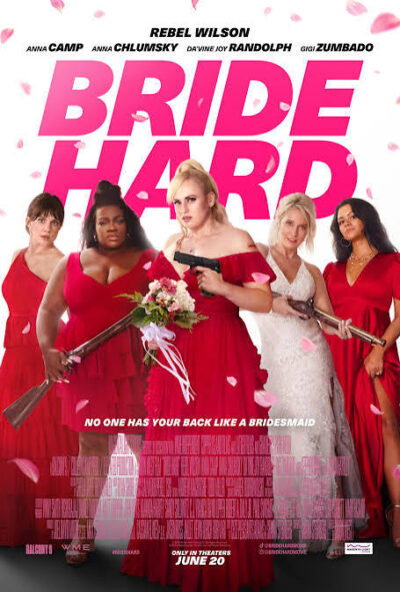
Bride Hard

★½
“Die Hard at… a wedding?”

Director West certainly knows his way around an action film. He is probably best known for Con Air, but I’m also a fan of his Chinese disaster porn flick, Skyfire, about a volcano-themed holiday resort (guess how that works out?). So, despite the critical drubbing this received, I was hoping this might still be entertaining. Unfortunately, it is not. It’s a comedy-action movie, that manages to fire blanks from both barrels. There is not a shred of originality to be found here. What isn’t stolen here from Die Hard, is ripped off from Bridesmaids – heroine Wilson plays her role like the makers ordered Melissa McCarthy on Temu. Writer Shaina Steinberg should be ashamed for the lazy sloppiness, painfully apparent here.

Sam (Wilson) is a secret agent, a fact which repeatedly interferes in attempts to reconnect with childhood friend Betsy (Camp), who is just about to get married. For instance, Sam has to abandon the bachelorette party, in order to recover a bio-weapon. On the day of the wedding itself, Sam is fortuitously away from the wedding party when a group of thieves, led by Dorff, attack the event, take everyone hostage and begin cracking the multiple locks on the family safe. But they are not just ordinary thieves, and Sam is the only hope to neutralize them. Sound just slightly familiar? That noise you hear is Steven de Souza preparing his demand for a screenwriting credit.

On the other hand, having seen the end product, I would sue to get my name taken off this heap of nonsense. I kept going back and forth as to which element was less effective: the comedy or the action. In the end, I would have to say the former, because I don’t think I cracked a single smile over the entire hour and three quarters. The characters are of the sort intended to be “larger than life”, but in this case, it means gratingly annoying. Sam wasn’t the worst to be fair. There are others here, whose company I would gnaw my own leg off to escape from, if I ever met them in the real world. Again, I put the blame for these failures, squarely on the shoulders of the script.

The action is not much better, with it being painfully obvious that Wilson needed to be doubled for any scene requiring speed, strength or flexibility. Basically, anything more than standing about – possibly stretching to swinging something like a fire-hose around for a few seconds. Why they couldn’t cast someone semi-plausible in the role escapes me. Spy did a far better job with the similarly plus-sized McCarthy. It all builds to… um, some kind of chase scene involving hovercrafts laden with gold bullion? To be honest, my attention was drifting elsewhere during the action climax, which is a savage indictment of its shortcomings. If the action heroine genre is struggling at the box-office, this kind of garbage is the reason why.

Dir: Simon West
Star: Rebel Wilson, Anna Camp, Stephen Dorff, Anna Chlumsky

Two Weeks to Live

★★★½
“Family values.”

If you described this as a dark spoof of Hanna, you might not be so far away. Since the death of her father, Kim Noakes (Williams) has been brought up off the grid by her controlling, survivalist mother, Tina (Clifford). She makes a trip to civilization to scatter his ashes, meets brothers Nicky (Rizwan) and Jay (Taheen Modak), who prank her that the world is ending. Falling for this, Kim decides to take revenge on the man who killed her father, crime boss Jimmy Davies. But in doing so, she kicks of a spiral of events putting her new friends, her mother and herself in severe peril, from the dangerous and smart Alan Brooks (Flemyng).

The comedy here is largely “fish out of water,” with Kim largely unaware of the nuances of modern life – but capable of killing you, eight different ways, with the contents of a drawer. Conversely, the brothers are naive and dumb respectively, and utterly unsuited for the violent mess into which they have become involved, desperately clinging onto normality. Admittedly, their own actions don’t help, Jay lifting a suitcase full of money from Davies’s house. Tina has own agenda too, having gas-lit her daughter in a variety of ways, lies which becomes more apparent to Kim over the course of the six, thirty-minute episodes. It’s all well-written, and I’m surprised it came and went without apparently much fanfare: I stumbled across it by accident, in Tubi’s “British crime” section.

You definitely need a British sense of humour to appreciate this: a lot of the comedy is bone-dry and self-deprecating, with Tina in particular a mistress of that most English form of wit, blistering sarcasm. However, the action proved rather better than I expected given the source and format. This does peak quite early, with a blistering brawl between Kim and Jimmy (above), which is one of the more hard-hitting I’ve seen on British television. [Jimmy is played by genre veteran Sean Pertwee, who is always good value. I could have sworn he was in Game of Thrones as well, which would have reunited him with Williams. But it seems he is the only British actor who wasn’t employed on the show!]

I was slightly sad that nothing thereafter quite reached the same level of hand-to-hand awesomeness. There is still a reasonable quota of action, but it’s more gun-based: the family which stays together, slays together, as Brooks and his henchwoman close in on the two families, and the cash-filled luggage. I found this the sort of unexpected delight which is a pleasure to stumble across. I had no real idea what to expect when I put on the first episode, but by the end, was shot-gunning episodes like they were tequila. While it would be nice to see more – I guess unlikely at this point – things are tidied up adequately, albeit in a somewhat contrived manner, involving a reluctant land-mine. All told though, more hits than misses.

Creator: : Gaby Hull
Star: Maisie Williams, Mawaan Rizwan, Sian Clifford, Jason Flemyng

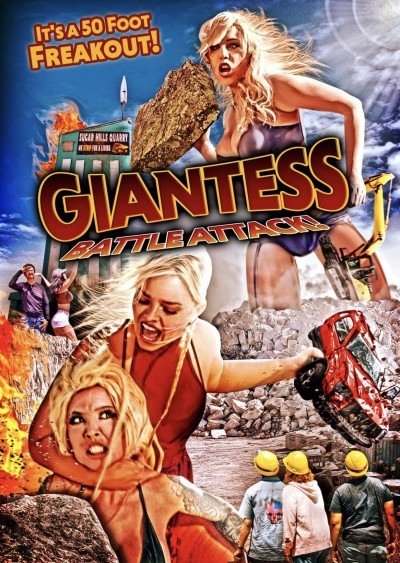
Giantess Battle Attack

★★★
“…the harder they fall.”

I was expecting this to be a follow-up to the previous Giantess films, most recently Giantess Attack vs. Mecha-Fembot! But it isn’t. This is instead, a sequel to Attack of the 50 Foot CamGirl, which I haven’t seen. However, I doubt it matters. This is much the same mix of titillation, tongue-in-cheek comedy and B-movie campiness. I think it’s safe to say, if you liked the earlier movies (and, personally, I was amused more than their quality probably deserves), this will likely hit the right spot. Director Wynorski has been doing this kind of thing for over forty years, and has no illusions about it. He has a cameo in this, complaining about the gratuitous nudity, which ends with him being pied off. And why not?
Following the events of CamGirl (I guess, anyway), the gigantic Beverly Wood (Smith) is now working in a quarry. She is trying to pay off all the damage she caused in the first film, with the help of loving boyfriend and quarry foreman Mike (Gross). A chance to escape her debts comes in the form of a $50 million PPV catfight against Anna Conda (Max), who is going to be supersized for the battle. But Beverly wants to go the other way and return to normal dimensions. Meanwhile, an extra-terrestrial threat looms, in the shape of Spa-Zor (Hall) from the planet Buxomus. She saw footage of Bev’s rampage, and travels to Earth to find an opponent who can match her size and skills.

There is, apparently, a whole giantess fetish thing. It’s not something I’m into. However, I was still amused enough over the brief (sixty minute) running time. It’s clearly not intended to be taken seriously, from the opening scene on Buxomus featuring a very terrestrial doorbell sound, and lines lifted shamelessly from Star Trek. That sets the lighthearted tone, and the film does a decent job of sustaining it thereafter. Even the obligatory sexual content is an improvement on Mecha-Fembot, played in a way closer to a fifties nudie-cutie than contemporary smut. It feels as if the cast and crew are all on the same page, pulling together, and for me, this helps paper over the obviously limited resources.

Naturally, it ends in a three-way fight, pitting Beverly and Anna against Spa-Zor at an oil refinery, which comes over like a fever dream version of a Godzilla finale. This is never going to be mistaken for high art or great cinema, and it’s certainly not for everyone. I wouldn’t argue if you said it was terrible – and, I suspect, neither would Wynorski. However, hand on heart, I was more entertained by this than The Marvels, which felt like a soulless commercial item, created purely for profit. While I’m under no illusions – a goal here was to make money – it feels like that was not its only purpose. I’d argue this is therefore closer to being true art. Now, if you’ll excuse me, I’m off for a nice lie-down in a dark room. 

Dir: Jim Wynorski
Star: Ivy Smith, Brian Gross, Masuimi Max, Kiersten Hall

Baby Assassins

★★★½
“We kill people so we don’t have to get these annoying jobs.”

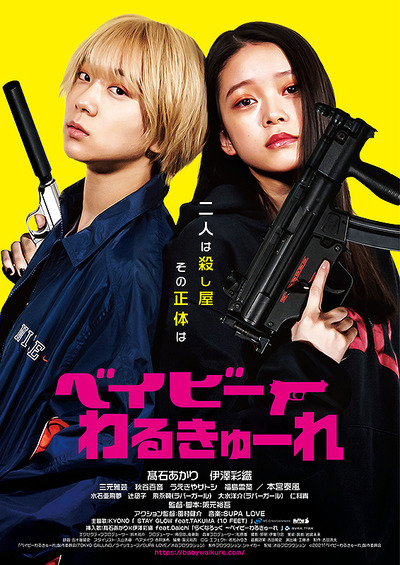
I’ve read complaints that the trailer mis-sells this, over-hyping the action components. Fortunately, I went in largely blind, so had no such preconceptions. I can see how it could be fair comment: while bookended by solid action, the middle is much more an oddball Japanese comedy. [If you’d told me this was directed by Sion Sono, I’d believe you] I still found it largely engaging, while occasionally hilarious and – sometimes simultaneously – utterly baffling. It’s about two teenage assassins, Chisato (Takaishi) and Mahiro (Izawa), who have been told by their handler they need to start fending for themselves. That means moving into an apartment, and finding work which doesn’t involve killing people.

As the line of dialogue above suggests, these are tasks for which both young women are singularly unsuited. Mahiro, in particular, is a self-confessed sociopath, who can barely keep up a normal conversation for five minutes, without wanting to shoot somebody. And it’s an urge that usually wins. We see this at the beginning, when a convenience store interview turns violent, and she has to fight her way out, past the manager and his (surprisingly loyal) employees. In the end, Chisato helps her get a job at the maid cafe where she works. I’d heard of those, but… yeah. Not sure if the depiction here is exaggerated for comedic purposes: it’s startlingly bizarre. Things ultimately go awry there when a Yakuza boss visits, and does not follow establishment etiquette, shall we say.

I was reminded of Violet and Daisy, in that this is as much about the relationship between the two young hired killers, as their actual killing. However, here the duo’s background is entirely opaque. How did they become hitwomen? Who is hiring them? Where are their parents? These are all questions that the film is utterly disinterested in answering. To be honest, the concept is a little shaky. Surely murder pays well enough that a part-time job in a 7-11 is not necessary? However, if you can roll with it, there’s a lot of amusement in getting a glimpse of what assassins do when not assassining, especially if you’ve ever lived in a similar arrangement. 

Izawa, a stuntwoman who doubled for Rina Sawayama in John Wick 4, handles most of the action. In addition to the early convenience store brawl, there’s also a final fight against the much larger Mimoto. It works, because Mahiro makes no attempt to out-power her opponent or go toe-to-toe with him, instead opting to use her advantages in speed and agility to gain an edge. I would like to have seen more of this, and some of the humour here is perhaps trying too hard to be “quirky”, complete with air quotes. But these are a pair of characters with which it’s fun to spend time, and certainly provides more amusement than I needed. I’ll be checking out the sequel, Baby Assassins 2 Babies, in short order. 

Dir: Yugo Sakamoto
Star: Akari Takaishi, Saori Izawa, Masanori Mimoto, Mone Akitani

Giantess Attack vs. Mecha-Fembot!

★★½
“The bigger they come…”

The first Giantess Attack! movie was an unexpected guilty pleasure: while obviously low budget, it had no pretensions and an undeniably goofy charm that, at least for me, helped paper over the cracks and microscopic resources. The end of it teased this very movie, and most of the main players have delivered on that promise. Can lightning strike twice? The answer is… not quite. Even at a crisp 67 minutes, it still feels like there is a lot of padding, with recycled footage and elements that go on, after their amusement value has expired. That said, it ends in another impressive giant battle, and still contains some genuinely amusing moments.

Frida (Riley) and Diedre (Tacosa) have split after the events of the first film: the latter has vowed never to become a giantess ever again, and has retreated to her “Fortress of Immeasurable Guilt” to build popiscle-stick models. Frida pays her a visit, and they end up in what can only be described as a cat-fight version of the famous brawl from They Live, over Diedre’s refusal to put on glasses. However, the main threat is the surviving Metaluna twin (Nguyen) from the first movie, who is plotting revenge on Earth. To that end, she kidnaps a scientist, miniaturizes him and forces him to make the mecha-fembot of the title, which goes on the rampage through LA. The only hope is our two heroines, though before they can save the city, the duo first need to reconcile.

There can’t be many movies which open with a Katey Sagal impersonator, but here’s one. It follows with a brutal parody of those cloying, guilt-ridden Sarah McLachlan ASPCA commercials, which is spot on, and resurfaces as a bit of a running joke thereafter. Then, however… the film kinda loses its direction and energy for much of the first half. The sequence where the scientist ends up in Metaluna’s lair, for example, is excruciatingly over-stretched. The same goes for Frida’s ascent up to Diedre’s fortress, where the sole element of humour is that she goes mountain-climbing in go-go boots. Some sequences definitely feel more aimed at the fetish crowd, of whom I am not one.

Once the robot is built – I confess, I did laugh at the supposed method of activation – and unleashed, things become a lot more fun. For we get what we came for, which is cheesy, OTT and completely ridiculous F-sized action. It’s a mix of model work, CGI and green-screen, all done with more enthusiasm than actual resources, yet remains the kind of film-making for which I have an odd affection. Much of Los Angeles is, indeed, destroyed, and our heroines are sentenced to 9,000 hours of community service as a result. Naturally, a third entry is teased, accompanied by the outrageously English accent of the eye-patch wearing “Nicky Fury”. Even if this sequel was a little weaker, I still cannot stop myself from looking forward to: Giantess Attack… In Space!

Dir: Jeff Leroy
Star: Tasha Tacosa, Rachel Riley, Christine Nguyen, Vlada Fox

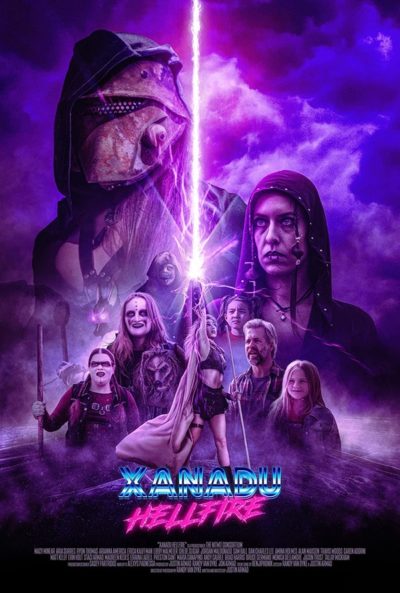
Xanadu Hellfire

★★½
“Olivia Newton-John not included.”

I went into this braced for it to be terrible, having sat through the same film-makers’, largely irredeemable Bloodsucka Jones vs. The Creeping Death. Fortunately, this is considerably better. Still very cheap and flawed, yet is at least aware of its own limitations, and tries to work inside them (albeit with mixed success). It’s about eight-year-old Ruby (Surrec), who lives with her single parent Dad, Steven (Thomas), and is obsessed with comic-book heroine, Xanadu Hellfire (Minear). For her birthday, Ruby wants to stage a ritual from the comic, and bring Xanadu back from her post-apocalyptic future. Dad humours her – at least until the ritual works, and Xanadu arrives, with wicked stepsister Raven (America) on her heels.
From here, things progress more or less as you expect. Xanadu has to adapt to life in contemporary society (I did laugh at her going to Ruby’s school, where the battle-bikini clad warrior princess is described as “an exchange student from Canada”). She bonds with Ruby, partly because she reminds the moppet of her absent mother. Conveniently, Xanadu and Mom take the same size in clothes, as we find out during a dress-up montage. Raven shows up, and “wreak havoc” as she and her sidekicks search for Xanadu. Xanadu, Ruby, Dad, some of Dad’s loser friends from high-school team and Ruby’s best friend, Becky, team up to take on Raven and Co.

It’s a super mixed bag of elements that are fun, and stuff which borders on the cringe. Sometimes, both are in close proximity. For example, Minear looks really good twirling her staff. But as soon as she goes into hand-to-hand combat, she slows down to about one-tenth of the speed. While I admire the avoidance of hyper-kinetic editing, the lengthy shots only exacerbate this problem. The comedy which doesn’t hit, misses by a mile, such as an extended joke about characters walking about in slow-motion. It doesn’t help that Ruby’s lines never sound like something an adorable eight-year-old would say e.g. “Eat shit, Frankenhooker!”. Yet some elements are genuinely funny, such as the way Raven’s minions team up with the local Goth girl. This leads to the exchange, “I thought you were dead?” “Only on the inside…”

It’s at its best when obviously not taking itself seriously. For instance, Becky going up to a minion before the final battle, and saying, “I like your make-up. Do you need a hug?” Sadly what follows is far from the climactic conflict the movie needs, and at 107 minutes long, this is in serious need of significant trimming. There was also surprisingly little difference between the post-apocalyptic world and the modern one, though this might have been a deliberate joke. Or it might not. The ending teases a sequel, which I’m all in favour of, providing it stops the makers from doing another Bloodsucka Jones movie. For I would be at least cautiously interested in seeing Xanadu’s further adventures, as despite the flaws here, there is genuine heart at its heart.

Dir: Justin Armao
Star: Macy Minear, Aria Surrec, Ryon Thomas, Arianna America

Polite Society

★★★½
“Almost everything, everywhere…”

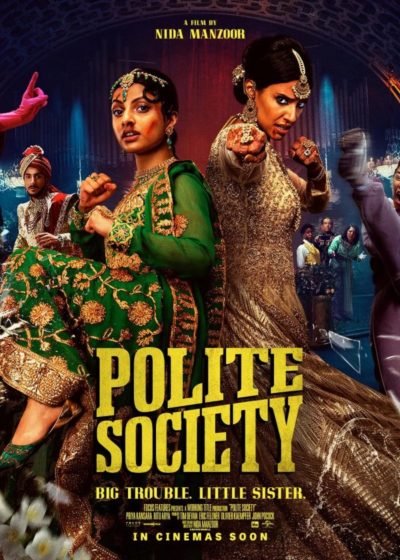
Sitting somewhere between Everything Everywhere All at Once  and Scott Pilgrim vs. The World, you will find this British comedy. It shares the same immigrant culture clash origin of the former, and the teenage angst of the latter – though, fortunately, without Pilgrim‘s smug self-awareness. It’s the story of Ria Khan (Kansara), a teenage daughter in an Pakistani family in Britain who wants nothing to do with her family’s expectations, and instead, dreams of becoming a stuntwoman. Her older sister, Lena (Arya), recently dropped out of art school and, to Ria’s horror, is now heading towards marriage to hunky scientist Salim (Khanna). He basically represents everything about traditional culture Ria detests.

She decides her sister must be saved from this fate, with the help of her plucky school-chums, and in increasing defiance, both of her family and the evidence that Salim is a nice guy, who genuinely loves Lena. That is, until Ria stumbles across the secret laboratory under his house, and it turns out she might have been right all along. Except, it might be his mother, Raheela (Bucha), who is the evil mastermind, with a plan to… No, I can’t say. Not so much for reasons of spoilerness, more because it’s such a dumb idea for a villainous plot, James Bond wouldn’t give it house-room. Even in the Roger Moore era. Regardless, Ria’s only hope is now to kidnap her own sister from her own wedding, under the nose of both Rahella and the bride’s parents.

This manages to tread the fine line between self-awareness and blatantly being “meta”. Ria is excellent, delivering fiercely as the committed teenager, who is 125% sure she is utterly correct, regardless of what any so-called “facts” might indicate. However, the real star is likely Khanna, who in just a few scenes manages to steal the entire movie, as the epitome of an evil overlord. I did sense some of the cultural beats might be lost on those outside Indian society. Most of the time, there’s enough context you can work out the details (and it was refreshing that the script avoided the obvious “arranged marriage” trope). But what is an “Eid” and why would you have an “Eid soiree“?

The action is surprisingly robust, setting up each fight with an introductory title. It generally delivers with emphatic oomph that provoked comment from me more than once: the fight between the two sisters was particularly savage. It was also appreciated that Ria’s idol is Eunice Huthart, who genuinely is one of the top British stuntwomen, having doubled for Angelina Jolie in Salt. I would have welcomed a bit more action, especially towards the end. It seems to be setting up a big fight between Ria and Raheela: this doesn’t arrive, instead being simply Ria landing the signature move she has been failing to complete all movie. But as an entertaining mix of dry British humour and flying fantasy, this works better than I expected.

Dir: Nida Manzoor
Star: Priya Kansara, Ritu Arya, Nimra Bucha, Akshay Khanna

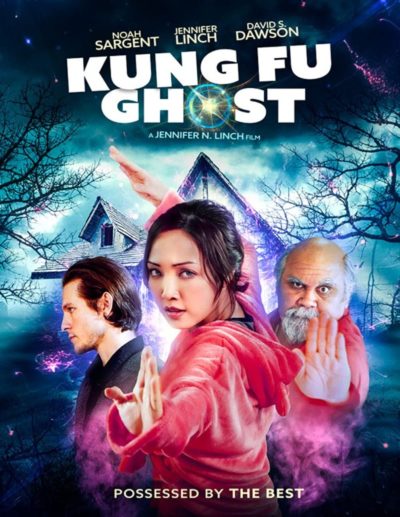
Kung Fu Ghost

★★
“The spirit is willing…”

This is another example of someone simply trying to do too much on their movie. For Linch not only starred in, produced and directed this, she also edited it, did the sound design and was the colourist. It’s not hard to predict her talents are not equally divided. It’s a shame, since I really wanted to enjoy this: much like its heroine, there’s a plucky, can-do attitude present, which can only be admired. Unfortunately, anyone above the age of eight is going to be quite hard-pushed to overlook the flaws. While the action is not especially one of those, the volume there is underwhelming, and the romantic, comedic and dramatic elements are hugely variable, to put it politely.
Daisy (Linch) returns from Vietnam after inheriting the house belonging to her late grandfather (Dawson). This turns out to be handed, both by his spirit and that of William (Sargent), a younger, cuter ghost. It’s actually a good thing, because it turns out some bad people are after an artifact hidden in the house. It can confer the gift of eternal life, and they send a selection of thugs and ninjas to take the relic. With Grandpa now dead, it’s up to Daisy to take over his role as its guardian. While she’s training up to be able to do the job herself, Grandpa is capable of possessing her when necessary, which imbues her – not entirely willingly – with his martial arts abilities.

It is certainly family-friendly, emphasizing the importance of familial loyalty, hard work and honour. So that’s nice. Linch knows her way around a fight sequence; unfortunately, the same can’t be said for delivering her lines in English. A thick accent, compounded by ropey audio work, may well leave you straining to figure out what she is saying, though fortunately she can still emote well enough to put over the gist. The romance between Daisy and William is strictly boiler-plate stuff, and the comedy is not much better, despite a Ghost parody which does at least reach moderately amusing (I did also laugh at the Jean-Claude Van Damme reference). This leads to long periods where there is simply not enough happening to hold your attention.

It is the kind of story which I could imagine coming out of Hong Kong in the early nineties – perhaps with Sammo Hung as the grandfather, and Moon Lee as the heroine – so I get the concept for which Linch was aiming. This has to count as a swing and a miss: even the notoriously variable HK comedy would likely be an improvement over what we receive here. That said, I’d not be averse to seeing more of Linch, in the right vehicle instead of this misfire. Despite the problems, Daisy is a genuine and likable character, and I did want her to succeed. Though my biggest unanswered question is probably: what happened to the cat she left behind in Vietnam? Inquiring minds need to know…

Dir: Jennifer N. Linch
Star: Jennifer N. Linch, David S. Dawson, Noah Sargent, Rene Fernandez

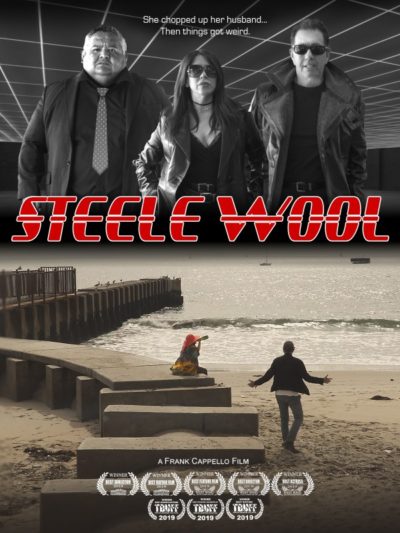
Steele Wool

★★★
“Puts the ‘hard’ in hard of hearing…”

Daphne Wool (Varela) has finally had enough of her abusive husband, so has killed him, chopping up the corpse and keeping it in a storage locker. Which actually is a good thing, because it turns out he was wanted by the Mob, and there was a price on his head. For their “help” in carrying out the hit, Daphne and pal Tony Steele (Cappello) are rewarded, but things go further. Daphne becomes a full-time assassin for the gangsters, learning to kill with everything from a paper-clip up, while Tony acts as her facilitator. However, they quickly become a liability to the organization, and are given a “poison pill” contract, being sent to kill weapons inventor Vincent McCabe.

The approach here is very much light in intent. Witness how Daphne’s training is largely watching movies like La Fille Nadia [sic], or the way in which she does, in fact, use a paper-clip as the instrument of one target’s demise. The film does a decent job of countering this with an awareness that this is a dirty and unpleasant business, as when she visits (from a distance) the widow of a target and their now fatherless child. It is a difficult balance for a movie to strike, and I’m not convinced Cappello gets it right, resulting in some awkward lurches in tome from the comedic to the supposedly heart-felt. Both come off a bit flat: I never got past a wry smile, and was never completely engaged.

This is not Varela’s fault, nor that of her character. Daphne is played gloriously against all the tropes of the female assassin: it’s no coincidence her most effective undercover disguise is an estate agent. Add to this, Varela is deaf: this element affects, yet does not define, her character and that’s exactly the way disability should be portrayed. It is even worked nicely in to the plot, with one of McCabe’s weapons in development being a sonic cannon. However, I’d like to have seen more of her in action; perhaps for budgetary reasons, this is limited, or perhaps Cappello just wasn’t interested in that aspect.

This brings me to the other issue: Cappello the director is too much in love with Cappello the actor. The latter wears out his welcome well before riding to the rescue of the supposed heroine, in McCabe’s underground lair. This is a shame, since Daphne is such a gloriously unconventional character, the reverse should have happened. Tony is never interesting to begin with, the script (also by Cappello, naturally) forgetting to give him any particular reason to exist, beyond Daphne needing someone to talk to. Having him become the hero for the finale, feels forced and unnatural. This is not enough to derail an excellent concept, or negate what I think is likely only the second disabled action heroine on this site, after Ready, Willing and Able. Yet it’s definitely a pity.

Dir: Frank A. Cappello
Star: Cami Varela, Frank A. Cappello, Nicholas Ontiveros, Arina Manta