



 ★★★
★★★
“Brave, but too much heart?”
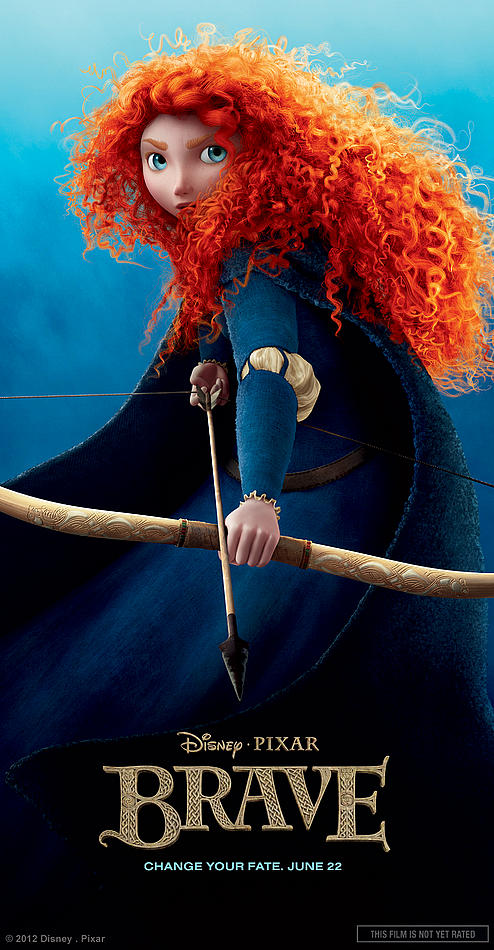 I was immensely stoked for Brave on a number of levels. First, Pixar kicks ass. With the exception of the underwhelming Cars and its pointless sequel, the quality of their work speaks for itself: Monsters, Inc is close to the finest animated movie of all time. Secondly, genuine action heroine films for the whole family are rare, to the point that they can probably be counted on the fingers of one hand over the past 25 years. Thirdly, it’s Scotland. Y’know, where I’m from. It’s the bit at the top of England. I feel I should mention this, because Pixar had originally tabbed Reese Witherspoon to voice the teenage, Scottish heroine, Merida. Fortunately, scheduling prevented this, and Pixar ended up with an all-Scottish lead cast.
I also note the somewhat troubled production: despite two names getting directorial credit, this wasn’t a co-direction. Mark Andrews replacing Brenda Chapman as a result of what Chapman called “creative differences.” This was certainly an embarrassment to Pixar, who had long been criticized for their very male-dominated output, and had made a big fuss about Brave, not just featuring a female heroine, but also written and directed by a woman. The problem, according to Andrews, was that the story was unfocused. He said, “Whose story it was – whether it was Merida or her mom’s story or Merida choosing which parent she was going to be more like – these things weren’t working.” Chapman was unimpressed, telling the NY Times, “To have it taken away and given to someone else, and a man at that, was truly distressing on so many levels.”
Does this impact the final movie? It’s hard to see how it couldn’t, either through a compromise of the original vision, or as a result of the realization, mid-way through production, that it wasn’t working. Not that it’s alone – many Pixar movies have had bumpy journeys to the screen. But in this case, the end result was greeted with muted box-office success. It seems odd to describe a movie that grossed $235 million as a disappointment, but Brave showed a lot less “legs” than most Pixar films. Almost all have gathered total US box-office receipts four times or better than their opening “wide” weekend. Brave’s multiplier, of 3.56, is ahead of only the woeful Cars 2 (2.89) in studio history.
Not to say it’s bad, because it certainly isn’t. Pixar have an absolute and complete handle on the technical aspects: even in 2D, this is the best-animated (if not necessarily the “best animated”) film of 2012. The landscapes are lush to the point of seeming photographic, the characters are richly-detailed, down to the last red-haired ringlet on Merida’s head, and in motion, you remember why Pixar is #1. And there are plenty of moments where everything comes together. Witness the sequence below, depicting a contest between three suitors to win the hand of Merica. It is filled with 100% pure awesome, climaxing with the heroine’s declaration, “I am Merida, and I’ll be shooting for my own hand,” before she literally bursts out of the confines of princessly expectations.
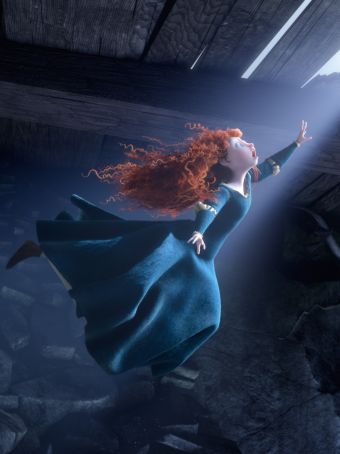 The problems are more with plotting – basically, the issue described above by Chapman is still present. The story starts in one direction, looking suitably action-oriented. It’s difficult to provide any specifics without giving spoilers – there’s a major plot-point not even hinted at in the trailers, which certainly surprised me. But I can see that it abruptly changes direction in the middle, going in a much less satisfactory direction, that seems almost to push Merida into the background of her own story. Even the climax relies less on any innate abilities of our heroine, such as her much-touted archery, or even her temperament, more the fortuitous toppling of a large geological entity [I doubt the film would have sold quite as well had it been named “Lucky”].
This conclusion is set up by the sort of happy compromise that is only deemed acceptable by both sides in fairy stories – anyone who has had a teenage daughter can vouch for this. I also have some qualms about the arranged marriage subplot that drives the first half of the film, which is depicted as little more than a “You’re going to do your homework, young lady, whether you like it or not” kind of way, which seems facile and dubious, even for a Disney-produced cartoon. And the introduction of “magic”, for the first time in a Pixar film, allows for the sort of convenient story developments that does nothing but weaken the overall structure. It’s not even a magical universe, instead, it’s more or less a one-shot deal, necessary to the plot.
It does fairly well in avoiding the Scottish clichés: one haggis joke, a random act of indecent exposure, and a soundtrack which oozes wannabe tartan are about it. The lack of any romantic love interest for the heroine is delightfully refreshing, and the lead actors all do a very, very good job in their roles, bringing their characters to life beautifully, to a degree that you can’t imagine any other voices coming out of their mouths. [I repeat: Reese Witherspoon?] It’s not boring. but fails to engross in the way that the better Pixar movies invariably succeed in doing. I got to the end entertained, but without any real sense of investment in Merida or her fate. Put bluntly: I just didn’t care about her, and the film succeeded mostly as a commercial for the Scottish Tourist Board. As a dramatic entity on its own merits, this falls somewhere between Brother Bear and Freaky Friday.
Dir: Mark Andrews + Brenda Chapman
Star (voice): Kelly Macdonald, Emma Thompson, Billy Connolly, Julie Walters
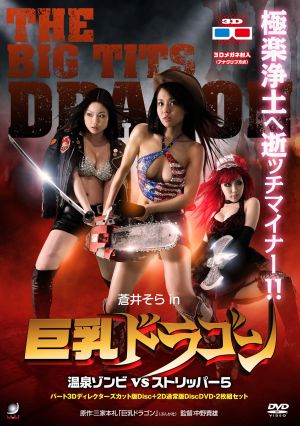 There seem to have been a spate of these recently. Not just zombie flicks – though there’s been no shortage of those – but zombie flicks set in or around strip clubs. This is the Japanese take, and follows more or less the expected pattern of such things, combining nudity, violence and self-awareness in varying degrees. At least initially, this is definitely leaning towards a 70’s, grindhouse aesthetic, but after a few minutes, that aspect vanishes, and never really returns. Instead, it’s a fairly straight-forward tale of a motley crew of stereotypical strippers, e.g. the money-hungry one, the intellectual one (who quotes George Bataille), who work at a pretty crap club in a spa town, but who find a tunnel leading across the street, which brings them to a book of dark magic and a well containing an apparently infinite supply of zombies.
 In contrast to
 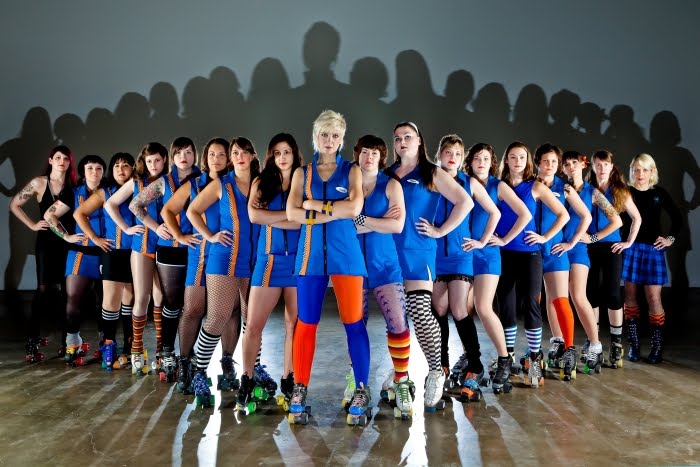 Not that there is any shortage of said personalities, such as the mother and daughter who both take part in the sport, or the three sisters who have been roller-skating virtually their entire life, and are feared across the entire Seattle league. There are, admittedly stories about romance and marriage included, but even these have a close connection to roller-derby, like the guy who proposes after his girlfriend became part of the championship-winning team [I can relate to this, having proposed to my wife immediately after the Arizona Diamondbacks won the 2001 World Series!]. I also enjoyed the insight into the different teams, like the Sockit Wenches (right) or the Derby Liberation Front, and the different ways in which they both perceive themselves and are perceived from the outside. Each has a different group personality, which of course, attracts other like-minded individuals, reinforcing that aspect of the team.
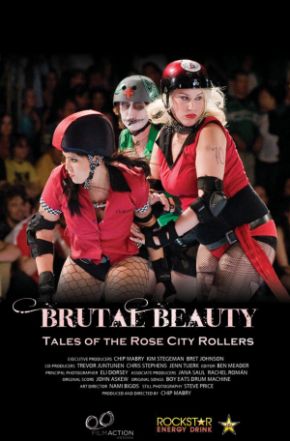 For the next entry, we leap forward to 2009, and Portland – a city which all we know about, we learned from Portlandia. And, on that basis, of course it’s a city which has roller derby, where it sprung, virtually fully-fledged to four-figure crowds. This is less of a landmark doc, in that it doesn’t cover the beginning, middle or end. It’s basically a year or so in the lives of the participants in the Rose City Rollers, which is the Portland league. It covers both their local season, and then, once that’s over, follows the travelling team, the Wheels of Justice, first as they head down to San Francisco to take on their hated rivals, then over to Denver for the regional championships.
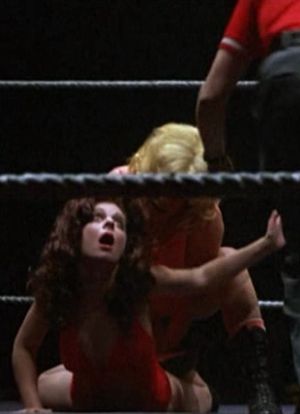 Rosa Rubinsky (Baff) is working as a waitress at a wrestling venue, when her swift dispatch of an over-affectionate coworker gets her noticed by a promoter (Bechler). He convinces her to try out, under the watchful eye of Mildred Burke [playing herself – she held the Women’s World Championship for about 20 years], and after some initial shock, discovers she likes the theatrical sport. Despite never having been outside the state of New York, she goes on the road, along with a set of other women wrestlers, and they travel up and down the East coast, putting on shows, though Rosa is still deemed too “green” to get in the ring. That changes after she meets the current women’s champion, Terrible Tommy (O’Brien, another genuine wrestler of the era). A bout for the belt is arranged, in which Rosa – known now as “Rosa Carlo, the Mexican Spitfire” – will take on Tommy for the title.
 If you’ve seen Bollywood films, you might expect the same here – a light, breezy romp, interspersed with gratuitous musical numbers. Wrong, on every conceivable level. It’s an almost unrelentingly grim portrayal of the life of Phoolan Devi (Biswas), sold off by her family at the age of 11, abused by her husband (Shrivastava) as well others in the higher-ranked Thakur caste, and basically treated worse than an animal. She’s eventually abducted by a gang of bandits, whose lieutenant Vikram (Pandey) is sympathetic to her: when the leader tries to rape her, Vikram shoots him in the head, and takes over, making Phoolan his co-chief. However, after the group’s true leader is released from prison, he’s none too happy, and sets out to teach Phoolan a lesson than will make her earlier misfortunes seem like paradise.
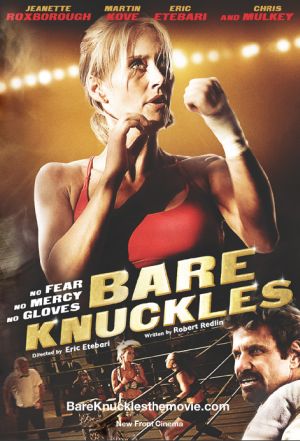 Samantha Rogers (Roxborough) works in a bar, where her no-nonsense approach draws the attention of somewhat shady fight agent Sonny Cool (Kove), who convinces her to try her hand in the world of unsanctioned women’s MMA. While the money’s good, a brutal beating at the hands of current champion Mona (Bridgett Riley) convinces Rogers to give up. However, Cool comes knocking on her door with news of a 16-woman contest with a six-figure, winner take all payout, that would set single-mom Rogers and her disabled daughter (Roxborough’s real daughter) up for life. The bad news is in two parts: it’s no-holds barred, and Mona will also be in the field, along with
 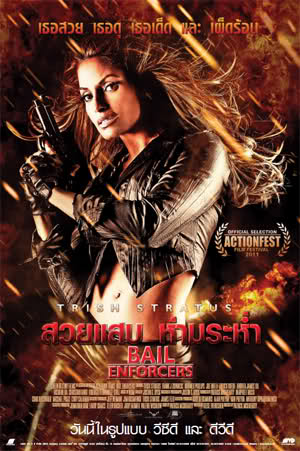 The films put out starring WWE wrestlers are a bit of a mixed bag: some are mindlessly entertaining, while others are near unwatchable. And much the same goes for their Diva’s division: some are actually good wrestlers, others are clearly chosen for their looks. Stratus does probably fall into the former category, but this doesn’t do her adequate justice, and top-billing is probably a bit of a stretch – she’s held hostage more than she kicks ass. She plays Jules, one of three bounty-hunters, who pick up a guy that suggests a deal: let him go, and he’ll point them to a wanted man with a $100,000 reward. They accept, but when taking the guy in, get a call from mob boss Hal Lambino (Rafla) who offers them one million dollars if they deliver the bail-jumper to him instead. Needless to say, the transaction doesn’t go smoothly.
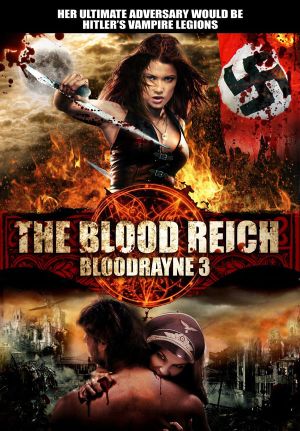 After the abomination that was Part 2, I’d filed the third entry under ‘watch whenever I have time’, until a spirited debate on its merits (or otherwise) broke out on over oun our
 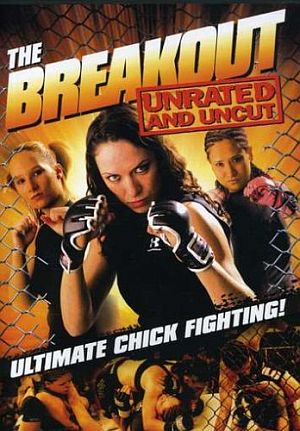 S’funny what you stumble across on Netflix, at the end of a long chain of “See also…” recommendations came this, which according to the
 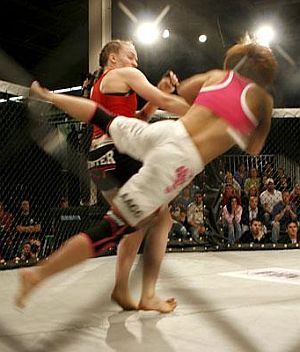 The shortest match of the night – lasting exactly one minute – was a bit unfortunate, as Shayna Baszler actually broke the arm of her opponent, Samantha Anderson. She was applying a submission hold on the arm, but it seemed that Baszler fell forward, resulting in the pressure being made much worse, and resulting in a clean break of her humerus. Ouch. The opening contest [on the DVD – there was an amateur fight not included for some reason] was the only one that lasted longer than one five minute round, with Marissa Inhofer beating Kirsty Bushnell. As well as being the brother of another MMA figher [Nick Inhofer was on The Ultimate Fighter 3] Inhofer was a roller-derby girl, and seemed to have brought a large contingent of her team-mates with her.