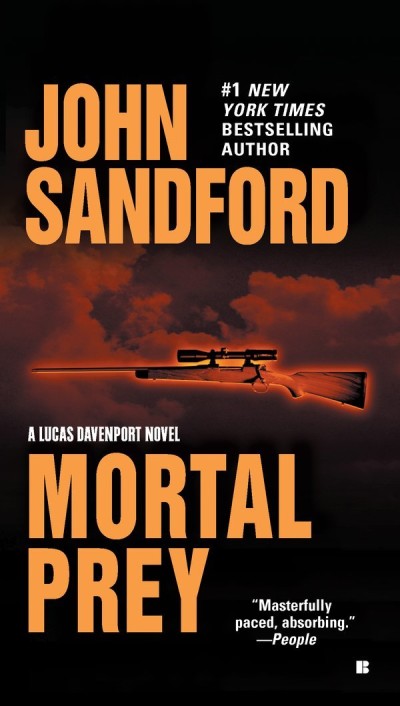
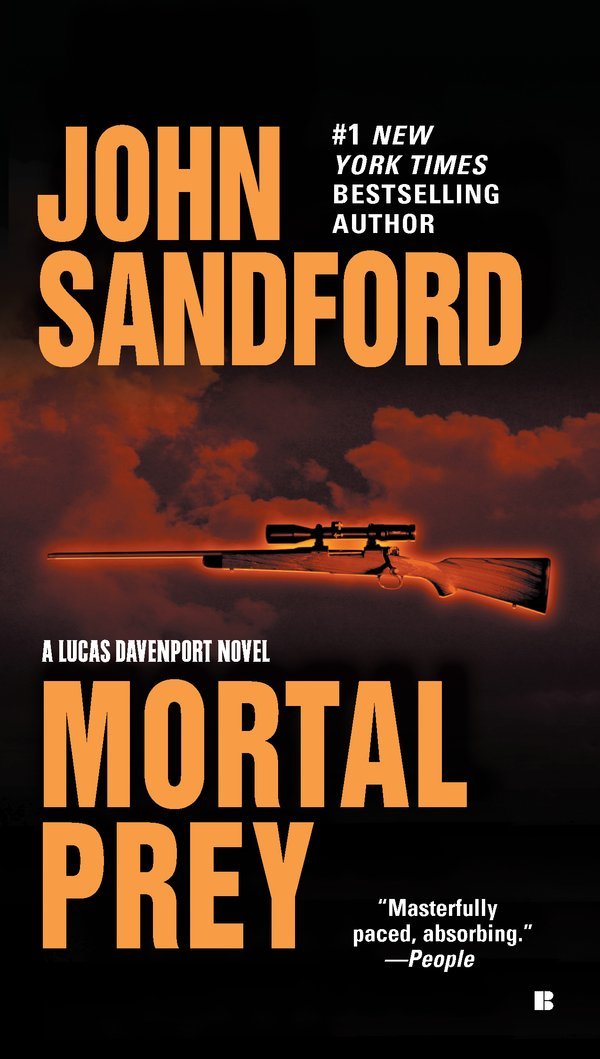
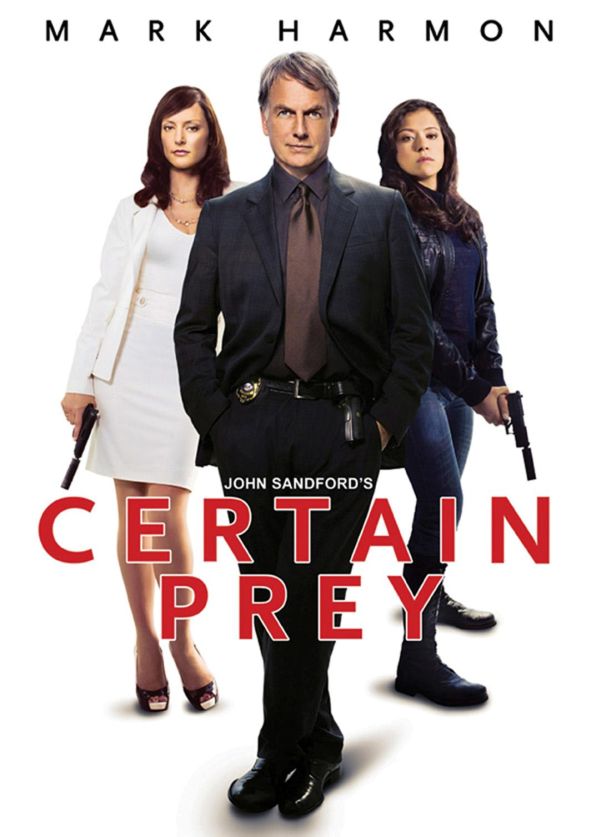
 Murder mysteries typically climax with the apprehension of the murderer, or murderers; but at the conclusion of the 10th Lucas Davenport series novel, Certain Prey, one of the two culprits, Clara Rinker (who’s been a professional hired killer ever since she was 16), made a clean getaway. When I finished that book, I was sure that readers hadn’t seen the last of her. Sure enough, this 13th series installment picks up her story three years later; and I knew that it was a story I couldn’t leave hanging.
It should be stated at the outset that this book has much the same flaws as its predecessor. While the characterizations of the secondary characters are sometimes, I think, a bit sharper here, most of them again are not likable. Series sleuth Davenport is even more unlikeable here than before. His abrasive, cocky, arrogant, “rules-don’t-apply-to-me” personality and his fondness for physical intimidation is clearly meant to give him an edgy, “bad-boy” appeal, but for me just manages to make him annoying. Compared to most traditional fictional detectives, moreover, he’s not in the top league; he’s willing to slog through a lot of leg work, and both books make reference to his uncanny luck, but having case solutions fall into his lap through luck and intuition is a cheap literary substitute for close observation (though here he admittedly does pick up on a couple of crucial details at one key point) and reasoned deduction. (The series isn’t pure noir, but has enough similarity to it that I could recommend it to noir fans; he reminds me more of fictional detectives in that tradition, like Sam Spade –though in fairness to Spade, I can’t imagine the latter freaking out like Davenport does at one place here.)
That the FBI would bring him in to consult on this case at all is also a stretch; apart from luck, he was hardly that effective against Clara in the earlier book. (There, the idea that they would cooperate with the Minneapolis police was quite plausible; but here, though the main setting is St. Louis, there’s apparently no attempt at all to cooperate with the local police there –which isn’t so plausible.) Sandford milks a supposed contrast between the allegedly street-smart local cop culture and the putatively effete, overly technology-reliant FBI mentality for all it’s worth, but I have my doubts about the realism of either end of that portrayal, as well.
However, the strengths of the earlier book are here in spades, too. The foremost one, again, is the portrayal of Clara, who’s one of the more complex, nuanced, vital and fascinating characters you’ll ever meet in the pages of fiction. She was already well-drawn in Certain Prey, which brought to life both her prominent ruthless/callous streak and her off-the-job “regular gal” side. (That book also vividly sketched her formative years, which were genuinely hellish –though if she’d had better moral fiber to start with, being the repeated victim of brutal violence herself would have given her a more compassionate perspective toward other suggested victims.) Here, though, Sandford deepens his portrayal exponentially, digging down to reveal the gentler and kinder side she doesn’t usually display. True, the evil side of her nature is pretty strong, and used to dominating. While she’s no sadist, and isn’t incapable of sparing people’s lives if she doesn’t believe killing is necessary, she also has no qualms at all about taking innocent life as part of her job, or if her survival depends on it (for her, being captured would mean death, since she’d certainly be executed), and she can be highly vengeful.
But though her capacity for empathy with her fellow humans is usually dormant, some people do evoke it; and her conscience isn’t always impotent. She does draw some lines even she won’t cross; and while she may threaten, for intimidation purposes, more than she’ll actually do, her bark is sometimes worse than her bite –even though her bite can be nasty.) And she’s a loyal friend you could literally trust with your life, a caring sister to her weak-minded little brother, and capable of genuine kindness and even love. Sandford shows us both the best and the worst sides of her nature here; it’s not wise to forget the latter for a minute –but not fair to forget the former, either.
Much more than in Certain Prey, the author raises profound ethical questions here, which are compounded of black and white that do represent absolute polarities, but which in the real world intermix in all sorts of challenging shades of gray. They’re not posed explicitly; they just arise naturally out of the situations, and they don’t come across as set up to cynically discredit the idea of absolutes (as they would be in the noir tradition), but rather as serious questions that seek to apply absolutes in a fallen world. (And trying to do that in the context of practical situations –real-life or fictional– is more apt to be illuminating than meditating on detached abstract principles.) The plotting also surpasses even the high standard of the earlier book. Successive developments are again completely unexpected but logical. While the familiar frequent taut tension and suspense is there through much of the book, in about the last fifth or so it becomes nearly unbearable, and the successive surprises literally throw your emotions and expectations around as if you were on a carnival thrill ride. The climax packed an unexpected emotional wallop that blew me out of the water.
It was hard to apply a star rating, but I thought the superior quality of this second novel of the pair deserved four. This is a grim, gritty, violent read, with a high body count; not everyone who dies here deserves to, and a couple of people are gruesomely tortured to death (not by Clara –in fairness to her, that isn’t her style), though their suffering isn’t directly described. Adjectives like comforting, happy and upbeat don’t apply here. But the adjectives riveting, thought-provoking, evocative, and powerful are most definitely appropriate!
Note: As in Certain Prey, there’s a lot of bad language here, often including obscenity, and some very coarse sexual attitudes expressed and evidenced by some of the male characters (but no explicit sex).
Author: John Sandford
Publisher: Berkley, available through Amazon in all formats.
A version of this review previously appeared on Goodreads.




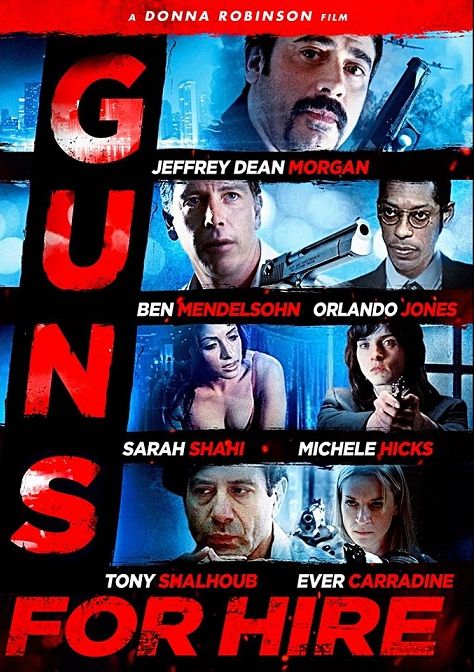 The first spectacular misfire of 2016, I was hoping for much more, than a story that could only be claimed to make any sense if it was entirely the ravings of a mentally-deranged idiot. Beatle (Hicks) is a tow-truck driver/assassin – yes, that’s what it says on her business cards – who rescues Athena (Carradine) from her abusive ex-boyfriend, Kyle (Mendelsohn). In revenge, he sets deranged psychopath Bruce (Morgan) on their trail, and he is prepared to stop at nothing to bring them back to his boss. Meanwhile, Athena hires Beatle to kill her, but they have to hang out until the change in Athena’s life-insurance policy, making Beatle the beneficiary, is officially completed. Except, is Beatle actually a killer at all? For her therapist seems convinced otherwise. The entire saga unfolds in flashback, as Beatle is being interrogated by a detective, who has found the videotape of Beatle’s infomercial for her hitwoman business. Certainly sounds like an unusual set-up, and potentially interesting, right?
 Stephanie (Powell) had been an assassin for the Italian Mafia, but had abandoned that life and settled down in London with her daughter. Years later, she is shocked to see her former lover, Alessandro (Canuso) show up at her job, and even more so when she gets an order she can’t refuse from her old employer, Franco (Gambino) – to kill Alessandro. Despite some qualms, not least how the family will react to her taking out one of their own, Stephanie carrier out the mission. But soon after, she finds herself being watched by the enigmatic Sam (Leese), who says he is there to protect her. Is that really the case, or does he have an entirely different purpose?



 The main mission given to Rie (Shiratori this time) is a little bit different, from her usual, straight-forward assassinations. Instead, she’s given the job of protecting a witness. Nana (Matsuda), the disgruntled mistress of an organ-trafficking ring, who has had enough and agreed to co-operate with the police. Rie is part of the protection detail, but soon finds out that the gangsters, under ever-so strange boss Kaneda (Nogami) with his transvestite tendencies, are not going to sit back and wait for Nana to take the witness stand. Oddly, the cops let Nana stay in her own apartment, perhaps figuring that’s the last place her former lover would look. but when that is unsurprisingly stormed, Rie takes the target back to the operative’s flat, where they hang out, exchanging small talk – that’s mostly Nana, of course, since Rie is about as talkative as the enormous pet fish she has in a tank, and to which she feeds goldfish.
 While twice as long as the first series, at 12 episodes rather than six, I can’t say it’s actually any better. Indeed, I think the dilution of the main element which was so much fun the first time round – the relationship between the two, disparate hitwomen, Roxie (Osment) and Veronica (Chriqui) – leaves this season less entertaining. Yes, it’s bigger and more exotic: but it feels spread thinner, to the detriment of the core aspects. The story takes up shortly after the events of the first series, with V+R in the Caribbean, waiting to get their share of the money from Eileen (Missi Pyle) and Mother (Gershon). But instead, an assassination squad is sent to get them, kicking off a reunion with Veronica’s “parents”, a deranged killer who thinks Roxie is his dead wife, a rogue CIA operative who sends Frank Barnes (Arquette) after Mother, and so on. It builds to a climax where Veronica, previously injected with a lethal nanobot virus that’s about to go off, takes part in an underground death match at a cockfighting arena, to prove her love for the deranged killer. I shit you not.