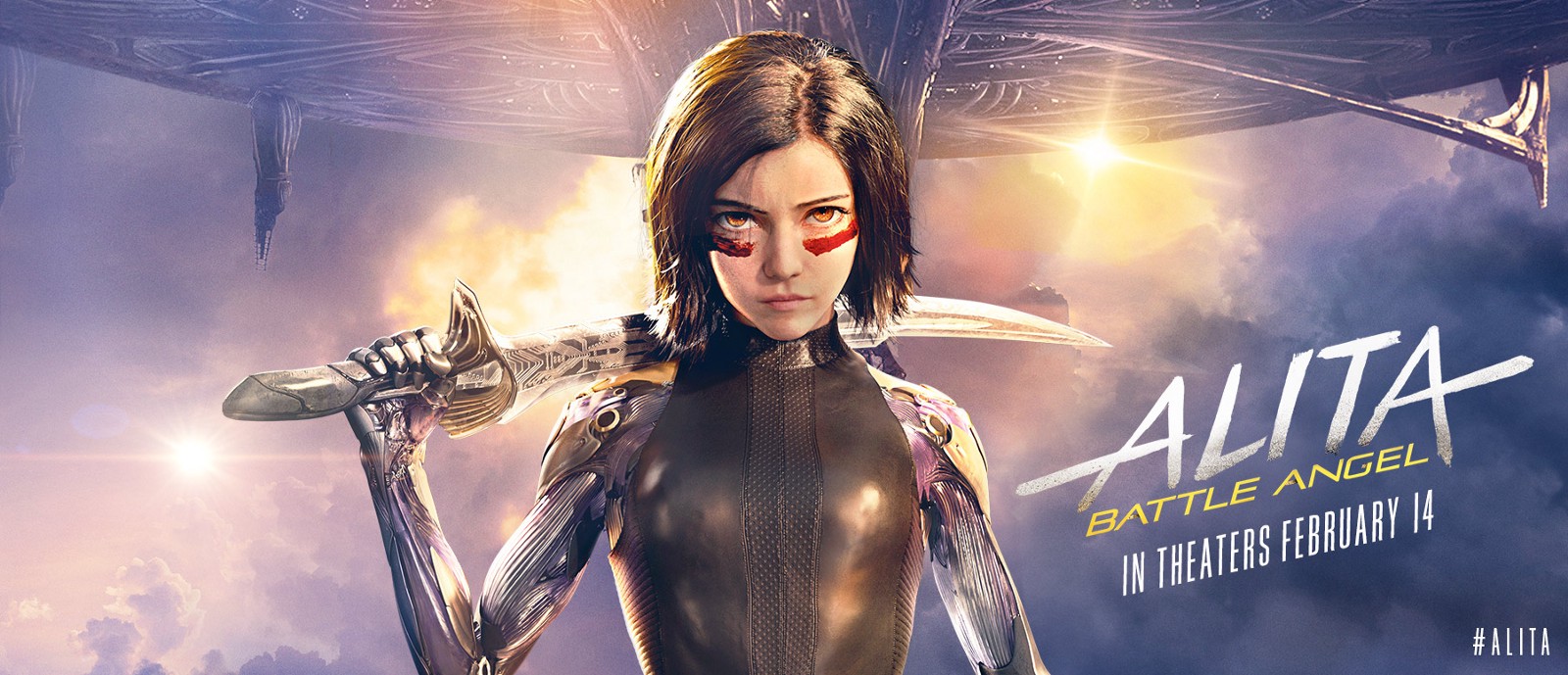
 ★★★★
★★★★
“Mechanical Pixie Dream Girl.”
 Depending on your definition, this is perhaps the most expensive action-heroine film of all time, estimated at more than $200 million before tax incentives. Given the fate of live-action adaptations of manga in the West, most recently Ghost in the Shell, this was always going to be a risky investment, even with the name of James Cameron, the most successful movie-maker in history, attached as a producer. At one point, people were predicting a bomb of Mortal Engines size. While Alita seems to have escaped that fate, it’s going to have to do very well in both China and Japan, the two remaining territories, if it’s to turn any kind of profit, never mind start a franchise.
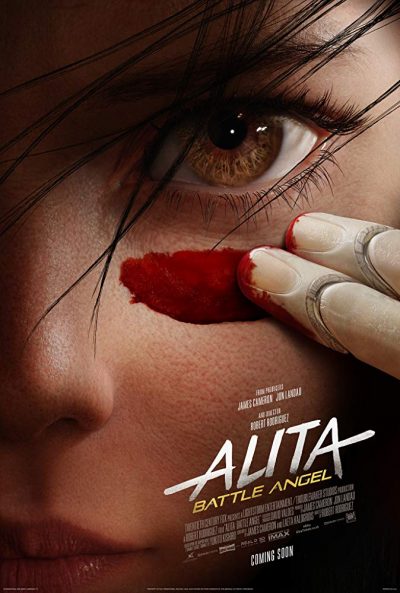 That’s a shame, because this is a solid, well-made piece of science-fiction, which does a particularly good job of creating a massive, epic world on the cinema screen. Rodriguez has been squeezing every penny out of his budgets since El Mariachi, and while there may not be much apparent overlap between Alita with Shark Boy and Lava Girl, the latter franchise was excellent training for RR in meshing computer graphics with actors. Sin City also laid similar groundwork, and helped set up the director with the chance to go big or go home. And there’s no doubt: Rodriguez went big. This was my first cinema trip of 2019, and was fully justified.
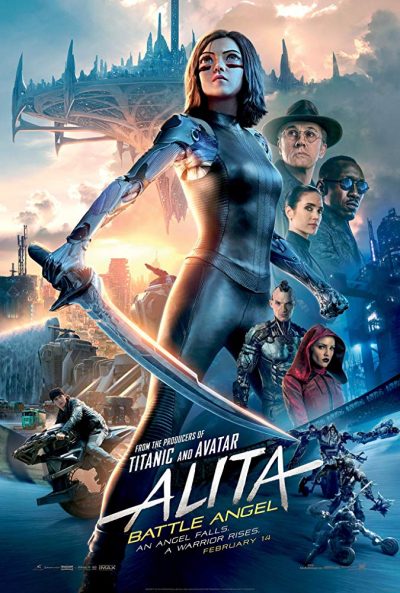
Having recently read the original manga, I was struck by how faithful the film was to most aspects. Right from the get-go, with Doc Ido (Waltz) finding the shattered remains of Alita (Salazar) on the scrap-heap below Zalem, there were shots which could have been story-boarded by the graphic novel. [Again, something Rodriguez also did in Sin City] Ido, in particular, looks exactly like I imagined him, and the same goes for Vector (Mahershala Ali), the shady power behind the scenes in Iron City, as well as Zapan and the rest of the bounty hunters.
The story is generally quite faithful, too. After her rescue, Alita tries to recover her past memories, becomes a bounty-hunter, falls in love with human boy Hugo (Johnson), takes up the brutal sport of Motorball, and experiences personal tragedy. However, the order of the events is shifted: in the manga, the tragedy is what spurs her entry into the Motorball arena. The film also adds Ido’s ex-wife, Chiren (Connolly), a character who was not in the comics, though does appear in the OVA. Here, they had a disabled daughter named Alita, who was killed by one of Ido’s Motorball goons. It’s a rather clunky subplot, which doesn’t add particularly much, beyond explaining from where Alita v2.0’s body came.
There has been much debate over Alita’s eyes, which have been CGI-increased in size to an extent rarely if ever seen in a live-action film. Of course, she’s a cyborg, so whatever. However, it is still something of a distraction, even though it appears they’ve been toned-down in size from early trailers, where it appeared her eyeballs would have occupied most of her brain’s frontal lobe. The eyes are one of the hardest things to get right with computer graphics, and when it isn’t, the results can be horrible, as with the resurrected Peter Cushing in Rogue One. This is better, and at some moments does enhance things, basically acting as a megaphone for Alita’s feelings. However, it also plays into the film’s main weakness: an apparent lack of genuine emotion. I’ll circle back to that a bit later.
As a spectacle, this is grand, offering sweeping vistas of a future world, densely populated with people, things and those in between. As an action movie, it works pretty well too. The two best set-pieces are the bar-brawl where newly-registered bounty hunter Alita proves her worth to her colleagues, and the Motorball game, where everyone else taking part cares only about killing Alita. There’s a palpable sense of progression in her skills over the course of the film. Initially, she’s clearly raw and unfocused, but after she is paired with her “berserker” body… [Inevitably, it has been the subject of PC whining, about it looking ‘too feminine’] Hoo-boy. By the end, she’s a weapon on mass destruction, regardless of the opponent’s size.
 And speaking of the end, one frequently-heard bit of criticism is that the ending is too “open,” apparently fishing for a sequel. I can’t say I felt that way at all. There’s certainly scope for more movies, apparently involving Alita going after the mysterious Nova. Yet the main thread of the film, involving Alita and Hugo, is definitively wrapped up. In comparison, say, to Marvel films, which almost inevitably have an in- or post-credit sequence blatantly signposting the next film, this felt conclusive. While there is perhaps need for a greater sense of escalation, or a bigger climax (that Motorball battle is trivial in its consequences), I’m largely baffled by complaints about the “lack of a genuine ending.”
As mentioned above, a more significant issue is that I hardly “felt” anything for any of the characters. Ido – stuck between paternal instincts of protection and a desire to allow Alita self-determination – perhaps came the closest. The relationship between Alita and Hugo is supposed to provide the film’s emotional engine. But between the former’s CGI make-up and the latter’s generic blandness, it doesn’t make much of a dent. There’s a scene where she literally tears out her heart and gives it to him: everyone, including the film itself, seems faintly embarrassed by the whole incident. Worse still – minor spoiler – the movie even goes so far as to kill a dog, without generating more than a blip of impact. Somewhere, John Wick shakes his head, sadly.
I was initially concerned about the PG-13 rating – not least because the first trailer before the film was for UglyDolls [an animated movie “about acceptance, diversity, joy and friendship” according to its site]. I needn’t have been: this is more From Dusk Till Dawn Robert Rodriguez than the Spy Kids version, with a gleeful approach to the semi-mechanized carnage. For I think it helps on the censorship front, that most of the carnage in inflicted on cyborgs, who are largely able to take a licking and keep on ticking. The manga was heavily into black market spine-ripping; here, it’s mostly limbs, which is slightly more kid-friendly, I guess.
In the end, this is just about everything for which I could have hoped. While I don’t necessarily agree with all of the artistic choices, the positives greatly outweigh the weaknesses. Although this is a low bar (hello, Speed Racer), it’s certainly the best manga/anime adaptation to come out of Hollywood. It’s a world I’d love to see explored further: whether Rodriguez and crew get the chance to do so or not, will remain in doubt until the final box-office figures arrive. Fingers crossed.
Dir: Robert Rodriguez
Star: Rosa Salazar, Christoph Waltz, Keean Johnson, Jennifer Connelly



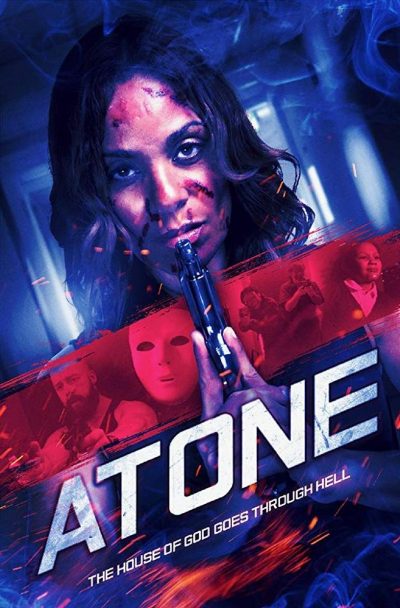 I mention the above for two reasons. Firstly, because Chris wondered why the film was called “At One”. Secondly, because when it finished, I turned to her and said those four little words which mean so much: “I can only apologize…” Yes, to use it in a sentence, I’ll be atoning for picking to watch this low-rent “Die Hard in a church” offering, for some time to come. [Though the following night, I had to sit through her choice of Justice League: paid back in full, I’d say…] There were a couple of aspects here that weren’t terrible; unfortunately, the overall execution was painfully close to… well, god awful seems the appropriate term here.
 I should probably have learned from my first experience with Ms. Hu: the thoroughly mediocre jungle ensemble piece which was
  I usually try to be tolerant when it comes to low-budget cinema and the resulting flaws. There are some things which you just cannot expect when a film is financed on the maker’s credit-card, and I’m willing to overlook rough edges if a movie can hold my interest in other ways. However, there are times when the end product is almost irredeemably bad, with few, if any, merits. This would be one such case. Your script is the main area which should be an area of equal opportunity, regardless of budget. Here, if anything, the flaws at the technical level are magnified by the failings on the page.
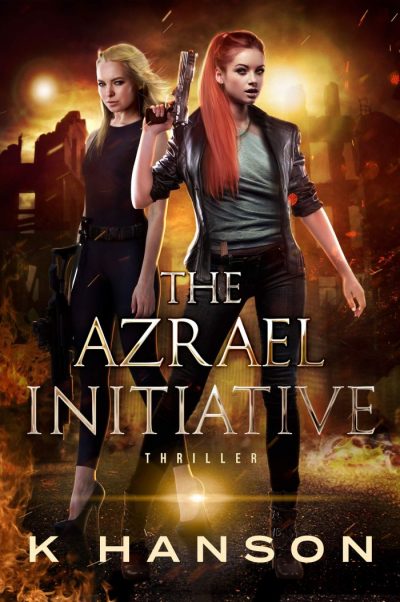 This feels less like a novel, than a novelization of a screenplay, adapted by a not particularly proficient writer. The text is littered with paragraphs which seem more like stage directions than literature, and is startlingly repetitive. For example, in one section near the beginning of the book, five of seven consecutive paragraphs start with, “As she/Kayla…” It’s not necessarily a bad screenplay, with an idea containing some potential. But it would be in need of several rewrites before any studio exec would sign off on it.
 After reading some particularly scathing reviews of this, e.g. “stunningly atrocious”, I was braced for something
 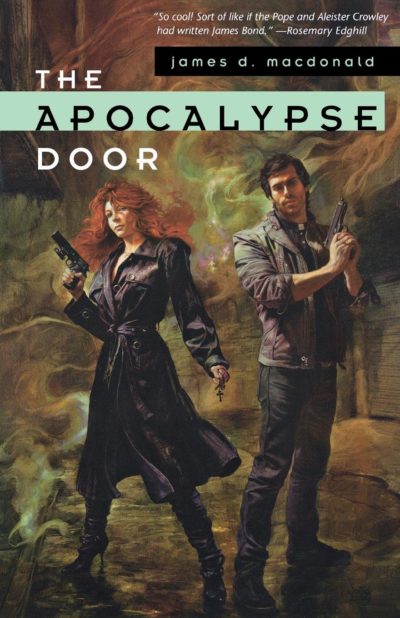 Those criticisms aside, however, this is a very gripping, exciting read, that moves along at a rapid pace right out of the starting gate. We have two distinct narratives here, alternating: a main one set in the author’s present (2002), laid out in the numbered chapters, and an earlier one from 1980, interspersed between each chapter in short sections titled “In-Country.” How the one strand is related to the other isn’t clear until near the end, although one connection comes into focus sooner than that. This is a challenging structure for a novelist to pull off, and to my mind Macdonald does it very well; both strands held my interest, and the rapid cutting between the two made for a constant cliff-hanger effect. I was completely hooked for both of them early on.
 This feels like a low-budget project in many ways, but manages to punch above its weight, in part due to an impressive supporting cast. While Lou Diamond Phillips, Danny Trejo and Steven Bauer are nowhere near as important as their names on the cover might suggest, their presence provide a solid foundation on which the less well-known members of the cast can build. In particular, Danay García as Loca; having bailed on Fear the Walking Dead after about two episodes, I wasn’t aware of her, but on the basis of this, she’s a name on whom we’ll be keeping an eye.
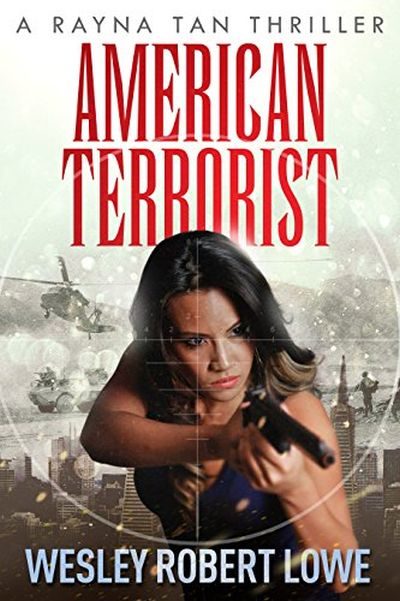 This was a disappointment, and a real chore to get through. If it had been a film, I’d have been reduced to surfing Facebook distractedly on my phone for the majority of its running time. Unfortunately, you don’t get to leave a book on in the background. It’s a stylistic and literary mess, throwing at the reader Canadian Special Forces heroine Rayna Tan, without providing any real background or character building beyond an incident in the Middle East. It then randomly switches around between her, a brother/sister pair of Islamic terrorists, Ahmed and Fatima, and their startlingly incompetent American recruits, who appeared to have strayed in from Four Lions. Throw in some unsubtle politicizing – even if I don’t necessarily disagree with the ideas expressed, it’s not what I want to read in my fiction – and it feels more like a half-finished collection of ideas than a coherent novel.
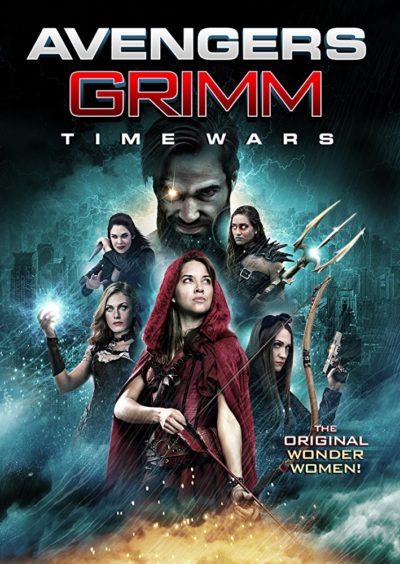 I was one of the few who didn’t mind