

★★★½
“Korma’s a bitch… Uh, I mean KARMA…
 Officer Shivani Shivaji Roy (Mukerji) is part of the Serious Crimes Squad in Delhi, whose approach to policing is very much “by any means necessary.” However, she is taken out of her area of expertise when Pyaari. a young girl she has been helping goes missing from an orphanage. Everything indicates the girl has been picked up by a sex trafficking ring, run by Sunny Katyal (Verma) and his partner, Karan (Bhasin), and will soon be sold off to the highest bidder and exported out of the country. Roy has to work her way up the chain to rescue Pyaari, despite opposition both from her boss, because it’s not her responsibility, and from the gang. As she gets nearer to the top, the climb becomes increasingly hard, with the criminals making it clear they won’t take lightly the threat to their lucrative business which Roy represents. It’s also clear they have friends in high places.
There’s a long-standing issue of extrajudicial action by the police in India, known locally as “encounter killings.” This film is far more likely to be the problem than the solution here, with the heroine behaving in a way of which Dirty Harry would certainly approve, yet severely at odds with contemporary Western policing methods. That’s apparent right from an early scene where she publicly assaults a culprit, punctuating a list of his offenses: “Section 143 – unlawful assembly. [Slap!] Section 147 – rioting. [Slap!] Section 132 – abetment of mutiny [Slap!]”, and so on. To see a male police officer do this in a modern movie would be shocking. To see a woman do it? It’s… kinda awesome, especially in India, a country where at the time the film came out, woman represented only 6.6% of the police force.
This comes to a climax at the end,. when she faces off against Karan, and he mocks her, saying his contacts will ensure he gets off lightly. She replies, “They can do it only if you reach the police station. But you won’t reach the police station, because this is India.” Then, when he asks, “Are you going to murder me in front of everyone?”, she responds, “In India, if 50 people take the law in their hands and kill someone, then it’s not called a murder. It’s called ‘Public outrage’.” As a rabble-rousing, cryptofascist call for vigilante justice due to corruption goes… This one certainly doesn’t hold back.
But it still works well, with Mukerji making Roy a well-rounded and sympathetic character. Her mission is driven as much by a semi-maternal rage as the usual macho bullshit, and she relies just as much on intelligence as brute force. Although the film loses steam when diverting attention to the bad guys, who are little more than cartoon caricatures, I especially enjoyed the phone-calls where Karan attempts to intimidate her, and fails completely. For Roy goes all Liam Neeson on him instead: “I don’t know what your name is. I don’t know where you are speaking from, who your boss is, or where you have kept Pyaari. But I’ve figured your type… I will hunt you down in 30 days.” Even the most liberal of viewers would be forgiven a fist-pump at the end when justice, legitimate or not, is served, piping-hot with a side of poppadoms.
Dir: Pradeep Sarkar,
Star: Rani Mukerji, Tahir Raj Bhasin, Jisshu Sengupta, Saanand Verma
 If you took four different films, by four different directors, and edited them together into a single entity, you might end up something similar to this. Oh, make no mistake: I still enjoyed most of this. It just doesn’t feel like a coherent whole, perhaps because it is a spin-off involving some of the same characters from an earlier film, Baby. For at least three-quarters of it, however, not having seen its predecessor shouldn’t be too much of a problem.
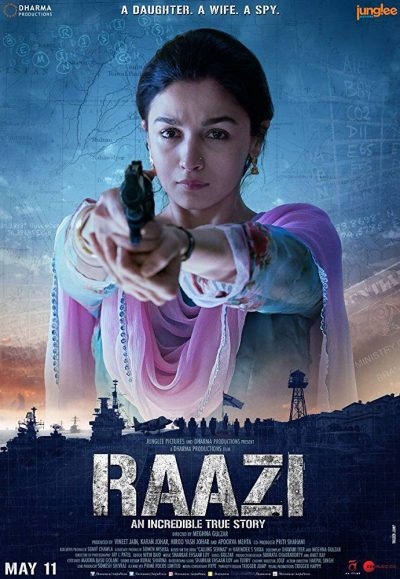
 This Indian spy thriller manages to be both remarkably restrained and human, avoiding a potentially jingoistic approach, and going for something considerably more measured. It takes place just before the war between India and Pakistan in 1971, when Indian agent Hidayat Khan is pretending to give information to Pakistan. In order to get close to their top brass, he convinces his daughter, Sehmat (Bhatt), to enter an arranged marriage to Iqbal Syed (Ahlawat), an officer whose father (Sharma) is a Brigadier in the Pakistani army. After being trained by senior intelligence officer Khalid Mir (Kaushal), she goes to join her new husband, and begins operations as a spy inside the Brigadier’s household.
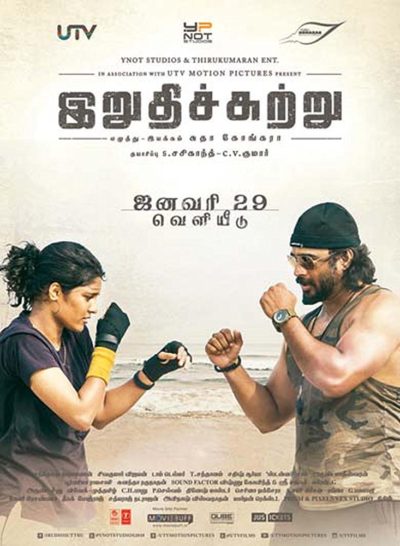 Despite thrashing virtually every sports cliché under the sun into the ground, this just about manages to skate by on the energy of its two central performances. Adi Tomar (Madhavan) is a boxing coach who gets hit with a trumped-up #MeToo charge by the head of the boxing association Dev Khatri (Hussain), and punted off to the backwoods of Chennai. There, however, he finds a raw jewel in Madhi (Singh), a fish-seller whose sister, Lakshmi (Sorcar), has been training as boxer with an eye to joining the police. But it’s Madhi’s aggression which attracts Adi’s attention, and he eventually convinces her to strap on the gloves.
 This is a modern update of the story of Savitri and Satyavan, originally found in Indian epic saga the Mahabharata [and when I say, “epic saga”, it’s 1.8 million words long!]. The tale has been an immensely popular topic for Bollywood, Wikipedia saying there have been thirty-four different film versions, dating back over a century to 1914’s Satyavan Savitri. The basic story is of a woman, Savitri, who defies a prediction that her chosen husband, Satyavan, will die in a year, and marries him anyway. She then has to talk the god of death out of collecting him.
 After exposing construction company Cementec as involved in corruption, journalist Kavya Krishna (Dam) is surprised to get a call from Siddharth Dhanrajgir (Devaiya), son of the company’s owner. He ends up offering her a job at far above her previous salary, and the two eventually grow into a relationship. However, it’s all a ruse: Siddharth dumps and firing Kayva, saying, “I fuck those who fuck with me.” When she tries to strike back by telling him she’s pregnant, he has her kidnapped and forced to have an abortion, which leaves Kavya permanently unable to have children. She vows to destroy Siddharth and his company, by any means necessary, using her investigative skills – and no shortage of feminine wiles – to get the information required.
 This is the first “true” modern Bollywood action heroine film I’ve seen, and has to be appreciated as such. While we’ve covered a couple of Indian films before, these have either been from outside the mainstream e.g. Bandit Queen, or have carefully corralled the action into socially-acceptable avenues, such as sport in Mary Kom. Neither is the case here, though the ending certainly has its share of hypocrisy, with the heroine being more or less sidelined, “for the greater good”.
 Time to set up GirlsWithoutGuns.org, perhaps. For this film brings home that among the most courageous of heroines are the unarmed ones – especially when facing people who are not. Such is the case with Neerja Bhanot, the 22-year-old head purser on Pan Am Flight 73 from Mumbai to New York in 1986. Just before takeoff after a stop in Karachi, the plane was taken over by hijackers from the Palestinian Abu Nidal Organization, who intended to divert it to Cyprus. Bhanot alerted the pilots, allowing them to escape and thwarting that plan. She then discarded the passports of American passengers, stopping the terrorists from targeting them. When they believed Pakistani forces were about to storm the plane, she opened the emergency exits, help shepherd passengers out, and sheltered children from the terrorists’ bullets.