★★★ [plus an extra ½ for hardness!]
“The night Olga decided to paint a British parking garage red”
 For one reason or another, in the last few years Great Britain has become the place to go for medium-budget action thrillers. Examples include the Pierce Brosnan-Milla Jovovich-actioner Survivor (2015) or the Noomi Rapace agent movie Unlocked (2017). Maybe this has to do with the “action-thriller” as a general genre, seeming to die out slowly in North America, where the comic book superhero genre appears largely to have replaced it. Be that as it may, The Courier belongs to that “dinosaur” genre. Released at the end of last year, it was not well-received by critics, though one has to ask: why?
No one expects profound thoughts on human nature or the state of society from an action movie. At least, I don’t. What I want to see when watching one, is a more or less well-connected story, nice visuals and definitely convincing action scenes. And though this may have several plot holes, that if you think about them, make the whole story fall down like a card house, it delivers on all of the above-mentioned elements. So I just can’t agree with the many critics who seemed intent on tearing down the movie for no reason at all. This isn;t to say the film hasn’t its problems: The movie opens with music over several photos and headlines of newspapers, and is all over a little bit too quickly, before you can realize this is the backstory (though later, the film uses flashbacks to explain certain things). I was also initially a bit clueless about who would be the main character, as she had not appeared yet.
Crime lord Ezekiel Mannings (Gary Oldman) is taken into police custody while sitting in an American church. As he is under arrest, he can’t do anything against witness Nick Murch (Amit Shah) who is going to testify against him, via internet live feed while sitting in a British safe-house. So it’s up to his daughter Alys (Calli Taylor) to make the necessary arrangements. Unfortunately for Nick, these are for a courier who will deliver a package, supposedly with equipment needed for the online interrogation. But they will unknowingly deliver a device that will release cyanide, killing off the witness and his guards – as well as the courier, who will be made to look like the murderer. [This part reminded me a bit of Unlocked]
Unfortunately for the bad guys, said courier is played by Olga Kurylenko. Kurylenko has made a moderate name as a regular in action movies and thrillers, since she first was seen by a large audience as the Bond girl next to Daniel Craig in Quantum of Solace (2008). In the past she could be seen in genre movies such as Hitman (2007), Centurion (2010), Oblivion (2013), The November Man (2014) or Momentum (2015). Here, dressed in black skin-tight leather and on a motorbike, she evokes visual memories of Lisbeth Salander or maybe Milla Jovovich in Ultraviolet (2006). Personally, I think she is not such a good actress and a little expressionless. But in the context of an action movie, that might have starred Bruce Willis in the 80s, she works perfectly well. There is some good-natured banter between her and Shah (who’s cursing is not entirely convincing), that is funny without becoming ridiculous.
Naturally, it goes without saying that the involuntary heroine has to rescue Nick. Equally naturally, that won’t be easy, for Mannings’ daughter has already called in the heavyweights to finish the mission. Mayhem with fatal consequences ensues. 😉 The movie is R-rated in Germany, and I think that’s justified, with the fights and kills more graphic than we’re used to in an average action thriller today. There is quite a bit of bloodshed, and also remarkable inventiveness, the Courier’s opponents using anything from snipers to drones to master that merciless woman. Meanwhile, she herself has a computer-equipped motor-helmet that could be right out of Tony Stark’s workshop.
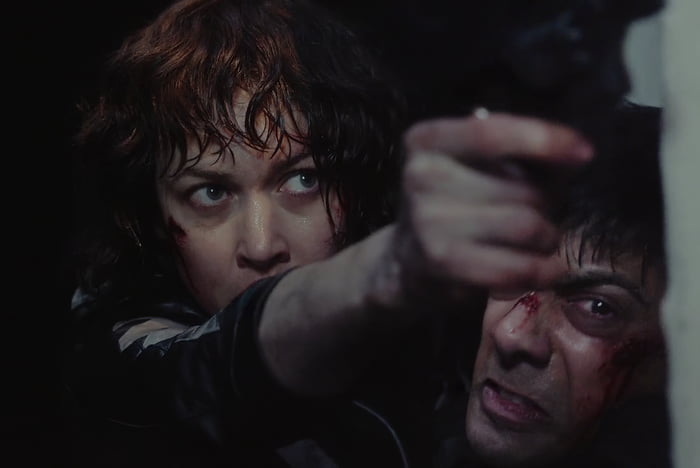 If Kurylenko’s character never reveals her name, at least some backstory is given as to why she is such a badass fighter. She used to be an Ukrainian soldier, part of a special forces battalion in Syria. After the death of her brother, she deserted and went to ground, taking menial jobs like this one. So for once we’ve got an explanation, as to why a smaller woman can take on big men who are professional killers. The fact that she is not just throwing them over her shoulder to the wall – like, let’s say, Angelina Jolie in Salt (2010) – adds a more realistic feel to the fights. We regularly see Kurylenko bleed, or even get overwhelmed. When she wins, it’s usually due to her quick thinking, using whatever the situation offers to kill off her opponents, or her army experience.
Some critics have called this the worst performance of Gary Oldman’s career and I just wonder how they came to this assessment. This is a solid, toned-down villainous portrayal by Oldman. You wanna see over-the-top Oldman? Go and watch Léon: The Professional (1994), The Fifth Element (1997) or Lost in Space (1998)! For me, it seems like “evil Oldman” has settled down and mellowed a bit with age. I find it more regrettable his character doesn’t have much to do, due to his house arrest. He mainly sits around, drinks whisky and listens to music – including the Diva Plavalaguna song from The Fifth Element, a nice inside gag.
There’s definitely a desire for some visual beauty and style. For example, when we see at the beginning the courier driving alone on a motorway while drenched in blue light, or flashbacks that pop up in black and white, and sometimes slow-motion. Director Adler has put more effort into this movie than other action directors usually do. Also, the very good soundtrack is worth mentioning. Though the end feels a bit abrupt, after someone turns out to be on the pay list of Mannings, only to run into a trap set by the courier and Nick.
While this might not be anything special or groundbreaking, in my personal opinion, the movie has been judged very unfairly by the critics. It doesn’t blow the feminist trumpet, where you have to point out, like an idiot and a thousand times, that this is a woman who wins against men. Oh, and have I already mentioned THIS CHARACTER IS A FEMALE? But it is a good, mindless bit of fun, of the gorier variety. There are moments in life when you are not in the mood for Bergman, Fellini or Bunuel films and just want to see some well-done bloody action. By that standard, the movie delivers, and should be judged on what it promises to be. If you were expecting something else? That’s your problem, not the movie’s.
Dir: Zackary Adler
Star: Olga Kurylenko, Gary Oldman, Amit Shah, Alicia Agneson




 It’s interesting to compare this with the recently reviewed Ride Like a Girl. Both are sports movies based on real events, and neither really do much story-wise, except trot out the standard tropes for the genre about overcoming obstacles on the way to triumph. Yet this succeeds somewhat better, likely because of the unusual central concept. Two Indian grandmothers, unable even to read, take up competitive shooting in their sixties, and end up becoming national heroines as a result. Tell me you’re not intrigued by that.
 Not quite the first film from Kazakhstan I’ve ever seen. That would be
  This version of the story of Rani Laxmibai, Queen of Jhansi, falls unfortunately between two stools. As a result, it seems likely to leave no-one satisfied, so its critical (3.5 on IMDb, 24% on Rotten Tomatoes) and commercial (less than $180K in North America) failure doesn’t come as much of a surprise. Western audiences were perhaps put off by the stereotypical portrayal of the colonialists – matters may not have been helped by a surprising, and I’d say quite harsh, R-rating. But, conversely, Indian audiences may well have been unimpressed by the Westernization of their beloved historical heroine. Most obviously – apart from the star being born in Manhattan – would be the hinted-at relationship between the Jhansi and good Briton, Major Robert Ellis (Lamb). This element seems to have been taken from Rani, a book by London-based author Jaishree Misra, whose publication triggered protests in her native land in 2008.
 Make no mistake, this is a cheap and unashamed knockoff of Jumanji, made by the company who specializes in these mockbusters, The Asylum. It’s not their first such venture into the action heroine genre. If you remember my evisceration of
  I can’t believe there have been seven X-Men movies now. I think the last I saw was the second, which came out in 2003. Since then, there seems to have been a lot of mutants under the bridge, so to speak – and, it appears, some jiggery-pokery with timelines. That’s the only way to explain the death early on in this origin story, of someone I’m
  I was enormously surprised to see this one pop up on Netflix – it’s not as if the
 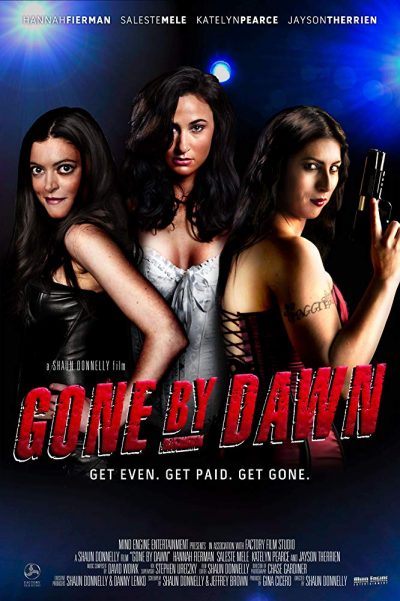 I decided I might as well combine these two into a single review. Having watched them back-to-back, even though made and set three years apart, they felt very much like the continuation of a single story about the same characters. The main one is Roxy (Mele), who is a dancer at a Wisconsin strip-club run by the sleazy Stag (Therrien), mostly as a money-laundering front for local organized crime. When he and his pal rape an employee, Alana (Pearce), Roxy along with the victim and another dancer, Crystal (Fierman), decide to take revenge by robbing Stag. That means getting into the safe in his office where the money is, and he’s not exactly going to give up the combination freely. Still, nothing that a piano-wire garrotte round the testicles can’t solve, surely? Except, as usual in this genre, the heist doesn’t go smoothly. Stag’s office quickly begins to resemble a mortuary, as unwelcome guests need to be handled.
 I didn’t think the sequel worked as well. While Roxy returns, she has been recast, being now played by Matheis – I’m not sure what happened to Mele. Still, I did laugh when one supporting character greets her with, “You look different!” Oddly, while the first film started with Roxy skipping town, the second sees her back, working at the same venue where she was involved in a multiple homicide. I know strippers are renowned for making poor decisions, but still… It turns out, having absconded with nine hundred grand of the mob’s money isn’t a good idea. They want it back, and to this end, have sent a trio of hired killers, named the Three Bears by Roxy. They’re prepared to do anything, up to and including both kidnapping and murder. But Roxy, along with Jesse (Radzion), a friend of Alana’s, and another dancer, Alura (Laventure), plots to turn the tables on the Three Bears, by robbing their boss.
 And there I was, thinking Maleficent: Mistress of Evil would be the prettiest picture I saw in all of 2020. There’s a new champion, and whoever assembled the look of this one should have been honoured at the Oscars. Shot in Barcelona and the Canary Islands, it beats Maleficent by almost entirely avoiding CGI, in lieu of stunning locations such as the former residence of sculptor Xavier Corberó: “a mazelike estate constructed from cement that features nine connected structures and 300 arches.” That quote comes from a
  This strange little film probably makes more sense if you’ve seen The Woman, in which a feral cannibalistic woman, played by McIntosh, was captured and kept in the basement of a dysfunctional family. While this features McIntosh in the same role, it does work as a standalone film: its predecessor may help explain some of the background. Here, the woman drops off her equally uncivilized teenage daughter (Canny) at a hospital. Unsure of quite how such an unusual child should be handled, Darlin’ – called that, because of a bracelet spelling that out which she is wearing – is handed over to the Catholic church.