




★★★½
“Aliens meets The Terminator in a brisk, head-on collision.”
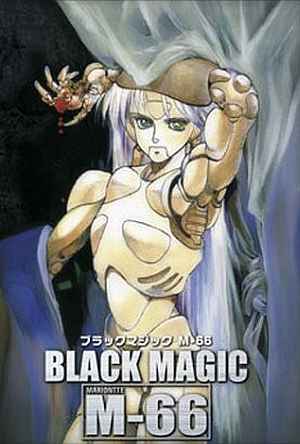 Shirow has certainly done his fair share of anime works that are regarded as classics – his best-known creation is probably Appleseed. This is from relatively early in his career; indeed, coming out in 1991 made it one of the first anime to be ‘properly’ distributed in the West [and, by that, I mean subtitled and not cut down for a child audience]. It centers on the titular pair of military androids, who are released after their transport craft goes down in the middle of a forest. The army cordon off the area, which draws the attention of Sybel (Sakakibara), a reporter, unwilling to let anything stand in the way of her story. She witnesses a hellacious fire-fight in which one ‘droid is destroyed, while the other escapes, and discovers the goal for the android is to kill the inventor’s young grand-daughter, Ferris. As the only person who knows the current location of the daughter, it’s up to her to save the child.
Barely half the length of an average movie, this fairly gallops along, towards an extended climax in a high-rise block, where Sybel is the only thing left standing between the relentless robot and its target. This is when the film is at is best, with action sequences that wouldn’t shame most Hollywood action movies. Less successful – in fact, basically absent (admittedly, no real surprise given the running time) – is any real effort at developing the characters. We know Sybel is focused, because she leaves her apartment with her camera, yet forgets to put on clothes. That’s about the extent of it, and she is the best-served of anyone in the film; Ferris, for instance, does little but squeal in an irritating manner. It’s also a product of its time: originally made in 1987, animation has changed radically in the more than two decades since, and the style now looks somewhat clunky, especially when it tries to simulate camera movement.
Still, the storyline holds up nicely, and given America’s fondness for remaking Japanese genre films, one wonders why they haven’t bothered to mine the animation vaults further [though Speed Racer probably acts as a good counter-argument!]. It’d certainly be very easy to see this as a James Cameron movie.
Dir: Masamune Shirow
Star (voice): Yoshiko Sakakibara, Shinji Ogawa, Yû Mizushima, Chisa Yokoyama
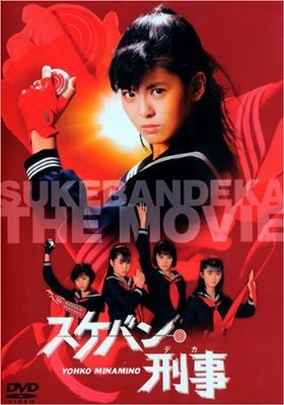 This film was made between season two and season three of the television series, and represents a passing of the torch from Saki, SD #2 (Minamino) to SD #3 (Asaka), in preparation for the upcoming TV show. Saki has just about given up her life as a detective, but finds herself dragged in when she, literally, bumps into someone on the street. He turns out to be an escapee from Hell Castle, a reform school for wayward kids on an island near Tokyo, and she discovers that Principal Hattori (Ibu) is training the pupils to be a brainwashed army for an upcoming coup d’etat [the word is exactly the same in Japanese, incidentally]. She goes to her bosses with the information, but the investigation is quickly killed from above, for reasons I’m sure you can guess. So, it’s up to Saki to put together a team, sneak onto the island, rescue the inmates and stop Hattori. He turns out to be a nemesis from the TV show, though that back-story will, for obvious reasons, be lost on the vast majority of Western viewers.

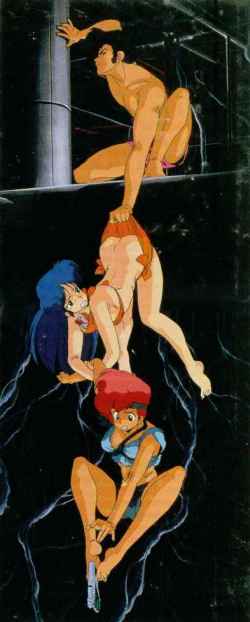 If you’re going to start with Kei and Yuri, this is as good a spot as any; it may not be the first entry in the series, but requires no prior knowledge at all. Even complete novices will be up to speed by the pre-credit sequence, which sees them – oops! – destroying an entire space-station after they decide to pursue the bad guy, rather than handling the explosive suitcase with which he has tried to distract them. They’re then sent to investigate some strange happenings on a mining planet, which is being plagued by attacks from monsters. They discover that the creatures are the results of failed experiments by Dr. Wattsman, who has plans to force nature’s hand, by making the next evolutionary step beyond mankind. Meanwhile, gentlemen thief Carson D. Carson is there, for his own reasons.
 A Roger Corman production. Those four words cover much turf, both good and bad; this inclines toward the latter, simply because it takes an interesting premise, and goes next to nowhere with it. It’s less a sequel to, than a remake of the 1974 film, also starring Dickinson, which is generally believed to be superior. However, that isn’t on heavy cable rotation this month, so you’re stuck with the follow-up. Dickinson plays Wilma McClatchie, evicted from her home by uncaring businessman Morgan Crawford, and whose husband is killed in the process. She and her daughters Billie-Jean and Polly take up a life outside the law, but when Crawford makes a run for governor, their crimes take on a political perspective, as they aim to sabotage his campaign.