★★★ [plus an extra ½ for hardness!]
“The night Olga decided to paint a British parking garage red”
 For one reason or another, in the last few years Great Britain has become the place to go for medium-budget action thrillers. Examples include the Pierce Brosnan-Milla Jovovich-actioner Survivor (2015) or the Noomi Rapace agent movie Unlocked (2017). Maybe this has to do with the “action-thriller” as a general genre, seeming to die out slowly in North America, where the comic book superhero genre appears largely to have replaced it. Be that as it may, The Courier belongs to that “dinosaur” genre. Released at the end of last year, it was not well-received by critics, though one has to ask: why?
No one expects profound thoughts on human nature or the state of society from an action movie. At least, I don’t. What I want to see when watching one, is a more or less well-connected story, nice visuals and definitely convincing action scenes. And though this may have several plot holes, that if you think about them, make the whole story fall down like a card house, it delivers on all of the above-mentioned elements. So I just can’t agree with the many critics who seemed intent on tearing down the movie for no reason at all. This isn;t to say the film hasn’t its problems: The movie opens with music over several photos and headlines of newspapers, and is all over a little bit too quickly, before you can realize this is the backstory (though later, the film uses flashbacks to explain certain things). I was also initially a bit clueless about who would be the main character, as she had not appeared yet.
Crime lord Ezekiel Mannings (Gary Oldman) is taken into police custody while sitting in an American church. As he is under arrest, he can’t do anything against witness Nick Murch (Amit Shah) who is going to testify against him, via internet live feed while sitting in a British safe-house. So it’s up to his daughter Alys (Calli Taylor) to make the necessary arrangements. Unfortunately for Nick, these are for a courier who will deliver a package, supposedly with equipment needed for the online interrogation. But they will unknowingly deliver a device that will release cyanide, killing off the witness and his guards – as well as the courier, who will be made to look like the murderer. [This part reminded me a bit of Unlocked]
Unfortunately for the bad guys, said courier is played by Olga Kurylenko. Kurylenko has made a moderate name as a regular in action movies and thrillers, since she first was seen by a large audience as the Bond girl next to Daniel Craig in Quantum of Solace (2008). In the past she could be seen in genre movies such as Hitman (2007), Centurion (2010), Oblivion (2013), The November Man (2014) or Momentum (2015). Here, dressed in black skin-tight leather and on a motorbike, she evokes visual memories of Lisbeth Salander or maybe Milla Jovovich in Ultraviolet (2006). Personally, I think she is not such a good actress and a little expressionless. But in the context of an action movie, that might have starred Bruce Willis in the 80s, she works perfectly well. There is some good-natured banter between her and Shah (who’s cursing is not entirely convincing), that is funny without becoming ridiculous.
Naturally, it goes without saying that the involuntary heroine has to rescue Nick. Equally naturally, that won’t be easy, for Mannings’ daughter has already called in the heavyweights to finish the mission. Mayhem with fatal consequences ensues. 😉 The movie is R-rated in Germany, and I think that’s justified, with the fights and kills more graphic than we’re used to in an average action thriller today. There is quite a bit of bloodshed, and also remarkable inventiveness, the Courier’s opponents using anything from snipers to drones to master that merciless woman. Meanwhile, she herself has a computer-equipped motor-helmet that could be right out of Tony Stark’s workshop.
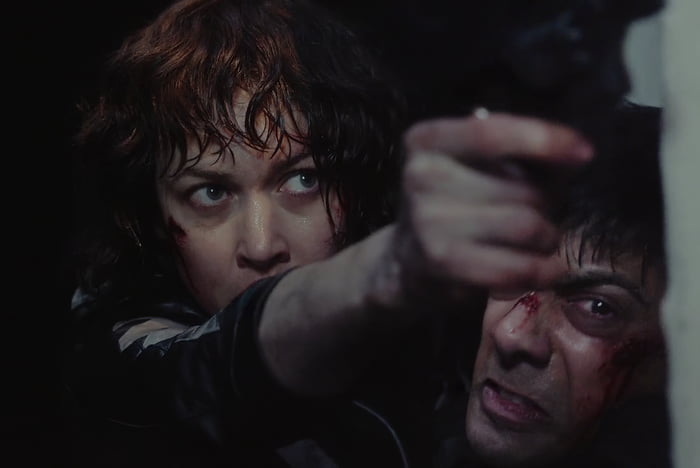 If Kurylenko’s character never reveals her name, at least some backstory is given as to why she is such a badass fighter. She used to be an Ukrainian soldier, part of a special forces battalion in Syria. After the death of her brother, she deserted and went to ground, taking menial jobs like this one. So for once we’ve got an explanation, as to why a smaller woman can take on big men who are professional killers. The fact that she is not just throwing them over her shoulder to the wall – like, let’s say, Angelina Jolie in Salt (2010) – adds a more realistic feel to the fights. We regularly see Kurylenko bleed, or even get overwhelmed. When she wins, it’s usually due to her quick thinking, using whatever the situation offers to kill off her opponents, or her army experience.
Some critics have called this the worst performance of Gary Oldman’s career and I just wonder how they came to this assessment. This is a solid, toned-down villainous portrayal by Oldman. You wanna see over-the-top Oldman? Go and watch Léon: The Professional (1994), The Fifth Element (1997) or Lost in Space (1998)! For me, it seems like “evil Oldman” has settled down and mellowed a bit with age. I find it more regrettable his character doesn’t have much to do, due to his house arrest. He mainly sits around, drinks whisky and listens to music – including the Diva Plavalaguna song from The Fifth Element, a nice inside gag.
There’s definitely a desire for some visual beauty and style. For example, when we see at the beginning the courier driving alone on a motorway while drenched in blue light, or flashbacks that pop up in black and white, and sometimes slow-motion. Director Adler has put more effort into this movie than other action directors usually do. Also, the very good soundtrack is worth mentioning. Though the end feels a bit abrupt, after someone turns out to be on the pay list of Mannings, only to run into a trap set by the courier and Nick.
While this might not be anything special or groundbreaking, in my personal opinion, the movie has been judged very unfairly by the critics. It doesn’t blow the feminist trumpet, where you have to point out, like an idiot and a thousand times, that this is a woman who wins against men. Oh, and have I already mentioned THIS CHARACTER IS A FEMALE? But it is a good, mindless bit of fun, of the gorier variety. There are moments in life when you are not in the mood for Bergman, Fellini or Bunuel films and just want to see some well-done bloody action. By that standard, the movie delivers, and should be judged on what it promises to be. If you were expecting something else? That’s your problem, not the movie’s.
Dir: Zackary Adler
Star: Olga Kurylenko, Gary Oldman, Amit Shah, Alicia Agneson




 I previously reviewed the ninth volume in the Wardstone Chronicles series, I am Grimalkin, and site contributor Dieter was kind enough to send me a copy of this, the 12th installment. It’s obviously a bit odd to be so selective about reading and reviewing a series, but neither Grimalkin nor Alice are the main character, and by all accounts, the other volumes don’t qualify. I probably should read all the others, to be completely fair in my assessment here… But then I look at my pile of unread books, which even though it’s largely virtual, is threatening to declare independence and become its own country. So, file that under “some day”.
 I say that, since this Korean film appears to have been at least a partial inspiration for not one, but two Bollywood films which were recently reviewed here:
  This is certainly something of a novelty and/or a gimmick. But it’s none the less reasonably effective for it. Templeton – who is a woman, despite her first name, given to her after the character of Christopher Robin in the Winnie The Pooh books – suffered from polio as a young child. This left her with a badly damaged right leg; despite this, she pursued an acting career, and became a regular on soap The Young and the Restless for eight years. While I’ve seen a few disabled action heroes – Daredevil was blind – as far as disabled action heroines go, it’s basically her and Imperator Furiosa from Mad Max. And Charlize Theron wasn’t genuinely short an arm, so advantage Templeten. Though, sadly, she appears to have passed away in 2011.
 This is a painfully lazy knock-off of a certain, well-known action film, in which terrorists take hostages in a multi-storey building over the festive season. This action is as cover for their actual goal, which is the robbery of a well-secured vault. But one of the inhabitants evades the initial surge, and begins to run interference. They get help and moral support over the airwaves by someone on the outside, and use the air-ducts in the building to avoid detection. Yeah. It’s like that, and you’ll probably understand why my eyes were rolling when we get the line, “Ho-ho-ho, motherfucker.” Now, there’s no doubt the makers openly acknowledge their inspiration. But pleading guilty doesn’t get you out of the crime. At least other, similarly inspired movies, e.g.
  It has been twenty years since
  I reviewed the
 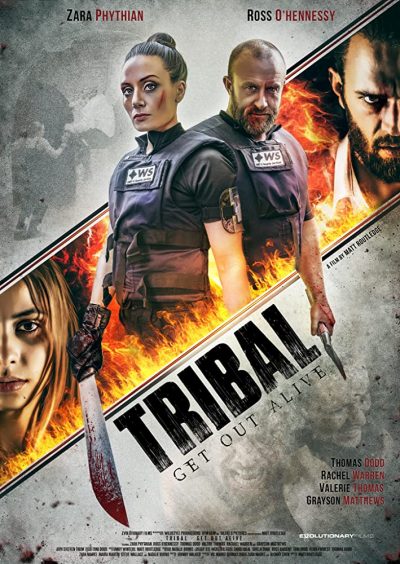 The IMDb omits the colon from the title, making rather less sense. Though it’s not inappropriate, because sense is likely not this film’s strongest suit. Indeed, I’d be hard-pushed to call it a “good” film. It is, however, consistently entertaining, and a fine piece of B-movie making. Ex-soldiers Caitlin (Phythian) and Brad (O’Hennessy) are bailiffs… Wait, is that a thing outside the UK? Just in case it’s not, let me quickly explain: they are not quite cops, but are still legal officials who can, for example, impose evictions or collect debts.
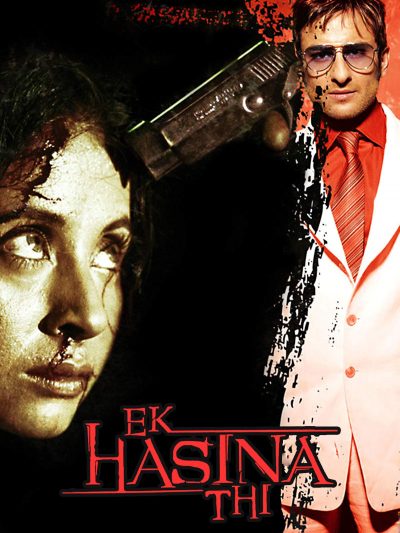 A somewhat cheesy melodrama, this throws together elements from Western pot-boilers Double Jeopardy and If Tomorrow Comes, adds a handful of Bollywood spice, and to be honest, probably overcooks the whole thing a bit. The title translates as “There Was a Beautiful Woman”, presumably referring to the heroine of the piece, travel agent Sarika (Matondkar). Into her office one day comes hunky businessman Karan Singh Rathod (Khan), and after some reluctance, she begins a relationship with him. However, it turns out he is actually a mobster, and manipulates her into taking a fall rather than incriminating him, which nets Sarika a seven-year prison sentence. Escaping from jail, she vows to destroy her former lover, and in turn, works on framing Karan with his criminal pals, by making it look like he murdered a colleague and stole money.
 I can’t believe there have been seven X-Men movies now. I think the last I saw was the second, which came out in 2003. Since then, there seems to have been a lot of mutants under the bridge, so to speak – and, it appears, some jiggery-pokery with timelines. That’s the only way to explain the death early on in this origin story, of someone I’m