




★★
“Over-stuffed to the point of bloat”
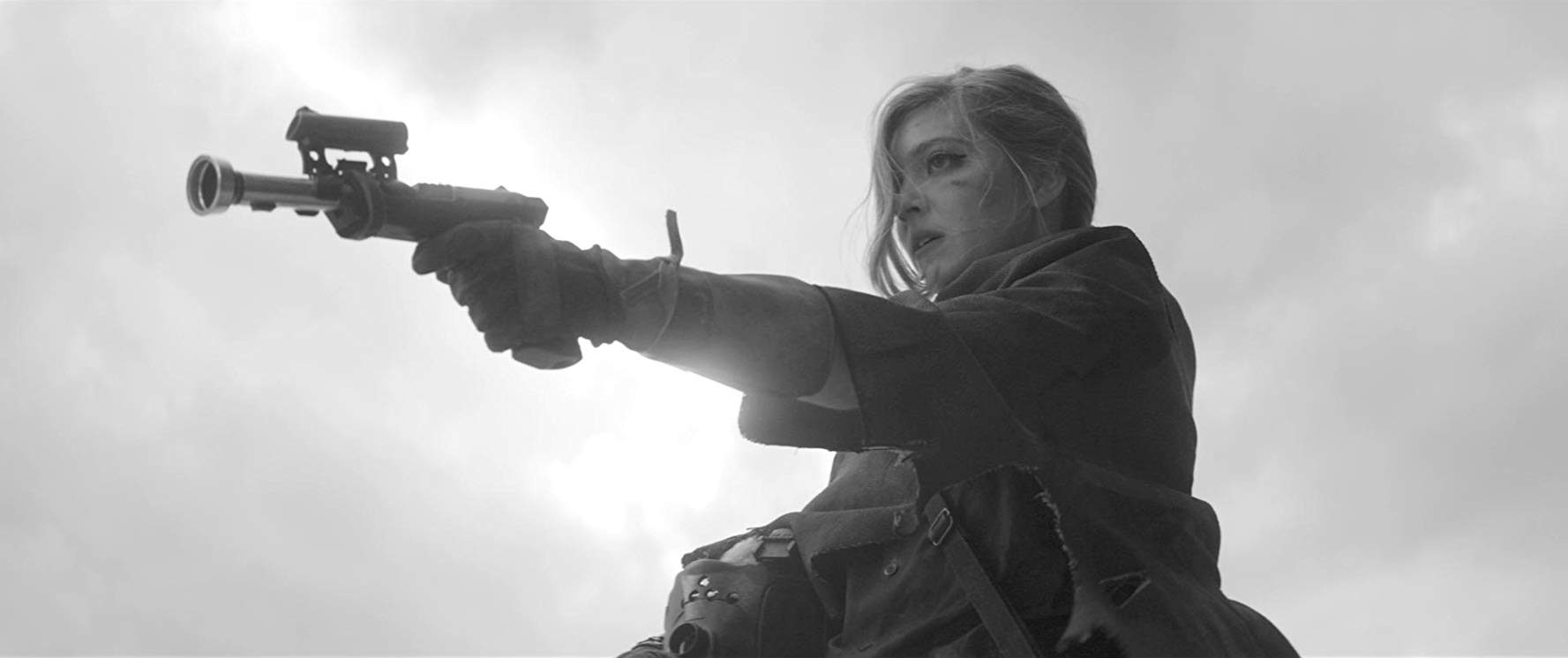 There are some very interesting ideas here. Unfortunately, probably too many of them. As a result, the end-product feels like a half-baked collection of semi-formed thoughts – none of which are explored to the extent they deserve. It begins with an apocalypse, apparently triggered in order to stave off an alien invasion. Fast-forward a few years, and we join Sarah (Hutchinson), one of four children who are shortly to be teleported to a space station orbiting around another planet, which is the target for future habitation, and where the President of Earth now resides. Except an alien sympathizer stages an assassination attempt, leaving the children dropped onto the planet’s surface, along with the Commanfer (Trigo), who had a role in the apocalypse seen earlier. But he ends up being taken over by a parasite which turns him psychotic and he begins hunting down the children. Who need to locate the President, who also crash-landed nearby, because…
Well, I’m still not sure about that. Or about a number of other things here. For the film seems to have the attention span of a goldfish, and ends up like an elevator pitch, hurling concept after concept at you, in the apparent hope that you’ll do the work of arranging them into something coherent and interesting. Because it appears writer-director Bolduc couldn’t be bothered. There’s no shortage of imagination here. Heck, you’ve got enough here for at least a trilogy of films, possibly more, covering territory from The Terminator to David Cronenberg’s They Came From Within. And I genuinely wanted to root for Sarah, a serious-minded and likeable girl, who is thrown in at the deep end, having not only to survive on an alien planet, but also keep the other three from bickering their way to death. While the alien planet looks suspiciously like Earth, the effects are generally decent for the budget, save for one wobbly monster earlier on – and that’s in Sarah’s imagination, so probably deserves a pass.
But you’ll be left with far too many questions for this even to approach acceptability. Why does the terrorist set his bomb with a 15-minute delay? Why does the space station only seem to have a couple of escape pods? How can an alien fish parasite effortlessly infect and control a human host? Why does it want to hunt down the kids? What’s so important about this President? Is there any relevance to Sarah’s bed-ridden mother? How does this all tie together with the pre-apocalypse footage, where the Commander appears to play a key part in triggering Armageddon? There’s an apparently wilful failure to explain what is going on, which grew increasingly wearing on me, over even the relatively brisk 83-minute running time. In this aspect, it reminded me of another recent SF film with a teenage protagonist, Prospect. The two films’ directors should combine forces: maybe they could come up with one decent story between them.
Dir: Drew Bolduc
Star: Shannon Hutchinson, Vito Trigo, Jasmina Parent, Johnathan Newport
 Struggling artist Summer (Oldham) takes on a temporary job as a phone-sex operator to make ends meet. It gives her a very jaundiced view of men, having had to plunge into the worst and most sordid depths of their fantasies. After realizing that some pose a more direct threat, and funded by hush money from one of her customers, she buys the car of the title. and takes their information, along with the tapes she has recorded of them, on a little road-trip across the South and West of America. She’s heading towards her sister (Hinchley), bringing the perverts to justice as she goes, and seeking closure for her own past.
 Despite a startling cover, this isn’t as sleazy as it seems. Indeed, even the title appears to be erring on the side of restraint, having apparently avoided the more obvious (and arguably, accurate) one of Killer Pussy. While the heroine certainly has an… interesting choice of costume, that’s as far as the film wants to go. It’s an odd approach: a sleeve like that sets up certain sets of expectations, which the movie has no apparent interest in matching. It’s not as if anyone of a sensitive nature is going to have got past the cover, so it seems odd to exercise such self-discipline when it comes to the content.
 You could skip the first 30-45 minutes of this, and it really would not affect your enjoyment level significantly. It seems to be one of those cases where the director is far more in love with the dialogue and characters than they deserves, and so we have to sit through far too much flapping of jaws by the latter, delivering the former in inane and uninteresting conversation, before we get to the meat of the story. Which is, as follows.
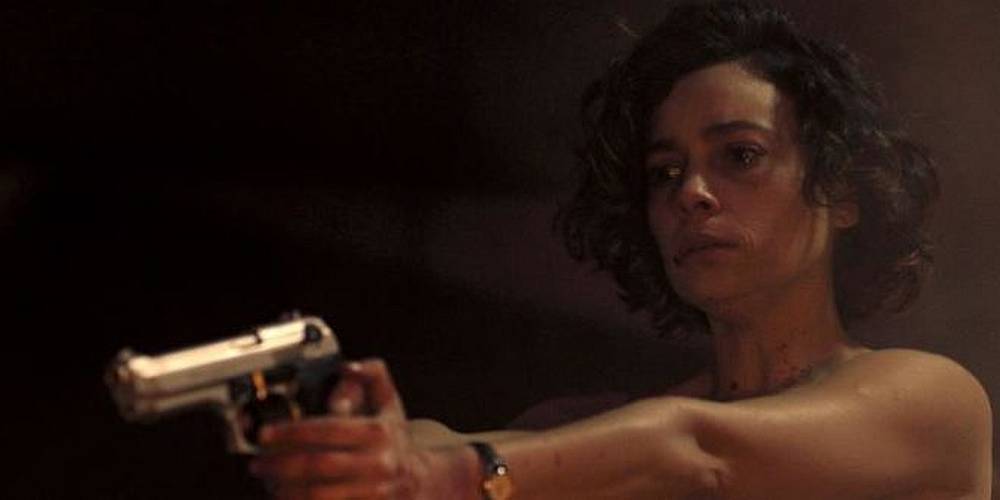 This is not an easy film to watch. The easily-offended should stay away. Indeed, even the hard to offend, which include myself, may find it rough going. To give you some idea, the opening scene is set in a 1978 Chilean torture chamber where a political dissident is being interrogated. When she won’t talk, her son is drugged and forced to rape his own mother. It actually goes on to get worse still, but that’ll give you some idea. In terms of disturbing opening scenes, I can’t think of many equivalents.
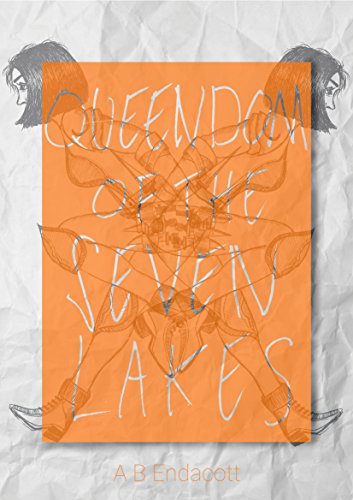 There is an interesting set-up here: unfortunately, it’s one which truly doesn’t get developed far enough. Elen-Ai is a 21-year-old woman, who has been brought up since birth to be an assassin for hire, part of “The Family.” Her latest commission is a little different: it’s not to kill, but to protect. For she is hired to make sure that Gidyon, the teenage son of Latana, Queen of the Second Country, stays alive. This is a matriarchal society, where power passes down the female side. But Latana has only her son, and is set to upset the traditional apple-cart by proclaiming Gidyon as her heir apparent. This decision will potentially be rejected by some among the seven clans who comprise the queendom, and may make him a target for those who’d rather see him out of the way. Hence, Elen-Ai’s presence, to make sure that doesn’t happen, as he begins a national tour around their estates, seeking support for his position.
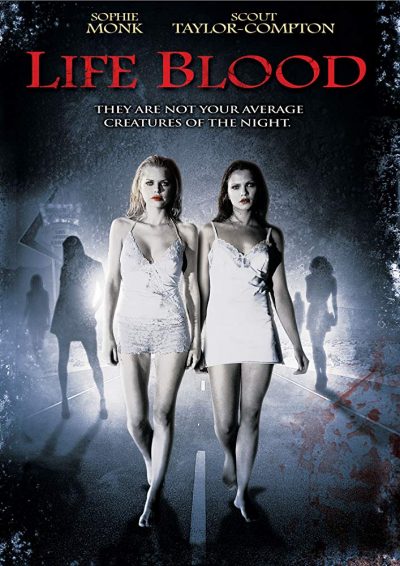 There’s a fascinating idea at the core here. Namely, that vampires were created by God, in order to mitigate mankind’s sin by preying on the most evil examples of humanity. They’re effectively angelic enforcers. The potential in this is great. The execution, however… Well, it largely comes down to two such vampire/angels sitting around a gas station for the majority of the running time. This isn’t the only aspect which is poorly considered. It starts in 1969, when lesbian couple Brooke (Lahiri) and Rhea (Monk) are at a New Year’s party. Brooke kills a rapist, stabbing him (literally) 87 times, and the pair then flee. In the desert, they are visited by God (model Angela Lindvall), who makes Rhea into one of her enforcers.
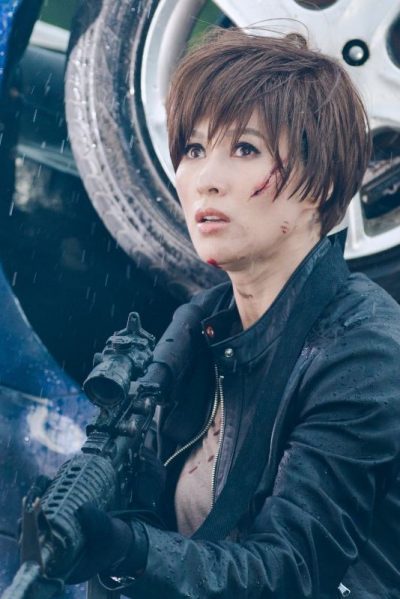 “Guess who’s back, back again. Jadey’s back, tell a friend…” Okay, that’s as close as you’re ever going to get as a rap from me. But I was genuinely delighted to see this stared Jade Leung, who was perhaps the
  Dear god, this is tedious. It takes forever for anything to happen, and when it does, the impact is less than overwhelming. Ronnie Price (Pearson, occupying territory somewhere between Angelina Jolie in Girl, Interrupted and Michelle Rodriguez) is a former GI, suffering from PTSD after three tours in the Middle East, who took to “self-medicating” herself with heroin in an attempt to deal with what she went through. This doesn’t do too much for her anger issues, and after one brush with the police, she’s made to choose between prison and a spell in a remote, women-only rehab facility. Reluctantly, she chooses the latter, though it’s not long before her PTSD flashbacks kick in, and threaten to make her stay a brief one.
 A woman (Butler) agrees to take part in a contest. live-streamed for betting purposes, where 20 players are put through a series of tests, designed to push them to the physical and mental breaking point, with the (literally) last person standing getting a million dollars. Her only associate is the Game Master (Fuertes), who oversees the challenges and relays the results from the other location to her. Initially, it seems like he is on her side, cheerleading and encouraging her. But the further into the event she proceeds, the more questionable his actions become, to the point where she begins to doubt everything he tells her.