
★★★
“Something mighty morphing in my pants.”
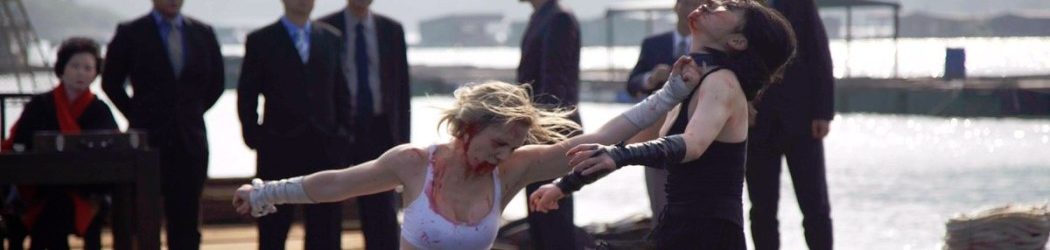
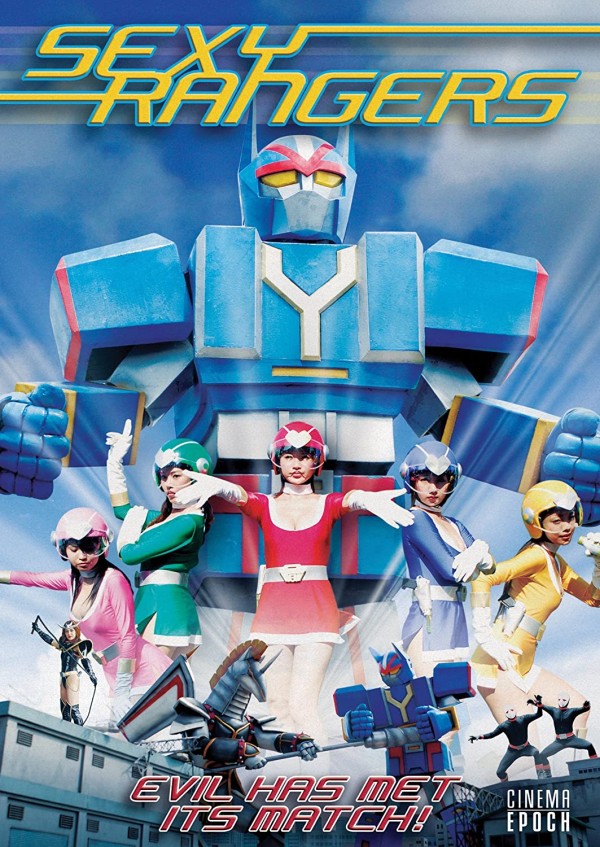 Because what the world really needs, is an all-girl version of Power Rangers, tasting very strongly of cheesecake. That’s what you have here, in a world where women’s breasts are a source of energy. Okay, later on we discover it’s actually male appreciation of women’s breasts that is the true source of power, but let’s not quibble over details. This “pai” energy has been used by Professer Saionji to create a team of five, color co-ordinated heroines, who use their abilities to fight off monsters from other dimensions, sent here under the control of Queen Amorous (Yamada). These “Pai Rangers” are firmly referred to in the subtitles as “Sexy Rangers”, presumably to avoid a cease-and-deist from Saban. Their leader is the Red Ranger, Momiji (Tejima), apparently because her breasts are the biggest. Um, the biggest source of pai energy, I mean. Occasionally, she and her team need to recharge, which is done by flouncing about the beach in bikinis, exploiting the male gaze.
It is, of course, utterly ridiculous and possesses all the production value you would expect, given a budget estimated on the IMDb at 50,000 Yen. Adjusting for inflation and converting to dollars, that’s $480 in 2021 terms. I double-checked no zeroes had gone missing in the process. It does appear largely to have been filmed in car-parks. But I have to say, it’s bright, colourful and energetic, and all stupidity is absolutely in line with the show which is its inspiration. Witness the two main monsters: Unikong, which is an armoured, lance-wielding unicorn, and Camerang, a humanoid camera. Because, why not? Anyway, Queen Amorous kidnaps the Professor’s daughter, ransoming her for a device which can extract the pai energy from the Rangers, weakening them so that her monsters and their (literally faceless) minions can overpower them and take control of Earth. Meanwhile, she’s working at the order of King Muscle, a giant eyeball – again, because why not?
The fight scenes are more or less complete garbage, barely even reaching “I kick in your general direction, you vaguely swing in my postal code” level. But what would you expect when you have five bikini models going up against a giant camera? They clearly are not the point; the director’s choice of camera angles and focal points makes that abundantly clear. Yet it helps that everyone takes it dead seriously; maybe it’s just me, but the hottest woman here is likely evil Queen Amorous, the one who shows the least amount of skin. Not that there’s every anything more than copious cleavage, I should point out. Though I can’t think of many films which feel more like a porn flick, yet fail to contain any actual nudity. As such, the combination of wholesome values (loyalty to friends and family, perseverance, etc.) and fan service is quite conflicting. I would still watch this on a weekly basis. Hell, considering the cost, I’d be prepared to fund a sequel.
Dir: Shinji Nishikawa
Star: Yû Tejima, Yuzuki Aikawa, Jun Suzuki, Yoko Yamada
a.k.a. Big Boob Squad: Sexy Rangers
 Running a crisp 58 minutes in its omnibus edition, this is a bit like

 I kinda agonized, for far longer than I should have, over whether this was a 3-star or 2½-star film. It’s probably 2¾. Or perhaps 2 5/8. No, 2 11/16. In the end though, it doesn’t matter. It’s just another in Megan Fox’s attempts to become the next Angelina Jolie, following in the footsteps of the similarly okay but not exactly memorable

 ★★★
★★★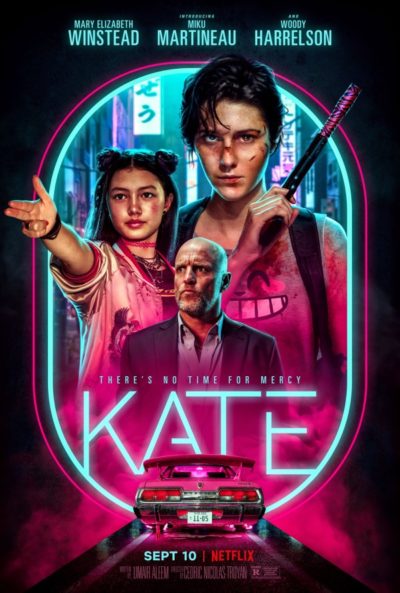 There is also, quite often, some kind of emotional resonance, in the cases where the child is not biologically related [when that is the case, you don’t typically need or get any more explanation, blood being thicker than water]. Maybe the kid acts as a surrogate, a replacement for one previously lost (Alien), or the heroine could never have. Or if a girl, the protagonist can perhaps see a younger version of herself. The other common theme is the use of the child as a key, to unlock the adult. Often, the latter has lost her humanity, typically through harsh circumstances, becoming largely a lone figure, with her emotions suppressed. The “childlike innocence” of the young person, to use a cliché, can be used as a psychological crowbar, pricing open the hard shell of the grown-up, allowing them to reconnect with their humanity. The more emotionally-driven immaturity also stands in contrast to the adult’s stoicism, often to an extreme degree.