★★★★
“Hannibal Lecter’s kid sister, crossed with Carrie”
This small-scale production – a cast of little more than half a dozen, and one location, not counting the park scenes which bookend it – packs a wallop significantly above its weight. Psychiatrist Jimmy Fonda (Neil) is brought into a military facility by an old friend, Olivia (Andersen), to interview a young girl, Ellie (Liles), who is being held there. To avoid pre-judging her case, Fonda deliberately avoids reading the documentation about her with which he has been provided. But the stringent security precautions (“In the event the subject escapes the restraints, drop to the floor and cover your head”) under which she’s held, should give him a clue that this is far from a normal nine-year-old. If it didn’t, the conversation with her which follows certainly does.
For Ellie is incredibly bright, and completely sociopathic. Turns out she killed her mother, and also possesses freakish paranormal talents of telekinesis, which is why she’s locked up in this military facility. However, her wilful rejection of all authority has led those in charge – Colonel Birch (Palame) in particular – to the conclusion that euthanasia is the only option available, given the threat she poses. Olivia, who still believes in Ellie’s humanity, called in Fonda as a last hurrah to prove the young girl is salvageable before she is put down. Ellie, however, is having none of it, and seems intent on embracing her fate. Is this just a facade, or is she as incorrigibly dangerous as the authorities believe?
With such a low-key approach, a lot is riding on the performances of the two leads, and both Neil and Liles hit it out of the park. For a film which, for the great majority of the time, is nothing more than two people talking to each other, it’s remarkably engrossing to watch the two fencing for intellectual dominance. The chess game which they play is perhaps rather too obvious a metaphor for what’s going on here, yet it remains fascinating throughout. Even the slightly stilted and artificial nature of Liles’s performance – par for the course in almost any actor of her age – works for the character, because we’re unsure to what extent Ellie is, indeed, delivering a part she has decided to play.
The effects are generally similarly low-key, but used effectively to enhance things, from the first glimpse we get of Ellie’s powers through to the higher-tier unleashing of them. You could argue that the end is predictable; however, the way the set-up is constructed, there are really only two ways this can logically end. Either Fonda succeeds. or he doesn’t. Your mileage may vary as to which you think is more plausible, and whether or not the film-makers agree with you. I’ll confess we differed in our opinions, yet the journey there was still more than entertaining enough to allow me to shake hands and part on very good terms with the film.
Dir: Alex Haughey, Brian Vidal, Nathan Leon Star: Richard Neil, Savannah Liles, Jolene Andersen, Emilio Palame
I’m tempted to award this an extra half-star, simply for pissing off liberal film critics, upset by the fact that most of the film is devoted to a white woman killing Latino drug dealers. Of course, they completely miss all the points, instead complaining – and these are direct quotes – there is “not a word about corporate complicity in the opioid crisis” and that the heroine’s “true enemy is a system of income inequality driven by hyper-capitalism.” Because, of course, if was hyper-capitalism which gunned down the husband and daughter of Riley North (Garner) in the parking lot of a fun-fair. Oh, my mistake: it was Latino drug dealers.
The main complaint though, is it “bought into the political rhetoric that conflates gang members with law-abiding immigrants.” Uh, speaking as a thoroughly law-abiding immigrant: no, it doesn’t. I never felt at all conflated. But then, I never regarded Trainspotting as any kind of indication that all Scottish people are heroin addicts. For that’s the mistake critics like this keep making, going all the way back those who claimed Basic Instinct was homophobic: taking characters in a film as statements about that group as a whole. As one defense of the film wrote, “all too many members of the Left have reacted to Trump allegedly making gang members represent immigrants by, yes, making gang members represent immigrants.”
Enough politics. The important question here is, is this revenge-driven vigilante pic any good? To which the answer is… somewhat. There’s certainly nothing much new or innovative in the story. After the shooting described above, the scumbags responsible get off, and Riley goes on her mission of vengeance, killing not only those directly responsible, but those on both sides of law she feels were culpable. That involves going all the way up the food chain to Diego Garcia (Raba), the drug boss who ordered the hit, though Riley takes no small pleasure in destroying his organization on the way, not least the piñata factory which operates as a distribution hub.
The film seems to leave a slew of opportunities on the table. For example, the five years before Riley’s mission got under way, when she was living off the grid and acquiring the “very particular set of skills” [director Morel also helmed Taken] necessary for the task. Or the way she operates as an “angel” for the homeless inhabitants of Skid Row. Or the social media debate, mentioned in passing, which her vigilante actions against Garcia and his gang has kick-started. Or Riley’s eventual payback against another mother for a long-ago wrong. Expanding on any of these might have offered more interesting ways to go, rather than being mostly a clone of this year’s Bruce Willis vehicle, Death Wish, in itself a remake that added little to the 1974 original.
Instead, we are left with little more than a competent exercise in Garner returning to her Alias roots, though as such it’s entertaining enough. The fights here are crisply handled, reaching a peak on the piñata warehouse assault, I’d say – an environment which offers a great deal of opportunity for innovative carnage. It’s the bits in between which are the problem, setting up interesting angles, then failing miserably to take advantage of them, instead offering almost as much footage of the cops chasing Riley (Ortiz and Gallagher). And at least it’s not Elektra, the film effectively responsible for killing off comic-book action heroines for a decade, as well as putting Garner’s career in big-budget movies on life-support. We can be grateful for that, I suppose.
Dir: Pierre Morel Star: Jennifer Garner, Juan Pablo Raba, John Ortiz, John Gallagher Jr.
Having dipped my toe into the animated DC World with their 2009 version of Wonder Woman, I thought I’d scope out this more recent entry. It collects together both seasons of the Vixen web series, as well as new footage. The series began in 2015, with six five-minute episodes under Tucker, and six more followed the following year, directed by Geda. It’s a cross-over from the “Arrowverse”, with appearances from the Flash, Green Arrow and Black Canary, among others – some of the voices here are done by the same actors as the live-action TV shows.
The focus, however, is on Mari McCabe (Echikunwoke), a orphan from Africa who was brought up in Detroit by a foster family. Virtually all she has linking Mari to her original roots is a necklace, and this is no ordinary trinket. The totem allows the wearer to tap into animal spirits and gives them their powers, e.g. strength of a gorilla, speed of a cheetah, etc. This comes as a bit of a shock, not only to Mari, but also to the rest of the Arrowverse, who were under the impression superpowers were only the result of exposure to intense radiation.
Regardless, several problems result for Mari from this. Firstly, she has to try and figure out how to control and harness the potential abilities. Secondly, her older sister, Kuasa (Rose), feels the totem belongs to her, and their struggle for control forms the focus of season one. In the second series, we discover it is just one of five elemental artifacts, and when the “fire” totem is discovered, former general Benatu Eshu arrives in Detroit, intent on acquiring it, for… the usual reasons power-hungry former generals want to get their hands on relics of great import, I guess.
While more or less your standard superhero origin story, there is an underlying awareness, occasionally bordering on self-mockery. This certainly helps, given I’m no real fan of the superhero genre in general, so seeing this poke fun at itself – albeit gently – basically beat me to the punch. Some of the background characters were occasionally an issue for a novice like me, who is almost entirely unaware of the Arrowverse. I imagine most viewers will not be in that boat, but I felt it worked better when concentrating directly on McCabe, and exploring her background and development.
The animation seems cut from the same cloth as Wonder Woman, which means it makes for nicely fluid action. Although in some of the more talky sequences, I was occasionally distracted by the absence of movement anywhere except the lips. They do a good job of crafting a feature out of something episodic, even if the join between the two seasons is fairly obvious. Fans of Arrow should stick around for the post-credits sequence which (I’m informed!) ties into Echikunwoke’s subsequently appearance in a guest role as Vixen in Arrow. Yet even for someone like me, outside that group, this was a character I liked, and wouldn’t mind seeing more of – whether in animation or live-action.
Dir: James Tucker + Curt Geda Star: Megalyn Echikunwoke, Anika Noni Rose, Neil Flynn, Sean Patrick Thomas
A breezy yet slightly odd mix of comedy and ultra-violence, this drops Audrey (Kunis) and her gal pal Morgan (McKinnon) into the middle of a spy caper, after Audrey’s boyfriend Drew (Theroux) dumps her, only for Audrey to discover he was a CIA spy. He tells her she must deliver a statuette to a Viennese cafe, or the world will be in great peril. After the peril rapidly arrives, heavily-armed, she and Morgan head off to Europe, with no idea of who they can trust. In hot pursuit – whether for reasons good or bad – are MI6 agent Sebastian Henshaw (Heughan), and the agents of “Highland”, a criminal syndicate also very keen to get their hands on the statuette and what it contains. A whirlwind tour of European cities follows, including Budapest, Paris, Amsterdam and Berlin.
I’ve rather more time for Kunis than McKinnon; I have previously found a little of the latter’s shtick tends to go a long way e.g. the Ghostbusters reboot, and that’s the case again here. There’s not just much of a character arc for Morgan: she starts the film off being loud and obnoxious, and more or less maintains the same, honking note throughout. Audrey is more restrained, both as a character and in Kunis’s performance, and I found that worked considerably better, to the point the film might have been fine with just her as the lead on her own. Although that might have made the obvious comparisons to Spy all the more apparent. As is, it lacks quite the same level of supporting presence given there by Miranda Hart and Jason Statham.
Surprisingly, it maybe works better as an action film than a comedy, despite Fogel’s almost non-existent work in the area previously. [Some second-unit magic being worked?] Drew and Sebastian do much of the heavy lifting, yet not all of it. In this area, there’s a great car chase, and I enjoyed the supporting role of Ivanna Sakhno as Russian gymnast-assassin Nadejda, as well as Gillian Anderson as Henshaw’s deadpan boss. Nadejda also has one of the drollest comic moments: ordered to assassinate “two dumb American women,” she’s confounded by discovering just how many dumb American women are present in Europe. The hitwoman ends up battling Morgan on a trapeze. Because Morgan went to circus school. As you do. Yeah, the script here will occasionally make you roll your eyes like that.
The end hints at some kind of franchise, which has the potential to be more fun than this origin story, the pair becoming fully-fledged agents on their own, rather than operating in the shadows and under the protection of their male counterparts. There’d be something to be said for a film featuring a pair of spies who simply pretend to be those “dumb American women” for cover purposes, while actually being smart and entirely competent. Such a film likely would need to feature someone else other than McKinnon, however. I’d be perfectly fine with that.
Dir: Susanna Fogel Star: Mila Kunis, Kate McKinnon, Sam Heughan. Justin Theroux
After her father is killed, Shaun (Union – yes, I know “Shaun” is an odd name for a woman) heads to the remote home Dad owned in the country, with her two young children, to clear it out. Unfortunately, she crosses paths there with Eddie (Burke) and his gang of three thugs. They are at the house, in the belief there’s a safe which contains a large quantity of money. Shaun and family represent an unwelcome interruption, because they’re on a strict schedule, before the security company makes it out to investigate their disabling of the phone lines. The thugs take the kids hostage, with Shaun stuck outside the very secure home. Fortunately, she has taken a hostage of her own – the safe-cracker Eddie brought along.
This initially makes for a somewhat interesting twist on the usual scenario: rather than being trapped inside and trying to get out, the heroine needs, as the title suggests, to break into the building. And the “mother bear seeking to defend her cubs” motif is always a good foundation. Unfortunately, there hasn’t been nearly enough effort put into the scenario past that point. In particular, both sides need to behave with the enhanced level of contrived idiocy necessary to the plot. If either Shaun or Eddie had acted in accordance with simple principles of common sense, this would likely have lasted no longer than 15-20 minutes. Though in Eddie’s defense, he is a razor-sharp intellect compared to his minions. I’d have a quiet word with his HR department about quality control, which is clearly not among their recruitment tools.
Everything from the basic premise on, is questionable at best. What kind of cheap-ass security company takes several hours to respond to an alert? Quite how Shaun is capable of going toe-to-toe with career criminals like Eddie and his crew is never explained, and nor is her decision not to get help, beyond vaguely hand-waving lines such as, “Moms don’t run, not when their babies are trapped in the nest.” Other dialogue includes, “I wish I could have had a Mom like you,” entirely expositional statements, e.g. “You’re a woman, alone at the mercy of strangers, and your greatest weakness is locked inside this house,” and the climactic, “You broke into the wrong house!” which for anyone, like me, who’s a fan of Tremors, will provoke sniggers more than the intended triumphant cheers.
These quotes are also a fairly accurate representation of the level of effort that we see put into the characterizations here. Thus, among Eddie’s henchmen, we get the inevitable Heavily Tattooed Latino Psychopath, as well as the Nice Guy Who Didn’t Sign Up For This. It’s all very by the numbers, and while Union does her best, the script ensures that’s not much more than coming off as a low-rent version of Halle Berry in Kidnap. Mind you, given the tagline there was “They messed with the wrong mother,” this project largely feels like it was cribbed from the same playbook. And there are certainly better movies available to steal from.
Dir: James McTeigue Star: Gabrielle Union, Billy Burke, Richard Cabral, Levi Meaden
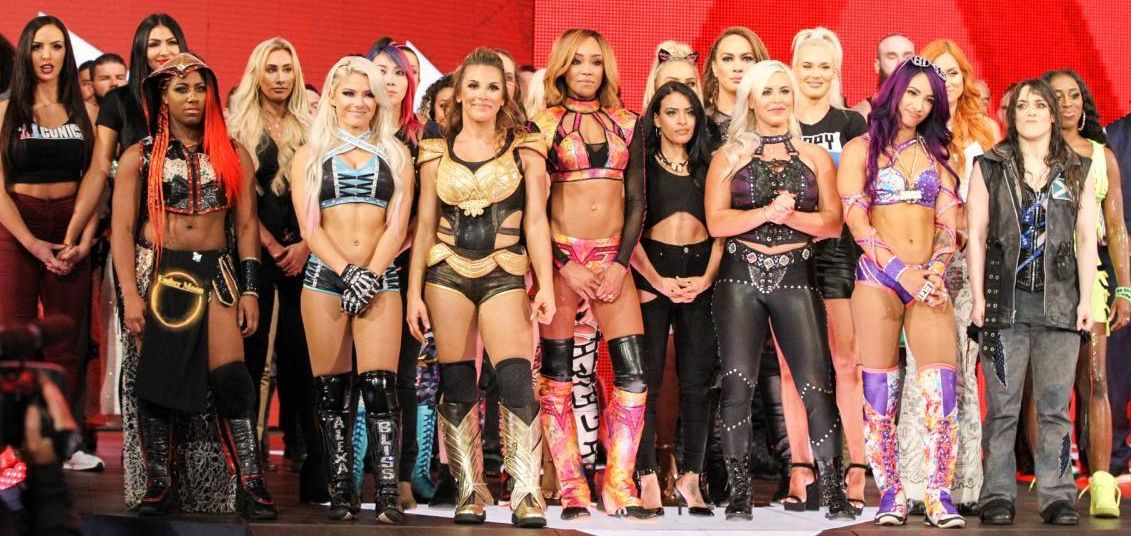
The WWE has had a fraught relationship with women’s wrestling over the years, but things seem to have been heading in a positive direction recently. They dropped the terrible “Divas” tag, renaming the belt back to being the women’s championship, and with Triple-H overseeing things, seemed to be bringing in talent based on wrestling ability, rather than just looks. While very much a work in progress, this led to ground being broken on October 28, with the company holding its first-ever pay-per-view show entirely filled with women’s matches. That there was enough talent to make such a show possible, in itself indicated how things had changed. However, it was not without controversy.
The event itself was announced in July, and may have been a reaction to criticism of WWE after their April Greatest Royal Rumble show in Saudi Arabia. Due to that country’s social climate, women were not allowed to wrestle there, and after a promo video included them in action, the Saudi General Sports Authority issued an apology for this “indecent material.” Having a women-only PPV seemed like an acknowledgement of the issues. Yet Evolution was overshadowed by another WWE event in Saudi Arabia, scheduled a week later – a situation not helped by the murder of local journalist Jamal Khashoggi at the country’s consulate in Istanbul. The concept also came in for criticism from those who felt the company was patting itself on the back for “evolving” out of depths which were entirely of Vince McMahon’s own making.
I can’t honestly say these factors had any impact on my interest in the largest women’s show ever – at least, in the United States. For back in 1994, AJW held their oddly-named Big Egg Wrestling Universe show at the Tokyo Dome, with a crowd of over thirty thousand in attendance. In comparison, attendance at the Nassau Coliseum was less than one-third that, at 10,900. Still, it was an order of magnitude up on the previous American high, likely belonging to Impact Wrestling‘s One Night Only: Knockouts Knockdown show, which took place before a crowd of 1,100 in May 2014. And, for me, the possible positives heavily outweigh any negatives: a good show could encourage viewers to check out all-women federations like Shimmer or Shine. A rising tide floats all boats – I note a local Arizona federation staged its first gyno-centric show the weekend after Evolution.
But would they deliver? Technically, it was a decent presentation by WWE, if a little smaller-scale than expected – the regular RAW set-up was elsewhere in the country, so they had to make do a bit in terms of lighting and spectacle. I did like the commentary team of Michael Cole, Beth Phoenix and Renee Young, who all seemed genuinely enthusiastic – even Cole, who can sometimes come over as a bit of a dick. With that said, let’s go through the seven matches on the official card (there was a ‘dark’ bout that took place before the broadcast began) and see how they fared. Spoilers. of necessity, follow the rest of the way.
1. Trish Stratus and Lita defeated Mickie James and Alicia Fox. Things started slowly, as two retired Hall of Famers returned to kick the show off. Though James has been around almost as long, and fought against Stratus and Lita when they were active (both retired in 2006). This seemed intended as a bridge, to link the past to the present, but the fact the veterans had been out of ring action for more than a decade inevitably meant this was mostly slow and careful. Though the biggest botch belonged to Fox, whose save on a pinfall attempt was so late, the referee had to stop counting. The icons won after Lita hit her signature moonsault. She was the first woman I ever saw doing that move, and it’s still impressive [especially now at the age of 43!].
2. Nia Jax won by the 20-woman Battle Royal. Never been a big fan of the Battle Royal; it makes the ring look like a brawl on a rush-hour train in the early stages. Still, it was nice to see some more veterans, including Alundra Blayze, and Molly Holly, whom we interviewed in 2006. Iy did showcase the depth of women’s talent now present in the WWE. There were times in the past when I doubt they could have found 20 women in the company for a bout like this, without including make-up artists and secretaries. Things became less chaotic once we eventually got down to the final few competitors, and I was pleased to see Jax win. She’s one of the furthest from the archetypal “Diva” – billed at six foot tall and 273 pounds – yet unlike some of the larger men, is no slouch in the ring. Fun fact: her cousin is Dwayne “The Rock” Johnson.
3. Toni Storm defeated Io Shirai in the 2018 Mae Young Classic tournament final. The first singles match was an excellent one, despite being between two wrestlers not yet on the main roster. Both were familiar though: Storm had reached the semi-finals of the 2017 Mae Young Classic, while Shirai was part of one of our all-time favourite matches on Lucha Underground. Storm is an Australian, and could hardly be more archetypally Antipodean if she tried: tall, blond and fit. She’s going to be a star. For Shirai, the problem for WWE may be finding people of her level, against whom she can wrestle. I almost sensed her having to slow down and pull her punches here, to avoid overwhelming Storm. As with most Japanese wrestlers, the key to her success in the West will be if she can get her personality on the mic, something which has limited many of them in the past.
4. Sasha Banks, Bayley, and Natalya defeated The Riott Squad (Ruby Riott, Liv Morgan, and Sarah Logan). There’s nothing like a good bad girl, and the Riott Squad provides three of them. They certainly had my backing – but then, I’ve never been impressed by Banks, and for some reason, Bayley irritates me more than anything (I think it’s at least partly the hair). I thought the Squad worked particularly well as a team. If the rumblings about WWE introducing a women’s tag division prove true, then you could pick any two of the trio and they’d be more than credible contenders. Their opponents though? Meh. Largely forgettable, even Natalya, who typically represents good value for money.
5. Shayna Baszler defeated Kairi Sane for the NXT Women’s Championship. The two, shown below, have been feuding in NXT (the WWE’s top developmental brand), with former MMA fighter Baszler winning the title in April, but losing it to Sane in August. This was also a rematch of the final from the first Mae Young Classic, in which Sane prevailed over the “submission magician” Baszler – and was similar in content, with Bazler trying to ground and pound Sane, while the latter used her speed and agility to stay out of her opponent’s grasp. While Sane lost, it was largely only through the intervention of Baszler’s friends in the front-row, who helped her regain the title. That dubious interference helps solidify her heel status nicely, though she will need to do a better job of not seeming like Pepsi to Ronda Rousey’s Coke.
6. Becky Lynch defeated Charlotte Flair in a Last Woman Standing match for the WWE SmackDown Women’s Championship. This was pretty much a universal pick as match of the night: in Cageside Seats‘s poll, it got 86% of the votes, with nothing else at more than 4%. I can see why (though preferred Storm/Shirai). At almost half an hour long, it was epic in length: a stark contrast to the women’s match which started the #GiveDivasAChance trend on Twitter, and helped open the door for this show. That bout in 2015, pitted Paige & Emma against the Bella Twins, and lasted… 26 seconds. However, Lynch’s superior talent was often glaringly obvious, especially in the early stages, with Flair starting very slowly. She did improve as it went on, and this eventually blossomed into a full-on brawl, with kendo sticks and ladders used without mercy as weapons. It ended when Lynch powerbombed Flair through a table, and left her unable to beat the referee’s ten-count – the only way to win this match. It was certainly the fight that defined the event.
7. Ronda Rousey defeated Nikki Bella for the WWE Raw Women’s Championship. Our daughter went to school in Scottsdale with the Bella Twins. I’m sure she would have enjoyed seeing Nikki get the crap pounded out of her by “the most dangerous woman on the planet”. It was interesting how Nikki uses “diva” – WWE’s official designation for women wrestlers until April 2016 – as a term to get heel heat. In many ways, she is the last of that ‘old guard’, and to be honest, the sooner she’s gone the better, because she and her sister still can’t do more than take part in glorified catfights and make duck-faces. As such, Rousey is the anti-Bellas, and I’m fine with that. However, I’m unimpressed by WWE giving her the title, four months after her pro wrestling debut – at Wrestlemania. Considering the women who have honed their craft in obscurity for decades (hello, Mercedes Martinez), guess there’s still work to be done before WWE truly “gets” it.
All told, it was a solid event, especially considering it was the first of its kind. Yet if it is to be at all meaningful, it can’t be the last, and if WWE could avoid overshadowing it next time, simultaneously shooting itself in the foot, that would be just great… There won’t be quite the same novelty to promote Evolution II, yet that shouldn’t be a problem, as long as the weekly shows continue to provide a chance for the women to show their talents on a regular basis. It’s been a long time since I’ve been as optimistic about the potential future for women’s wrestling in the West, and despite the flaws, in future years we may look back to this event as a watershed in its blossoming.
Star: Ronda Rowsey, Nikki Bella, Becky Lynch, Charlotte Flair
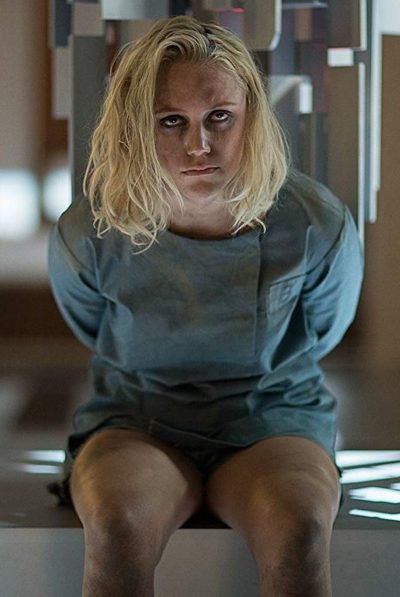
Julia (Monroe) is a petty thief, who is abducted from her house and wakes to find herself, along with other random low-lives, prisoner in a mysterious facility. All of them have an electronic implant in their neck, which gathers data as they are put through a series of tests. Using her thieving skills, Julia leads a breakout attempt, which is brutally foiled by the facility’s automated defense system, a robot called Aries. But the attempt brings her to the attention of Alex (Skrein), the man running the project. He’s a tech innovator, who has been working on a super-AI, called Tau (voiced by Oldman), and using the data gathered from his kidnapped subjects to make it smarter. Julia’s brain makes her particularly suitable, and with time running out before he has to present Tau to its backers, he sets her to work. But Julia begins building a relationship with Tau, with the aim of using its naivety to turn the AI against its cruel creator.
I was expecting something perhaps a little more like Cube based on the trailer and the early going, with more of Julia and the other prisoners going through the tests. However, that aspect is disposed of relatively early. This is possibly wise, since the whole “kidnapping for experimental purposes” angle doesn’t make much sense, with Alex clearly not short of money or smarts (he comes across as an evil cross between Mark Zuckerberg and Elon Musk – some may consider the word “evil” there to be redundant!). Why not come up with a method of research which doesn’t require the death of the test subject? Anyway, with the resulting blood mopped up off the floor by a squad of semi-autonomous mini-drones, it then becomes a three-hander, between her, Alex and Tau, as they fence for psychological, and occasionally physical, dominance inside the confines of Alex’s fabulous house.
This looks lovely (the director’s background and previous work has mostly been in the art department), and occasionally has moments of effectiveness: Tau’s love of music is endearing, and his voracious desire, fed by Julia, to learn about the outside world is almost childlike. I also liked Julia’s feisty physical presence; this transfers well across from her previous “final girl” roles, such as in It Follows, especially during her confrontations with Aries. But the script frequently veers off to far more obvious beats. The self-destruct system is particularly blatant in its foreshadowing. and if I’ve learned anything from this kind of movies, it’s that biometric sensors on doors are a bad idea. If you ever see one in a movie, you know they inevitably lead to someone losing the necessary body part e.g. an eyeball in Demolition Man.
The script likely would have benefited from ramping up the pulp quotient along similar lines, since it isn’t quite smart enough to succeed on brains alone. When it takes a more visceral and less cerebral route, such as the first escape attempt, it’s notably more effective than when it tries to be clever.
Dir: Federico D’Alessandro Star: Maika Monroe, Ed Skrein, Gary Oldman (voice)
★★★½
“She’s more cold-blooded than any man I’ve ever seen.”
This Western was released in 1953, and feels decades ahead of its time. It’s set toward the end of the Civil War, in the town of Border City, which sits exactly on the dividing line between North and South. A settlement built on mining, it has remained a neutral zone under strictly enforced rules laid down by Mayor Delilah Courtney, selling lead to both sides for their bullets. As well as Yankee and Confederate soldiers in the area, the picture is complicated by Quantrill’s Raiders, a group of independent (yet generally pro-South) soldiers under Charles Quantrill (Donlevy). [They really existed, and as the film reveals, had some well-known names in their ranks]
Quantrill arrives in town alongside Sally Maris (Leslie), there to visit her brother, Bill, who runs the local saloon. However, tensions are high, since a couple of years earlier, Quantrill had abducted Bill’s girlfriend, Kate (Totter), taking her as his wife. Kate instigates a gunfight in which her husband shoots Bill, and after some doubts, Sally takes over the saloon. But Kate won’t let it lie, and her enmity leads to a gunfight between the women, which Sally wins, although she refuses to finish the wounded Kate off. When the Yankee army rides in, seeking to end Quantrill’s group, she shelters Kate, despite all that has happened. Meanwhile, Sally has fallen for Lance (Lund), a supervisor at the local mine, who is playing a dangerous game as an undercover agent for the Confederacy.
A lot to unpack in a brisk 90 minutes, with a great concept, of which I’d like to have seen more use made. An entire film about Mayor Courtney and her hardcore approach to neutrality (which includes summary execution for anyone she perceives as threatening the balance) would have been worth the watch. But it’s mostly the Sally/Kate dynamic which drives the film, leading to a saloon cat-fight after Kate threatens to start singing Dixie – an incendiary act which could easily trigger a blood-bath. Even more impressively, it escalates into the duel mentioned above (and shown below) – is it the first gun-fight in cinema, solely between two women? It’s a spectator sport, with the rest of the town watching in fascination; the men on both sides simply let things unfold as they may.
Though it’s really Sally’s story, Kate gets the poster and is also the subject of the tagline at the top. Proof, once more, that bad girls have more fun. There was, apparently, a difference in approach between the two actresses, Joan Leslie saying, “Audrey later told me she played the whole thing for farce, while I was doing it straight.” Yet fifties farce turns into female empowerment when viewed through a 21st-century lens, especially when Kate is lamenting her husband’s hold over her, which is positively #MeToo in tone: “At first I fought him. I tried every way I knew to try and escape. And later on, I became just like him.” Yet she’s actually far more of a dangerous wild-card than Quantrill.
I must say, Sally’s transition from straitlaced lady to whorehouse madam is rather jarring, and it’s never satisfactorily explained why she’s such an expert shot. The film never quite manages to recapture the refreshing energy of her duel against Kate; it feels like that should have been the climax, rather than petering out at the end of the war, with everyone joining in a rousing chorus of Dixie. And Totter’s pair of musical numbers appear to have strayed in from another film entirely. Yet the two leads are more than capable of carrying this: it’s especially interesting to note how this foreshadows the similarly-themed, yet much better known, Johnny Guitar, released a year later.
Dir: Allan Dwan Star: Joan Leslie, John Lund, Audrey Totter, Brian Donlevy
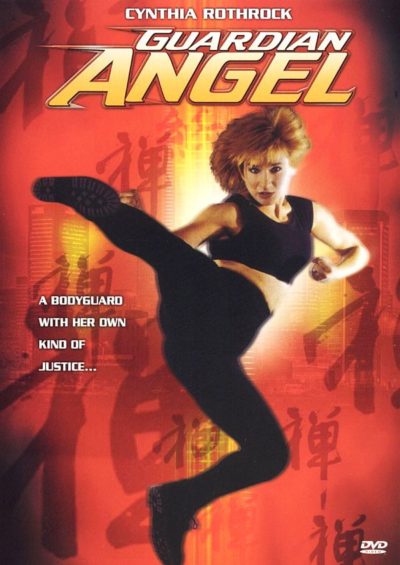
To explain the above, there are significant chunks of this which are terrible: make no sense, or are flat-out dumb. Its depiction of policing, in particular, is awful. Apparently, if you’re on a stakeout and a deal between two gangs has turned into a Mexican standoff, the best way to defuse the situation is to run downhill towards them, firing your gun in the air – and not bothering, at any point, to identif yourself as a law enforcement officer. I laughed like a drain at that, and there are innumerable other moments of such character stupidity or cinematic incompetence. Yet, none of that stopped me from being adequately entertained.
Rothrock stars as LAPD officer Christine McKay, who is investigating a counterfeit money ring. During an attempted (and very poorly-planned, if I may say so) sting operation, her fiancé is killed by Nina Lindell (Denier), one of the people at the head of the ring, before she is subsequently arrested. Christine attacks Nina at court, and quits the force in disgust before she can be suspended, becoming a bodyguard for hire and living in a trailer with her pet dog – who arguably emotes more convincingly. She is hired by Hobbs (McVicar), a rich playboy, in need of protection from a stalker ex-girlfriend: his choice of McKay makes sense, because said ex is Nina, who has also just helicoptered her way out of prison. It turns out Hobbs’s brother was part of the counterfeiting ring, and is the only person who know the location of the printing plates.
If the above doesn’t sound like it makes much sense… trust me, it doesn’t. Neither heroine nor villainess behave in ways indicating the possession of any notable intelligence. We are deep in “necessary to the plot idiocy” here, and as for whoever wrote the script, their knowledge of police procedure was entirely taken from other low-budget nineties action flicks. But can you realistically complain about such things, in a film whose climax involves gratuitous multiple jet-skis and power-boats, as well as a helicopter? The film exists to show Rothrock kicking butt, and when it sticks to this, certainly does enough to pass muster. Although I’d recommend scheduling a bathroom visit when her boyfriends bites the bullet, so you can avoid the less than adequate efforts at showing distress.
Denier chews the scenery to better effect and, must say, with a female front and centre on both sides of the screen, it’s surprisingly gynocentric. It doesn’t stop there – McKay’s boss on the force is also female (Dalva), as is her first partner – though she dies with even less impact than the fiancé! There are occasional beats where comic relief Hobbs isn’t entirely irritating, and given the low standards of the genre for wit, that’s praise indeed. If still some way short of Rothrock’s best Hong Kong work, this likely rates above average among her American films (again, a back-handed compliment!), and as undemanding throwbacks to a less sophisticated era go, is certainly… undemanding.
Dir: Richard W. Munchkin Star: Cynthia Rothrock, Daniel McVicar, Lydie Denier, Anna Dalva
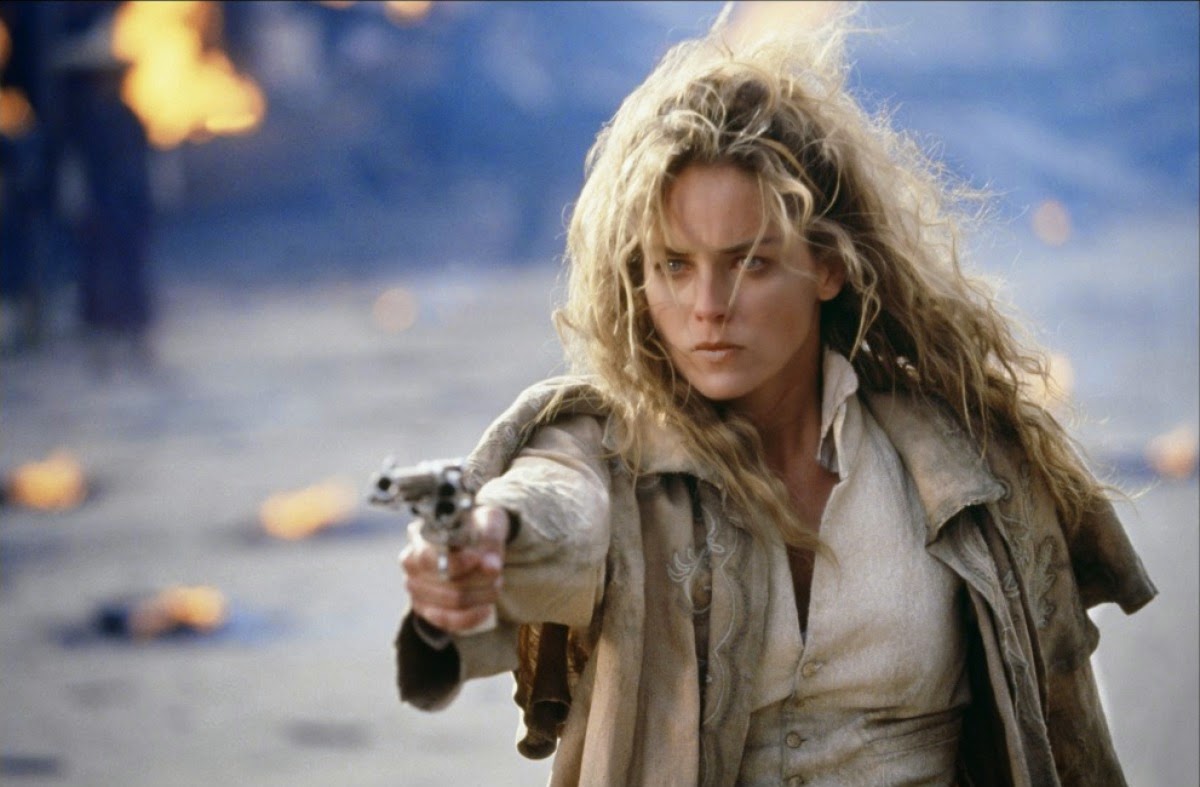
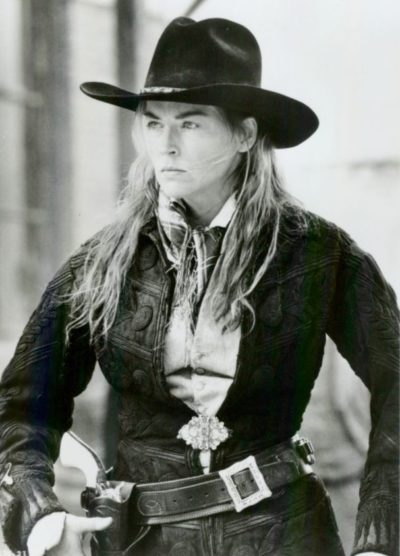
1995 possibly marked a recent low for the commercial appeal of action heroines in Hollywood. December would give us one of the biggest disaster movies of all time, in Cutthroat Island and March saw Tank Girl bomb. Together with this attempt to give the Western a female spin, the three movies had a combined budget of $155 million, but grossed less than $33 million. While Westerns were enjoying a return to popularity in the years after Unforgiven, it was almost as if Sony had learned nothing from Fox’s dud in the same area the previous year, Bad Girls. They instead doubled down on something which was not just a Western, but specifically a pastiche of the spaghetti Western subgenre.
In hindsight, its commercial failure was almost inevitable, even though after Basic Instinct in 1992, Sharon Stone was one of Hollywood’s hottest actresses. So when Sony bought Simon Moore’s script the following year, they approached her to star. She not only came on board as the lead actress, she also became one of the film’s producers, and had no hesitation in wielding that power. For example, she insisted that Sam Raimi – then, largely known only for his work on the Evil Dead trilogy – had to direct it, or she would not be involved. Similarly, she went to bat for then largely unknown actors Russell Crowe and Leonardo DiCaprio, going so far as to pay the latter’s salary herself. The subsequent Oscars for both men suggest she had a good eye for upcoming thespians.
Moore was eventually fired, with the studio bringing John Sayles on board. However, Moore was re-hired three weeks before shooting was scheduled to start, due to the movie becoming excessively long: he simply discarded all of Sayles’s changes, and Sony accepted what was basically the original version. However, during shooting, Raimi realized he had an issue. “I came to the studio and said, can you find me a writer? I’ve shot this movie, and the end isn’t quite working… They suggested Joss Whedon, who was doing Buffy, so I met Joss and he saw the movie, and he helped me solve this ending in one afternoon,” adding one more name to the list of future stars who worked on the film.
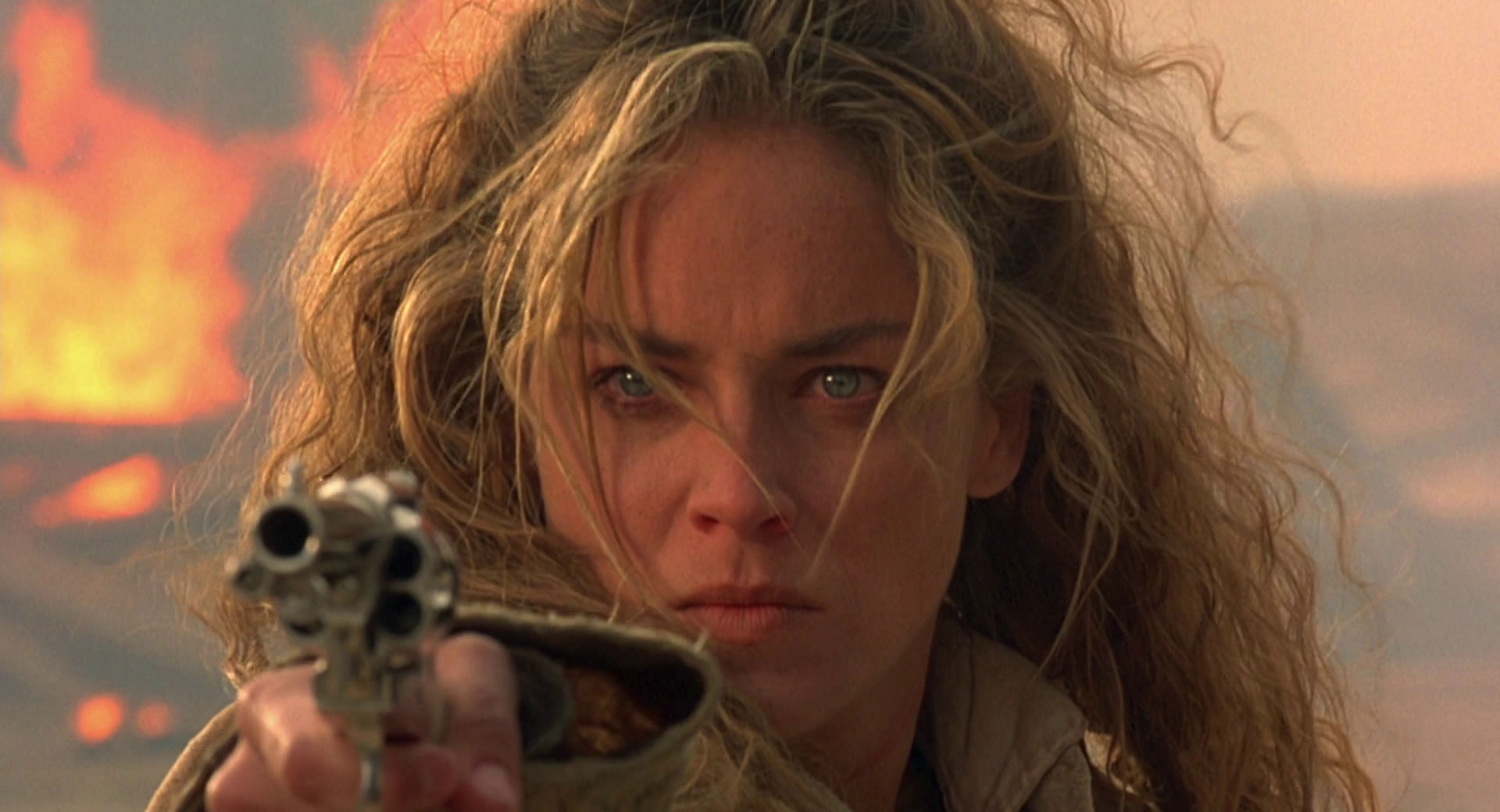
The concept here is pure gimmick. The town of Redemption lives under the iron hand of Herod (Hackman), who organizes an annual gunfight contest he always wins, partly to flush out anyone who might be plotting against him, mostly because he enjoys it. This time, 15 other entrants are drawn by the $100,000 prize, as well as other reasons. The more or less willing participants include Herod’s son (DiCaprio), former partner Cort (Crowe) and a mysterious woman (Stone), named in the credits as The Lady, actually called Ellen. She has a particular grudge against Herod, since his involvement in the death of her father, though things are more complex than you initially suspect. Getting revenge, however, requires Ellen to get through a tournament increasingly stacked against her.
The Varietyreview at the time nails the main problem: “Given the inevitability of an Ellen-Herod showdown, despite a couple of twists [Moore] has thrown into the last reel, the film quickly becomes hamstrung by the rigid dramatic constraints imposed upon it by the gun tournament format. No matter how many fancy ways Raimi invents to stage the shootouts, the tedium is quick in coming, and there’s nothing else going on between times to build up suspense, character or interest.” Moore has failed to grasp that while Westerns often climaxed in a gunfight, this does not mean that more gunfights = a better film. They are the full-stop at the end of a cinematic sentence. And like. Those, when. You use them. Too often, the. Results are jarring rather. Than effective.
It’s a shame, because the supporting cast is quite stellar, and deserve better. Outside of those already mentioned, there’s also Tobin Bell, who’d go on to become horror icon Jigsaw in the Saw franchise; Lance Henriksen; Keith David; and, although his scenes were deleted, Raimi’s long-time friend, Bruce Campbell. Seeing the talent which gets rushed in and out of the story in about five minutes makes me wonder if a feature film was the best medium for the idea. It might have worked better as an ongoing television series, each episode telling the back story of the participants and ending in their duel. A rotating series of guest stars would have worked very nicely, with the season covering one of Herod’s contests, leading up to the final gunfight in the last installment.
I’m not certain Stone is perhaps the best candidate for the role, since she seems to think staring really hard is the key to dramatic success. You’d think she might have known better, given apparent action heroine ambitions from relatively early in her career. Even before breaking through to stardom in Total Recall, she was in her fair share of adventure flicks – albeit not very successful ones – such as King Solomon’s Mines and Allan Quatermain and the Lost City of Gold. Unlike Geena Davis, however, Stone didn’t seem to persist in her efforts: the critical acclaim she received the same year for Casino, pushed her career back toward more dramatic pastures. This therefore stands out as something of an oddity in her filmography.
Time has perhaps been slightly kinder to this than its companions in action heroine failure for the year. Raimi eventually showed an ability to deliver this kind of comic-book spectacle with his work on the Spiderman franchise, and that may have been a better home for his stylistically excess flourishes than this. Naturally, as an Arizona resident, this film now triggers a certain amount of native pride, having been filmed largely around the state, in particular at Old Tucson Studios [unfortunately, a good portion of which burned down a couple of months after Quick was released, forcing its closure for two years] and Mescal, 40 miles southeast of Tucson.
It may not be the greatest Western – or even a particularly good Western. Yet two decades later, it likely remains the biggest production in the genre with a female lead, and as such, it deserves a certain respect. Especially when the commercial failures in recent years of Jane Got a Gun and Woman Walks Ahead, suggest that position at the head of the class probably isn’t going to be under threat, any time soon.
Dir: Sam Raimi Star: Sharon Stone, Gene Hackman, Russell Crowe, Leonardo DiCaprio




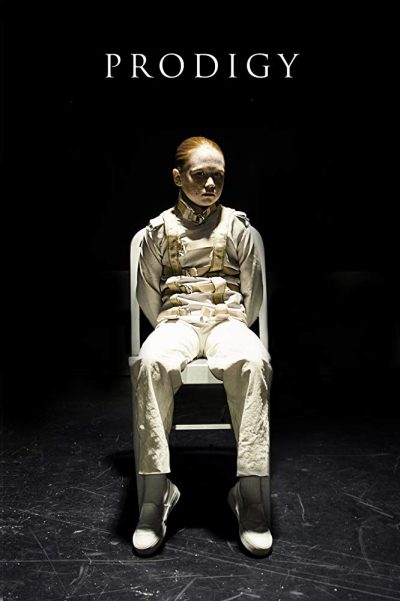 This small-scale production – a cast of little more than half a dozen, and one location, not counting the park scenes which bookend it – packs a wallop significantly above its weight. Psychiatrist Jimmy Fonda (Neil) is brought into a military facility by an old friend, Olivia (Andersen), to interview a young girl, Ellie (Liles), who is being held there. To avoid pre-judging her case, Fonda deliberately avoids reading the documentation about her with which he has been provided. But the stringent security precautions (“In the event the subject escapes the restraints, drop to the floor and cover your head”) under which she’s held, should give him a clue that this is far from a normal nine-year-old. If it didn’t, the conversation with her which follows certainly does.
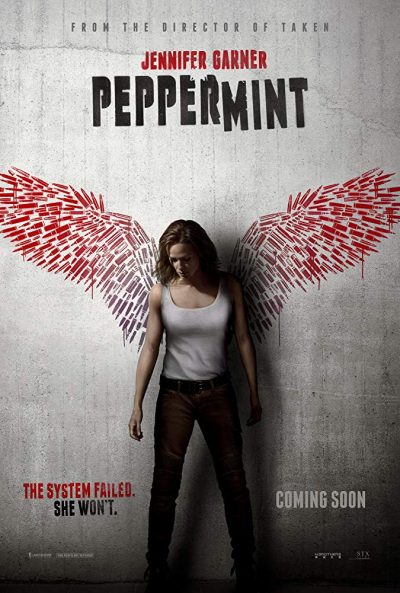 I’m tempted to award this an extra half-star, simply for pissing off liberal film critics, upset by the fact that most of the film is devoted to a white woman killing Latino drug dealers. Of course, they completely miss all the points, instead complaining – and these are direct quotes – there is “not a word about corporate complicity in the opioid crisis” and that the heroine’s “true enemy is a system of income inequality driven by hyper-capitalism.” Because, of course, if was hyper-capitalism which gunned down the husband and daughter of Riley North (Garner) in the parking lot of a fun-fair. Oh, my mistake: it was Latino drug dealers.
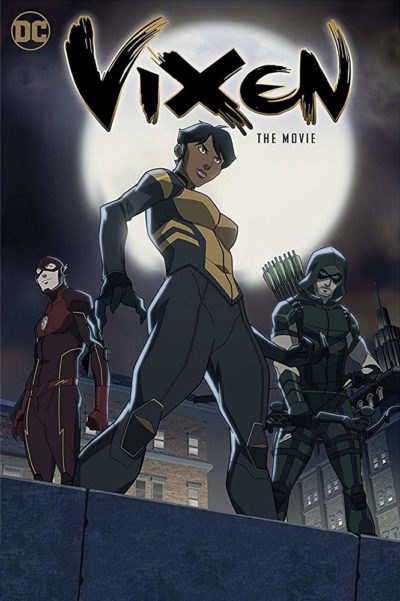 Having dipped my toe into the animated DC World with their 2009 version of
 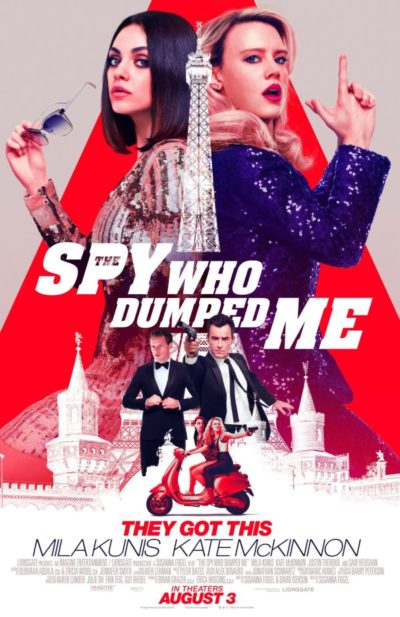 A breezy yet slightly odd mix of comedy and ultra-violence, this drops Audrey (Kunis) and her gal pal Morgan (McKinnon) into the middle of a spy caper, after Audrey’s boyfriend Drew (Theroux) dumps her, only for Audrey to discover he was a CIA spy. He tells her she must deliver a statuette to a Viennese cafe, or the world will be in great peril. After the peril rapidly arrives, heavily-armed, she and Morgan head off to Europe, with no idea of who they can trust. In hot pursuit – whether for reasons good or bad – are MI6 agent Sebastian Henshaw (Heughan), and the agents of “Highland”, a criminal syndicate also very keen to get their hands on the statuette and what it contains. A whirlwind tour of European cities follows, including Budapest, Paris, Amsterdam and Berlin.
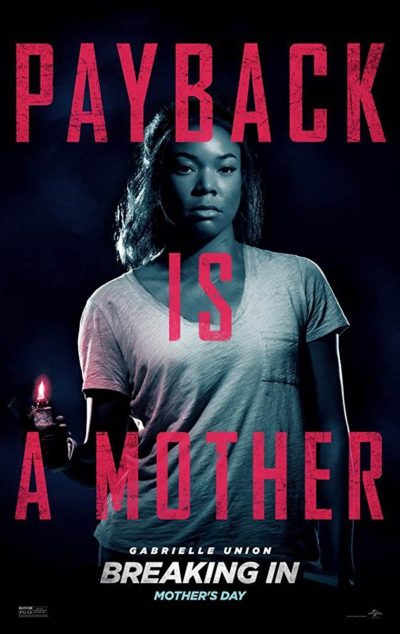 After her father is killed, Shaun (Union – yes, I know “Shaun” is an odd name for a woman) heads to the remote home Dad owned in the country, with her two young children, to clear it out. Unfortunately, she crosses paths there with Eddie (Burke) and his gang of three thugs. They are at the house, in the belief there’s a safe which contains a large quantity of money. Shaun and family represent an unwelcome interruption, because they’re on a strict schedule, before the security company makes it out to investigate their disabling of the phone lines. The thugs take the kids hostage, with Shaun stuck outside the very secure home. Fortunately, she has taken a hostage of her own – the safe-cracker Eddie brought along.
 ★★★½
★★★½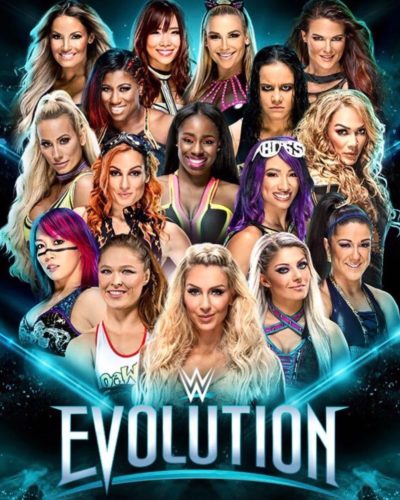 But would they deliver? Technically, it was a decent presentation by WWE, if a little smaller-scale than expected – the regular RAW set-up was elsewhere in the country, so they had to make do a bit in terms of lighting and spectacle. I did like the commentary team of Michael Cole, Beth Phoenix and Renee Young, who all seemed genuinely enthusiastic – even Cole, who can sometimes come over as a bit of a dick. With that said, let’s go through the seven matches on the official card (there was a ‘dark’ bout that took place before the broadcast began) and see how they fared. Spoilers. of necessity, follow the rest of the way.
 Julia (Monroe) is a petty thief, who is abducted from her house and wakes to find herself, along with other random low-lives, prisoner in a mysterious facility. All of them have an electronic implant in their neck, which gathers data as they are put through a series of tests. Using her thieving skills, Julia leads a breakout attempt, which is brutally foiled by the facility’s automated defense system, a robot called Aries. But the attempt brings her to the attention of Alex (Skrein), the man running the project. He’s a tech innovator, who has been working on a super-AI, called Tau (voiced by Oldman), and using the data gathered from his kidnapped subjects to make it smarter. Julia’s brain makes her particularly suitable, and with time running out before he has to present Tau to its backers, he sets her to work. But Julia begins building a relationship with Tau, with the aim of using its naivety to turn the AI against its cruel creator.
 This Western was released in 1953, and feels decades ahead of its time. It’s set toward the end of the Civil War, in the town of Border City, which sits exactly on the dividing line between North and South. A settlement built on mining, it has remained a neutral zone under strictly enforced rules laid down by Mayor Delilah Courtney, selling lead to both sides for their bullets. As well as Yankee and Confederate soldiers in the area, the picture is complicated by Quantrill’s Raiders, a group of independent (yet generally pro-South) soldiers under Charles Quantrill (Donlevy). [They really existed, and as the film reveals, had some well-known names in their ranks]
 To explain the above, there are significant chunks of this which are terrible: make no sense, or are flat-out dumb. Its depiction of policing, in particular, is awful. Apparently, if you’re on a stakeout and a deal between two gangs has turned into a Mexican standoff, the best way to defuse the situation is to run downhill towards them, firing your gun in the air – and not bothering, at any point, to identif yourself as a law enforcement officer. I laughed like a drain at that, and there are innumerable other moments of such character stupidity or cinematic incompetence. Yet, none of that stopped me from being adequately entertained.
 ★★★
★★★ Moore was eventually fired, with the studio bringing John Sayles on board. However, Moore was re-hired three weeks before shooting was scheduled to start, due to the movie becoming excessively long: he simply discarded all of Sayles’s changes, and Sony accepted what was basically the original version. However, during shooting, Raimi realized he
  It’s a shame, because the supporting cast is quite stellar, and deserve better. Outside of those already mentioned, there’s also Tobin Bell, who’d go on to become horror icon Jigsaw in the Saw franchise; Lance Henriksen; Keith David; and, although his scenes were deleted, Raimi’s long-time friend, Bruce Campbell. Seeing the talent which gets rushed in and out of the story in about five minutes makes me wonder if a feature film was the best medium for the idea. It might have worked better as an ongoing television series, each episode telling the back story of the participants and ending in their duel. A rotating series of guest stars would have worked very nicely, with the season covering one of Herod’s contests, leading up to the final gunfight in the last installment.