




★½
“Uneven historical action: early example of woad rage?”
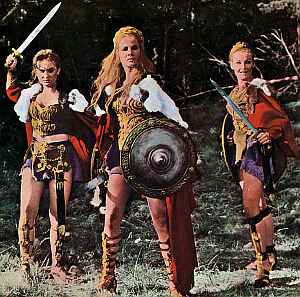 Hammer were best known for their horror movies, but tried virtually every genre save Westerns at one time or another. This Roman “epic” is loosely based on the life of Boadicea, who led a revolt against the Romans in the first century A.D. They get the name of her tribe right (the Iceni), and some basic facts, such as her suicide after capture, but change her name to Salina and sprinkle in some wild inaccuracies. Despite the title, there are no actual Vikings to be found, and we also get the Druids worshipping Zeus, a Greek god!
The low budget is painfully obvious, particularly in the battle scenes, where you can almost count the participants, and the lack of sets beyond tents. In between times, however, it’s not such a disaster, with a script that pits merchants, Druids, Britons and Romans against each other, and allows for infighting, treachery and backstabbing galore. The main thrust is the budding romance between Salina (Carita – her only screen role, one source indicating she went back to being a hair-dresser) and Roman governor Justinian (Murray), who fall into a lake before falling into each other’s arms, to the chagrin of people on both sides.
Salina eventually has to strap on the armour herself and go to war, but her lack of experience (in both acting and action) is painfully obvious. The likes of Hammer regular Keir, as Justinian’s treacherous second-in-command, perform with commendable endeavour; it isn’t really enough to save this half-baked effort from failing on most levels.
Dir: Don Chaffey
Star: Carita, Don Murray, Andrew Keir, Donald Houston
 After thirty minutes, I was toying with the idea of giving this the first ever 0 star rating. On that basis, eventually creeping up to two counts as something of a miraculous recovery. The heroine is an alien, transporting her child across the English countryside, while being pursued by white-masked hunters. There is almost no dialogue, which is so obviously a penny-pinching device it hurts – the video stock and woeful “martial arts” don’t help.
 Women-in-prison is not a genre greatly within our remit, since they’re often just an excuse for a bit of soft-core masochism. There are occasional exceptions, however, and this is one, with its origins as a network TV show forcing restraint of the more exploitative aspects, as well as permitting the characters to develop more fully than in a movie.
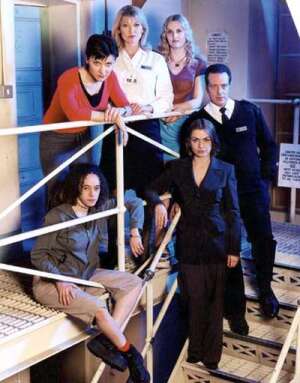 Somewhere around the middle of the series, I realised that this is soap-opera, pure and simple. As someone who’d never be seen dead watching a soap, this was disturbing. Fortunately, moments later, Jim Fenner did something else truly rotten to the core, and my attention went back to H.M. Prison Larkhall. Such is the joy of the show: it defies categorization.