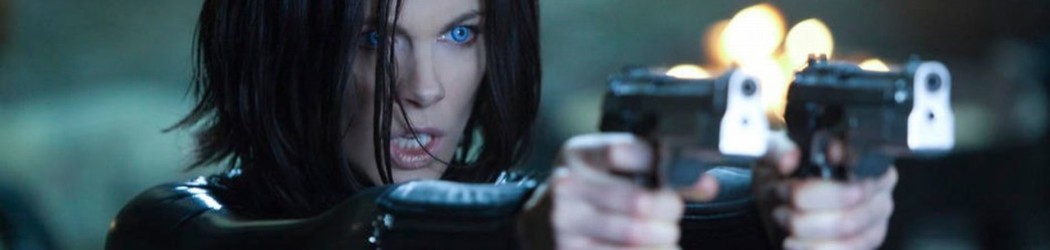

9-Ball

★½
“A load of balls.”

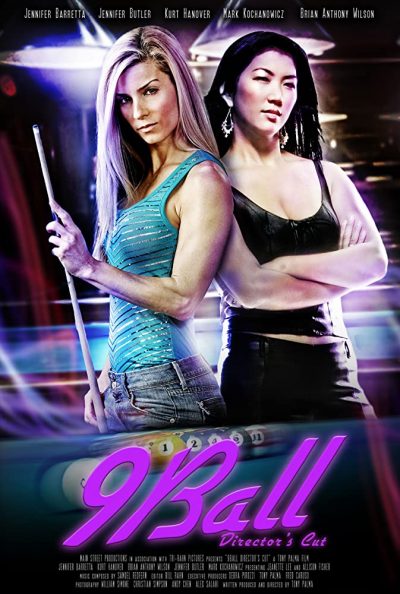
Oh, dear. There’s part of me which thinks this is what you get when you try and make actors out of pool players. For the star here, Barretta, is one of the top women cue artists in the world. She’s joined here by cameos from a couple of bigger pool stars i.e. people even I’ve heard of, in Jeanette ‘The Black Widow’ Lee and Allison Fisher, and you can’t really expect much out of any professional sportswomen, in terms of acting ability. However, she isn’t that bad, though this may just be relative to some of her fellow cast members. And, to be fair to the actors here, you could be an Oscar-winner, and still not be able to do anything with the wretched script, which is little more than a parade of cliches, when not being a shameless advert for the American Poolplayers Association and its leagues.
Gail (Barretta) is the daughter of a pool player, who saw Dad stabbed to death in the street in front of her house. Taken in by creepy Uncle Joey (Hanover), Gail has clearly inherited some of her father’s skills, and Joey makes her turn them to his benefit, hustling suckers for money in bars. But, of course, Gail has dreams of her own, meeting Nice Guy™ Mark (Kochanowicz), and wants to leave Joey to head out on her own as a professional player. Hence the largely pointless cameos by Lee and Fisher, advising Gail how to achieve her goal. Joey isn’t happy at the prospect of using his cash cow, and beats up Gail, who absconds with his “retirement fund”. Though initially sent to jail, he gets bailed out, and the time spent inside hasn’t exactly improved his temper.

I was really hoping for considerably more, and better filmed, pool. It’s  closer to being a Lifetime TVM with occasional interludes of the sport. And on the (sporadic) occasions we see Gail in action, we mostly see her striking the cue ball, or the target ball going into the pocket – hardly ever both in the same frame. What’s the point of having one of the world’s top players in your movie, if you rarely see them making their pro-quality shots?

It all builds towards an APA team tournament in Las Vegas, which at least. is a little better in this regard. Though that only shows up in the last ten minutes, leaving precious little room for any kind of tension to built. We gallop through it, to a final shot which don’t realize is the final shot, until after it has been pocketed. Even Joey’s subplot is hustled off-screen with an absolute minimum of excitement, despite him turning up at the event with a gun. There are possibilities in the idea, which I won’t deny: after all, pool is one of the few games where men and women can compete on equal terms. But they are painfully squandered by the wretched direction and script. As bar sports action heroine movies go, I guess we’ll have to wait for the Fallon Sherrock biopic.

Dir: Anthony Palma
Star: Jennifer Barretta, Kurt Hanover, Mark Kochanowicz, Jennifer Butler

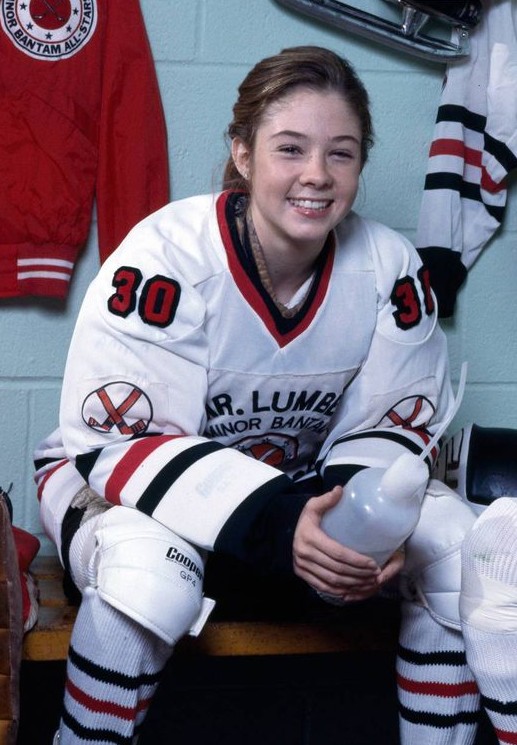
Hockey Night

★★★
“Cool as ice.”

At one point, the teenage heroine in this sports flick is asked, “What do you want to play hockey for?” In a modern film, I suspect you might get a long speech about female empowerment, proving that girls can do anything boys can, and so on. But here, her response is three words: “I like it.” It’s a plain and simple response which illustrates the approach taken by this plain and simple TV movie. That plain simplicity is both its biggest strength and its greatest weakness, for there are certainly no boundaries being broken or preconceptions challenged here. It’s exactly what you would expect from the genre and the story.

The Yarrow family have moved from the big city to the small, rural Canadian town of Parry Sound, described by local girl Evelyn as “the armpit of North America.” When daughter Cathy (Follows) asks Evelyn, “What do you do for fun?”, the reply is, “They haven’t invented it yet.” But they do have hockey…  And Cathy had been the goal-tender for the local girls’ team back in Toronto. Since there’s no equivalent in the small town, she tries out for, and wins, a spot on the local boys’ team, under coach Willy Leipert (Moranis). But this co-ed approach meets with opposition, in particular from the team’s sponsor, who threatens to pull his support if Cathy is allowed to play.

Yeah, from the above you can probably pencil out, with about 95 percent accuracy, how things will unfold, leading up to the finale of the big game between Parry Sound and local rivals, North Bay. Will Cathy fall for the team’s star player, Spear Kozak (Bisson)? Will there be moderate, but non-threatening, family strife as her mother fails to understand? Will curmudgeonly and chauvinist commentator, Bum Johnston (Chaykin) be won over to support her? Will there be montages along the way? I offer no prizes for anyone correctly guessing the answers to all of the above questions.

Yet there’s a simple and honest warmth here that works. Parry Sound is the birthplace of Bobby Orr, who is to hockey what Pele is to football, and the affection for the game is clear. There isn’t much conflict, to be sure – nobody ever tells Cathy directly that she poses a problem. Yet this feels in keeping with the polite and non-confrontational nature of the society depicted here (it would be a sweeping generalization to claim it of Canada as a whole. And yet, not necessarily inaccurate). Sure, her team-mates are sometimes jerks: they are, however, teenage boys, so it goes with the territory, especially with regard to teenage girls.

The two young leads are both very likeable, and it’s easy to see why they went on to greater things. Follows, in particular delivers a quiet, understated performance which is likely far more effective than a brazenly defiant one. Moranis and Chaykin provide good support, and deliver the kind of colourful  characters found in any small town. The plot may be hackneyed and obvious, yet as forty-year-old TV movies go, this is likely better than you would expect.

Dir: Paul Shapiro
Star: Megan Follows, Yannick Bisson, Rick Moranis, Maury Chaykin

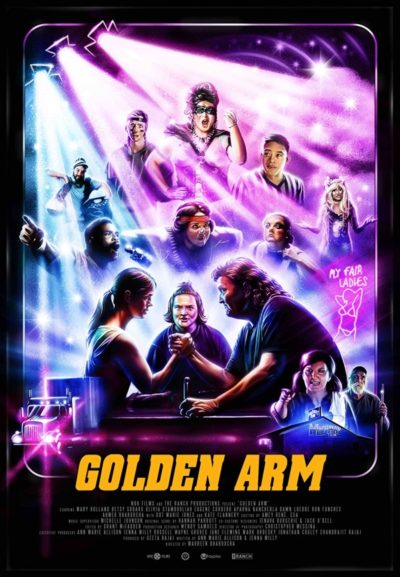
Golden Arm

★★★½
“Arms and the (wo)man.”

The sport of arm-wrestling has been featured in the movies before, most notably the Sylvester Stallone vehicle, Over the Top. But that wasn’t a comedy – at least, not intentionally. This entry, as well as switching to the distaff side, also has its tongue in cheek, while still sporting a strong message about female empowerment, that never becomes a lecture. If you’re looking for an inspiration I’d saw the first season of TV series GLOW is very much a touchstone. As there, we have a woman who becomes involved in a sport at a difficult time in her life, only to find herself… well, finding herself as a result of her new endeavour.
The heroine is Melanie (Holland), a mild-mannered cafe-owner whose enterprise is almost out of business. Her pal, truck driver Danny (Sodaro, sporting one of the worst haircuts in cinema history), takes part in women’s arm-wrestling, but just had her wrist broken by the infamous Brenda the Bone Crusher (Stambouliah).  Seeking revenge, she eventually convinces Melanie, who has a natural talent – the “golden arm” – to enter the national championships in Oklahoma City. The goal is to win the crown, and fifteen thousand dollars that go with it, to save Melanie’s business and take down Danny’s nemesis. But the path towards that title will go through not only Brenda, but over a number of other hurdles for the rookie athlete, both physical and mental.

There’s very little new here in terms of plotting. Everything unfolds exactly as you’d expect, right down to the final which pits – surprise, surprise! – Melanie against Brenda in a best-of-three battle. Still, the joy here is in the characters and performances. There appears to be, if this film is to be believed, a significant overlap between arm-wrestling and pro wrestling, with the participants here adopting personas and cutting promos to intimidate their opponent. Melanie, for example, begins as a masked wrestler called “Freaked Out”, after the ring announcer mistakes a comment as her name. But she eventually becomes The Breadwinner, complete with a dusting of flour on her cheek.

However, the greatest pleasure is the Melanie-Danny relationship, which builds over the course of the film. They’re total opposites – “Please don’t say ‘twat'”, begs Melanie repeatedly – but there’s still such chemistry, you can see how they’d be fast friends. It’s so good, in fact, that the romantic angle between Melanie and referee Greg (Cordero) seems entirely superfluous. It actually drags down the rest of the movie, and provides nothing of substance except for an explicit reference to The Natural. That’s another apparent inspiration, in its story of a sports star rising above injury at the moment they need to most.

This is thoroughly foul-mouthed, albeit for comic purposes, and I will say, it doesn’t all quite work. For example, there’s an extended discussion over the female equivalent of “going balls out,” that’s frankly a bit cringe. However, the sheer heart on view throughout is undeniable: that powers this through the flaws, and will likely leave you with a big, goofy grin on your face.

Dir: Maureen Bharooch
Star: Mary Holland, Betsy Sodaro, Olivia Stambouliah, Eugene Cordero

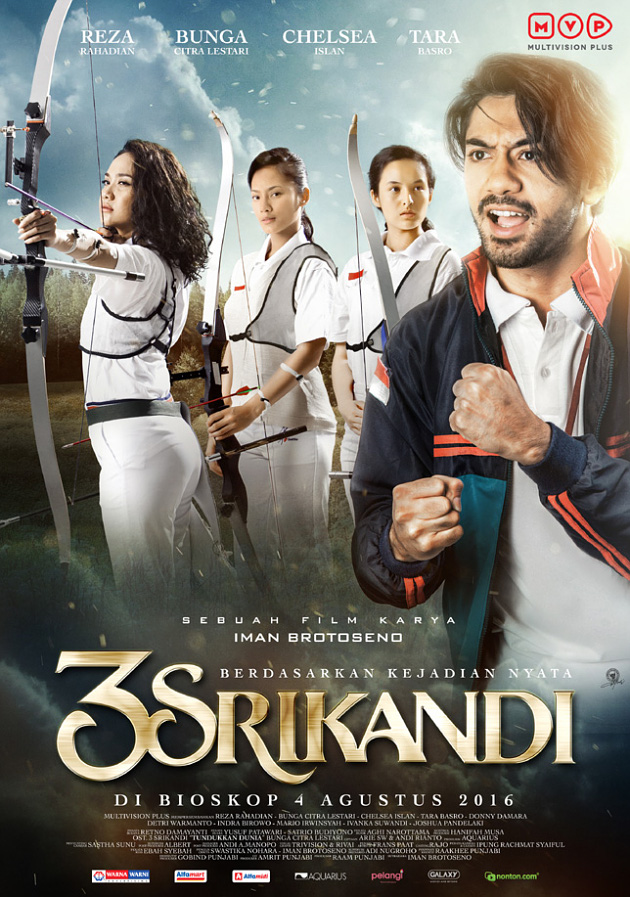
3 Heroines

★★½
“Largely misses the target”

As the Olympics get under way in Tokyo (COVID permitting – this is a pre-scheduled post!), it seems an appropriate point to review this, which tells the story of the 1988 Indonesian women’s archery team. They became the first ever from their country to win a non-exhibition medal at the Olympics. This was quite a big deal, considering at the time, the population of the country was 175 million, and they had been competing in the games for 36 years without any success. However, the resulting movie manages to be more like a soap-opera with arrows than the thrilling sports movie it should be, considering they clinched their medal with a sudden-death shoot-out against the might of Team USA.

They do get that aspect right, but I’m less certain about the veracity of some other elements. For example, much is made of coach Donald Pandiangan (Rahadian), “the Indonesian Robin Hood,” seeking redemption for having missed the 1980 Olympics due to a boycott. Omitted is the awkward fact he did get to take part in the 1984 Olympics… and came 43rd. Anyway, he has the task of licking into shape the trio of potential candidates: Lilies Handayani (Islan), Nurfitriyana Saiman (Lestari) and Kusuma Wardhani (Basro). The archers have their own range of issues to deal with as well, such as an unsupportive family, who just want them to settle down, marry (their choice, naturally), and get a good job. It’s basically a class in Sports Movie Cliches 1.0.1, with the stern, disciplinarian coach butting heads with his young charges, who just want to sneak out. [I was amused to see the local cinema playing Arnie classic, Commando!]

It does have a certain naive charm, and is so sincere about itself that you can’t complain too much. I think the pseudo-musical number into which the three heroines break, complete with singing at their hairbrushes, demonstrate the good natured and non-threatening approach here. But it’s more than two hours long, and the ratio of drama to sport is far too heavily tilted towards the former. Even when we get to Korea, it doesn’t help that in those days, Olympic archery wasn’t the dramatic, head-to-head knockout contest it later became. That would have been way more exciting to watch, than all teams shooting simultaneously, as depicted here.

The director does his best, and the shoot-off is likely the film’s most effective sequence. Though if I was American, I might be offended by its portrayal of one of their athletes shoving an Indonesian rival to the ground during the competition. I am fairly sure this did not happen, instead being fabricated for dramatic effect. But since I’m British, I don’t care. Our gals finished a plucky fifth. Mind you, I can imagine the South Korean women’s team who actually won the event – as they have every single Olympics where it has taken place – are probably wondering, “Where’s our movie?” I guess it goes to show, being a plucky underdog is just more cinematic. Sorry, Korea.

Dir: Iman Brotoseno
Star: Bunga Citra Lestari, Chelsea Islan, Tara Basro, Reza Rahadian
a.k.a. 3 Srikandi

Range Runners

★★
“The loneliness of the long-distance runner”

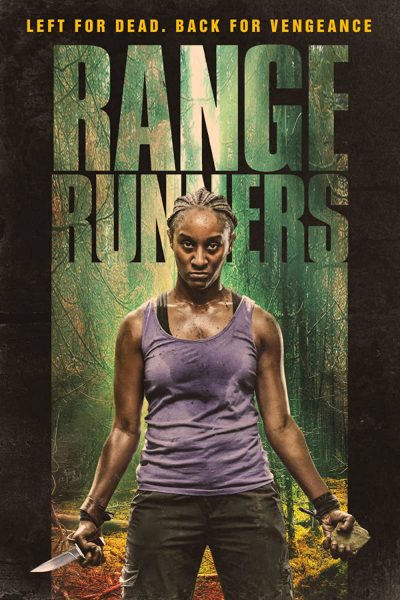
Mel (Cooper) is engaged on a project of running the Appalachian Trail (or a convincing facsimile thereof), with some help from her sister, who meets her at various points to provide support and fresh supplies. Mel is currently on her own, starting an eight-day section of the hike where she’ll be out of contact. However, she bumps into a couple of suspicious characters, deep in the woods: Wayland (Leonard) and his partner, Jared (Woods). Initially, it seems like a creepy, but one-off random meeting. It turns out to be considerably more and subsequent encounters escalate, until Mel is sent plummeting over the edge of a drop-off, badly injuring her leg, but in possession of something very important to Wayland and Jared. Will she be able to escape her pursuers and make it to safety?
A good chunk of this effectively takes place inside the heroine’s head, as she pushes through the forest. There are flashbacks, in particular, to her youth when she was an athlete in training, being coached by her father. His approach was very much one of tough love, with the emphasis on “tough”, and a fondness for aphorisms, such as “[Your body] doesn’t tell you what to do, it’s the other way around.” It seems to have done the trick, giving Mel the mental toughness necessary to cope with the situation. However, it doesn’t exactly make for thrilling cinema, and considering the film runs 112 minutes, a little of this kind of thing goes a long way.

This is nicely photographed, it must be said, and the wooded location is used effectively, setting up a world in which a threat conceivably lurks behind every trunk and branch. The issues are much more with the plot, which fails on a number of levels. Not least, is the lack of motivation given to the villains, whose presence and actions are never well-defined, beyond being required in order for the plot to reach its (entirely predictable) conclusion. There are few if any surprises along the way. Even when the film tries to make you believe Mel has found sanctuary, anyone who has seen any wilderness survival films, will basically be waiting for that not to be the case.

By the time you filter out what’s unnecessary, and what doesn’t work, there’s probably not much more than 45 minutes of decent content to be found here. Rather than it being Mel vs. Wayland + Jared, it’s more a case of Mel vs. herself, or at least her own doubts and emotional baggage. The finale is decent, pitting our wounded athlete against the pair, and proves rather more satisfactory than most of what has been seen to this point. It’s an example of a film where the destination proves better than the journey to get there. Depending on your view, this may or may not be a suitable parallel to hiking the Appalachian Trail…

Dir: Philip S. Plowden
Star: Celeste M Cooper, Sean Patrick Leonard, Michael B. Woods, Sarah Charipar

Gripped: Climbing the Killer Pillar

★★★
“Climb every mountain…”

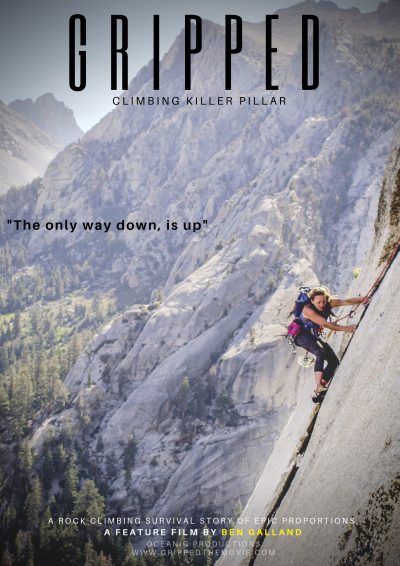
Newbie climber Rose (Maddox) is on her first trip to do some “real” climbing, rather than on a rock wall at her local gym. There, she meets and falls for the insanely rugged good-looking Bret (Lyman, who appears to have strayed right off the cover of a romance novel entitled “Love in the Surf”). After a couple of successfully, but relatively simple climbs, the pair head to take on something more challenging: the infamous “Killer pillar” of the title. Half-way up, a hand-hold used by Bret breaks, sending him tumbling down the cliff-face. Though the rope stops the fall from being fatal, he suffers a torn shoulder and head injury, leaving him unable to lead, and unable to descend. As the poster tagline says, “The only way down is up.” So, it falls on Rose, despite her lack of experience, to take over and forge a route up the near-sheer escarpment, that Bret will be able to navigate in her wake.

The mountaineering stuff here is excellent, and it seems that everyone involved was doing their own climbing. While for much of the time, I suspect they probably weren’t too far off the ground, there are a few shots that should come with a trigger warning for vertigo sufferers. Particular kudos to cinematographer John Garrett, who captures the stunning landscapes of the Sierra Nevada mountains in California – and, I suspect, did his share of climbing to get some of the angles. It just feels like legitimate climbing, in contrast to the Hollywood stuff seen in movies such as Cliffhanger. I note the presence in the supporting cast of notable real climbers, such as Jacki Florine, who in 2006 became the first woman to climb fourteen 14,000-foot peaks in California in 10 days. Another mountaineer, Natalie Duran, whom we recognized from her appearances on American Ninja Warrior, also has a supporting role as a jealous fellow climber.

The main problem is that the dramatic aspects don’t kick in until after the 50-minute mark, and it borders on the tedious to that point. Lovely scenery can only take you so far, when the romantic relationship at the movie’s heart is thoroughly unconvincing. We don’t need to see the banal process of them getting together, or the development of their interactions. This could, and probably should, have saved time by being an existing couple; Rose could still have been a novice climber, making her debut in the big outdoors. That would even have added a personal motivation to her heroics, rather than it being to save some hunk she met two days ago. Whatevs. They made the movie they wanted too, and it’s not on me to list ways to potential improve it! I’d say you can pay attention here when they clip on their gear, and safely ignore just about everything else.

Dir: Benjamin Galland
Star: Amanda Maddox, Kaiwi Lyman, Megan Hensley, Bryce Wissel

Ride Like a Girl

★★½
“Trots, when it should gallop”

This opens and closes with footage and photographs of the real Michelle Payne, who is the subject of the film. Part of me wonders if that documentary approach might have proved a more successful one, rather than the parade of sports drama cliches we get here. Admittedly, quite a lot of them are based in fact. Payne was the first woman to ride to victory in the Melbourne Cup – that’s Australia’s premier horse-race, roughly equivalent in prestige to the Kentucky Derby or Grand National in the US or UK respectively. This alone, is quite an achievement. But she did so as one of ten brothers and sisters, who largely had to bring themselves up after their mother died when Michelle was only six months old. Her father was a horse trainer, and no fewer than eight of his offspring became jockeys, including Michelle of course.
In this version, Palmer plays the heroine, with Neill the ever-tolerant father attempting to steer her career. It’s not easy, with Michelle having to deal with a racing establishment that still doubts women can be as good jockeys as men, before eventually convincing owner Darren Weir (Stapleton) to give her a chance. She also has to come back from an fall that left her with a fractured skull and bruised brain. Then, she almost lost the opportunity to ride her horse, Prince of Penzance, in the big race after being suspended for racing tactics perceived as dangerous, fairly or not. In other words: basically checking off all the obvious impediments, and the film adds little or nothing of note to them, though some of the racing footage is effective enough. [The film, probably wisely, glosses over post-Cup events. Prince of Penzance went lame and had to retire; Weir was charged with cruelty to animals; and Payne got another suspension for amphetamine abuse. Oops]

It works better when it’s remaining grounded, in a way only Australians can be. Neill does a good job of that as the long-suffering father, and it’s a shame he all but vanishes from the second half of proceedings. It does offer amusing moments like watching a posse of nuns (or whatever the collective term is for them!), marching into a bookmakers on Melbourne Cup Day to bet on Payne and her pony. Much credit is also due to the film-makers for letting Payne’s real-life brother, Stevie, who has Down’s Syndrome, play himself in the movie. But it does suffer from what is likely an inevitable problem given the source material: we know how it’s going to end, and how it’s going to get there as well. Given this, taking a few more risks with the approach or the portrayals of the characters might have been warranted. Instead, Griffiths seems intent on taking the safest route she can find between plot-points which are largely obvious. The results are, as you’d expect, little more than feel-good fodder.

Dir: Rachel Griffiths
Star: Teresa Palmer, Sam Neill, Sullivan Stapleton, Stevie Payne

Strider

★★★½
“The loneliness of the long-distance runner.”

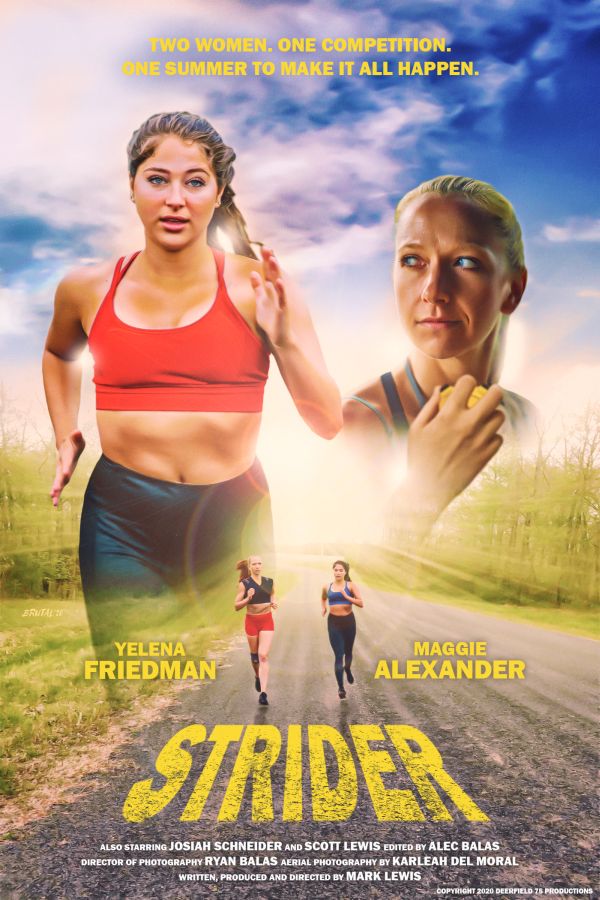
This is certainly a borderline entry for the site, in terms of “action”. There’s running. Lots of running, through the very scenic, beautifully photographed New England countryside. And that’s about it. if you’re expecting fisticuffs, gun-play or mayhem… look elsewhere. That, I must stress, doesn’t make this a bad film. Admittedly, it falls close to Generic Sports Movie 1.0.1. Teenager Jody Sue Brightwell (Friedman) is spotted by a “between jobs” track coach, Hannah Dalton (Alexander). as Jody Sue runs on the road, largely to escape the problems of her everyday life – such as an absent mother and her two, hell-spawned younger brothers. Hannah sees raw talent and agrees to take her on, with the goal of getting her ready for the Pinnacle Games, where a good performance could open the doorway to a professional career.

Of course, between here and there, various problems get in the way.  The doubts of her father (Lewis), who knows Jody Sue’s past history of giving up. The approach of Hannah to training, which gives no quarter to anyone’s feelings. Jody Sue’s new boyfriend, Tim (Schneider), who wants to support her, yet ends up being a potentially fatal distraction to her chances. Really, there are only two ways this can go at the end. Jody Sue can triumph in the Big Race, or not, and both are almost inescapably cliched. Either way, along the road (literally, in this case), relationships will be tested, lessons learned, and limits tested. If you’re looking for anything groundbreaking in the story… again, look elsewhere.

But this is absolutely one of those cases where the journey is more important than the destination. Crucially, the characters here all feel incredibly genuine. Thanks to both a solid script and performances that are all good or better, they speak and behave in ways which make them feel real. They’re all – well, with the exception of the Hell-spawn – nice folk, trying to do the best they can. There are no villains here, and while that does limit the scope for dramatic conflict, it makes for an engaging experience. These are people with whom it’s a pleasure to spend time, and that’s perhaps rarer than you’d think in cinema. Despite occasionally awkward gaps in the narrative – why, exactly, is Hannah apparently unemployable? – you should find yourself caring about them as events unfold.

Helping matters, the technical aspects are excellent. The film looks incredibly crisp, as mentioned above, with some great aerial photography work, and the soundtrack does a very good job of enhancing the overall experience. Finally, I actually watched the second half of this while getting in my daily miles on the elliptical in the living-room. It seemed appropriate to be running, while watching a film about running, right? But for whatever reason, I ended up cracking through more calories than I had for several months. I guess this can truly be considered an inspirational movie…

Dir: Mark Lewis
Star: Yelena Friedman, Maggie Alexander, Scott Lewis, Josiah Schneider
[The film is currently available on Amazon Prime]

Saand Ki Aankh

★★★
“Grannies with guns”

It’s interesting to compare this with the recently reviewed Ride Like a Girl. Both are sports movies based on real events, and neither really do much story-wise, except trot out the standard tropes for the genre about overcoming obstacles on the way to triumph. Yet this succeeds somewhat better, likely because of the unusual central concept. Two Indian grandmothers, unable even to read, take up competitive shooting in their sixties, and end up becoming national heroines as a result. Tell me you’re not intrigued by that.

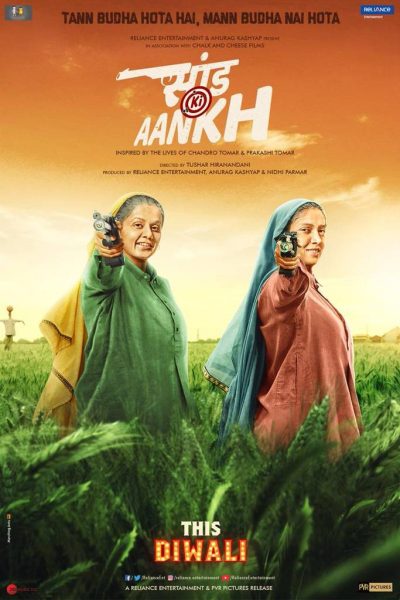
Chandro and Prakashi Tomar (Pednekar and Pannu) are part of a large extended family in Uttar Pradash. In this world, women do much of the work, while the men lounge around. If the film is to be believed, smoking hookah pipes and demanding snacks are their main occupations, viewing the woman as machines for pumping out babies. But things change when a local doctor (Singh) opens a shooting range. One of their grand-daughters goes along for a lesson, and the grannies – who initially attend for moral support – discover a natural talent for the sport. However, the family’s patriarch, Rattan Singh Tomar (Jha), would never permit them to travel to competitions, so deception needs to be carried out. But as the contests get bigger, so do the lies.

While the story does span several decades, it concentrates mostly on the characters in their later years, which makes it a little odd that the producers cast a pair of thirty-something actresses for the lead roles. Presumably the idea was that it was easier to make them up to be older, rather than making sixty-five year olds look thirty. I can’t say it always works. Indeed, there are points where they look closer to the Beatdown Biddies from GLOW than genuine senior citizens. At 146 minutes, it goes on too long as well. The makers could have significantly reined in the montage sequences, and the likely inevitable musical numbers add nothing to proceedings either, at least to this Westerner’s eyes. [I will admit, I’m not the intended audience there]

Despite this, is still manages to work, and the running time isn’t as much of a problem as I feared it would be when I started. It is one heck of an eye-opener to see what life in rural India is like, especially for women, and quite puts all our #FirstWorldProblems in perspective.  There’s a calm dignity about the two heroines which is effective, and it’s easy to see how that temperament transfers to their sport, even in the face of initial heckling by unconvinced audience members and opponents. It’s also about the first GWG film I’ve seen which looks at the purely sporting aspects of firearms – one of the few fields in which men and women can compete on an equal footing. The Indian title translates as “Bull’s-eye”; while I’d not claim the film scores to that degree, it hits its targets at least as often as it misses.

Dir: Tushar Hiranandani
Star: Taapsee Pannu, Bhumi Pednekar, Prakash Jha, Vineet Kumar Singh

The Furnace

★★★
“Run Mary Run”

Two days after getting married, Mary Harris (Bernadette) is involved in a car accident which kills her new husband and leaves her barely able to walk. But she has one goal: to compete in the Furnace, an ultra-marathon race through the African wilderness, in which she and her late husband had been planning to take part. This aim goes strongly against the desires of her mother, but Mary won’t be deterred. With the help of her mentor (Dlamini, looking like a younger version of Morgan Freeman), nicknamed “Coffin” due to his day-job as a gravedigger, she claws her way back to fitness, and to the start-line. But is she prepared for everything the environment can throw at her, and make it to the finish? To do so, she’ll have to overcome not just the lethal heat, but also predators for whom she’d be a tasty snack, and poisonous scorpions whose venom induces disorienting hallucinations.

It’s certainly a change of pace for Bernadette, who has previously been seen on this site in Killing Joan and All Girls Weekend, as well as the largely woeful I Spit On Your Grave reboot, Deja Vu, not reviewed here. This is a film heavy on the F-word – by which I mean “faith”. Its religious overtones may be enough to write it off for many, but even as someone who possesses no real commitment there, it still worked well enough as a story about fighting through and triumphing over adversity. The race itself is the most effective section, with a constant stream of problems to overcome, and fortunately that does represent the majority of the film’s running-time. I must admit, I guessed the truth about her running companion, Raphaella (Linn) well before the film revealed it, and that angle is perhaps one where the faith-based elements become more than a little overwhelming.

Exhaustive research i.e. five minutes of Googling, couldn’t locate any race comparable with the Furnace, and it does seem a highly perilous endeavour, even with a GPS attached to participants. “If you’re stationary for more than seven hours, you’re disqualified, and we come pick you up,” says the organizer. Shouldn’t that be “If you’re stationary for more than seven hours, you’ve been eaten by hyenas, and we come pick up whatever is left in a bucket”? It’s certainly not my idea of a challenge to which I aspire, but there are people like Mary who seek to push their limits, so it’s not that far-fetched. Throw in decent cinematography and animal work and you’ve got something that  entertained me rather more than I perhaps expected, though Coffin’s voice-over does become a little superfluous in places. It’s not a film which an atheist is likely going to be able to appreciate, yet dammit, even I found myself getting fractionally emotional for the final scene. I’d probably be more inclined to credit Peters’s performance for that, rather than any kind of divine intervention.

Dir: Darrell Roodt
Star: Jamie Bernadette, Luthuli Dlamini, Laura Linn, Thandi Puren