This is the second in the tetralogy of novellas originally marketed as the Sheriff Bride series, from the small press Lovely Christian Romance, and each written by a different author. It follows the fortunes of the four firearms-capable Hardin sisters; the first book explains how they came to share the position of “sheriff” (actually, town marshal) in the fictional western Texas community of Waterhole in the later 1870s. From the beginning, it was predictable that each book would focus on one of the sisters’ finding her life partner; and the identity of those partners for the middle two sisters, Jo and Dan, was already adumbrated in the series opener. (The books definitely need to be read in order.)
Our story here takes place a bit over six months after the preceding one. In terms of both general literary vision and prose style, the two have a lot in common, although the editing and proofreading is much better here –there were no continuity issues, and no bracketed editorial comments surviving into the printed text. There’s little information available online about Brooksie Cox, but this seems to have been her first publication, and one of only two (Goodreads lists four, but two of those are omnibus editions that apparently each include one of the other two). With no author’s or publisher’s note(s), we don’t know the genesis of this series and its unusual multiple-author structure; but I’d hazard the guess that the idea may have come from the much more prolific author of the first book, Teresa Ives Lilly (who seems to be the publisher’s mainstay house author, and maybe the actual owner), and that Cox modeled her own prose style on that of the more experienced Lilly. Given that the latter’s is verbally repetitious and averse to using pronouns where they would make the text smoother, the reproduction of both of these features here isn’t felicitous. :-(
Second-oldest sister Jo (Josephina) is an avid animal lover, and the most tender-hearted of the sisters. (Though she’s a good shot, her hunting was often hampered, to her father’s great displeasure, by her reluctance to pull the trigger on an animal.) Waterhole’s storekeeper, Tom, is similarly soft-hearted (the first book let us know that he prefers to catch a fly by hand and release it outside rather than swat it!), and it wasn’t surprising that he and Jo were attracted to each other. By the time of this second installment, she’s running an impromptu amateur animal hospital from the back room of the store. Here, there are two intertwining plot strands: one involving Tom’s younger (and much more spoiled and self-centered) brother Henry, who’s been a trapper in Canada for years, but shows up early on with a young Indian woman, Morning Glory, in tow as his personal slave, and the other involving a pair of not-very-bright would-be train robbers.
My rating for the first book was two and ½ stars. Several aspects of this second one, though, don’t work as well for me in terms of realism, and I wasn’t able to give it more than two stars. First, while (for at least some Native American peoples) tribal law may have allowed the fathers of young women to sell or gamble them away as slaves, by the late 1870s U.S. law didn’t countenance that. So the community’s project of buying Morning Glory’s freedom was unnecessary. Given the long warfare between Texans and the Comanches, and the ill-feeling of many whites in that era towards Indians, as well as Texas’ secession in the previous decade with defense of slavery as one of its officially-avowed reasons, the community’s unanimous sympathy with Morning Glory also seems a bit of a stretch. Though it’s true that slavery was much less entrenched in arid west Texas than in the east Texas cotton country; and Jo’s mother was apparently Northern-born, since her two brothers died fighting for the Union.
Second, it’s a standard romance-genre trope that at least one party to the romance has hang-ups to overcome, but Tom’s here seem sort of contrived. Yes, his previous fiancee broke their engagement because she didn’t want to live in a place like Waterhole; but it’s patently obvious that Jo doesn’t have that problem, and by now the community is becoming more female-friendly than it was then. His fear for her safety in a potentially violent job is more credible (if she has a problem shooting a deer, might she not also have a fatal hesitancy in shooting a human, even with her life on the line?), but the denouement here doesn’t actually discredit that fear. That brings me to some issues with the denouement.
In the first book, I had no trouble believing that a sober woman with quick reflexes, who’s trained and experienced with a pistol, could outdraw a partly-drunk male, even if he and a bunch of cowed townsfolk thought he was pretty hot stuff with his gun. It was said in the Old West that, “God created men and women, but Col. Colt made them equal.” But here, I did have trouble believing that a woman could tackle and physically overpower a presumably bigger and stronger armed male; and not much respect for her intelligence in trying it, when she could easily have covered him with her own gun from behind and demanded his surrender. Her two armed sisters didn’t display much smarts there, either.
If I were Tom, that incident would have exacerbated my concern for her, not laid it to rest. The outcome of the tale here also depends on believing (which I’m not certain that I do) that it can automatically be assumed that every cave in west Texas is inhabited by a swarm of bats which will emerge at sunset; and we’re also asked to believe that Jo’s love for animals makes her the only Hardin sister who would know this, when all of them are wilderness-wise. I also had a problem with our heroines letting an arrested petty thief just walk out of jail, even on the condition that he leave the area, in exchange for a tip leading to the arrest of bigger prey. Finally, although I give Cox credit for treating inter-racial romance positively, the secondary romance here came across to me as implausible and unconvincing.
All of this said, I did finish the book (my wife and I read it together – and she liked it much better than I did, her taste in Westerns not being nearly as critical), and it held my interest. Cox’s characterizations aren’t deep, but most of the characters are likable. Like the author, the main characters are evangelical Christians, and there’s a positive portrayal of the role of faith in their lives. We also see the effects of Christian conversion in a couple of cases, though we’re not privy to the scenes/conversations where those conversions take place (so there’s no lengthy evangelistic exposition). The series can appeal to fans of Westerns, Western romance and “Christian fiction” who don’t expect much depth and just want some harmless, time-passing entertainment.
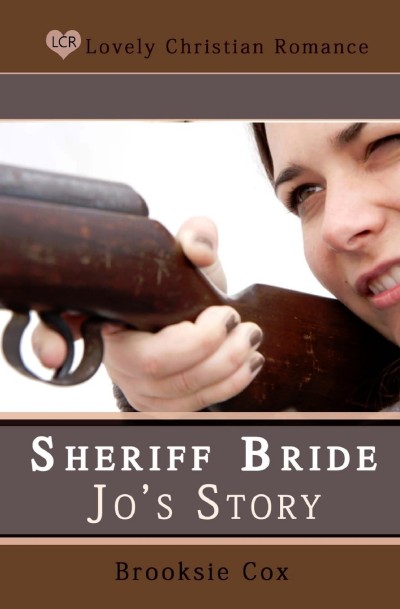
A brief word about the cover art is in order. It’s a nice bit of action-heroine iconography, and does depict an actual scene from the book (a rifle-shooting contest). But while the young lady here has lovely brown eyes, we’re told in the books that Jo and all of her sisters are green-eyed; and the kind of colored nail polish this markswoman is wearing didn’t come into vogue until the 1920s. So, no awards for accuracy here!
Author: Brooksie Cox
Publisher: Lovely Christian Romance Press, available from Amazon, both as an audio book and a printed book.
A version of this review previously appeared on Goodreads.
This short (107 pages) novel is the series opener for the Sheriff Bride series. (The latter has more recently been marketed as the Brides of Waterhole, Texas series, which includes additional books; but my interest is just in the original tetralogy.) Each of the four books (all written by different authors) focus on a different one of the four Hardin sisters, whose unique situation is delineated in the first book, set in the later 1870s. (No date is actually given, but there’s a passing reference to a wanted poster for the notorious outlaw Sam Bass, who was criminally active in 1876-78.) Raised in eastern Texas, the sisters were reared in the Christian faith by their devout mother, who’s been dead for years. But their father was a physically abusive drunk, who resented the fact that they were born female. However, he was a tough customer well versed with firearms, and in his sober moments taught them gun skills, hunting and tracking techniques (he lived off the furs from their hunting, though he drank and gambled away most of the proceeds) and wilderness survival. By the time our story opens, his reputation for prowess at shooting has spread to western Texas.
The book opens with the text of a short letter from one Mark Carlin, banker and leading citizen of Waterhole (population 35 in the town proper, all male), accepting John Hardin’s application for their advertised position of first-ever town sheriff. (That’s actually an authorial error, since in most U.S. states sheriffs are elected to serve entire counties; a peace officer hired to serve just one community would be a town marshal, as opposed to a Federal one.) Having celebrated his good fortune with a drinking binge, however, the inebriated Hardin died in a fall from his horse on the way home. But Carlin had sent him a generous amount of cash for traveling expenses. At the suggestion of eldest sister Sam (Samantha), not having any money or other employment prospects, Jo, Dan and Rob, a.k.a. Josephina, Daniella, and Roberta, agree to join her in traveling across Texas to present themselves as willing to share the position. As readers will be well aware, the wild West of that day wasn’t a hotbed of equal employment opportunity ideals, so the prospects for the success of the ladies’ quest in the face of ingrained male sexism are daunting.
While this is an excellent and very original premise for a novella series, though, the execution of it here has to be called somewhat lackluster. Lilly’s prose style tends to be repetitive, both in language (and in using character’s names over again where a pronoun would serve her better) and in ideas, with points often being restated or reemphasized in the same paragraph when it’s not needed; she also has a tendency to tell when there would be more effective ways of showing. Some attempt was made at editing, but the proofreading was poor (there are only a few typos as such, but I finally deduced that the three or four bracketed repetitions of a sentence in different words were vestiges of textual corrections that weren’t edited out in the final draft!).
There are continuity issues that better editing would have corrected; for instance, in one chapter characters continue talking while waiting after knocking at a door, only to arrive at the door and knock after finishing the conversation; and while the sisters arrived in Waterhole by stagecoach, in a late chapter their arrival was said to be by train. (The town has no train station.) These tended to take me out of the story. In one scene, a doctor extracts a bullet from a gunshot wound in a man’s hand; but the average revolver in that setting fired a .44 bullet, which at the short distance involved there would never have been stopped by the relatively flimsy carpal bones of a human hand. ((On reflection, though, given the position of the combatants, this is actually plausible, given that the bullet had to first pass through the target’s clenched fingers and then through the handle of the gun he was holding. But in my opinion, that still should have been explained.)
On the positive side, the story held my interest, and my wife’s (we’re reading the series together –and yes, we do plan to follow it.) The theme of women proving themselves in a demanding and male-dominated profession that requires some combat skill comes through despite the mediocre execution, and appeals to readers (like myself) who admire action-oriented heroines and appreciate an equalitarian feminist message. (In the latter respect, the ending is also particularly good.) Given that the small-press publisher here is Lovely Christian Romance, it won’t be a surprise that Lilly (and the other series writers) is an evangelical author and that Christian faith plays a role in the tale. (One character is a preacher; Christian ethics underlies the discussions about lethal force, and there’s a serious appreciation of the redemptive power of the gospel.) It also won’t be a surprise that one aspect of the story (which doesn’t swallow up the other aspects!) is a clean romance, but for me that was a plus. (Given that the main storyline takes up a bit over two weeks, it could be faulted as a case of insta-love, but I felt it was plausible under these circumstances and in this era.)
A final point that could be made is that while we’re told that Rob, the youngest sister, is only 14, we aren’t told the older ones’ exact ages, and I’d like to have been. (Their mother was married for 25 years, and died when Rob was fairly young; but we’re not told exactly how young, nor how long it was into the marriage before she bore Sam. Sam could be anywhere from her mid-30s to her very late 20s; I picture her as about 29, and the other two ladies in their mid-to-late 20s.)
Author: Teresa Ives Lilly Publisher: Lovely Christian Romance Press, available from Amazon, both for Kindle and as a printed book. A version of this review previously appeared on Goodreads.
Turns out that Marvel and DC are not the only ones creating “cinematic universes” based on comic book. Another example can be found, perhaps surprisingly, in Indonesia. This film is part of the Bumilangit Cinematic Universe, and is a follow-up to 2019’s Gundala. I haven’t seen that, but I’m 99% sure that the scene in the end-credits is a direct cross-over to that, featuring its hero, given the apparent prediction late on of a team up to come between him and Sri Asih. Otherwise, though, this stands on its own, and you don’t need to have seen Gundala, or be familiar with the comic-book series about Sri Asih, created by R.A. Kosasih, and first published all the way back in 1954.
This is the third incarnation of the character, which was also first seen on the screen in 1954, in a now lost Indonesian movie of the same title. In this version, we begin with the birth of Alana during a volcanic eruption, in which her father is killed. Brought up by her mother, Alana is highly talented in martial arts, but has problems controlling her temper. After she fails to throw a fight as arranged against rich playboy and serial abuser Mateo Adinegara, he sends his men to beat up Alana’s mother, and the situation then escalates. Someone kills Mateo and his father, industrialist Prayogo Adinegara (Saputra) vows revenge. The result ends up triggering Alana’s transformation into her final form, the reincarnation of fire goddess Sri Asih.
Which is convenient, because someone is trying to carry out a ritual to obtain ultimate power, a process which require the sacrifice of a thousand souls. With the help of cop Jatmiko (Rahadian), who teeters between honesty and corruption, and childhood friend Tangguh (Nichol), now a journalist, Sri Asih has to figure out what’s going on, and stop the ritual. It’s all earnestly naive in an adorable kind of way. There’s a touching faith in journalistic integrity, and also lines like, “If you are unable to learn how to defeat your anger, it’s only a matter of time before it defeats you.” Occasionally this does topple over into clunkiness, such as when someone late on literally says, “I just remembered <key plot point about the thousand soul sacrifice>” Really?
However, if you can buy into the tone and go along with it, you’ll have a good amount of fun. It certainly does not feel like 134 minutes, which is more than can be said for some Marvel or DC product, though this is somewhat less highly polished. I do wish the fight scenes had been less CGI heavy: the impact is considerably more when Sri Asih and her opponents are knocking chunks out of concrete pillars than when she’s flying unconvincingly through the air. The best thing about Indonesian martial arts is the hard-hitting aspect, and that only intermittently comes through. It does have a cheerful “can do” attitude that’s endearing, and I’d not mind checking out further installments.
This e-story (at 73 pages, it’s at the longish end of the “short” story continuum) by my Goodreads friend, new independent author Theodore B. Ayn, is one of several recently-published works to his credit, and so far the only one of them that I’ve read. (I’m hoping eventually to read the rest.) While I didn’t officially receive it as a review copy, I treated it as one (the author kindly extended a general offer of a free e-copy long enough to allow me to take advantage of it when I’d otherwise have missed out). When I started it, I’d intended to read only a short bit, and to return to it later; but I wound up finishing it in a single sitting. As that indicates, it was (at least for me) a page-turner, and a propulsively quick read.
Ayn has an obvious admiration and respect for women who are both strong and muscular physically and who have a matching moral and emotional strength (an attitude that I share); and based on the cover art and descriptions, this is exhibited in all of his works, not just this one. (Arguably, the description of this one provides information that would be better picked up by the readers as the narrative goes along, though it isn’t a “spoiler” as such.) Basically, this particular story, set in a small Midwestern town that’s never identified in any more detail than that, pits brawny waitress Jeannie against even brawnier ex-biker gang member Clyde (no last names given for either) in a physical confrontation brought on by his sexism, arrogance, and hot temper. That description, however, is deceptively simple. This is a character-driven story which isn’t simple at an emotional level, and also isn’t predictable. (It should also be stated at the outset that it’s not an “enemies to lovers” romance; there’s no romantic element in the tale at all, let alone between the two adversaries.) Both main characters are complex, and developed in surprising depth.
The prose style here is straightforward and direct. Overall, Ayn prefers straight narration over dialogue, though he provides realistic dialogue where it’s needed to reveal character and move the plot. Technically, it could be claimed that, especially in developing his two lead characters’ back stories, he uses a fair amount of telling rather than showing. But within the constraints of the short format and of the centralizing of the fight itself as the outward core of the story (though inward developments are taking place at the same time), there’s no real alternative to that technique, and it’s actually well-suited to the kind of effect the author successfully creates. This is descriptive fiction, with no speculative element. I’ve characterized it as general fiction, rather than as crime fiction or action-adventure, because the characters are ordinary civilians, neither career criminals nor law enforcement professionals; no guns are involved, the setting is mundane, and the situation is one that could easily occur in everyday life. We’re in a very different atmosphere and milieu than that of, say, a typical Modesty Blaise adventure.
A word is in order about the art work here. While this isn’t a graphic novel as such, it’s greatly enhanced by, altogether, no less than 30 illustrations (some full-page) of particular scenes, in the same style as the cover art. These serve the same purpose that traditional book illustration always has, that of enabling the reader to more vividly visualize the characters and events of the story (and serve it very effectively!), but as the author confirmed to me in a personal message, they’re AI-generated. Personally, I would argue that such a use of AI to supplement the author’s creative vision is legitimate; it brings to life scenes he wants to depict in the way he wants them depicted, but with a draftsmanship he wouldn’t actually be able to create by hand. (Though the ability to use AI to create it also requires an expertise of its own.)
Unless a reader is scandalized by the sight of bare female arms or legs, there’s nothing salacious about the art here, and nothing suggestive or sexual about the story’s content. Bad language is limited to a couple of d-words. While this isn’t “Christian fiction,” it is fiction written by an author who’s a Christian; but it’s not “preachy” in any sense. (The lead characters are secular, and their spiritual state is only referenced in a single sentence.) It is, though, fiction that focuses on a rough, no-rules street fight between a man and a woman, with an antagonist whose moral code doesn’t include any scruples about hitting a woman, and a female protagonist who doesn’t see her gender as disqualifying her from slugging or kicking a man if it’s necessary. The author also has the kind of moral vision which can view a physical fight as an instrument, rather than an antithesis, of moral order. This story wouldn’t be recommended for readers who would be repelled or triggered by that type of imagery, content, or messaging. However, I’m not numbered in that group; and for me the story proved to be ultimately wholesome, emotionally enriching, and rewarding.
Author: Theodore B. Ayn Publisher: Self-published, available through Amazon, currently only for Kindle. A version of this review previously appeared on Goodreads.
Sira (Cissé) is a young African woman, travelling through the fringes of the Sahara Desert in Burkina Faso, on the way to get married to Jean-Sidi (Barry). However, their caravan gets involved in an incident with Islamic terrorists, which escalates into murder, with Sira being abducted by the terrorist leader, Yéré (Minoungou). He changes his mind, raping Sira and leaving her in the desert, because she is “not worthy” to die by his weapon. She survives, and stumbles across the terrorist camp, and takes shelter nearby, sneaking in to obtain food and water. After a group of other kidnapped women show up, to be used as sex slaves, Sira begins to put a plan in motion, with help from an unexpected ally.
Lured in by the poster, I was hoping for something along the lines of Revenge, especially in the wake of early dialogue about how the heroine had been trained to take care of herself by her brothers. But this is a very different kettle of fish. I have a bunch of questions, not least over the time frame involved. Sira is living in the rocks beside the camp for the better part of a year. It’s long enough, to go from not being aware of a pregnancy, to giving birth in the same rocks. While it’s certainly a memorable image to have her blazing away with an automatic weapon, her child strapped across her back… It doesn’t make a great deal of sense.
Yéré’s terrorists don’t appear to do anything much for the great bulk of the time either, except sitting around. They do eventually go out on an attack in the final twenty minutes, but the amount of terror they generate is minimal. Indeed, everyone does their share of sitting around since nobody seems particularly bothered by Sira’s long-term absence. The police, and the authorities in general, are notable by their absence until the very end. Though this may be an accurate assessment of the local situation; I can’t say. Jean-Sidi makes a half-hearted effort to join up with Yéré’s forces. The fact he’s a Christian proves a bit of an instant red flag there, and Yéré does not take kindly to the attempt.
It’s only at the very end things crack open, with the terrorist camp proving to be unexpectedly flammable. It does offer a glimpse into a culture of which I had little experience or knowledge, and Sira is an interesting character, one whose resilience is remarkable, given the circumstances under which she has to operate. This was the first time Burkina Faso submitted a movie to the Oscars (it was filmed in Mauritania for safety reasons), and is technically decent. But for a film over two hours long, it’s in need of significantly greater narrative impetus. It has the shape of a thriller, yet definitely wants to be a drama. At least I get to cross another country off my map of world cinema.
I was rather surprised to see the name of Alexander Witt pop up as the director, at the end of the first movie in this Chilean trilogy. He has been a stalwart second-unit director in Hollywood for decades, going back to Speed in 1994. With regard to the site, he fulfilled the same role on Aeon Flux, but is best-known as the director of the second film in the Resident Evil franchise, Resident Evil: Apocalypse. That was his sole directorial credit prior to Sayen, and I must confess… I was today years old when I discovered he was Chilean. I presumed he was German, based off his name and his work on the Berlin-shot Apocalypse. But, no. Born in Chile, albeit of German descent. He returned there to take the helm, almost 20 years later – again with an action heroine story.
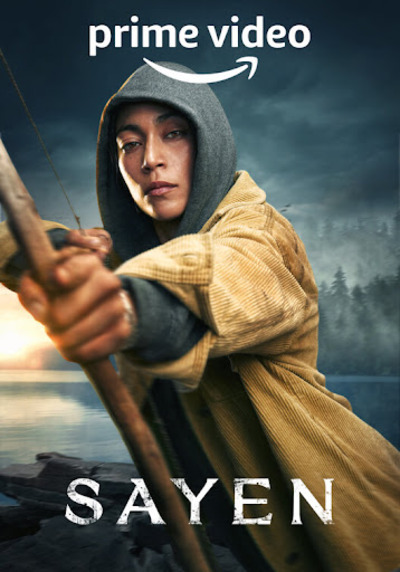
Sayen
★★½
This takes place in the Araucanía region, where Sayen Coñuepan (Montenegro) has just returned to her indigenous homeland. Her grandmother is presented with an offer for her land, but a suspicious Sayen discovers it’s a front for a mining company. Things escalate, with Antonio (Piper), the junkie son of the company’s head, Máximo Torres (Arce), shooting the old woman dead. Sayen vanishes into the jungle, with Antonio and his henchmen in hot pursuit, knowing that if Sayen is allowed to go public with what she knows, it could make things very difficult for the company. However, this is very much her territory, and she has skills to make things potentially very difficult for them.
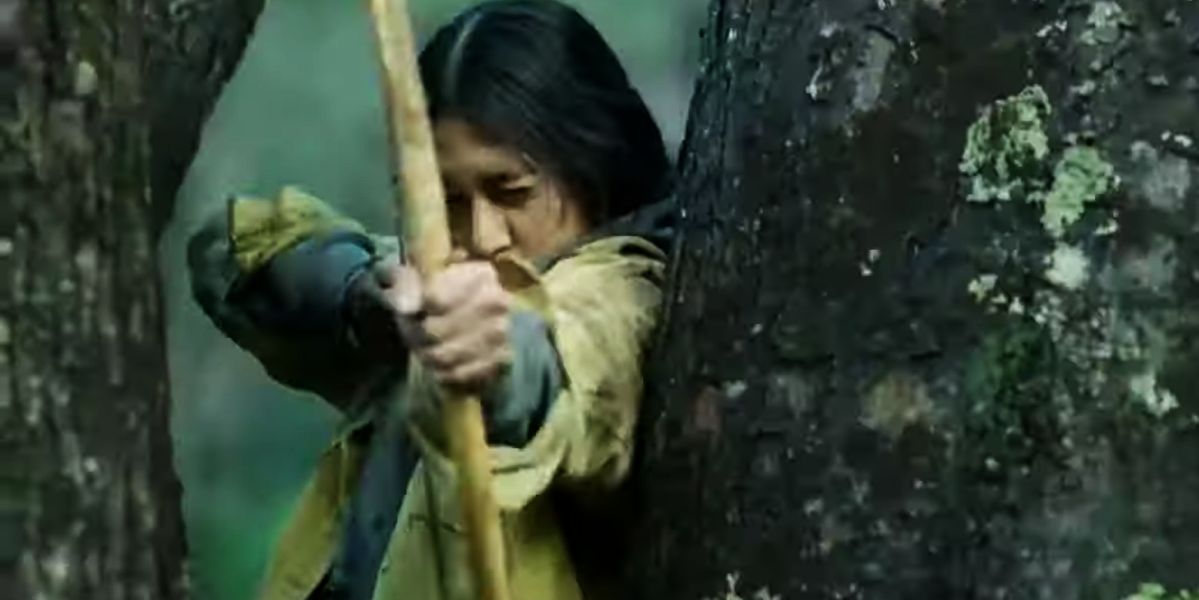
As a jumping-off point, this is… okay, I guess. It begins with a po-faced caption which informs the viewer this is going to be an Important Message Movie. The early going is a bit of a slog, leading to me coming to the conclusion, just because something is “traditional” doesn’t necessarily make it any good. Once granny is gunned down, the film shifts gears and gets more energy. However, I was expecting Sayen to go full Rambo, using the environment to her advantage. She doesn’t really, short of crafting a bow, which she uses one (1) time, and a bit of impromptu first-aid. Meanwhile, the bad guys could hardly be less subtle about their villainy, if they were given wax mustaches to twirl.
Admittedly, this may be necessary to make things clear for the international audience, who may not be up to speed on the intricacies of indigenous politics at the bottom of South America. We need black hats and white hats: keep things simple. Oh, and Chilean rap. Okay. It is interesting how Sayen doesn’t kill anyone – at least not directly. Oh, people die in her wake. Quite a few of them. However, it’s things like death through careless driving, for example. Or pointing a speedboat at a pier, then leaping off. Given the circumstances, surely no jury in the land would convict. After this lacklustre opening, while I can’t say I was keen to get to the next installment, I’m reluctant to quit any story in the middle.
Sayen: Desert Road
★★★
However, I felt the sequel works a little better. It takes place in an entirely different environment, relocating from the southern forests to the Atacama desert, one of the driest places in the world. The enemy remains Actaeon, the predatory industrial corporation headed by Torres, who have built a lithium extraction facility, after bribing their way to approval. Sayen, now with a businesslike crew-cut, is looking to find evidence of this corruption, and gets help from Qumal (Sánchez), a young woman whose father was among those who accepted the money. A SD card contains the required proof, but Acteon and their minions remain hot on Sayen’s trail, and prepared to stop her, by any means necessary.
This is at least somewhat more nuanced and less simplistic. While Torres remains the personification of evil, things are greyer elsewhere. A good example, is Qumal’s father: turns out he used the money received from Acteon to build a school for the town. There’s also one of the minions, Gasper, whose loyalties seem flexible, and who makes good points about the realities of life in the area. Sayen, though, is largely unbothered by these, though still defiantly proclaims herself not to be a murderer, despite what the authorities and media are saying about her. The desert locations provide some good opportunities for vehicular mayhem. I’d say Actaeon should probably look at revamping their driving courses, because some of their employees literally can’t steer to save themselves.
I’m still not entirely on board with Sayen’s mission: I tend not to feel eco-terrorism is better than any other flavour. However, this benefits from not needing to spend time on set-up, though does mean you really can’t watch it without having seen the first part. I was definitely surprised by a couple of twists at the end, where one character I expected to survive into the next movie, ended up dead, and one I thought was already dead, turned out to be alive. This set things up for the third installment, with Actaeon’s parent company Greencorp proving, in the corporate world, there’s always someone bigger and more morally dubious than you. Will Sayen be able to continue her battle, and also maintain her “clean hands” policy? Guess we’ll find out…
Sayen: The Huntress
★★★
There’s a further shift in setting here, the series moving to an urban location, of the Chilean capital Santiago, where Sayen has joined up with a group of activists. They are seeking evidence that Greencorp, under its CEO Fisk (Aarón Díaz), has bribed senators to vote against a bill protecting the country’s water from exploitation. There’s treachery on both sides, with a mole in Sayen’s group bringing heat on their heels, in the particularly interesting shape of female enforcer Jo (Niav Campbell – not to be confused with Neve Campbell!). On the other hand, they receive help from an unexpected source, because it’s not just eco-terrorists who have had enough of Fisk’s shenanigans…
There are some positives here, with the city landscape providing another fresh set of locations for Witt to work in action sequences, including zip-lines, base jumping and cycling. I particularly enjoyed the multiple battles between Jo and Sayen, although the director is still too inclined to go with the quick cuts, as he did in RE: Apocalypse. There’s a decent balance between the action and drama, with the high-level political intrigue working well. On the other hand, the film suddenly drops in a romantic interest for the heroine, which had me wondering where this came from. I wouldn’t worry about it. He isn’t around for long. It all ends a little too neatly, Sayen apparently able to sustain her position on the moral high ground.
All told, if you said this was a South American take on The Millennium Trilogy, I would not be inclined to disagree. In both cases, you have a young woman with a grudge against the powerful, who has the skills to make them pay for their unpunished crimes. Sayen is more hands-on than Lisbeth Salander, although the latter could take care of herself. I think the heroine here is probably less unstable: without the death of her grandmother to propel her down this path, you could easily see Sayen living a normal life, getting married, having kids and perhaps opening a legal help centre for the local residents. Instead, she ended up hunting the head of a global corporation, seeking justice for relentlessly putting the quest for profits ahead of everything else.
After a bit of a shaky start, putting the message ahead of the medium, the second and third films made for decent entertainment. They were all close to the ninety minute mark, avoiding the cinematic bloat we see too often in movies that do not need to be two-plus hours, and Witt’s experience in well-staged action is apparent. Having a heroine who won’t directly kill, but who is not averse to cracking heads if necessary, is a tricky needle to thread, and I’m not sure this is always successful. On the other hand, Sayen comes from a fresh and interesting background, and the trilogy as a whole does explore new territory. I can’t truly recommend it, but if you are interested in watching these, nor would I argue against it. You do you, gentle reader – you do you.
The Chinese title is 狙击之王:暗杀, which Google Translate informs me translates as “Sniper King: Assassination”. I don’t want to assume anyone’s gender, but I think I’m going to go with the alternate title above, as more appropriate, over the one on the poster. Because there’s no doubt about the amazing talents possessed by Anna (Yang), for whom a shot at three kilometers range is barely an inconvenience. We get right into the action with her being committed as a psychopath after begin captured, following her assassination of a drug lord. Yet another drug lord, actually – she has a deep hatred of them, for reasons we eventually discover, and has been taking them out with regularity.
It’s not long before someone tries to kill her in the psychiatric facility, but she’s able to escape (somewhat), with the help of struck-off former doctor, Nasipan (Tao). However, she is forced, with the aid of a nano-bomb injected into her bloodstream, to take a mission for Artest (Mak). There’s a war of succession going on in the country of “Libiwala”, with the prospect of drug production becoming legal in the country – to the joy of crime boss Roger (Lee). Artest requires Anna to liquidate all those in line for the leadership to prevent this. Or maybe encourage this. It’s all a bit murky, and the plot twists and turns until the very last scene, though never gets incoherent.
This one captivated me inside five minutes, with the hellacious firefight in the asylum, culminating in Anna sniping a sniper right through their scope. The action doesn’t let up for long thereafter, with some excellent set pieces involving both weapons and hand-to-hand combat. For the latter, Artest probably gets the bulk of it. But on the opposing side is a henchwoman who makes Gogo Yubari look like the picture of mental balance (I think she may be played by Guo Muhan, but I don’t recall hearing her name), and cuts a striking figure in her long blond hair and sword. It’s just one of the numerous things this film gets right, including occasional moments of comedy that genuinely made me laugh out loud, the movie winking at its own excesses.
It’s simply a fun experience, with characters you can get behind, and an impressively strong anti-drug message. All the players are given depth to their roles, and the chance to develop them. Even the little kid, playing the third in line to the Libiwalian throne, is not irritating – and that’s high praise coming from me, as far as child actors go. All told, this is one of the most purely enjoyable ninety minutes I’ve spent of late, easily surpassing bigger budget films like Cleaner or The Gorge, and given my expectations, is likely going to be the most pleasant surprise of the year. The whole movie is embedded below. Take five minutes to check out the opening sequence, and see if it hooks you as well as it hooked me!
Dir: Huo Sui-qiang Star: Yang Xing, Henry Prince Mak, Tao Tao, Lee Dong Hyuk
a.k.a. Sniper King: Assassination
Regular readers will already be aware of the long history of stuntwomen, going back a hundred years to the serial heroines of the silent era. But there’s still a lot to be learned from this documentary about these fearless, and largely unsung, daredevils. Narrated by Rodriguez, it’s mostly a series of discussions between OG stuntwomen, like Epper, who was Lynda Carter’s double in Wonder Woman (and who passed away earlier this year), and members of the current generation, such as Amy Johnston, of Lady Bloodfight fame. The anecdotes shared by the former are an often fascinating insight into the struggles to be taken seriously, in a time when many directors would rather slap a wig on a stuntman.
In comparison, the modern equivalents seem a little bland. It almost feels like the adversity through which Epper and her contemporaries went, reinforced their characters. I mean: doubling for Pam Grier, as David did, feels like it would be rather more of an influential experience than doubling for Scarlett Johansson. Not that this stops some of the modern stuntwomen from complaining about inequalities in the business. To be honest, this aspect does come off as a little whiny in nature. Rather more inspiring are statements like, “I didn’t want to be respected for a girl. I didn’t wanna be good for a girl. I just decided I was gonna be really good.” That’s the kind of attitude which I respect more than blaming sexism and racism.
Another slight weakness is, it’s quite easy to lose track of who’s who, especially once you get past the main participants, and people you recognize. Not that there is much chance of failing to recognize Jessie Graff, of Ninja Warrior fame. Though it’s a little surprising Zoë Bell – arguably the best-known of modern stuntwomen, albeit a crown perhaps now passed to Graff – doesn’t merit more than a passing mention. It’s fun simply being a fly on the wall as Graff hangs out with her colleagues, bouncing on her trampoline, or watching renowned stunt driver Evans fake drag-racing with her son, and doing handbrake turns on the roads around their property. As Rodriguez enthuses, “I love that your neighbors are cool with all this.”
It is a little weird that the two male directors talked to are Paul Verhoeven and Paul Feig. Verhoeven is his usual entertaining self, but Feig comes over as almost smugly “right-on”. Mind you, if you’ve seen his painfully earnest Ghostbusters remake, you’ll understand his mindset. The documentary does take a rather chilling turn, though justifiably so, discussing the risks faced by all stunt performers, including fractures, concussions, paralysis and even death. It’s easy to overlook, especially now when we assume everything is green-screened or CGI. Some of the stories from the veterans, of the days when safety standards were… less stringent, shall we say, are staggering. You should certainly leave this with a deeper appreciation for those willing to risk their lives and limbs, purely for your entertainment.
Dir: April Wrig Star: Jeannie Epper, Debbie Evans, Michelle Rodriguez, Jadie David
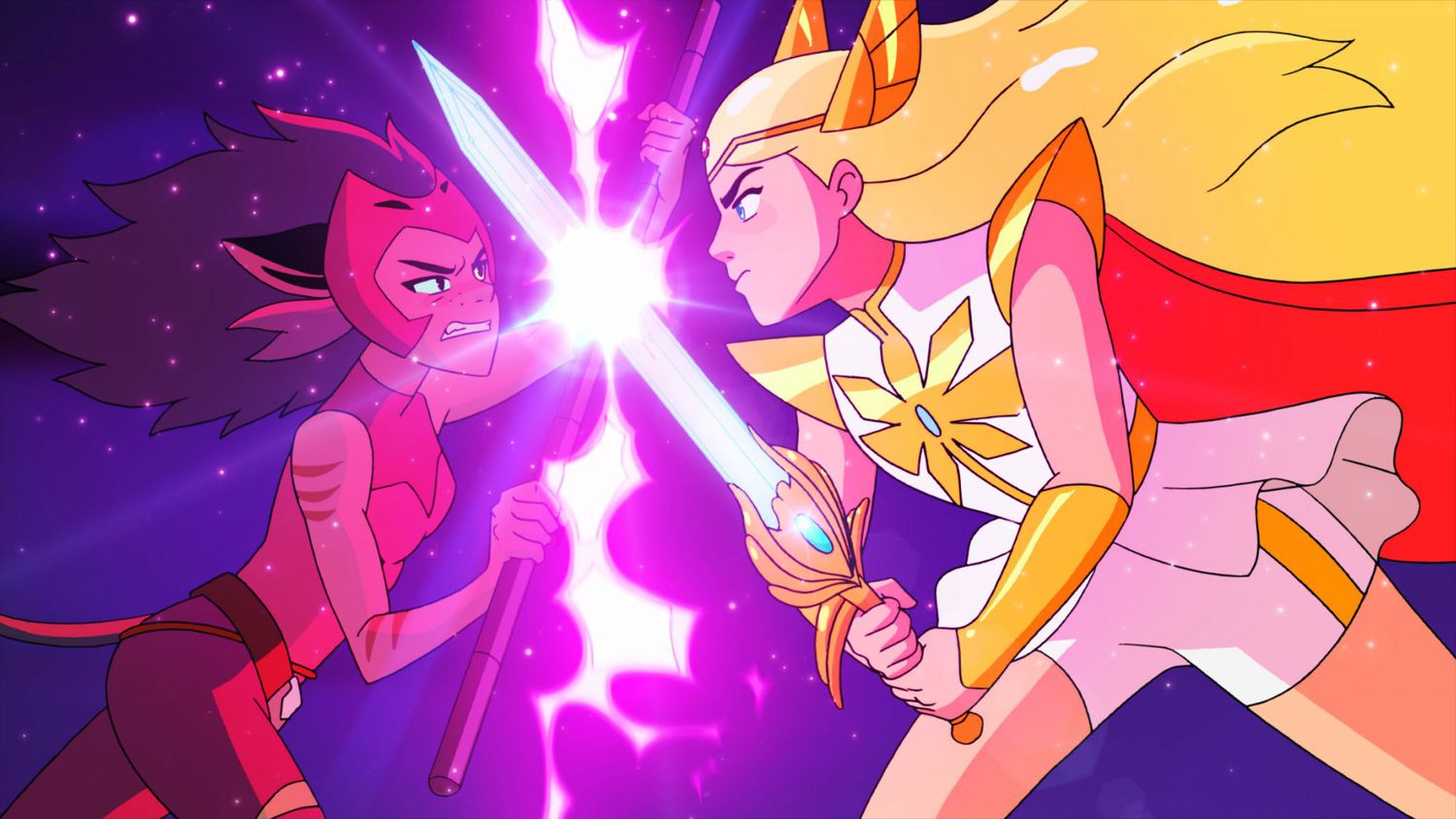
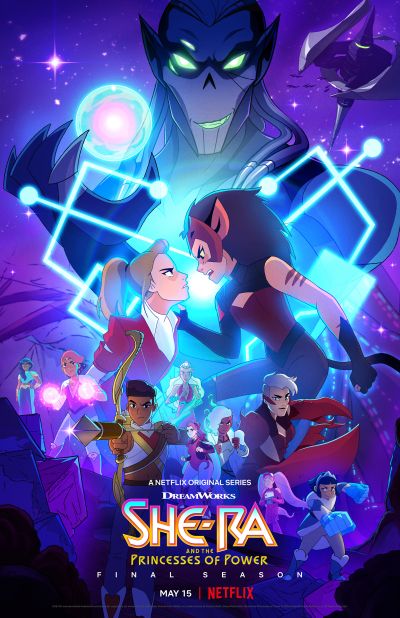
When the reboot (you hardly can call this just a remake) of She-Ra and the Princesses of Power – and please note the plural form! – was released by Netflix in 2018, it immediately drew fierce criticism. The main issue was re-designing the classic character of heroine She-Ra as well as others. The original animated series ran from 1985-87, and featured very feminine-looking characters. You could call them the feminine ideal: large in size, fit, attractive and yet still more realistic than the musclebound hero from mother series He-Man and the Masters of the Universe, of which She-Ra was a spin-off.
Though it has to be said: those characters then looked very much alike, as if the same model was used for almost all of them. In the new show, which ran for 5 seasons between 2018-20, the characters look more like prepubescent teenagers, and it was one of the things old fans took issue with. She-Ra and her allies were once an ideal of what a young girl might hope to look like as a grown-up, similarly to Barbie. The reimagined version stresses more diversity in body-shape. The character of Glimmer is more rounded – arguably a bit over-weight – which drew ire, too. But these characters also look more androgynous, essentially eliminating the feminine ideal. We seem to live in a time when female characters aren’t allowed to look stereotypically female, though there seems no such problem with heroes e. g. Hugh Jackman in Deadpool & Wolverine.
The show was soon called “woke”, but this is only justified, in that it fits the usual Netflix inclusion rules. So, the character of Bow, the archer, is black and has two fathers; there are indications some characters have relationships with people of their own sex; there is a lizard person whom we are informed online is transgender; then there is heroine She-Ra, who at the very end of the series (similar to The Legend of Korra), enters a relationship with her constant frenemy, Catra. I personally didn’t mind, though it may have something to do with me never caring for She-Ra in the 80s. It makes a difference if you create an original character like Korra, or take a preexisting character and change them drastically. I would have a beef, too, if let’s say James Bond in his next incarnation would be declared homosexual.
Though woke? Is it woke? Well… not in the sense I normally understand the word. For me, it means an agenda is being pushed. I can’t really say I see this here, unless the agenda is to stress that people exist who are not hetero-normative. Which… is true? The focus is on the story; we don’t get characters demonstrating against being sexually or politically repressed by the evil patriarchy, or talking about the problems of their gender orientation in modern society. This is no more woke than The Dragon Prince, another popular Netflix show. Part of the attention is probably due to creator ND Stevenson, who has stated he is – according to Wikipedia – “nonbinary, transmasculine and bigender,” as well as having bipolar disorder and ADHD. Well, whatever it is, is reflected in Stevenson’s work, in She-Ra as well as Netflix animated movie Nimona, based on his graphic novel.
But what is the story?
The core is the same. Adora, a human girl, has been raised as a soldier by the Horde, an alien race ruled by the evil Hordak, who is at war with the inhabitants of the planet Etheria. When Adora finds the magical sword of power that makes her She-Ra, Princess of Power, she learns the Horde aren’t the good guys. She swaps sides to fight them, with the support of several princesses living on Etheria, who all have special powers. However, there is no mention here of Prince Adam (a.k.a. He-Man), Adora’s brother, separated from her at birth when she was kidnapped by the Horde. This fits the modern animated He-Man series released by Netflix in 2021, which was in a totally different drawing style – its characters wouldn’t have matched. And as far as I know – someone correct me, if I’m wrong here – Adora’s childhood was not part of the original story. I’m also unaware she shared a sisterly childhood bond with Catra, a humanoid with cat-like features, in the Horde.
For it’s here where the new show differs from the old stories. And is all the better for it, as the relationships of the characters inform the story of the new series and are essentially the core of it. As Adora leaves the Horde, she puts herself essentially in opposition to Catra. Like her, Catra has been a childhood protégé of Shadow Weaver, a mysterious woman with magical powers and loyal servant of Hordak. Shadow Weaver has raised the two girls but has always been lying to them and treating Catra badly compared to Adora. This plants the seed of a competitive relationship between the two girls. There are definitely shades of Avatar – The Last Airbender in this.
Catra sees Adora’s defection as a personal betrayal, which leads her to fight against Adora more and more. At the same time, it becomes clear that Catra cares – in her own twisted way – for Adora. Her actions are, in some way, a logical result of her upbringing by Shadow Weaver, who later in the proceedings will turn to Adora’s side, too. In the end, Catra is on Adora’s side, declaring her love, which finishes the story.
The series got a lot of praise for inclusivity and character reinvention and has a quite enthusiastic fan-base. Though I don’t see anything here, I hadn’t seen before somewhere else, especially in the Avatar series, as mentioned. It’s not surprising a show like Sailor Moon and the style of Miyazaki films (though I fail to recognize the latter in the show), were cited as influences. The fan-base here, which may mainly consist of “non-heterosexual oriented” young people is definitely not the same fan-base as the original series. So if the intent was to enlarge interest in the franchise in general, I guess one could say: Mission accomplished!
On the other hand, it’s clear this new spin on an old title has split fandom – or, rather, created a second fandom. This is not necessarily a good thing. It can result in embittered online wars and open hostility between members of different fan groups, both claiming ownership of “their story” and how it should be portrayed or interpreted. It’s not the only case. See franchises like Star Wars (George Lucas’ or the Disney version?) and Star Trek (“old Trek” vs. “new Trek”?). If you are as old as I am, you may even remember a time, long before Internet and personal computer communication existed, when people argued over if Kirk or Picard was the better captain, or Sean or Roger the better Bond. Change, it seems, always creates controversies. Therefore, the new show – as good as it is – has created a problem for the franchise that won’t be solved in a foreseeable future.
The plot is interesting and captivating, depicting a cycle of childhood abuse that repeats itself later, with Catra attacking Adora and others – just as she was mistreated and psychologically manipulated by Shadow Weaver when she was a young child. It gave the characters a depth you probably wouldn’t have expected, from a reboot of an old animated show – one that itself was just a spin-off of another show, made more than 30 years ago. But that’s the thing, isn’t it? We always expect “our” franchises to continue year after year, decade after decade, telling us the same stories without changing. But the world constantly changes, and you can’t expect series and franchises not to reflect that in some way. It’s especially true, if we talk about series lasting more than a generation.
What I also liked here very much, were the action scenes. When Catra was being evil-sarcastic to Adora it did remind me a bit of Shego being mean to Kim Possible, or Callisto toying with Xena (another… princess…). But it also has to be said that the show needed some time to get going, had some episodes that felt like fillers, and while characters like She-Ra, Catra, Shadow Weaver, Entrapta, Scorpia or Hordak were mostly written interestingly, others felt a bit bland, underdeveloped and interchangeable. Though it might be a given, if you have so many characters in one show. It is true, the show didn’t break new ground, though I didn’t expect it to. These reboots typically repackage an already existing product, despite presenting it to the audience as something entirely new. Is so much praise justified for a show that essentially is recycled? Just because the main characters come out as lesbians at the end?
Additionally, it has been pointed out that the redemption of Catra is more than just a bit questionable. [Though she isn’t the main villain of the show: it’s still Hordak, who in the original show was also the mentor of He-Man’s archenemy Skeletor.] She has attacked and tried to kill Adora several times and went so far as wanting to destroy the entire world, rather than see Adora succeed in her goals. That’s pretty bad, and one wonders how such a character can just be forgiven. Admittedly, Etheria might have a different legislation and jurisdiction than planet Earth! But someone put it quite well: “Catra is a war criminal. Why is she not being treated as one?”
In the end the show is indeed comparable to Sailor Moon – it’s all in the name and power of love and forgiveness. Who wants to question logic here? For all its perceived “controversial” elements and flaws, the show is good entertainment, which is where my main focus always lies. Netflix’s streaming rival, Amazon, announced a while ago they wanted to do a live-action She-Ra series (recent news reports suggest it may be He-Man’s turn next). This caused something of an uproar among the fans of the Netflix show, obviously fearing She-Ra may become straight again! It’s history repeating, similar to the reactions of original series fans when they first saw the Netflix show. Though if indeed that She-Ra show is produced, its story-telling will have to match the quality of this one.
But it seems you can never make everyone happy at the same time!
Creator: ND Stevenson Star (voice) : Aimee Carrero, AJ Michalka, Karen Fukuhara, Marcus Scribner
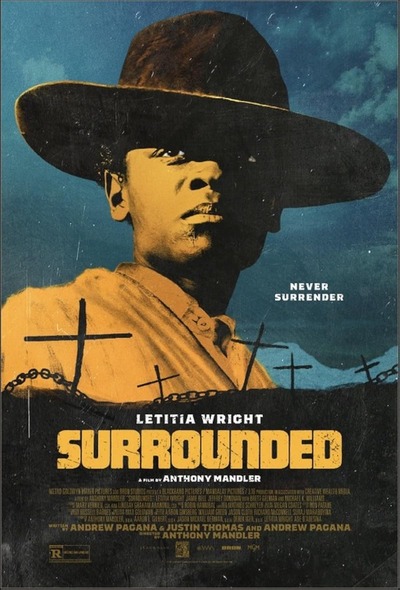
This is certainly a little different from the usual Western. It takes place a few years after the conclusion of the Civil War. Mo Washington (Wright) is on her way to Colorado to take up a piece of land she bought with her hard-earned savings. To avoid trouble on the journey, she is dressed as a man, though being black is problematic enough at that time. The stagecoach in which she’s travelling – or rather, on which, the driver not wanting a Negro inside – is attacked by brigands, led by notorious bank-robber Tommy Walsh (Bell). After a fierce fight, Walsh is captured, but the coach, complete with Mo’s documents, plunges off a cliff.
The good news? There’s a ten thousand dollar bounty on Walsh’s head, and Washington is left to guard the fugitive while another passenger, Wheeler (Donovan), goes to fetch the authorities. The bad news? That leaves her alone with Walsh overnight, and there are others interested in the fugitive, including those after the reward, and the remaining members of the Walsh gang. Because he’s the only one who knows the whereabouts of the very large pile of loot, resulting from their last robbery. Mo is going to have to figure out who she can trust. For instance, is Walsh’s offer, to split the loot if she frees him, legit? It would certainly more than cover the losses she suffered when her Colorado land went over the edge.
As with the Hong Kong movies which use the gender disguise thing, it does require a large suspension of disbelief. As soon as Wright opens her mouth, any illusion of her being able to pass for male goes out the window of the stagecoach. On the other hand, gender is almost irrelevant as things unfold. I suspect eliminating the need for concealment would not have helped the intended moral here. The racial element however, is much more pertinent, with Mo having literally walked off her owner’s plantation. Yet there’s more in common with Walsh then it initially appears. Well, providing you accept at face value and trust his story, about being orphaned at age eight by robber land barons. Which might or might not be wise.
It’s in their scenes together where the film is at its strongest, even if they’re just sitting by the campfire, talking. If it feels almost like a play, this is still engrossing, two actors in prime form. Less successful is the arrival of a third party, not least because this leads to a poorly-staged fight, unfolding in near total darkness, where it was impossible to see what was happening. Maybe it worked better in the cinema? At home, it severely took me out of the experience, staring at a blank screen. Fortunately, this recovers to a decent finale, with Mo deciding she is the only person she can truly trust. In the end though, her character seems less fully-rounded than Walsh, despite, or perhaps because of, all the talk. As a result, this only intermittently fulfills its undeniable potential.
Dir: Anthony Mandler Star: Letitia Wright, Jamie Bell, Jeffrey Donovan, Michael Kenneth Williams



 My rating for the first book was two and ½ stars. Several aspects of this second one, though, don’t work as well for me in terms of realism, and I wasn’t able to give it more than two stars. First, while (for at least some Native American peoples) tribal law may have allowed the fathers of young women to sell or gamble them away as slaves, by the late 1870s U.S. law didn’t countenance that. So the community’s project of buying Morning Glory’s freedom was unnecessary. Given the long warfare between Texans and the Comanches, and the ill-feeling of many whites in that era towards Indians, as well as Texas’ secession in the previous decade with defense of slavery as one of its officially-avowed reasons, the community’s unanimous sympathy with Morning Glory also seems a bit of a stretch. Though it’s true that slavery was much less entrenched in arid west Texas than in the east Texas cotton country; and Jo’s mother was apparently Northern-born, since her two brothers died fighting for the Union.
Second, it’s a standard romance-genre trope that at least one party to the romance has hang-ups to overcome, but Tom’s here seem sort of contrived. Yes, his previous fiancee broke their engagement because she didn’t want to live in a place like Waterhole; but it’s patently obvious that Jo doesn’t have that problem, and by now the community is becoming more female-friendly than it was then. His fear for her safety in a potentially violent job is more credible (if she has a problem shooting a deer, might she not also have a fatal hesitancy in shooting a human, even with her life on the line?), but the denouement here doesn’t actually discredit that fear. That brings me to some issues with the denouement.
In the first book, I had no trouble believing that a sober woman with quick reflexes, who’s trained and experienced with a pistol, could outdraw a partly-drunk male, even if he and a bunch of cowed townsfolk thought he was pretty hot stuff with his gun. It was said in the Old West that, “God created men and women, but Col. Colt made them equal.” But here, I did have trouble believing that a woman could tackle and physically overpower a presumably bigger and stronger armed male; and not much respect for her intelligence in trying it, when she could easily have covered him with her own gun from behind and demanded his surrender. Her two armed sisters didn’t display much smarts there, either.
If I were Tom, that incident would have exacerbated my concern for her, not laid it to rest. The outcome of the tale here also depends on believing (which I’m not certain that I do) that it can automatically be assumed that every cave in west Texas is inhabited by a swarm of bats which will emerge at sunset; and we’re also asked to believe that Jo’s love for animals makes her the only Hardin sister who would know this, when all of them are wilderness-wise. I also had a problem with our heroines letting an arrested petty thief just walk out of jail, even on the condition that he leave the area, in exchange for a tip leading to the arrest of bigger prey. Finally, although I give Cox credit for treating inter-racial romance positively, the secondary romance here came across to me as implausible and unconvincing.
All of this said, I did finish the book (my wife and I read it together – and she liked it much better than I did, her taste in Westerns not being nearly as critical), and it held my interest. Cox’s characterizations aren’t deep, but most of the characters are likable. Like the author, the main characters are evangelical Christians, and there’s a positive portrayal of the role of faith in their lives. We also see the effects of Christian conversion in a couple of cases, though we’re not privy to the scenes/conversations where those conversions take place (so there’s no lengthy evangelistic exposition). The series can appeal to fans of Westerns, Western romance and “Christian fiction” who don’t expect much depth and just want some harmless, time-passing entertainment.
A brief word about the cover art is in order. It’s a nice bit of action-heroine iconography, and does depict an actual scene from the book (a rifle-shooting contest). But while the young lady here has lovely brown eyes, we’re told in the books that Jo and all of her sisters are green-eyed; and the kind of colored nail polish this markswoman is wearing didn’t come into vogue until the 1920s. So, no awards for accuracy here!
Author: Brooksie Cox
Publisher: Lovely Christian Romance Press, available from Amazon, both as an audio book and a printed book.
A version of this review previously appeared on Goodreads.
My rating for the first book was two and ½ stars. Several aspects of this second one, though, don’t work as well for me in terms of realism, and I wasn’t able to give it more than two stars. First, while (for at least some Native American peoples) tribal law may have allowed the fathers of young women to sell or gamble them away as slaves, by the late 1870s U.S. law didn’t countenance that. So the community’s project of buying Morning Glory’s freedom was unnecessary. Given the long warfare between Texans and the Comanches, and the ill-feeling of many whites in that era towards Indians, as well as Texas’ secession in the previous decade with defense of slavery as one of its officially-avowed reasons, the community’s unanimous sympathy with Morning Glory also seems a bit of a stretch. Though it’s true that slavery was much less entrenched in arid west Texas than in the east Texas cotton country; and Jo’s mother was apparently Northern-born, since her two brothers died fighting for the Union.
Second, it’s a standard romance-genre trope that at least one party to the romance has hang-ups to overcome, but Tom’s here seem sort of contrived. Yes, his previous fiancee broke their engagement because she didn’t want to live in a place like Waterhole; but it’s patently obvious that Jo doesn’t have that problem, and by now the community is becoming more female-friendly than it was then. His fear for her safety in a potentially violent job is more credible (if she has a problem shooting a deer, might she not also have a fatal hesitancy in shooting a human, even with her life on the line?), but the denouement here doesn’t actually discredit that fear. That brings me to some issues with the denouement.
In the first book, I had no trouble believing that a sober woman with quick reflexes, who’s trained and experienced with a pistol, could outdraw a partly-drunk male, even if he and a bunch of cowed townsfolk thought he was pretty hot stuff with his gun. It was said in the Old West that, “God created men and women, but Col. Colt made them equal.” But here, I did have trouble believing that a woman could tackle and physically overpower a presumably bigger and stronger armed male; and not much respect for her intelligence in trying it, when she could easily have covered him with her own gun from behind and demanded his surrender. Her two armed sisters didn’t display much smarts there, either.
If I were Tom, that incident would have exacerbated my concern for her, not laid it to rest. The outcome of the tale here also depends on believing (which I’m not certain that I do) that it can automatically be assumed that every cave in west Texas is inhabited by a swarm of bats which will emerge at sunset; and we’re also asked to believe that Jo’s love for animals makes her the only Hardin sister who would know this, when all of them are wilderness-wise. I also had a problem with our heroines letting an arrested petty thief just walk out of jail, even on the condition that he leave the area, in exchange for a tip leading to the arrest of bigger prey. Finally, although I give Cox credit for treating inter-racial romance positively, the secondary romance here came across to me as implausible and unconvincing.
All of this said, I did finish the book (my wife and I read it together – and she liked it much better than I did, her taste in Westerns not being nearly as critical), and it held my interest. Cox’s characterizations aren’t deep, but most of the characters are likable. Like the author, the main characters are evangelical Christians, and there’s a positive portrayal of the role of faith in their lives. We also see the effects of Christian conversion in a couple of cases, though we’re not privy to the scenes/conversations where those conversions take place (so there’s no lengthy evangelistic exposition). The series can appeal to fans of Westerns, Western romance and “Christian fiction” who don’t expect much depth and just want some harmless, time-passing entertainment.
A brief word about the cover art is in order. It’s a nice bit of action-heroine iconography, and does depict an actual scene from the book (a rifle-shooting contest). But while the young lady here has lovely brown eyes, we’re told in the books that Jo and all of her sisters are green-eyed; and the kind of colored nail polish this markswoman is wearing didn’t come into vogue until the 1920s. So, no awards for accuracy here!
Author: Brooksie Cox
Publisher: Lovely Christian Romance Press, available from Amazon, both as an audio book and a printed book.
A version of this review previously appeared on Goodreads.
 While this is an excellent and very original premise for a novella series, though, the execution of it here has to be called somewhat lackluster. Lilly’s prose style tends to be repetitive, both in language (and in using character’s names over again where a pronoun would serve her better) and in ideas, with points often being restated or reemphasized in the same paragraph when it’s not needed; she also has a tendency to tell when there would be more effective ways of showing. Some attempt was made at editing, but the proofreading was poor (there are only a few typos as such, but I finally deduced that the three or four bracketed repetitions of a sentence in different words were vestiges of textual corrections that weren’t edited out in the final draft!).
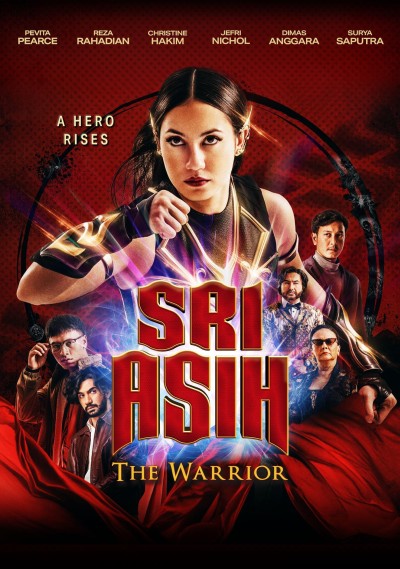 Turns out that Marvel and DC are not the only ones creating “cinematic universes” based on comic book. Another example can be found, perhaps surprisingly, in Indonesia. This film is part of the Bumilangit Cinematic Universe, and is a follow-up to 2019’s Gundala. I haven’t seen that, but I’m 99% sure that the scene in the end-credits is a direct cross-over to that, featuring its hero, given the apparent prediction late on of a team up to come between him and Sri Asih. Otherwise, though, this stands on its own, and you don’t need to have seen Gundala, or be familiar with the comic-book series about Sri Asih, created by R.A. Kosasih, and first published all the way back in 1954.
 The prose style here is straightforward and direct. Overall, Ayn prefers straight narration over dialogue, though he provides realistic dialogue where it’s needed to reveal character and move the plot. Technically, it could be claimed that, especially in developing his two lead characters’ back stories, he uses a fair amount of telling rather than showing. But within the constraints of the short format and of the centralizing of the fight itself as the outward core of the story (though inward developments are taking place at the same time), there’s no real alternative to that technique, and it’s actually well-suited to the kind of effect the author successfully creates. This is descriptive fiction, with no speculative element. I’ve characterized it as general fiction, rather than as crime fiction or action-adventure, because the characters are ordinary civilians, neither career criminals nor law enforcement professionals; no guns are involved, the setting is mundane, and the situation is one that could easily occur in everyday life. We’re in a very different atmosphere and milieu than that of, say, a typical Modesty Blaise adventure.
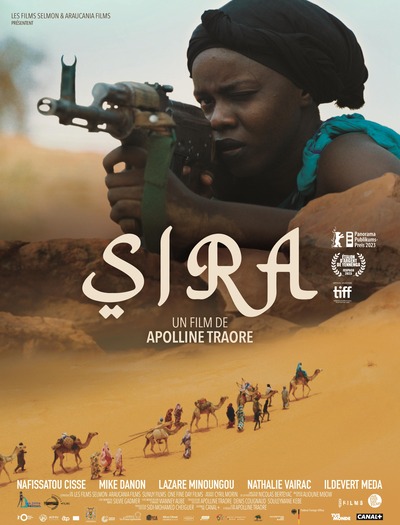 Sira (Cissé) is a young African woman, travelling through the fringes of the Sahara Desert in Burkina Faso, on the way to get married to Jean-Sidi (Barry). However, their caravan gets involved in an incident with Islamic terrorists, which escalates into murder, with Sira being abducted by the terrorist leader, Yéré (Minoungou). He changes his mind, raping Sira and leaving her in the desert, because she is “not worthy” to die by his weapon. She survives, and stumbles across the terrorist camp, and takes shelter nearby, sneaking in to obtain food and water. After a group of other kidnapped women show up, to be used as sex slaves, Sira begins to put a plan in motion, with help from an unexpected ally.
 I was rather surprised to see the name of Alexander Witt pop up as the director, at the end of the first movie in this Chilean trilogy. He has been a stalwart second-unit director in Hollywood for decades, going back to Speed in 1994. With regard to the site, he fulfilled the same role on
  As a jumping-off point, this is… okay, I guess. It begins with a po-faced caption which informs the viewer this is going to be an Important Message Movie. The early going is a bit of a slog, leading to me coming to the conclusion, just because something is “traditional” doesn’t necessarily make it any good. Once granny is gunned down, the film shifts gears and gets more energy. However, I was expecting Sayen to go full Rambo, using the environment to her advantage. She doesn’t really, short of crafting a bow, which she uses one (1) time, and a bit of impromptu first-aid. Meanwhile, the bad guys could hardly be less subtle about their villainy, if they were given wax mustaches to twirl.
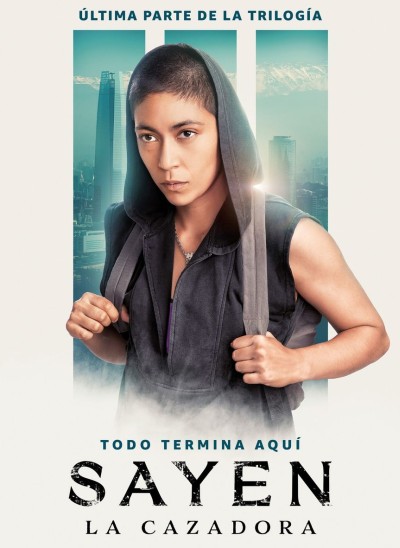 Sayen: The Huntress
 The Chinese title is 狙击之王:暗杀, which Google Translate informs me translates as “Sniper King: Assassination”. I don’t want to assume anyone’s gender, but I think I’m going to go with the alternate title above, as more appropriate, over the one on the poster. Because there’s no doubt about the amazing talents possessed by Anna (Yang), for whom a shot at three kilometers range is barely an inconvenience. We get right into the action with her being committed as a psychopath after begin captured, following her assassination of a drug lord. Yet another drug lord, actually – she has a deep hatred of them, for reasons we eventually discover, and has been taking them out with regularity.
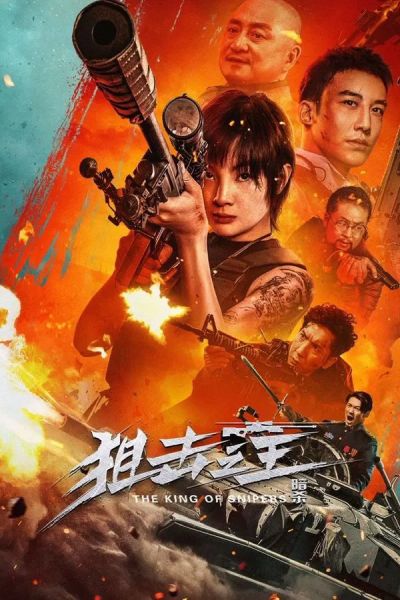 It’s not long before someone tries to kill her in the psychiatric facility, but she’s able to escape (somewhat), with the help of struck-off former doctor, Nasipan (Tao). However, she is forced, with the aid of a nano-bomb injected into her bloodstream, to take a mission for Artest (Mak). There’s a war of succession going on in the country of “Libiwala”, with the prospect of drug production becoming legal in the country – to the joy of crime boss Roger (Lee). Artest requires Anna to liquidate all those in line for the leadership to prevent this. Or maybe encourage this. It’s all a bit murky, and the plot twists and turns until the very last scene, though never gets incoherent.
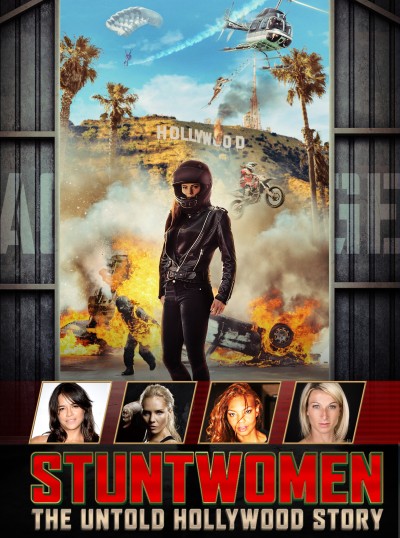 Regular readers will already be aware of the long history of stuntwomen, going back a hundred years to the
  ★★★½
★★★½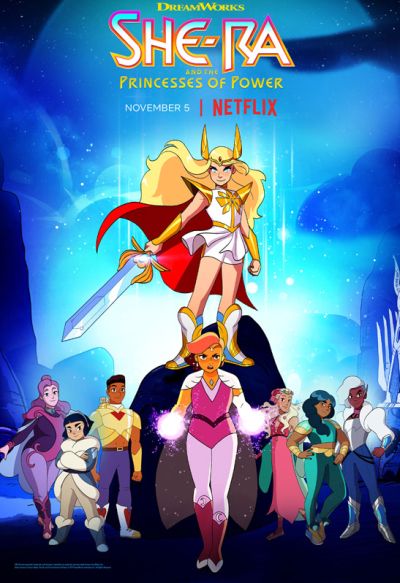 Though woke? Is it woke? Well… not in the sense I normally understand the word. For me, it means an agenda is being pushed. I can’t really say I see this here, unless the agenda is to stress that people exist who are not hetero-normative. Which… is true? The focus is on the story; we don’t get characters demonstrating against being sexually or politically repressed by the evil patriarchy, or talking about the problems of their gender orientation in modern society. This is no more woke than The Dragon Prince, another popular Netflix show. Part of the attention is probably due to creator ND Stevenson, who has stated he is – according to Wikipedia – “nonbinary, transmasculine and bigender,” as well as having bipolar disorder and ADHD. Well, whatever it is, is reflected in Stevenson’s work, in She-Ra as well as Netflix animated movie
  On the other hand, it’s clear this new spin on an old title has split fandom – or, rather, created a second fandom. This is not necessarily a good thing. It can result in embittered online wars and open hostility between members of different fan groups, both claiming ownership of “their story” and how it should be portrayed or interpreted. It’s not the only case. See franchises like Star Wars (George Lucas’ or the Disney version?) and Star Trek (“old Trek” vs. “new Trek”?). If you are as old as I am, you may even remember a time, long before Internet and personal computer communication existed, when people argued over if Kirk or Picard was the better captain, or Sean or Roger the better Bond. Change, it seems, always creates controversies. Therefore, the new show – as good as it is – has created a problem for the franchise that won’t be solved in a foreseeable future.
 This is certainly a little different from the usual Western. It takes place a few years after the conclusion of the Civil War. Mo Washington (Wright) is on her way to Colorado to take up a piece of land she bought with her hard-earned savings. To avoid trouble on the journey, she is dressed as a man, though being black is problematic enough at that time. The stagecoach in which she’s travelling – or rather,