



★★★
“A thoroughly Canadian apocalypse”
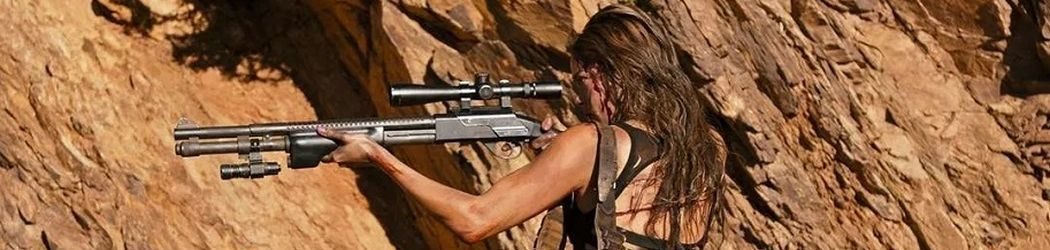
 Really, for a reported budget of about $6,500 – and those are Canadian dollars, which currently works out to less than five grand in freedom dollars – this is quite impressive. You could argue that trying to create a convincing post-apocalyptic scenario on such a tiny budget is biting off more than you can chew. And there are certainly moments which just don’t work. But in its low-key approach, it’s probably a more accurate reflection than many of the way in which the world might end. Not with a bang, but with a whimper, and a slow grinding to a halt.
In this case, it’s an electromagnetic pulse weapon, detonated high in the atmosphere (most likely by North Korea, going off early radio broadcasts) and wiping out everything that use electronics. Which, these days, is virtually everything. When it does, young heroine Niamh (Ferreri, the director’s daughter) is staying with her grandmother, because Dad is away on a business trip. Initially, they hole up, trying to wait it out, but eventually resources dwindle and Niamh has to strike out on her own. Fortunately, Dad was a bit of a prepper and so she is better prepared than most girls her age for life in the new, primitive world, as well as encountering other survivors, both good and bad.
Undeniably, you have to allow a lot of leeway for the very limited resources. Even given the rural setting, it’s never clear to where 99% of the population has gone, or why; a throwaway line saying, “A bunch of people left a few nights ago,” is about as close as we get. The collapse of civilization into anarchy and chaos is depicted by a shot of Niamh and her grandmother, peering out the window and looking concerned, while somewhat riotous sound-effects are heard. All told, as the tagline above implies, it’s a very polite end of the world. It’s also a bit unusual, and therefore refreshing, to see a positive portrayal of survivalists. Rather than the usual wild-eyed paranoiacs, they’re depicted here as down-to-earth, and simply prepared for unfortunate events.
The technical aspects are quite impressive, especially on the visual front where it certainly doesn’t look like a microbudget production. However, the film does drag in the middle. From the point at which Niamh meets another young survivor, Will (Davidson), it seems to spin its wheels for the longest time, despite the pair stumbling across a rare car still capable of driving. It takes the injection of an external threat before the plot begins to move forward again, and Ferreri deserves credit for getting its depiction of killing right, as not something which should be done lightly by anyone.
The movie did tie up its loose ends up a little too conveniently, just when it was looking set fair to be nicely ambiguous. Though on the other hand, this offers a somewhat hopeful note on which to finish things. That might not be a bad thing after a generally downbeat experience, and if it remains the complete cinematic opposite of, say, Fury Road, that’s not entirely a bad thing.
Dir: Adriano Ferreri
Star: Rosa Ferreri, Liam Davidson, Derek A. Bell, Martin Saunders
 After a disease has wiped out all adults, the town of Potters Bluff has divided into two camps, delineated by the river running through the town. On the west are the Titans, a quasi-fascist order of jocks operating out of the old high school and led by Jeremy, whose motto is “Strength, power, respect.” On the east are the free-spirited remainder, living under and protected by Jack (Bourgeois). However, after hijacking the contents of a Titan truck, Jack is abducted by them and held hostage. A three-person party sets out on a rescue mission: Jack’s sister Nat (Iseman), her best friend – and painfully obvious lesbian, right down to the mohawk – Scratch (Kwiatkowski), and Sony (Friese), a former Titan who recently defected to the East, and whose inside knowledge is essential to their survival and the success of the mission.
 First, the good news. Whatever the issue was with
  For whatever reason – presumably misguided stylistic reasons – the great bulk of the film is buried in darkness. Seriously, three-quarters of the film feels like it’s illuminated solely by natural lighting. And given it mostly takes place underground, in rooms with no windows, this is a major problem. The movie reaches its literally darkest moment during an early scene where the camera pans over an underlit set to an even more underlit door where someone has entered to deliver a message. You cannot see who it is. You just hear a disembodied voice, before the camera pans back. It’s a horrible mis-step, whether due to poor shooting, a poor transfer, or a bit of both. It largely dooms the movie, to the point where even an energetic final third is unable to rescue proceedings. For how can you begin to enjoy something you can’t see?
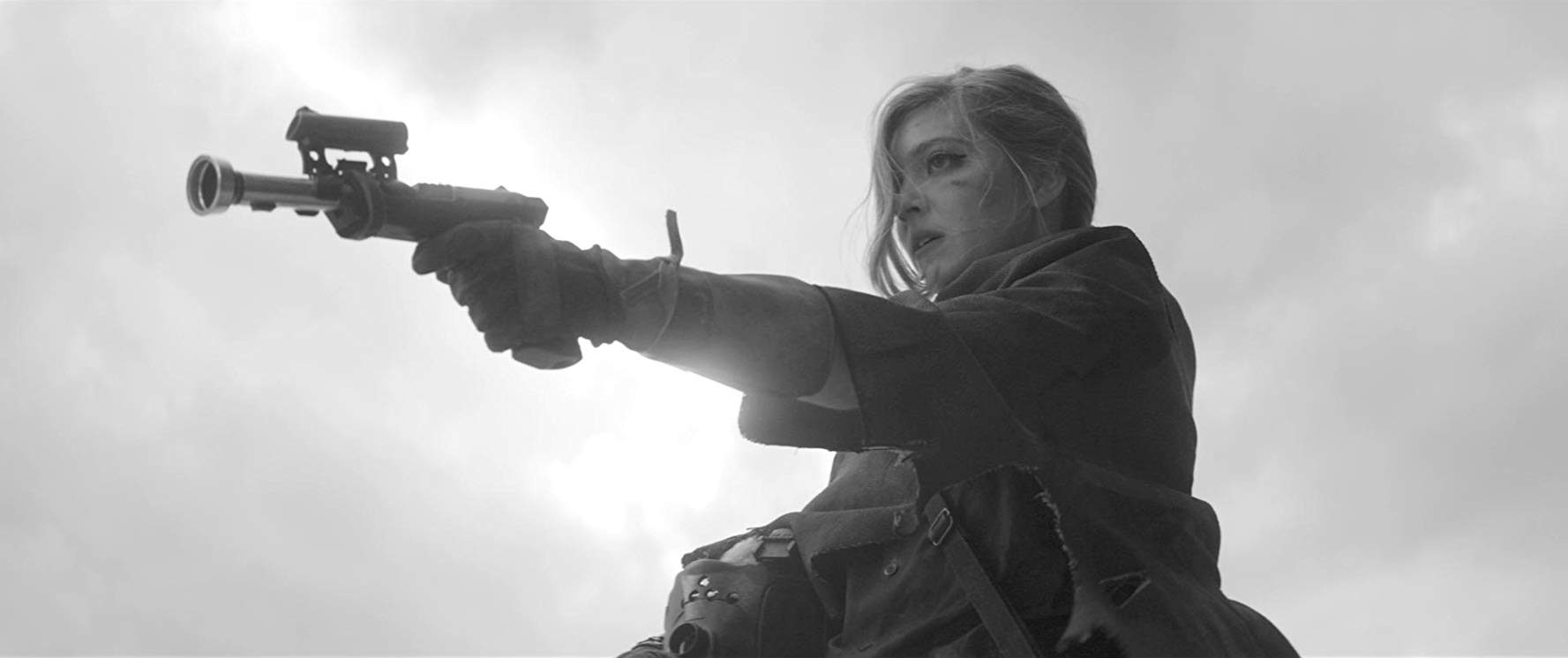 There are some very interesting ideas here. Unfortunately, probably too many of them. As a result, the end-product feels like a half-baked collection of semi-formed thoughts – none of which are explored to the extent they deserve. It begins with an apocalypse, apparently triggered in order to stave off an alien invasion. Fast-forward a few years, and we join Sarah (Hutchinson), one of four children who are shortly to be teleported to a space station orbiting around another planet, which is the target for future habitation, and where the President of Earth now resides. Except an alien sympathizer stages an assassination attempt, leaving the children dropped onto the planet’s surface, along with the Commanfer (Trigo), who had a role in the apocalypse seen earlier. But he ends up being taken over by a parasite which turns him psychotic and he begins hunting down the children. Who need to locate the President, who also crash-landed nearby, because…
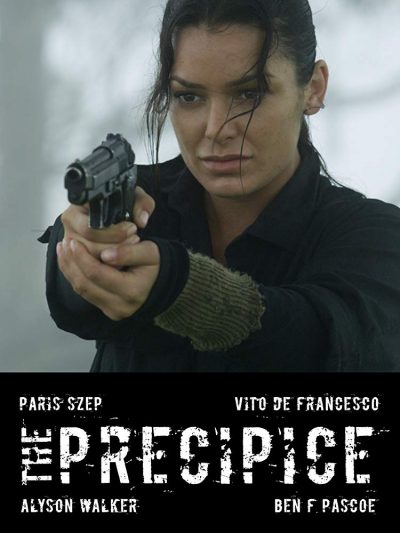 There’s nothing wrong, as such, with a film playing its hand close to its chest. However, you’ve got to give the audience enough information to keep them interested, and wanting to find out more. It’s here that this movie fails entirely, doggedly remaining so reluctant to tell you anything, I wanted to strap it down in a chair and start waterboarding. We don’t even get names for anyone involved, it’s that willfully unforthcoming. This begins in the aftermath of a shoot-out at a wind-farm, from which there are apparently only two survivors: a woman (Szep) and her captive (de Francesco). They head across the rural terrain towards a rendezvous with her allies, pursued not only by the captive’s allies, but also other interested parties.
 After an un-specified global apocalypse, humanity is reduced to small bands of scattered survivors, who have to try and scratch out survival, while avoiding the attacks of “reapers”, mutated creatures which stalk the landscape, especially after dark. One of those survivors is Juliette (Ashworth), who is on a foraging mission in the desert when an accident throws her off the road, and leaves her with a badly-broken leg. She has to wait for help to arrive, fending off the reaper (Botet) which is prowling the area, with whatever she can find to hand. As she does so, she thinks about life before the apocalypse, where she escaped drug addiction with the help of her boyfriend, gallery owner Jack (Fitoussi) – only for happiness to be fleeting, and taken away from her when multiple tragedies strike.
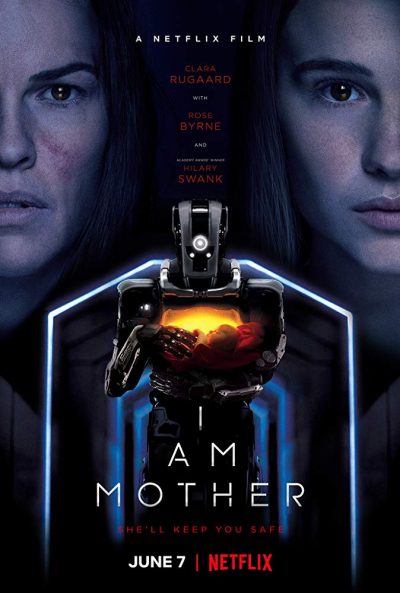 After an extinction-event has turned Earth uninhabitable, an underground “ark” holds thousands of human embryos, overseen by a robotic Mother (voiced by Byrne, performed by Hawker). One embryo is brought to fruition, becoming Daughter (Rugaard, resembling a young Jennifer Garner), who grows up into a young woman, educated by Mother to believe she’s alone on the planet. But she begins to doubt what Mother tells her, and these doubts are confirmed when another, older woman (Swank) shows up. Let in by Daughter, she tells tales of humanity outside struggling for survival against robot killers. Everything Daughter has been told is a lie. Or is the new arrival telling the whole truth either?
 This one may be the origin of the meme, “After the apocalypse, food, water and gasoline are in short supply – but hair-spray will still be plentiful.” For there’s no denying the absolute silliness of this slab of post-apocalyptic nonsense. But it’s still imaginative and energetic enough that my interest was largely sustained. We’re apparently long enough after World War III for it all to have become the stuff of almost-forgotten legend. In the aftermath, the world is now occupied by roaming bands, mostly of men. However, certain women are gifted with special powers, and they have banded together into the titular group, under their reverend mother, and are feared by most as witches.
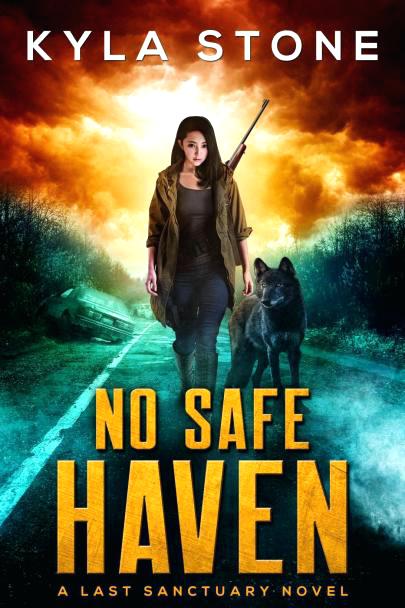 I’ve read enough action heroine novels now to be more than familiar with the tropes of the genre. For example, I can do without ever reading another novel which puts fantasy creatures like elves and magic into a modern-day setting. The zombie apocalypse is another scenario which has been done to death. I mean, we even abandoned The Walking Dead, and watching that was pretty much muscle memory. However, this novel proves there’s still life in the genre, offering some interesting twists on it.