
Dead of Winter

★★★½
“Old, bold and cold.”

Thompson seems to be having a second wind, making her first appearance on this site at the age of sixty-six. That’s a decade more than Liam Neeson was when he became an action star with Taken, and probably makes Thompson the oldest debutante here. This comes on the heels of series Down Cemetery Road which, while not quite qualifying here, certainly was more brisk than expected. At this rate, I might even have to forgive her for throwing shade at Audrey Hepburn. No question about the credentials of Winter for this site, since it plays like a cross between Fargo and Taken. There’s not a lot of fat here, certainly. Things kick off just a few minutes in, and barely stop thereafter.

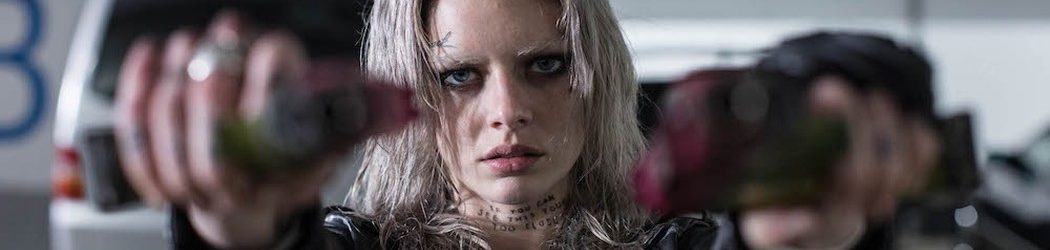
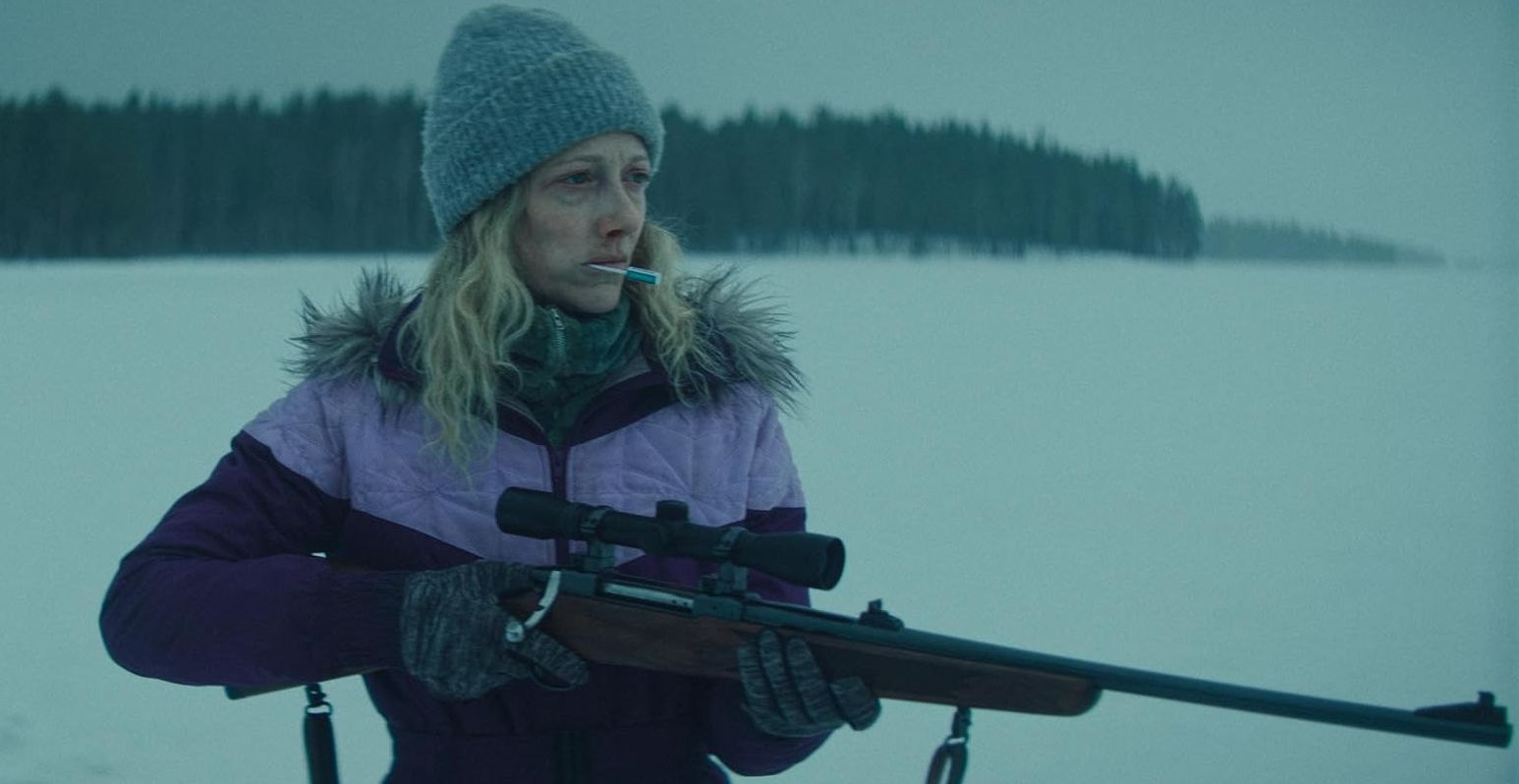
Barb (Thompson) is on the way to a lake in Minnesota – a part played by Finland – for some ice fishing. She gets turned around, and stops at a remote cabin to ask for directions. There she meets an odd man (Menchaca), and notices some blood on the ground. Then, at the lake, she sees the man chasing after and recapturing a young woman (Marsden), so realizes she has stumbled into the middle of a kidnapping plot. After the obligatory “no signal” scene, Barb realizes she is the victim’s only hope. But the man may not be her biggest problem. His wife (Greer) is the real brains behind the operation, very highly motivated, and prepared to go to any lengths to stop Barb from interfering in the grim plan.

I will say, it does take a bit of getting used to, hearing Thompson going full Marge Gunderson, eh? This is no comment on the accuracy of the accent, a topic on which I am not qualified to speak. It’s just odd. However, this is not a particularly dialogue-heavy movie, with Barb spending much of it alone and in the wilderness. We never find out either of the antagonists’ names, incidentally, the end credits just calling them Purple Lady and Camo Jacket. The film focuses increasingly on the two women. Purple has nothing left to lose, generally having the edge in firepower and ruthlessness – as is demonstrated after Barb is able to reach help through a CB radio. But Barb has motivation of her own. 

This comes out in rather clunky flashbacks to the early days of her relationship with her husband. Truth be told, I didn’t feel these added particularly much; the same information could have been provided more efficiently, and in ways which didn’t derail the tension of the current situation. Though I did like how the young Barb is played by Thompson’s real-life daughter, Gaia Wise, I found myself impatient for the film to return to the one-on-one battle, which you know is going to end badly for someone. Or someones. The film doesn’t disappoint there, with a brutal struggle in the middle of a frozen lake, good enough to make me forget the combatants have a combined age of 116. 

Dir: Brian Kirk
Star: Emma Thompson, Judy Greer, Marc Menchaca, Laurel Marsden

De La Cruz

★★½
“Proverbs 21:15.”

Which, in case you were wondering, is: “When justice is done, it brings joy to the righteous but terror to evildoers.” Though based on this, I would suggest adding “…eventually” to the end. Because you are going to need a lot of patience here. While this is a rape-revenge movie, the sexual assault in question takes almost an hour to show up. Until that point, there are two threads, and you’ll also be waiting for them to connect. By far the less interesting is the teenage soap opera of the pure and innocent Yoli De La Cruz (Diaz), and her friends, the somewhat annoying Daniella, and the immensely irritating Adriana. Boys, parties, etc. You know the score.
The other is rather more intriguing, being the struggle of former MMA fighter, now a cartel hitman, Lobo (Patiño), to leave the criminal life. This comes after a near-religious experience involving Santa Muerte, who is basically the personification of death in Mexican folklore. Meanwhile, Yoli ends up being raped by Victor (Issac GH). The moral here is, you’re clearly far better off being a slut like Adriana, and going with it. Victor is the son of the local police chief, so justice will not be done. However, this is where – after an hour and twenty minutes – the stories join up. Because Lobo turns out to be Daniella’s cousin, and agrees to teach Yoli a very particular set of skills, so she can administer her own vengeance. 

Things definitely improve in the latter stages, not least because Adriana is almost entirely absent. You will need to be extremely patient to get to the good stuff. Lobo holds the film together, and there’s a great scene where he’s talking to Yoli’s father (Gaviria), and explaining why he can’t do anything himself. The way Santa Muerte gets mixed in isn’t bad, though when she rises up behind Yoli before her first bout, it does look like someone cosplaying as the Grim Reaper. There is a reasonable amount of effort put into the heroine’s transition from shrinking violent to avenging angel, though it is a little montage heavy, writer/director Baez being unable to get out of his own way. 

It certainly needs a good half-hour edited out in the early stages, when there is simply far too much faffing around, to use a good old British phrase. There’s also a weird lack of location: while presumably set in Mexico, going by references to cockfighting arenas, etc. there’s a significant amount of English being spoken. It ends in “To be continued…” having opened, one hundred and thirty minutes earlier, with a “Part 1” caption. I had spent much of the previous two hours bracing for a cliffhanger, which mercifully never appears, this being relatively tidy. Would I mind a part two? That depends largely on whether Baez avoids the faffage which dragged the first half here down like an anchor. Lobo and Yoli going 100% vigilante might be of interest though. 

Dir: Michael Baez
Star: Sofia Diaz, Raul Patiño, Noe Issac GH, Fernando Gaviria

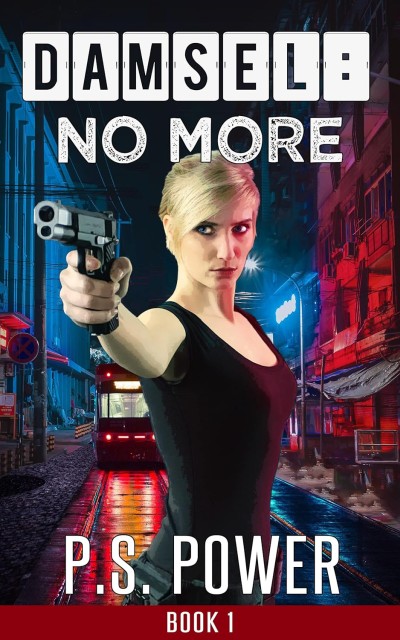
Damsel: No More, by P.S. Power

Literary rating: ★½
Kick-butt quotient: ☆☆

It’s rare that I can pin-point so exactly, the moment at which a book jumped the shark. But in this case, I can. I came across a paragraph which was so striking in its badness, I actually put the book down, to ponder what the heck I just read. It did not improve on several repeat attempts, and thereafter, I was simply unable to enjoy the book. Oh, it hadn’t been any great shakes to that point, but it became a genuine chore, and if I did not want to write this warning review, would certainly have become a DNF. Here we go:
Instead, she got out of the car, let Veronica lock up and secure the used towel in the back, in the trunk, which had a change of clothing in it, which the woman grabbed, carrying it with her. Since she still had chemicals all over her, that made sense to see to.

I am not exaggerating when I say that my eleven-year-old self would have been embarrassed to assemble those words in this order in a story. That this book is somehow rated over four stars on Goodreads makes me weep for the literacy of the population at large. The cover is what lured me in. The concept isn’t bad. But the execution is like being trapped inside the head of Kim Kardashian, and I would not wish that on my worst enemy. The heroine is Hannah de Peyser, a rich, vacuous heiress, who has had enough after the fourth time she gets kidnapped. “She might not be a hero, but she isn’t going to be anyone’s victim, not any longer. The damsel is gone, and in her place is a force to be reckoned with.”

Except… not mentioned, is that this is a bad superhero caper, with the world populated by caped crusaders with various powers. Our heroine initially has no such ability, but develops over the course of it, the ability to remote view people. If you’re thinking this could easily be used as a crutch to escape bad writing… No comment. She’s also apparently good at convincing people, including really stupid scenarios, such as that they are coated with an explosive that will blow up if they return to the United States. I feel like I lost measurable IQ points reading that chapter. 

In regard to action, so far, she has spent almost all her time training in VR, with the actual action highlight being her foiling a robbery at a truck stop. There is a lot of space spent discussing thing like a “third gait,” which is apparently a better way of running. I did not sign up for a kinesiology lecture, but apparently some people did: again, four-plus stars on Goodreads. I somehow ground my way through the pages to an underwhelming ending. Do not hold your breath for any more reviews.

Author: P.S. Power
Publisher: Orange Cat Publisher, available through Amazon, both as a paperback and an e-book
Book 1 of 8 in the Damsel series.

Desolation, by David Lucin

Literary rating: ★★★½
Kick-butt quotient: ☆½

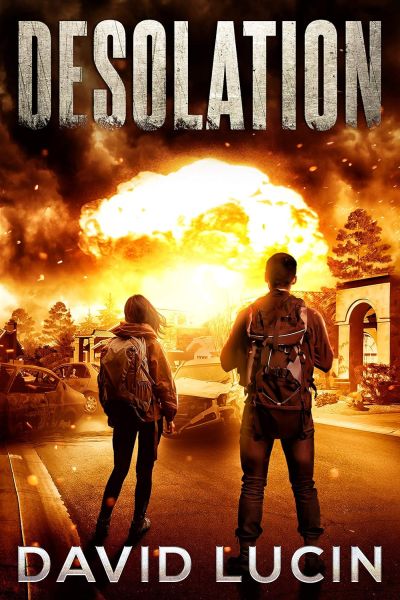
When the apocalypse comes, if popular fiction is any guide, it’s going to be undead and craving brains. But not far behind in terms of literary popularity, appears to be an EMP. This is a high altitude nuclear detonation, which would unleash an electromagnetic pulse – hence the name – capable of frying anything with a circuit board, continent-wide. It is generally not good for civilization. I think this is the first such book I’ve covered, and I was particularly intrigued, because it’s set here in Arizona. Which is a little weird, because the author appears to be based out of Vancouver, British Columbia. I presume some connection to the state.

It mostly takes place in the northern mountain town of Flagstaff, where Jenn Jansen is attending college when the power goes out, and the world grinds to a halt. Not that it’s exactly a great world to begin with, already teetering on the edge of famine and war, with multiple conflicts around the globe (in particular between the US/NATO and China), while most of the population live in poverty, even in the United States. Jenn’s parents are down in Phoenix, which… the author doesn’t seem to like much, calling it a “desert hellscape” among other things. [Looks out window] OK, he’s not wrong… But it doesn’t get any better after the city gets hit by multiple air-burst nukes. Help is not coming to Flagstaff any time soon.

Jenn has to figure out what to do, though at least initially, basic survival is not too rough. However, she gradually realizes not everyone is willing to pull together, and hard times make for difficult moral decisions. She’s rather better at these than her boyfriend, Sam, who comes from a more privileged background. His family are in Payson – between Flagstaff and Phoenix – and the pair head down there to bring them up to Flagstaff. That pushes Jenn further along her evolution. According to the author, “By Book 4, she’s not the impulsive, bossy, and sometimes annoying girl from Book 1; she is a soldier and a cool-headed leader,” and I can see the early signs of this appearing already, though I never found her especially annoying. 

Action-wise, it is fairly restrained, but there is a sense of escalation, with the book giving us good insight into Jenn’s thoughts. Of note, her reaction to having to use increasing degrees of violence is explored in more detail than I would have expected. It’s not easy or facile, but by the end, the blood on her hands is mounting. I sense that’s only going to increase, as it appears the next part has her becoming part of a reconnaissance expedition to Phoenix. That’s a story I am interested in reading, and not just for reasons of personal familiarity, also to see how Jenn develops. But perhaps my neighbourhood might make an appearance. Even if it’s going to be a bit radioactive.

Author: David Lucin
Publisher: Highway 3 Publishing, available through Amazon, both as a paperback and an e-book
Book 1 of 6 in the Desolation series.

Dirty Angels

★★★½
“Dirty deeds, done dirt cheap.”

It’s important to realize that this is a throwback to movies from an earlier, simpler time. One when action movies could consist largely of a red-blooded American hero, killing evil furreners in spectacularly violent ways. And it didn’t matter much whether the person playing the hero was actually a foreigner themselves i.e. Arnold Schwarzenegger. Thirty years later, we are supposed to be more tolerant, and watch films where nuance has replaced shallow stereotypes. We have met the enemy and he is us, or some similar guff. Dirty Angels cares not one whit for such niceties. Its sole concession to ‘progress’, is a hero with a vagina. Who is still actually a foreigner, Eva Green being French. 
She plays Jake, a hard-ass soldier who has been causing trouble for the military brass, since an incident in Afghanistan where the rest of her team was killed. She gets a chance to put things right after ISIS kidnap a batch of girls from a school in Pakistan and take them back over the border. It needs to be a majority female team because reasons, and so we get minions referred to only by their skill-set, e.g. The Bomb (Bakalova) or Medic (Rose). I was a little worried by the latter’s presence: going by her recent films, she should have been called The Bomb. However, she’s a minor presence compared to Green, whose irresistible force beats the immovable object of Rose.

Adding to Jake’s enthusiasm, the ISIS leader behind the kidnapping is Amir (Iskander), the same man responsible for killing her comrades. However, they can’t cross the border armed, so before launching an assault on Amir’s compound, they first need to liberate the necessary weaponry. This all provides Campbell, recently seen here with The Protégé (and he has Daisy Ridley’s The Cleaner out early next year), with plenty of opportunities for some seriously messy violence, and a high body-count on both sides. Throat slitting, head shots and some severe stabbing ensue, though there is some dodgy CGI. An exploding helicopter at the beginning is shockingly bad. Fortunately, it is not a portent of what’s to come, with a lot of good, practical effects work instead. 

In other reviews, I’ve seen a lot of predictable whining from predictable whiners, but the bottom line is, I was entertained. A very significant portion of that is down to Green, whose intensity fuels the whole movie. [This represents a reunion with Campbell, who directed Green for her breakout role in Casino Royale] With someone less effective in the lead role – coughRubyRosecough – this could potentially have been a whole star lower. Again, it is a throwback to times where a crap action film could work, given a star with enough charisma, and once more I’m thinking of Arnie. There’s nothing new or innovative here, certainly. I was not looking for such, just a cacophony of giant fireballs and mild to moderate xenophobia. Sometimes, that really is all you want. It’s the simple things which matter…

Dir: Martin Campbell 
Star: Eva Green, George Iskander, Maria Bakalova, Ruby Rose

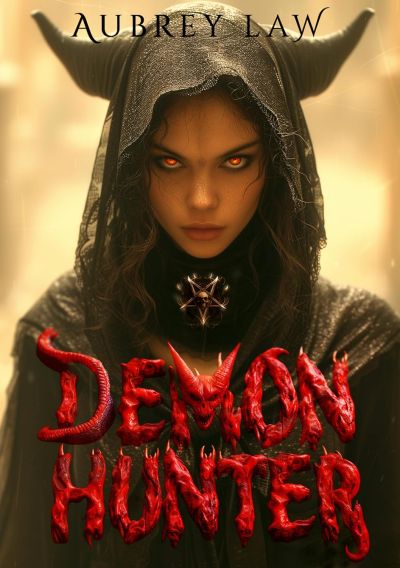
Demon Hunter, by Aubrey Law

Literary rating: ★★½
Kick-butt quotient: ☆☆☆½

I wouldn’t call this great literature, by any stretch of the imagination. In fact, in many ways, it’s not very good. But I must admit: I was entertained, and was far from unhappy to realize that I’d picked up an omnibus of books 1-5 further into my reading list. I’m not sure I’m going to bother with reviewing those following installments; certainly not independently, it would be a bulk package, if at all. But I’m going to read them, and probably enjoy them. What’s interesting is, the author has created a protagonist who is, in many ways, a terrible person. But by then pitting them against arguably worse people, the reader is left on her side.

It begins a long time in the past (round about the birth of Christ, I think), when royal princess Annis has to flee after her mother, Amelia, kills her father. Annis had been trained in the dark arts, and vowed to continue building on these skills, until she is eventually powerful enough to take revenge on Amelia. Over a millennium later, her lifespan extended unnaturally and now a skilled Black Witch, Annis is captured by witch-hunters, tortured and executed, her soul descending into hell. After biding her time in torment for centuries, she seizes the chance to escape, finding herself in modern-day Los Angeles and occupying the flesh of a sex slave called Ashley.

She’s not happy about it, and certainly has the skills to punish those unfortunate enough to be on her lengthy list. Methods of dispatch Annis can use include: making your heart explode, forcing you to kill yourself, and – a personal favourite – Exoskeleton, a spell that violently relocates all the victim’s bones to the outside of their body. Given everything she can do, seems odd that the main quest in this book is for a weapon, the Judas Dagger, forged from the thirty pieces of silver paid to Judas Iscariot for his betrayal of Christ. Compared to Exoskeleton, sticking ’em with the pointy end seems very low-energy. Admittedly, there are a lot of entities on her trail too, though so far none pose much of a threat.

You could call this trash, to which I would nod, and reply, “Yes. Your point being…?” So far, there have been precious few indications of pretension or depth, with Annis simply reacting – usually violently – to the circumstances in which she finds herself. There’s hardly a sympathetic character here. Sonja, another sex slave who is rescued by Annis, comes closest but she quickly ends up turned into a ghoul who needs blood to survive, and isn’t too fussy about its source. I hope we get someone who represents a bit more of a challenge for Annis, because when you can stop an opponent’s pulse dead, most battles don’t last long. Albeit a bit guiltily, I confess to being not disinterested in finding out.

Author: Aubrey Law
Publisher: Independently published, available through Amazon, both as a paperback and an e-book
Book 1 of 7 in the Revenge of the Witch series.

Dominique

★★★★
“Ukraine 1, Colombia 0.”

We’ve been keeping an eye on the career of writer-director Ojeda since Savaged, more than a decade ago. We last saw his work with The Russian Bride, which shares the same star in Orlan, but I do feel the pieces have finally come together. Sure, this is imperfect. However, the positives are pretty damn impressive, and as a throwback to the action golden era of the eighties, this is close to spot-on. It begins with a plane crash, as the aircraft piloted by Dominique (Orlan) is shot down in rural Columbia by the local cartel. Their effort to loot the wreckage goes wrong, because Dominique is not dead, and quickly demonstrates the skills she had in a previous life as a Ukrainian assassin. 

She was badly injured in the crash, and ends up taking shelter in the small town of San Lucas, at the home of police officer Julio (Carvajal) and his family. He’s gathering evidence against his corrupt boss, Chief Santiago (Compte), who’s working with the cartel. When Julio is exposed, Santiago decides an example must be made of the informant, wiping out not just his employee, but his entire family. The only thing standing between them and annihilation is Dominique. After she successfully repels the initial assault, she has to fortify the family home, and prepare to fend off everything Santiago can throw at her. Which is a lot of cannon fodder. Most of it tactically inept, I must say.
The character work in this is strong, on both sides. Santiago is spectacularly evil, to the point he could have been a caricature. Yet Compte’s performance keeps it just human enough to be truly scary, due to his complete disregard for life. On the other side, Orlan keeps things very subdued, to the point of seeming dead inside, due to past trauma. Is this limited acting range? Or a very subtle performance? Could be either. In any case, it works, tiding the viewer over until the extended eruption of violence, which occupies most of the movie’s second half. As noted, it does rely on the attacking forces underestimating their opponents, to put it mildly. But Ojeda mixes the combat up nicely, and it’s a blast to watch.

The ending. Hoo-boy. It does one thing right, both brilliant and terrible at the same time. But it then bails out, what should have been the climax, is literally run underneath its end-credits. This is a brave choice by Ojeda. It didn’t work for me, and I’d rather have seen one final spasm of ultraviolence from the heroine. That it still was good enough to get our Seal of Approval says something. If it had sealed the deal, the movie could have ended up making my top ten for the year. It remains a film I enjoyed watching, and would definitely not mind seeing Dominique in action again in future. Or whatever Ojeda comes up with: I’m down for that too.

Dir: Michael S. Ojeda
Star: Oksana Orlan, Maurice Compte, Sebastian Carvajal, Alanna De La Rossa

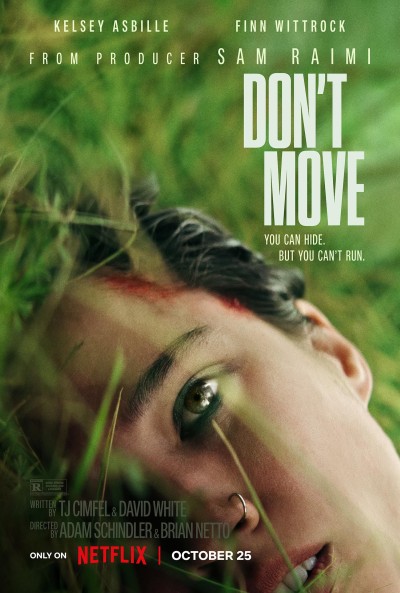
Don’t Move

★★★
“Suicide hotline stalking”

A somewhat gimmicky but adequately competent Netflix Original, I guess the moral here is that being abducted and stalked by a serial killer is the best kind of therapy. We meet Iris (Asbille) in the remote woods where her young son previously died. She never recovered, and is now standing on edge of a cliff, contemplating suicide. She’s interrupted by the arrival of a stranger, Richard (Wittrock), who talks her down. However, it turns out he has an ulterior motive: he wants to be the one to kill Iris. He tazes her, and while subsequently managing to escape, she has also been injected with a muscle relaxant that in twenty minutes will render her unable to move. 

Obviously, this makes for a perilous situation, as the drug slowly works its way through her system, eventually shutting down almost all conscious muscle movements. As such, it is going to be an “action” heroine film more in spirit than literally. For the vast majority of the film, Iris is unable to do very much more except blink enthusiastically. Naturally, both coming and going, the chemicals operate in exactly the way necessary to facilitate the script, and ratchet up the tension. Need to alert a suspicious police officer (Francis) to her presence? She will be able to move her hand just enough for that purpose, albeit very slowly. However, the script is assembled well enough, these moments feel organic enough to pass muster.

I think the best sequence has her washing up on the land of the reclusive Bill (Treadwell), an old geezer who is initially able to help. However, he is interrupted by the arrival of Richard, supposedly looking for his mentally disturbed wife. Bill can sense this isn’t exactly the truth, but Richard spins a plausible web of lies, all while Iris is inches away, unable to do anything. This generates quite the nervous energy, before it’s suddenly released. Indeed, Bill is an interesting person, albeit by the low standards of “minor characters in serial killer films”. Richard, too, has some surprises in his back-story. An unexpected phone call upends his carefully prepared plans, requiring a quick disposal of Iris, which leads to the movie’s climax. 

This is where it does topple over in terms of credibility, with more than one, “Wait, what?” moment. Apparently, a dunk in cold water is all it takes to reverse any pharmaceutical effects. Didn’t do much earlier, but I’ll say no more. While it’s always an issue if a film can’t stick the landing, Asbille delivers a good enough portrayal to keep me interested. That’s especially so, given the physical limitations imposed on her by the script; there are points where her eyes are the entire performance. Like most Netflix Originals, this isn’t likely to leave a lasting impression. However, unlike some, it did not leave me feeling my time had been wasted. Producer Sam Raimi, his name larger on the poster than the stars or directors, shouldn’t be embarrassed by this.

Dir: Brian Netto, Adam Schindler
Star: Kelsey Asbille, Finn Wittrock, Moray Treadwell, Daniel Francis

Duchess

★★
“Largely ignoble.”

Marshall has been involved in our genre back to 1998, when he wrote Killing Time. Since then, there have been some classics (The Descent), but the trend has been gently downhill. Of late, he seems to be doing a lot of work with wife Charlotte Kirk (a mere 22 years his younger). The last here was The Lair, which Kirk co-wrote with her husband and starred in. The same is true for this, just to slightly lesser effect, and with even more derivative results. This feels in particular like an early Guy Ritchie film, with larger than life underworld figures, hyper violence and snappy dialogue. Well, those are the goals, anyway. Execution is a different thing, to varying degrees.
The heroine is Scarlett Monaghan (Kirk), rescued from her low-rent pickpocket career by international man of mystery, Robert McNaughton (Winchester), and whisked off to a life of luxury in the Canary Islands. Turns out her new boyfriend is a diamond trafficker, and that’s a very risky business to be in, given the huge profits to be made. While he has a loyal cadre of associates, such as Danny Oswald (Pertwee), not everyone in his circle is trustworthy. After an associate tries to rape Scarlett, and is killed by her, the violence and treachery escalate to the point where she and Robert are left for dead. She isn’t prepared to let it lie, and comes back from the grave to take revenge on those responsible.

Bits of this work reasonably well, with Kirk making a good impression. [Also: you’ll understand why the director married her… I now move rapidly on!] Monaghan is a character with a rough-hewn charm, and a fierce loyalty to those for whom she cares, be that friends, family (with the exception of her father, played by Colm Meaney) or Robert. The big problem here is pacing. The movie is almost two hours long, and barely the last twenty minutes are involved in the interesting stuff: Scarlett’s vengeance. Even when this shows up, it’s hardly The Bride taking on the Crazy 88’s. Indeed, you could argue the most fun action is the opening scene of the movie, which then rolls into a flashback of how we got to that point.

Some of the violence is striking. Scarlett goes to extremes to extract information, and veteran actress Stephanie Beacham, playing Robert’s business partner, goes full Colombian necktie on a minion who tries to steal from her. This does feel at odds with the overall tone. It’s quite light in its atmosphere, populated by larger than life characters – Beacham’s sweary boss is the most obvious example – rather than aiming for gritty realism. This did a barely passable job of holding my attention. It probably should have joined proceedings considerably later, with all Scarlett’s London life largely irrelevant. Did appreciate the Peckham mentions though, having caught the train to work daily from there, back in the nineties. That I was more excited by this than 95% of the film, is likely a warning. 

Dir: Neil Marshall
Star: Charlotte Kirk, Philip Winchester, Sean Pertwee, Colin Egglesfield

The Dive

★★
Breaking bad.”

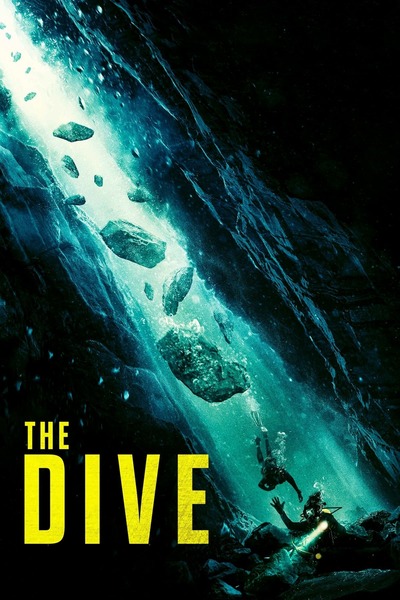
This is an English language remake of Breaking Surface, a 2020 film from Sweden. It is also a sterling demonstration of what happens when you do not follow the Golden Rule of Remakes. “Only remake a film if you can improve on the original.” The first red flag here is the quick turnaround, just three years after the original. It’s clear that the idea here is simply to copy the film, for an English language audience who don’t want to read subtitles. We’ve seen this kind of thing before, when Nikita was turned into Point of No Return, also three years later. There, as here, the remake is entirely superfluous if you’re familiar with the original, and does not fare well in any comparison. 

As you’d expect, the basic story is the same. Sisters Drew (Lowe) and May (Krause) have drifted apart over the years. But a shared passion for diving brings them back together for a trip on a remote stretch of coastline, to explore an underwater cave system. Initially, it goes well, until a rock slide leaves May with her leg pinned at the bottom of the sea. Her oxygen running out, it’s up to Drew to return to the surface, call for help, and bring down fresh tanks to keep her sister breathing. Naturally, it’s not as simple as that, with Drew having to overcome a slew of obstacles, from a car boot that won’t open, to equipment that malfunctions.

I’m quite hard-pushed to work out specifically why this had more or less the same ingredients as Breaking Surface, yet is so much less effective. It just feels like each element is a third- or fourth-generation photocopy of the original. The sisters, for example, are less appealing. There’s the same dynamic, in that May is the calm and collected one, while Drew is not suited to handling a crisis. But May comes off almost as robotic, while Drew is shrill and aggravating. There’s also a similar back story, involving a childhood incident. Here though, it seems to get in the way of the main plot, rather than enhancing it, with useful or interesting background. It sometimes feels like you need to know diving stuff too, and I don’t. 

To be fair, if I hadn’t seen the original, this would certainly score higher, perhaps around three stars. It’s still a good scenario, and I did like some elements, like the pointed note the sisters’ car is a rental. I just hope they got the damage waiver. But most of the changes, such as swapping out the chilliness of a Scandinavian fjord for the warmth of the Mediterranean (Malta, to be precise), seem pointless at best, and a detriment more often than not. By the end, which seems significantly more contrived in the original, I had an overwhelming urge to run off and watch Breaking Surface again. Though it did reaffirm my beliefs that caving = nope, diving = nope, and cave-diving = nope squared.

Dir: Maximilian Erlenwein
Star: Louisa Krause, Sophie Lowe