



★★★
“When the Blue Danube turned red…”
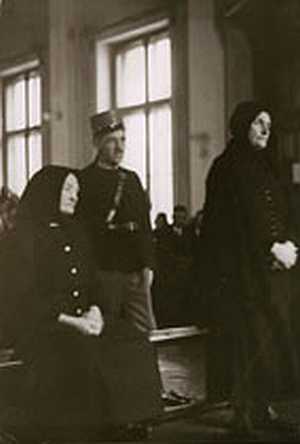 You wouldn’t know it to look at the sleepy Hungarian village of Nagyrév [population: 872], but there was a time between the world wars when this was the murder capital of the world. Between 1914 and 1929, an estimated three hundred people were poisoned to death, using arsenic obtained by boiling down flypaper. The great majority of the murders were committed by local women, who wanted rid of their husbands; the local midwife, Julia Fazekas, was the source of the lethal materials. This was in an era when divorce was all but impossible, and many marriages were arranged; Julia offered a quick and painless (for the wife!) escape from a life of abuse and a loveless relationship. Since she was the closest the village had to a doctor, and her cousin was in charge of filing the death certificates, she and her accomplices got away with their crimes.
All good things must come to an end, however. It’s unclear what triggered police action, but Fazekas knew the game was up, and by the time the police knocked on her door, she’d used her own poison to commit suicide. 26 of her associates, however, were taken to court; eight were sentenced to death, seven to life imprisonment and the remainder to various terms in jail. Eight decades later, Bussink returned to the village, and found some inhabitants still alive, who were around at the time, such as the 93-year old Rosika, in whose pantry one of the murderers hung herself from a nail. Her family then used the nail to hang bacon up.
It’s an not uncommon moment of gallows humour in the film (which puts the death-toll lower, at “only” 140). While Bussink initially met some resistance from the locals, they seem happy here to open up to her; the women, in particular, view past events with phlegmatic resignation. Maybe there’s something about Hungarian ladies; see also Vera Renczi, who murdered 35, including husbands, lovers, and a son early in the twentieth century, and of course, Countess Erzsebet Bathory. However, the film never really does more than scratch the surface, and the running-time is padded unnecessarily by shots of the local countryside, rather than providing more historical background. There’s a pointed, if very clumsy, allusion to modern times, with a local folk-dance club discussing the problems they have with their husbands.
The overall effect is to open the door on a largely-forgotten corner of murderous history, but Bussink doesn’t shine much light into the dark corner. There was word of a movie based on the topic, to star Helen Mirren, which shifted the location from Hungary to Yorkshire, with Anna Friel and John Hurt also involved, and Jon Sommersby Amiel as the director. [Curiously, Friel recently played Countess Bathory in another film] That was first announced in August 2006, but IMDB still shows it as “in development”, so who knows. I suspect the Hollywood fantasy will be nowhere near as bleakly murderous as the reality, somehow.

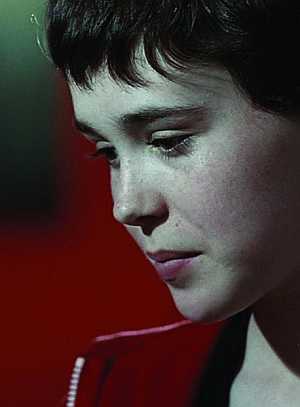 This is almost unbearably creepy, in two different directions: however, it’s almost impossible to discuss this film in any meaningful way without spoilers, so you have been warned. The danger of online predators is well-known, and when fourteen-year old Hayley (Page) agrees to meet photographer Jeff (Wilson), who is in his thirties, alarm bells are ringing. They reach a piercing level after she goes to his house, starts drinking vodka and flirting outrageously. However, the tables are abruptly turned: she’s spiked Jeff’s drink, and he wakes to find himself tied-up, and entirely at Hayley’s mercy. He soon finds out that’s a quality she is very definitely
 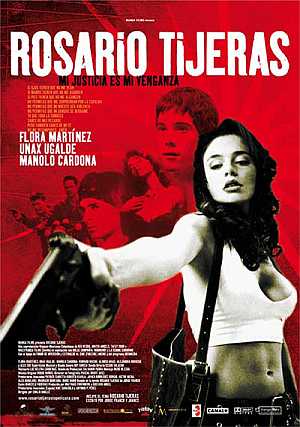 Antonio (Ugalde) and Emilio (Cardona) meet the gorgeous Rosario (Martinez) at a nightclub in Medellin, Columbia, and both form a relationship with her – Emilio, a physical one; Antonio, a platonic but perhaps more deeply felt attachment. While information on Rosario is limited, not least from herself, they soon discover that she has a dark past (Tijeras isn’t her surname, it’s Spanish for “scissors”. Let’s leave it at that, shall we?) and a dark present (among the many rumour swirling around is that she has killed 200 or more, in her role as a hitwoman for the local drug cartels). Nor is the forecast for her future sunshine and rainbows, since the first scene has Antonio carrying a badly shot-up Rosario into a local hospital, with the rest of the film told in a series of flashbacks.
 Not to be confused with the (rather tedious, IMHO) bunch of New York feminist artists, this is about Isabel, the well-educated daughter of a middle-class family, who opts to toss it all away and go into the jungles of Colombia to fight the revolution with FARC, the insurgents who have been rebelling against the government for more than 40 years. She undergoes training, both political and military, and has to adapt to an environment radically different from the one she knew before. It’s not always successful, and you wonder how she’s ever going to become a “freedom fighter” when she can’t even take part in the slaughter of a cow. [shown, below right – PETA activists will
 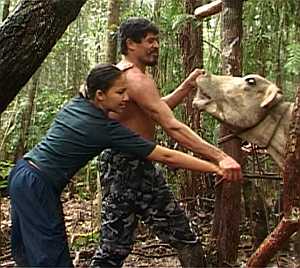 e the film-makers didn’t want to go down that avenue, and since they were out in the jungle, with a group of heavily-armed insurgents, I can hardly blame them for letting that angle slide. Instead, it lets the film speak for itself, and FARC does sometimes come across as little better than kids playing soldiers: one, particularly memorable part of the training, consists of recruits running around, waving wooden guns about and shouting “BANG!” at imaginary opponents. They also have a startlingly bad ‘national anthem’, which sounds more like the fight song from a third-rate community college.
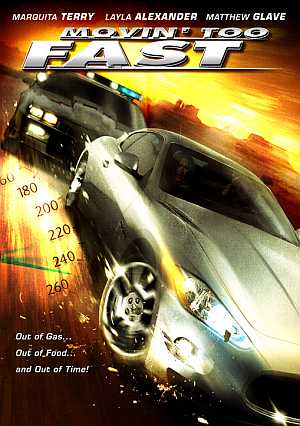 Yes, while there may not be a lot new here, the combination is at least somewhat interesting, and it’s put together solidly enough. Two students, Nina (Alexander) and Melissa (Terry) are on a cross-country drive, when they get stopped for speeding. Melissa makes a pass at the cop, but it’s an encounter that goes badly wrong, and she ends up beating him up with his own night-stick. When the duo get back on the road however, they find themselves being pursued by a police-car, which clearly has very bad intentions: with gas running low and – inevitably – no cellphone service to be found, can they survive?
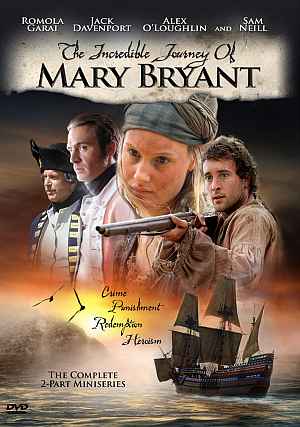 Most Aussies won’t thank you for mentioning it, but the colony was originally populated largely by the dregs of British society. Prisoners were shipped Down Under, thereby alleviating jail overcrowding and providing a cheap labour source for the new world. This mini-series recounts the story of one such unwilling emigrant, Mary Bryant, shipped off to Oz for a petty theft. She gives birth to one child en route, and has another there, but when starvation threatens her family, she plans a daring escape, and convinces her co-convicts to help, even though they’re 3,000 miles from the nearest safe haven.
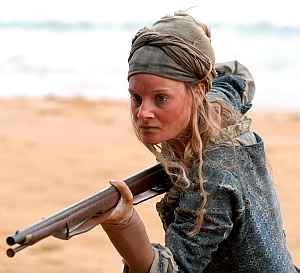 Here be historical spoilers I was surprised how close this was to the truth. Bryant was a Cornish convict, transported to Australia, who did take part in a break-out. Though captured in Timor and returned to Britain, there was indeed a public outcry, and those involved were pardoned. The main dramatic invention is Clarke’s relationship with Mary; he certainly didn’t kill her husband, who actually died of natural causes during the voyage back to Britain. The nod to James Boswell is legitimate too, as he was among those who campaigned for her release. Various books have been written about her; Google is your friend if you want to find out about these.
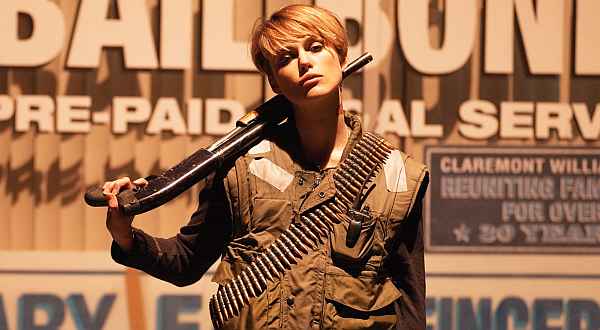 ★★½
★★½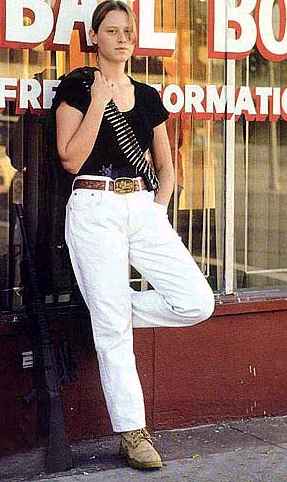 “This is based on a true story…sort of” is how the pre-credit disclaimer goes. Which does, at least, show far more honesty by Tony Scott than the usual claims in such things – Blair Witch and Wolf Creek shuffle their feet nervously. Unfortunately, my response would have to be, “This is a watchable movie…sort of.” Scott brings his usual, hyper-kinetic style to the table, but I was prepared for that and so didn’t mind it. No, the major problem was the derailment of the film from the potentially fascinating and probably unique character of Domino, into yet another heist movie. So instead of any insight into personality, we get to watch a bunch of gangsters and low-lives, of whom Domino is merely one, double-cross each other. It’s an hour of watching the corpse of Barbaro being beaten, if you get my drift; even Scott has been here before, to better effect, in True Romance.
 The film is filled with distracting stunt casting in the minor roles. This includes Christopher Walken, Mena Suvari, Lucy Liu, Jacqueline Bisset, two guys from Beverly Hills 90210 playing themselves, Macy Gray, Tom Waits and even Jerry Springer, though the episode of his show here is far duller and more earnest than the real thing. Walken is, inevitably, the only one to make much of an impression, playing a reality TV producer who wants to make Domino a star. He’s described as having the attention span of a ferret on crystal meth, probably an adequate metaphor for the film as a whole. It lacks the patience to stay with and develop any of the characters, so sniffs around them for two minutes, before scurrying off to find someone else instead.
 This appears to be aiming for a leg-up on The Descent bandwagon and its theme of “chicks vs. cave-dwelling monsters in a remote wilderness”; though there’s only one of each here, rather than it being a team sport. “Troubled young ranger” Danielle St. Clair (Vincent) is atop a remote tower, watching out for fires, but a careless use of dynamite unleashes an ancient Indian evil that’s been trapped in a cave for centuries. Fortunately, despite said centuries, the monster still knows how to disable satellite dishes and trash Jeeps, as well as ripping the heads off everyone in the area it meets – except for St. Clair, of course, whom it merely terrorizes. The inevitable native American (Schweig) gets wheeled on for one scene of indigestible exposition, trotting out the usual cliches about how we’ve lost touch with our inner child, or some such New Age guff. Not that the beast cares much, I was pleased to see.
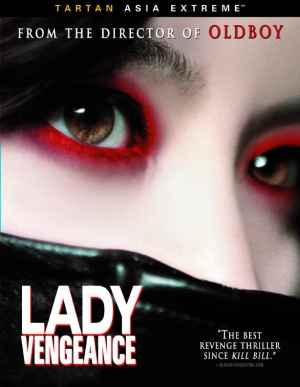 This film may need two viewings. First time up, I was irritated by an apparent lack of coherence – which was particularly annoying, since the non-linear storyline seemed almost completely superfluous. Second time round, it bothered me less though remained, perhaps deliberately, disorienting, and I still doubt the need for it. But the re-view left me better able to appreciate the great central idea, a chilling meditation on justice, revenge, the thin line between the two, and the effects on those who become involved. The final part of Park’s loose trilogy (after Sympathy for Mr. Vengeance and Oldboy) is the story of “kind-hearted Geum-ja” (Lee), who spends 13 years in prison, for the heinous murder of a young child. Except, she isn’t guilty, and spends the time forging alliances which will help with her new goal: revenge on the real perpetrator (Choi).
 The pace is stately, rather than adrenalin-driven, yet there’s no denying its place here. Much credit to Lee for a great performance in a complex character, capable of huge sacrifice in her quest for redemption: she cuts off a finger in front of the victim’s parents, and has to be physically restrained from removing more. Yet it seems that her charity and good deeds, such as donating a kidney to a fellow prisoner, may be part of her vengeance. And then, when her goal is within grasp…she steps back to allow others, perhaps better-motivated, to take her place. Or is the opportunity that she offers a poisoned chalice? The questions asked have no easy answers; neither proponents of capital punishment, nor those opposed to it, will find it comfortable viewing. By the end, there are no victims left; everyone is guilty – to use the old Sex Pistols line, no-one is innocent.
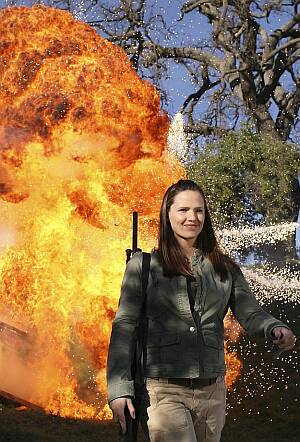 Our once-favourite TV show walks off into the sunset – literally – and we are confirmed in our belief that it is very, very hard to keep interest in a series going past the third season. Especially if you’re creator JJ Abrams, who was missing, presumably making the very Alias-like Mission Impossible III; he didn’t even return to write or direct the season finale. It was, on the whole, a credible stab at trying up loose ends: Rambaldi, the question of whether Sloan was good or evil, Syd’s relationship with her mother, and the real identity of Vaughan, about to be revealed at the end of season four, when he and Sidney were in a car-wreck. This led into the main arc of the series, a hunt for ‘Prophet 5’, a shadowy organization intent on the usual things shadowy organizations want. As opposed to, say, the Alliance, the Covenant, K-Directorate, SD-6, etc…