
Aileen: Life and Death of a Serial Killer

★★★★
“Lethally blonde.”

This is Broomfield’s second documentary around the topic of Aileen Wuornos, having previously made Aileen Wuornos: The Selling of a Serial Killer. It’s a glorious doc – one of my all-time favorites – but is more tangential, being about those around Wuornos, seeking to exploit her situation for their own personal gain. He thought he was done with the topic, but he was called as a defense witness during Aileen’s final appeal against the multiple death sentences, largely because among those exploiters was her lawyer at the time, Steve Glazer. But around appearing in the witness box, Broomfield decided to make a second documentary, this time focusing on the woman at the centre of proceedings, all the way up to her execution by lethal injection in October 2002.

What I love about Broomfield’s work is, he goes where the story leads him. Some documentarians – and I’m looking at you, Michael Moore – go into production with An Agenda (caps used advisedly). They then craft the end product towards that agenda. To me, that’s less a documentary than propaganda. Broomfield seems to have a much more open mind, and the results sometimes end up going in unexpected directions. Here, it’s clear that he has sympathy for Wuornos, but doesn’t pull any punches about her personality and mental state. He presents footage both of her claiming self-defense and absolutely confessing to having committed cold-blooded murder. The scary thing is, Wuornos appeared to me to be highly credible in each, contradictory situation. Maybe I’m just easily fooled. Sobering.

Certainly, there is evidence of Aileen’s anger issues. During his final interview, we see how she can go from calm discussion to volcanic ferocity in short order, for little or no reason, and storming out while flipping Broomfield the bird. If there had been a firearm to hand during this outburst… Yeah, watching this, the idea of her killing seven in less than a year definitely seemed possible. Rage and easy access to guns is a dangerous combination. But as the film proceeds, it appears Wuornos’s mental situation deteriorates into frequent surges of paranoia, claiming mind-control weapons are being used on her, and that the cops knew who she was after the first murder, and let her continue killing so they could exploit things in the media. 

Should someone so clearly ill in the head be executed? Political considerations – it being an election year, with the governor wanting to appear strong on crime – appear to have overridden any judicial concerns. A cursory mental exam pronounced her fit to die, and the sentence was duly carried out. On that day, Broomfield was interviewed by the media (a classic case of the snake eating its own tail). He said, “Here was somebody who is has obviously lost her mind, has totally lost touch with reality. We’re executing a person who’s mad, and I don’t really know what kind of message that gives.” As someone not averse to the death penalty, this documentary certainly made me pause for thought, and that alone proves its quality. 

Dir: Nick Broomfield and Joan Churchill

Sumuru

★★
“Queen of Outer Space”

A spaceship piloted by Adam Wade (Shanks) and Jake Carpenter (Bridgett) crashes on a planet at the far end of our galaxy. They’re searching for a colony which had landed there almost a millennium previously, only to find things not as expected. Somehow, over the centuries since, women have taken absolute control of society, relegating men to literal slaves, and worshipping a giant serpent as their deity. However, the men discover the planet is about to shake itself to pieces, and the residents need to be evacuated. Adam makes an ally of the current queen, Sumuru (Kamp), but that alone makes an enemy of high-priestess Taxan (Levin). She has held a grudge ever since the women elected Sumuru leader, and is intent on taking her place, by any means necessary.

This was (very loosely) based on a character created by pulp writer Sax Rohmer, best known as the creator of Fu Manchu. Less renowned is his character Sumuru, originally invented by Rohmer for a BBC radio series just after the war. She then became the villainess in five books published during the fifties. There were two previous movie adaptations in the sixties, also with Harry Alan Towers involved as producer. Shirley Eaton – best known for her painted death in Goldfinger – played Sumuru in The Million Eyes of Sumuru and The Girl From Rio. I’ve seen the first, and it doesn’t qualify for inclusion here; though if you’re interested, here’s my review elsewhere.

I mention all this, largely because it means I have about a hundred words less to write in regard to this. It’s a thoroughly forgettable South African film, which plays somewhere between an old-school episode of Doctor Who (the last time I saw so many scenes apparently set in a gravel-pit) and The Perils of Gwendolyn. It is at least slightly closer to the first novel than the previous movies; the book did have Sumuru plotting to create a “new world order,” ruled by women, but here it’s more a result of unfortunate circumstance, centuries ago, than any kind of deliberate plan. And given how quickly society unravels after the arrival of Adam and Jake, I’m uncertain how it lasted 900 years.

This really needs to have done more with the concept of a gynocentric civilization, and pitting warrior priestess against technocrat is an interesting idea. However, the film just doesn’t have the resources to construct anything close to what’s needed, with little more than 20 actors of either sex. There are too many missteps, such as the way the women speak exactly the same language as the spacemen [compare 12th-century English to what we have now, as a yardstick], or the remarkably well-preserved “ancient” technology. Adam occasionally provides a nicely sardonic commentary on the silliness of it all, and we do eventually get the hoped-for face-off between Taxan and Sumuru. It’s precious little return, and you’ve got to endure far too much running around rocky terrain, for even these small pleasures.

Dir: Darrell Roodt
Star: Michael Shanks, Alexandra Kamp, Simona Levin, Terence Bridgett –

Gunslinger Girl

★★★½
“Young and heavily-armed.”

gunslingergirlIf you want something more cerebral and family friendly than Kite – if a story about underage assassins can ever be family friendly! – then Gunslinger Girl is perhaps for you. Set in Italy, a shadowy government organization, the Social Welfare Agency, has a prototype project which takes young women from hospital beds, augments their strength, speed and agility with cybernetic accessories, and unleashes them as state-sponsored special agents, with a wide-ranging license to kill. Each has a handler, to maintain and direct their conditioning and act as backup. But these trained assassins are still little girls at heart, with a fondness for teddy bears and ice-cream, as well as forming disturbing attachments to their handlers, who become their only family.

Though probably the most disturbing thing here, is that these are the forces of good: this is your tax dollars (well, tax lira) at work, fighting against radical terrorists and organized crime. Does the end justify the means, in terms of both the physical and emotional costs paid by those who take part, especially those too young to offer any kind of informed consent? Perhaps wisely, the thirteen 22-minutes episodes don’t delve too far down that rabbit-hole, preferring to concentrate more on the relationships between the five girls who are the subjects of the project. There’s something of Ghost in the Shell here, with the heroines’ awareness of their own (now, largely mechanical) nature leading them to ponder what it is to be human, and whether they can even consider themselves as qualifying any more.

The action here is perhaps less frequent than you’d expect, each episode typically having one or two brief bursts of intense activity. This doesn’t soft-pedal the violence in any way, even if it doesn’t seem to have the emotional impact on its young subjects that you feel it might; this could well be the point, and may also be a side-effect of the amnesia which is induced in them. The technical aspects are solid, in particular the music which prefers a classical tone to the (over-used, to be honest) standard large helping of J-Pop tunes, and the show has been complimented for its attention to detail, particularly in the details of the weapons it depicts.

My main issue is the lack of any real story arc or escalation. You reach the end of the 13th episode and, while not ineffective (most of the girls sit out in a meadow, watching a meteor shower and singing Beethoven’s Ode To Joy, while one lies in a hospital bed), it would hardly pass for a satisfactory conclusion. This may well result from it being an adaptation of just the first two volumes, in a series actually running to fifteen. Given this, it might have been wise to cut down the characters; rather than splitting stories and characterization relatively evenly across the five, focusing on one or two in greater depth would potentially have been more successful. That said, I still appreciated its more thoughtful and leisurely pacing, and will certainly cover the sequel series in due course.

Dir: Hiroshi Ishidori
Star (voice): Eri Sendai, Yuuka Nanri, Kanako Mitsuhashi, Ami Koshimizu

Warrior Women

★★★
“If Xena was a history teacher.”

warriorwomenThis short series, originally produced for the Discovery Channel in 2003, consists of five, 45-minute episodes, each one focusing on a different historical figure. Specifically (and in Netflix-listed order), they are Joan of Arc, Grace O’Malley, Boudica, Lozen and “Mulan” – quotes for the last used advisedly, but we’ll get to that in a moment. The episodes themselves seem a little disjointed, composed of three separate elements that don’t quite mesh. You get talking-head interviews with academics and historical experts; dramatic re-enactments of events from the women warriors’ lives; and Lucy Lawless stomping around the locations, occasionally doing semi-practical demos like sword-wielding. The last seems particularly pointless, and seems inserted purely to appeal to Xena fetishists – not least the sequence where Lawless is getting woad applied on her face, and is informed by the giggling painter, that “the binding agent in this particular agent is semen.” And a thousand fan-fics were born…

The other main issue is, particularly in the early episodes, there isn’t anything new here – Joan, Grace and Boudica are all women whom we’ve written about here in the past, and you are largely watching them go over well-worn territory here. For example, it’s hard to imagine anyone interested enough in the topic to watch the show, will also not already have heard of Joan of Arc. The only one I hadn’t heard of before was Lozen, an Apache warrior and contemporary of Geronimo; however, the approach for this story is deadly dull, batting so straight down the “noble savage” archetype, that I literally fell asleep. The final episode is entitled “Mulan”, and I wondered how they were going to squeeze 45 minutes out of this, given virtually everything known about her is a single poem.  The answer, it turned out, was to spent 80% of the show talking about someone completely different from the late 18th century, whose sole connection to Mulan was being Chinese. This is a bit like titling your show “King Arthur” and then talking mostly about the Duke of Wellington. They’re both Brits, right?

That said, the actual topic, Wang Cong’er, a leader of the White Lotus Sect who rebelled against imperial rule, was a very good one. The story is one that certainly deserves to be better known – I’m quite surprised the movie industry there, which has mined many less interesting characters in the past, hasn’t developed anything based on her life, which had a nice, “heroic bloodshed” arc to it, right up to Wang flinging herself from a cliff, rather than let herself be captured. This is one where the various approaches mesh to excellent effect, despite the rather tenuous efforts to connect her to Mulan; not just building a living character, but putting her in a historical context that makes sense. It’s a shame the other four episodes only manage to achieve the same success on a sporadic basis.

Dir: Noel Dockstader and Patrick Fleming
Presented by: Lucy Lawless

Chop Shop


“Just because you CAN make a movie…”

chopshop…doesn’t mean you should. For this movie had a shot at setting a new low: I was serious contemplating awarding it no stars at all, before it fractionally redeemed itself in the final reel. Key word there: fractionally, because there is hardly a level of this which is not awful. Made in 2003, it’s set a decade or so previously and, if you’re being particularly charitable, you could perhaps think the early nineties video and audio quality is an attempt to capture the era in question. The sound – often an issue on micro-budget movies – is particularly terrible, ranging from muffled and inaudibly quiet to ear-splitting loud (and equally inaudible). But there is hardly an aspect here which is not cringe-inducingly bad in execution. Even the overall structure is so flawed, you wonder at what point it ever made sense.

There’s a narrator (Greer), who supposedly is telling the story of Lisa Stewart (Michaels) based on a journal she just happened to find, in which Lisa had documented her entire life – never mind that the journal is a thin school notebook containing barely any content, or that Lisa apparently abandoned this precious record without a second thought, for the narrator to find. As with so many other factors e.g. the scene of Lisa jogging with her journal, the purpose of the narrator is not clear. It seems to be to burble inconsequential rubbish such as – and I paused the movie specifically to write this down – “Now, I never had a near-death experience – but, Lisa, she nearly did.” There is a post-credits sequence which explains who the narrator is speaking to; this makes about as much sense as the rest of the film, which would be not very much.

The story being retold is set mostly at a car-repair place where the heroine takes her vehicle to be fixed after it was in a wreck. When she comes back to check on it, she is assaulted, raped by multiple employees, and dumped back in her own apartment by one of the workers, who doesn’t have the stomach to finish her off as ordered. A fatal mistake! For Lisa’s psyche has been shattered by the attack, and she returns to the compound on Halloween Night to wreak revenge on those who abused her. And, presumably, to pick up her car. It’s clearly aiming to be I Spit On Your Grave but doesn’t have anything like the necessary guts on either end of the rape-revenge story-line, though watching Stewart in psycho mode is at least more fun than watching her as a thoroughly unconvincing Buppie. I particularly laughed like a drain at the use of a vacuum cleaner as an offensive weapon, which could be (yet almost certainly isn’t) intended some kind of pseudo-feminist statement on the role of women in the workplace. Wretched in virtually every way, if there was ever such a thing as getting your artistic license revoked, the creator here should be summoned to court.

Dir: Simuel Denell Rankins
Star: Shannon Michaels, Shannon Greer, Rob Rose, Mark Schell

Warrior Queen (2003)

★★★½
“Rates much better as a drama than for historical accuracy.”

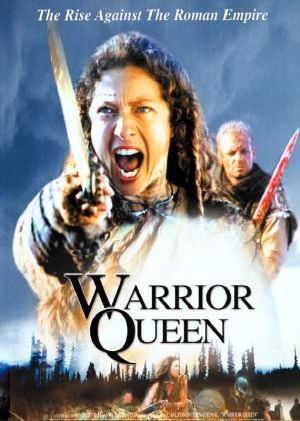
Probably best to approach this with few expectations of this being a factual representation of the time; more than once, it felt clearly like the writer was using the Roman occupation of Britain, and Boudica’s rebellion, as a metaphor for American’s involvement in Iraq. There are certainly enough anachronisms, particularly in the dialogue (the Roman Emperor chatting informally away with the leader of a British tribe, and references to “terrorists”), that it seems deliberate. The basic story is the one well-known of legend: after her husband’s death, and the raping of her daughters by the invading Romans, Boudica (Kingston) led her tribe in an initially successful revolt, only to be stopped when the full force of the Empire was turned on them.

There’s a lot of familiar faces here, most obviously Kingston, who is well-known (in this household, at least) as River Song from Doctor Who – I kept expecting Boudica to enter a scene and say, “Hello, sweetie!” But there’s also Potts, as a deeply creepy Emperor Nero, well before we knew him a nerd in Primeval, and Blunt, as one of Boudica’s daughters, has gone on to significant Hollywood fame. The performances are really what keeps this interesting: Kingston brings the right level of steely resolve to her role, and is particularly convincing when rousing her troops to battle. Equally as good is Michael Feast, as Roman general Suetonius, who is there because of a combination of “professional pride” and the Emperor’s whims, and puts across exactly the right sense of battle-weary experience.

What doesn’t work as well are the battles, in part because the budget for this falls well short of what we’re used to seeing in terms of the approximate period, e.g. Gladiator, 300. There are some moments of spectacle, such as a burning Roman encampment, or a plain covered with corpses, but the shortage of live extras is often embarrassingly obvious. They’re not well-shot either, with an irritating strobing effect which serves no purpose, and Boadica doesn’t do much actual fighting, mostly waving her sword from the back of a chariot [without spiked wheels, I was disappointed to note. Look, if you’re gonna play fast and loose with historical accuracy, you might as well include the coolest thing about the queen…]

Still, I can’t say we were bored, and the solid acting more than made up for the occasionally-shaky production values, though it is definitely important to go in to this, not expecting a Discovery channel documentary. Instead, this is Exhibit A, proving that when cinematic necessity and historical facts collide, the latter will almost always come off worse.

Dir: Bill Anderson
Star: Alex Kingston, Hugo Speer, Emily Blunt, Andrew Lee Potts

Carlito’s Angels

★★
“Do we really need a ghetto, microbudget version of Charlie’s Angels? But then, did we really need the TV reboot?”

In many ways, this is wretched beyond belief, crippled by near non-existent production values and likely only to appeal to those who live in the urban culture depicted. And yet… For every moment of wince-inducing idiocy [Agustin appears to be a big fan of Benny Hill, using speeded-up footage for “humourous” effect more than once], there were moments of surreal charm. For instance, “Captions for the Hispanic-impaired,” or the really terrible fight scene which breaks the fourth wall, turning into a “making of” segment which (and I can attest to this) accurately depicts the hell of being a microbudget moviemaker. Or that the large family of children belonging to one of the Angels includes a bearded midget. “He just showed up one day. Hey, he buys groceries, it’s cool” is her casual explanation.

As you’d expect, it’s a spoof, with the three leading ladies living in Harlem, and as in the original, getting their orders from Charlie by phone – except, here, that’s because he’s locked up in jail. While sent undercover at a strip-club, supposedly to track down some white girl whose sleeping with a local guy, they overhear their landlord Big Lou (Reynosa) getting a loan from the Mafia guy who owns the club. He promises to pay the loan back by fixing the “boleta,” the local numbers game. They’re not going to tolerate this attack on an integral part of their culture, so have to stop him and his associate, Triple Gauge, before they can bring this heinous plot to completion.

Credit the three leads for giving their all, attacking their characters with a great deal of energy, that helps overcome some of the obvious limitations. I’m pretty sure a lot of cultural references went whizzing way above my head, but as the kids say, I’m “down” enough [Phoenix is pretty Hispanic] to be able to get a good chunk. The plot is pretty awful, the action falls short of even the 1970’s original version, and there’s way too much yapping, of a style generally seen on afternoon talk-shows. But there’s a sense the people involved have genuine enthusiasm, and made it for the love of film-making. At barely an hour between (rather nifty) comic-book styled opening credits and (entirely unfunny) bloopers which close things out, it can hardly be accused of overstaying its welcome. I probably enjoyed it more than the grade above suggests, but I own the very substantial tolerance for poverty-row productions required; your reaction will likely depend on that.

Dir: Agustin
Star: Evly Pacheco, Alessandra Ramos, Jeni Garcia, Raymond Reynosa

Hood Angels

★½
“You’ll be a right Charlie if you bother with this one…”

I think I can safely say that this films fails miserably on just about every level. Now, I am probably not the target audience for this unashamedly ‘urban’ movie, but that didn’t stop me from enjoying the works of Pam Grier. This, on the other hand… Three women (Brown, Nurse and Sha – though I’ve my suspicions that one of them might just be a man) are arrested under dubious circumstances, but are bailed out to investigate the murder of one’s brother, a rising rapper. They get employed at his record-label, the questionably-spelled Murda Boi records, to scope out the suspects. Was it his partner in the label? The sleazy CFO? Or the mail-room man?

I can cope with bad acting, if the action makes up for it. I can cope with bad action, given an interesting storyline. I can cope with a pedestrian script, as long as the performances enliven proceedings. when each aspect is more hideously inadequate than the next…I was reduced, for entertainment, to seeing how far I could jab my thumbs into my own eyeballs, without making them pop. Okay, that’s an exaggeration. However, even the 99 cents I paid for this DVD would appear sufficient to have funded most of the production – with probably enough left over to buy acting lessons for the performers most in need of them [including two-thirds of the leading laideez – Brown is tolerable in this regard]

But I think it’s probably the action sequences which are the nadir of this film’s elements, carried out at the pace of a Vicodin-addicted sloth, and with the originality and fluidity of a Republican National Congress. The DVD cover and tagline are particularly wide of the mark, since only one of the trio holds a gun at any point, and that’s just to take it away from a villain. Okay, given the price, I wasn’t exactly expecting…well, anything. However, I haven’t been so underwhelmed by a movie in a very long time. That’s 85 minutes of my life I’ll never have back.

Dir: Paul Wynne
Stars: Kenia Brown, Allison Nurse, Kita Sha, Erica Goings

Haute Tension

★★★
As Judge Dredd almost said: “I am the saw!”

This Thanksgiving viewing – that may say more about our house than anything – was a suggestion by our teen daughter, which is somewhere between a incentive and a put-off. Normally, she won’t view anything with subtitles for more than two minutes; but her tastes are closer to Anchorman or The Notebook than French slasher pics. Reviews I read in advance were similarly split: either enthusiastic hype (“arguably the best horror movie since The Blair Witch Project” wrote James Berardinelli), or disparaging critiques which condemn it for a cheap twist (“Treats me like a jackass that will swallow anything”, says a writer at eFilmCritic.com).
The truth, as usual, lurks between: a warmed-over rehash of genre cliches, it’s done with sufficient verve to be tolerable. And while the surprise holes the plot sub-waterline, it is, at least, an attempt to modify conventions largely unchanged since Leatherface revved up the saw back in 1975: outsiders + loony locals = carnage. In this case, Marie (de France) and Alex (Maïwenn) head for a study weekend to the farm where Marie’s parents live. However, a single-minded psychopath (Nahon) kills Ma & Pa in spectacularly gory fashion – in the unrated version, at least – then kidnaps Alex, leaving Marie her sole hope of survival. The madman always seems one step ahead, in a way reminiscent of The Hitcher, though the killer here is scuzzy sleazeball rather than charismatic prankster. The cat-and-mouse chase leads deep into the remote countryside, before a final confrontation and the twist, which I have to say wasn’t a surprise. My first guess was a post-orgasm fantasy by Marie; it’s not (except tangentially, perhaps), and my second stab proved right.

But does it work? In hindsight, probably not; it needs too much cheating of viewpoints for everything before to become plausible. Much of the rest, however, is fairly effective; the lack of backstory works for the killer, and the deaths are great, in-your-face, nasty pieces of slaughter. Director Aja doesn’t really have much of an idea about tension, thinking that the absence of action, combined with ominous music, is sufficient to this end. Yet there is talent and potential present, and you can see why he has signed to a remake of the similarly-themed The Hills Have Eyes. Until then, this post-post-feminist slasher pic is a failure, albeit an interesting one.

Dir: Alexandre Aja
Star: Cécile De France, Maïwenn, Philippe Nahon
a.k.a. High Tension

Lady Jayne Killer

★★★
“Unquestionably flawed but cheesily energetic fluff.”

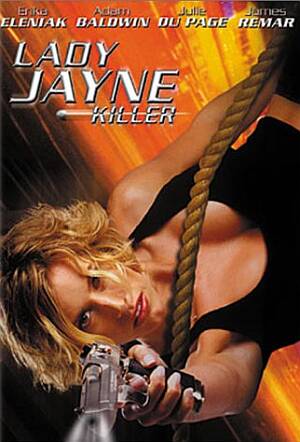
Memo to self: don’t tell your wife the star of a film was in Playboy. Chris’s interest, already somewhat on thin ice, evaporated entirely, pretty much the moment I made that mistake, and I almost had to handcuff her to the bed to prevent a sudden trip to the supermarket. The concept here is kinda cool: Mom Emily (Eleniak) vs. anti-Mom Jayne (du Page). The latter is a hitwoman for the Mob, with 20 kills to her credit when she decides to abscond with a million in cash. She ends up hitching a ride beside Emily and her 16-year old son Kerry (Lelliot) on their way to San Antonio, with the former owners of the money in hot pursuit. And the cops. And the FBI. Then Kerry – when not fantasizing about Eleniak in the shower [cue Chris’s neo-departure!] – decides to solves Mom’s financial problems with thievery of his own.

I certainly don’t blame them for changing the title from the amazingly bland original – though suspect a colon got lost somewhere on route… And this is contrived: with a cellphone, and more than enough ready cash, Jayne could easily hire a limo – or even take a cab to San Antonio. So why use Emily – then hang around, even after their car breaks down? That sound you hear is the film whistling loudly and putting its fingers in its ears. And despite a strict and straight-laced parent, underage Kerry still sports a Superman tattoo on his arm. This kind of sloppy attention to production detail damages a film which is sometimes smarter than it may appear.

For instance, Emily’s line that her son is knows about every woman who has appeared in Playboy is nicely self-aware, given Eleniak’s familiarity with the staples therein. :-) But she stays dressed here, leaving the lingerie to Du Page, and Kerry’s interaction with the babe dropped into his life are amusing – hey, in his shoes and at his age, I’d be a gibbering fool too. The plot twists its way, albeit predictably, towards the final battle between Mom and anti-Mom. As a time-passer, I found it by no means awful: while it’d have been nice if Emily had snarled “Get away from him, you bitch,” when she found Jayne holding a gun to Kerry’s head, I guess you can’t have everything.

Dir: Mark L. Lester
Star: Erika Eleniak, Julie du Page, Jeremy Lelliot, James Remar
a.k.a. Betrayal