



★★★½
“If you think wrestling is “fake” – think again…”
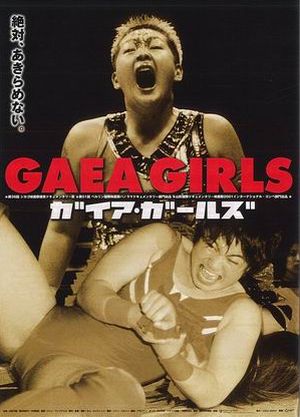 Out in the middle of the Japanese countryside is a square, unremarkable building that is the headquarters and training center for GAEA, one of the country’s leading women’s wrestling federations. Into this comes Takeuchi, making her second attempt to become a pro wrestler – the brutal training, under the glare of GAEA’s top wrestler Nagaua, caused her to give up last time. Will her second attempt prove any more successful? Can she get through to the final exam, and pass it to become a full member of GAEA?
There are moments here whih are just jaw-droppingly savage. For instance, Takeuchi, after failing to deliver dropkicks correctly, is on the receiving end of a truly malevolent one, which you swear came close to decapitating her. The next scene has Takeuchi being berated by the trainers for her failings: only eventually does the camera pan round to show the rookie, standing there, blood dripping from her face. And the emotional abuse through which Takeuchi is put, is possibly even worse. As proof of the world of difference between “fake” and “staged,” this is impeccable, and you can’t blame the other wannabes, who opt to leave, when they realize exactly what they’re in for. The grind behind the showmanship of pro wrestling has never been so well depicted.
The film’s weakness is the lack of background – and it’s significant, unless you’re fairly well-versed in the world of joshi puroresu. For instance, it’s never mentioned that Nagayo was one half of the Crush Gals, whom even Wikipedia calls “possibly the most famous and beloved women’s tag team of all time.” Without that knowledge, it’s hard to understand the respect she has, and why trainees put up with so much from her – indeed, though we see Nagayo in action, there’s nothing to indicate the elevated position she has in the sport, an icon of eighties Japanese pop culture. Similarly, there’s very little effort to probe into Takeuchi’s desires and dreams: why is she willing to go through this hell? I know enough about wrestlers and wrestling to have some idea, but for the uninitiated, I suspect the documentary will raise as many questions as it answers.
Dir: Kim Longinotto and Jano Williams
Star: Saika Takeuchi, Chigusa Nagayo, Meiko Satomura, Yuka Sugiyama
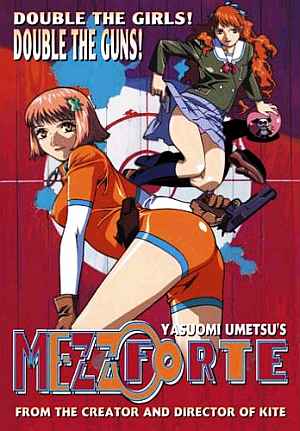 The Peach Twisters baseball team suck. This may be because the owner kills his pitcher with a baseball bat in the car-park, after losing a game? And he’s the model of restraint and sanity compared to his daughter, Momomi. The Danger Service Agency, a trio of troubleshooters, are hired to kidnap the owner (obviously, legality is a minor concern), but things go wrong, and he dies in the process. How can they escape this tricky situation? The core of the DSA is Mikura, who is a combat specialist, and easily the best thing in the group, as the other two are largely forgettable. But when Mikura goes into action, the film accelerates from 0-60 in about two seconds, which a cheerful, splattery approach that’s endearing. And she’s an upbeat character, which is a notable contrast to Umetsu’s other genre entry, Kite [Sawa, that show’s heroine, makes a cameo here].
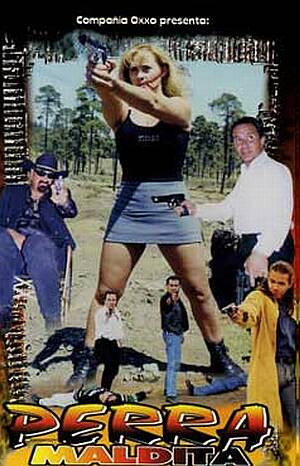 Camelia (Palmer) sees her way out of the ghetto in Ramiro (Saenz), a friend of her father’s who always has more than enough easy money. She convinces him to employ her as an apprentice, but discovers she likes sharing his life of drug-deals and casual slaughter. But they soon find out, they may not be the only ones capable of a good double-cross…
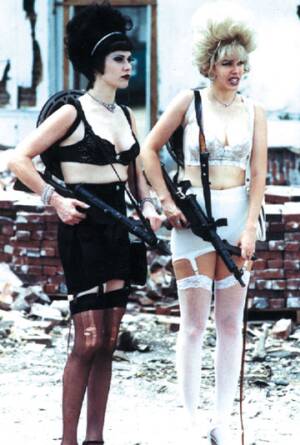 After civilization’s collapse, men have regressed to the level of Neanderthals, while women live in clans decided by their hair colour, with names like the FayWrays, Satanas and Tempests. Clothing is in short supply: lingerie, it would appear, is not, and nor are large, automatic weapons. Unsurprisingly, this leads perhaps to the finest opening five minutes in girls/guns cinema ever – “My name is Rachel, and I am a blonde. Blondes are extinct” – as our heavily-armed, suspender-and-stiletto clad heroines stagger round a post-apocalyptic landscape. This looks fabulous, and totally belies the fact that it cost $16,000 and was made in sixteen days.
 The opening shot zooms in on Rodriguez with her head down; slowly, she raises her head, and stares into the camera with ferocious intensity. If this renders the rest of the film largely redundant, it’s not really anyone’s fault. In Michelle Rodriguez, the makers have the perfect person to play Diana, a pissed-off, troubled/troublesome) teen, who finds that violence
 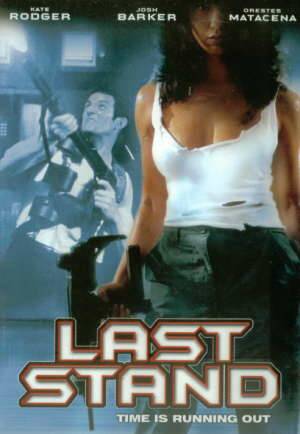 Okay, ‘godlike genius’ is stretching it a
 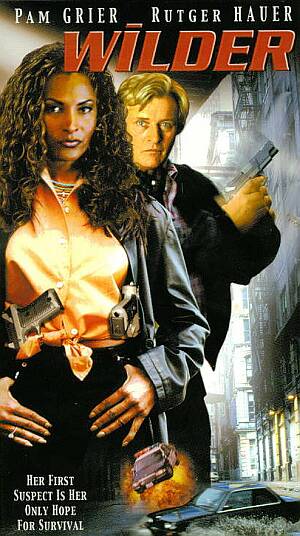 The first ten minutes of this seem intent on running out every stereotype possible: Pam Grier as a hot-headed black cop, juggling her job with life as a single mother, taking on prejudiced neighbours, etc, etc. Even her name – Wilder – sounds like something generated by a cliche machine. But as the film goes on, it twists away from the murder-mystery it starts as, eventually corkscrewing off into conspiracy theory, the black market in radioactive materials, illicit medical experiments and corrupt big business.