



★★★
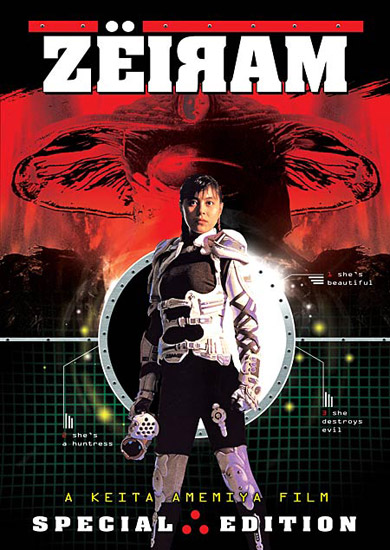 Zeiram and its sequel, Zeiram 2, both concern a creature which combines all the most unpleasant and lethal features of The Thing with The Terminator. It’s humanoid, at least in the number of functioning limbs, but its head appears almost mushroom shaped – though it’s hard to tell where Zeiram ends and its hat begins, for there’s a second face, embedded in the hat. This is capable of extending on a tentacle, to attack victims, taking in nourishment, and there’s evidence to suggest that it can absorb their DNA and use it to create monsters. Oh, and the rest of it is almost impossible to destroy.
However, trying to do exactly that is Iria (Moriyama), an interstellar bounty hunter, who has laid a trap to take Zeiram into an alternate, uninhabited dimension, in order to deal with him in a way that will pose no threat to the local population. However, she reckons without the arrival of electrical techs Kamiya (Hotaru) and Teppei (Ida), who have been dispatched by the power company to investigate the power-drain resulting from Iria’s tech. Through an unfortunate series of events, they end up in the alternate dimension with Zeiram, while Iria is largely stuck in our world, trying to keep them alive until she can fix her portal and get in there to help them.
The problems here are largely two-fold. Kamiya. And Teppei, There are few things less appealing than comic relief characters whose antics and mugging are supposed to be endearing or amusing, but fail miserably on both fronts. They bring very little to proceedings except for running time, and that’s a shame, because there is no shortage of bizarre inventiveness on view. And when the pair stop trying to be characters, shut the hell up, and simply team up with Iria to kick alien arse, it’s a lot better, because whatever they do to Zeiram, he/she/it just keeps mutating into another form and fighting back. You get the sense being fed through a wood-chipper would only be a minor inconvenience.
This also helps cover up Moriyama’s somewhat limited set of fighting skills. Admittedly, it’s possible she had to slow things down in order to fight a giant mushroom, but the hand-to-hand combat here is choreographed at about the speed of a Strauss waltz. She does have screen presence, however, and looks decent enough firing a gun. To a casual eye – that’d be my wife’s, wandering through the living-room – this could look like an episode of Amemiya’s Power Rangers, and it’s not surprising he would go on to direct some Kamen Rider films. But it’s too uneven to succeed: for every moment where you go, “Cool!”, there’s another where you’ll roll your eyes, or just go “Eh?”. For instance, the section where Zeiram squeeze out goo onto the ground, which grows into a half-man that has a burbling conversation with Zeiram, before getting its head stomped on. Altogether, now: eh?
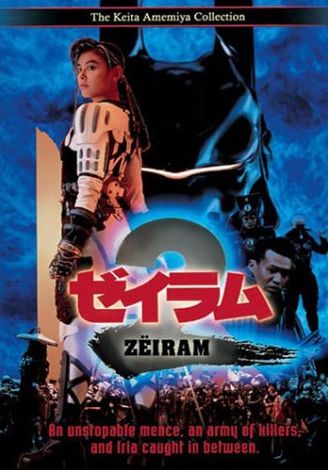 The sequel, which came out three years later, restores the “i” in the title, which was inexplicably removed from the original for it US release by Fox Lorber. This installment starts off as if it’s going to go in some radically different directions, even if all the main players are back. Iria is seeking an ancient artifact called the Carmarite, and additionally, has a new assistant, but he turns out to be untrustworthy. Meanwhile, a shadowy group has succeeded in regenerating Zeiram as a cyborg warrior (which makes a lot more sense if you’ve seen the anime, and know its origins), bending its will to their needs and turning it into a weapon. While initially successfully, this works about as well as most plans usually do, and it’s not longer before Zeiram is much more a menace than an ally.
However, just when you think the film is going into new and interesting territory… Well, I’m not quite show how it happened, but before long we were back in more or less the same situation as the original. Blah blah irritating comic relief blah another dimension blak Iria unable to help (this time because she gets herself locked in a room), etc. You’re looking at something which borders on being a remake of the original, and unlike something like Terminator 2, which upped the ante significantly, while telling a largely similar story, there isn’t any real sense of progression or development. Much as before, things do get better when things move into action, and Zeiram is again, a shape-shifting nightmare that won’t stay dead. And this time, not even a cute dog which strays into proceedings is off the menu.
It also helps that, this time around, Moriyama has a better handle on the action angle. Previously, it was very much a case of kick, pause, punch, pause, move, but she is a good deal more fluid here, and makes for a more credible heroine as a result. However, her strength is still more in the “looking cool with a gun” department, because her punches still look like they might be troubled by a damp paper-bag. On balance, the sequel’s lack of invention is approximately balanced by the overall improvement in Iria’s character and the slightly better overall production values – it still looks like you could fund it from your bedside table change – and it’s as worth watching as the first part. Which would be “somewhat”: call both of them a rent (or more likely these days, a download), rather than a buy.
Dir: Keita Amemiya
Star: Yûko Moriyama, Mizuho Yoshida, Kunihiro Ida, Yukijirô Hotaru

 While undeniably a product of its time – which would be 1991 – this has stood the test of time very well, and remains a solid piece of action SF. Eve Simmons (Soutendijk) is a researcher working for the US government on creating life-like robots for surveillance missions, and her creation, Eve VIII, not only looks like her, but has her memories and psychology too. When on a test run in San Francisco, Eve VIII is caught up in a bank robbery and a bullet sends her off the grid, and on her own mission. Jim McQuade (Hines), something like a proto-Jack Bauer, is brought in to track down the lost little robot, who has all of her creator’s complexes, but none of the social restraints, leading to a fondness for automatic weapons, which she uses with abandon as she works out her psychiatric issues [cheaper than counselling, and a good deal more fun]. Oh, and Eve VIII also has a nasty little surprise package tucked away inside. It’s up to McQuade and Simmons to stop the killing machine before things
  But as a straightforward B-movie, it works nicely, with Hines having a nicely sardonic wit: “A spinach lasagne, in a light tomato and basil sauce,” is the reply, when Simmons asks dubiously what is McQuade’s “specialty” as a government agent. I’m still trying to work out if the film is feminist or chauvinist: you could read it either way, with the ‘liberated’ (if robotic) woman a free spirit, though the ending firmly puts Even back in her place, to say the least. She also emasculates one man, somewhat familiar territory for Soutendijk, who previously wielded a scissors to leg-crossing effect in The Fourth Man. Gibbins, meanwhile, died in the 1993 Hollywood fires, while trying to rescue a cat. Guess there’s never an unstoppable robot around when you really need one.
 Chagoyan is perhaps the nearest thing Mexico has to offer to an action heroine. She best known for her role in Lola la Trailera (‘Lola the Trucker’), in which, she played the daughter of a haulier – she takes over his business and goes out for vengeance, after he’s gunned down for refusing to assist a drug-cartel. Almost a decade later, that director’s son would helm this, in which Chagoyan plays a teacher who moonlights as a crime-fighting vigilante. Not having seen part one isn’t much of a problem; presumably it explains her origins, and perhaps how she gets to spend so much time away from her job. All we see here is one class, before she and her midget sidekick take on a gang who kill one of her pupils (with a surprising amount of blood, it has to be said). Then, when she’s blamed for kidnapping the daughter of the police chief, she has to find the real culprits and clear her name.