
★★½
“A comedy, from the director of… Cannibal Holocaust ?”
 I’m not kidding. Director Deodato is best known as the man behind one of the most notorious of all “video nasties,” a film which created such a furore, he had to produce the actors to convince the Italian courts he hadn’t killed them. But in almost fifty years of work (he’s still active today), Deodato has done everything from spaghetti Westerns to science-fiction. And more than a decade before Holocaust, back in 1968, he directed this bawdy action-comedy.
Set in the early 17th century, the titular heroine (Love) is a peasant girl who discovers she is actually the daughter of a duke and duchess, overthrown and killed by evil baron, Don Alonso Imolne (Ireland). She sets out with her “virgin army” – initially consisting of two other local women, but growing along the way – to take revenge, with the help of the local rebels under Gennaro (Parenti, the film’s producer and also Love’s husband). However, the baron has his own plans, which involve burning Zenabel at the stake.
The main problem is Deodato’s inability to pick an approach and stick with it. Love actually makes for a very good heroine: she’s feisty, brave and smarter than just about anyone else in the film. However, these positive aspects are perpetually battling against the chauvinistic or flat-out elements of sexist comedy. These have not aged well – and, indeed, hardly seem less than Neanderthal, even by the dubious standards of sixties Italy. Let the rape jokes and blatant homophobia flow! Though the latter is at least defused somewhat by Stander (best known as butler Max from Hart to Hart) as a randy villager who pretends to be gay, in order to come along with the all-female army. Hey, I laughed, even if subtle, it certainly ain’t.
As the salacious German poster, and title which translates as “Countess of Lust”, likely suggest, there is no shortage of nudity from Love and the rest of her recruits. That’s likely because it’s an unofficial adaptation of Isabella, Duchessa dei Diavoli, an erotic comic which ran for a decade, starting in 1966. This beat the official film version, starring Brigitte Skay and directed by by another cross-genre veteran, Bruno Corbucci, to Italian screens by a year. I’ve seen that, under its US title of Ms. Stiletto, and it’s tilted significantly enough to the sex side, not to qualify here [though not so far as the 1975 French re-release of Zenabel, under the title La Furie du Desir, which had hardcore scenes inserted!]
This take is still an almost schizophrenic film. The wild swings from the empowering to the crude make it feel like two directors were involved, with sharply contrasting visions, and the poor editor was caught in the middle. Similarly, the viewer will be pulled in a number of different ways from scene to scene, and the end result for me tilted somewhat toward the negative. Though as far I know, at least Deodato didn’t get hauled into court this time, it perhaps does show his talents are not in the comedy genre.
Dir: Ruggero Deodato
Star: Lucretia Love, Mauro Parenti, John Ireland, Lionel Stander



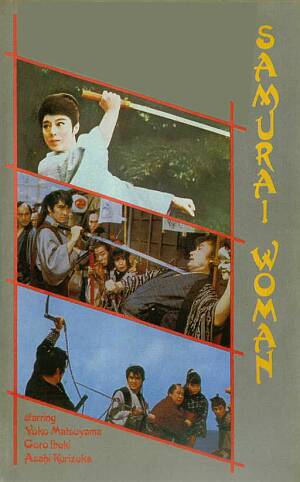 The third entry in the series saw a new director, and unfortunately, a marked turn for the worse, largely because the focus drifts off Oichi. It starts briskly enough, with the heroine coming into possession of a new, effective formula for gunpowder, something barely known at the time in Japan. Understandably, this makes her the focus of attention, in particular for a group with an interest in profiting from the discovery.
 Later that same year (1969), Oichi was back in action, and at the start of Trapped, seems quite content with her life as a bounty-huntress. She has even adopted an orphan, just as she herself was taken in herself, but two things wreck this relatively happy situation. She discovers her protege is really a runaway, not an orphan, and consequently has to abandon her – again, as she was discarded. Worse yet, she incurs the wrath of fellow bounty-huntress Oen (Matsuoka), a kitten with a whip
 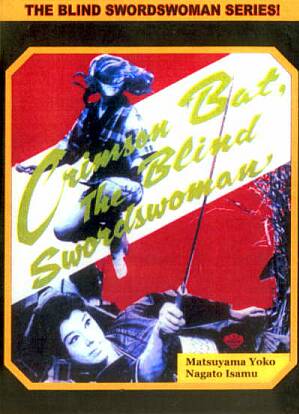 We meet our heroine Oichi as a young child, who has just been being abandoned by her mother – not sure what happened to father, but we later discover Mom’s a prostitute, so can probably fill in the blanks ourselves. To make matters worse, the tree under which Oichi takes shelter from a storm is struck by lightning, rendering her totally blind, in a way that’s – probably wisely – left medically unexplained. However, she is then taken in by a kind gentleman, who brings her up, and on into adulthood.