




★★★★½
“From bad to hearse…”

 It has been a long time since we’ve enjoyed a film so much. Right from the start, which shows a bride, in her wedding-dress, being stalked by a demon (or does it?), this grabbed our attention, and hardly let up for a second until the finale. I have to say, the odds are that you will either love this film, or fail entirely to ‘get’ what it’s trying to do and dismiss it as a lame Buffy ripoff. But in our living-room, it got four enthusiastic thumbs-up from the viewing panel, and seems like the perfect complement to beer and pizza.
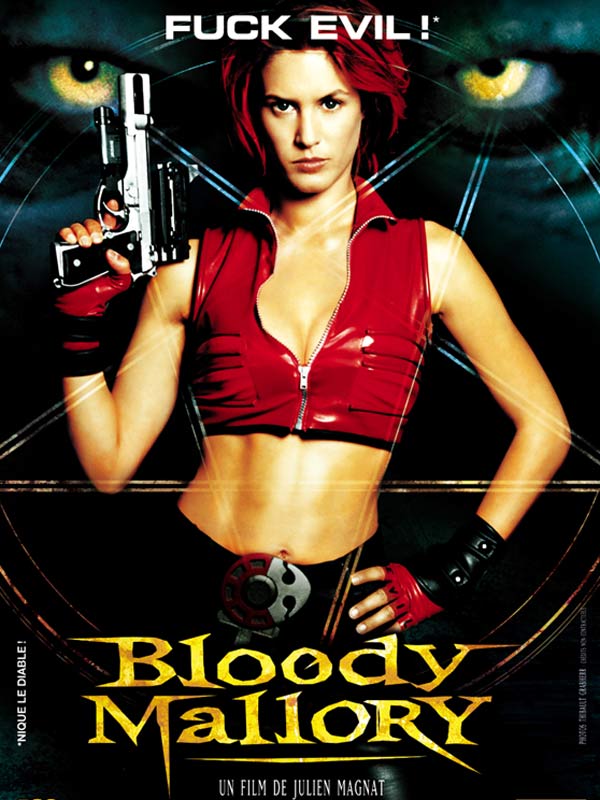
After the opening, things for Mallory (Bonamy) go from bride to worse. [Hey, so I squeeze every drop of use from a pun. Sue me.] She’s now head of a team that investigates, and deals with, paranormal attacks – France seems to be the only country which has realised that such evil critters actually exist. She loses one member of her squad while repelling ghouls at a convent, and at the same time, new pope Hieronymus I (Spielvogel) is being kidnapped. She discovers he’s being held hostage in a nightmarish alternate dimension, so has to follow, and save the world from demonic invasion through the Hellmou…er, portal which is going to be opened, oh, any minute now.
There’s no doubt that director Julien Magnat was influenced by all the “right” films when it came to constructing his heroine: Mallory has Lola’s hair, Buffy’s martial-arts skill, the intensity of Michelle Rodriguez, and some of Resident Evil‘s Alice too. But none of them ever had gloves with ‘FUCK EVIL’ on the knuckles, drove a hearse, ran over black cats because “you never know”, or wore a tight, red waistcoat with a big ‘M’ embossed on the back [how there’s room in it for a large gun remains a charming mystery!]. Portrayed by Bonamy, who is unknown outside France (her only English-language role is a schoolgirl in Merchant-Ivory’s Jefferson in Paris), Mallory comes across as a convincing and original entry in the action heroine genre.
The other members of the team are hardly less imaginative – or, at least, the females, the guys are nowhere near so colourful or interesting. Completing the heroic trio are Vena Cava (Ribier – I think the character’s name is a Diamanda Galas reference), a six-foot “action transvestite”, as Eddie Izzard would say, an explosives expert with automatic weaponry in her platform soles, and Talking Tina, a mute telepath who can transfer her consciousness into animals or the dumber end of humanity. Both are excellent supporting characters; in a kinder universe, they would merit franchises of their own, Cava, in particular,
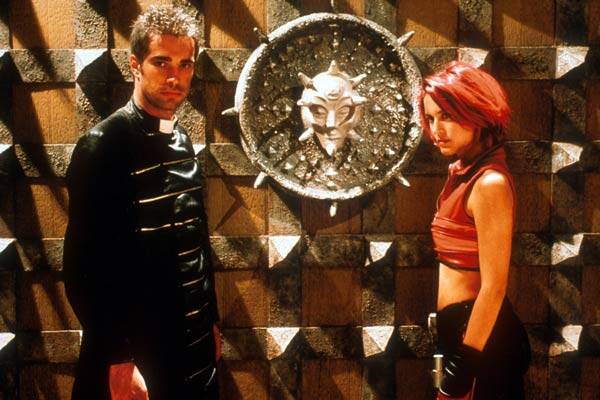
 Less effective or interesting are the men, and it’s abundantly clear where Magnat’s passion lies. Father Carras (Collado), the Vatican priest and papal bodyguard is bland and colourless, despite having a name borrowed from The Exorcist. The best is actually Mallory’s demon husband (Julien Boisselier), now stuck in limbo after the murderous end to their marriage. The pair have a relationship which is genuinely touching, in a way which Joss Whedon could only dream of.
On the side of evil, again, the femmes rule, with Valentina Vargas and Sophie Tellier, as Lady Valentine and her shape-shifting sidekick, Morphine, giving performances which are suitably excessive and on the money. However, the climax of the film is disappointing, largely because Mallory has no genuine nemesis, with whom she can go toe-to-toe at the end – who’s she going to beat up, the Pope? [Actually, given his intolerant statements, you’ll likely be rooting for this from the get-go]
Some of the effects definitely leave a little to be desired – the demon masks look extremely rubbery, although personally, it reminded me of another energetic B-favourite, Rabid Grannies. However, the digital effects are great, particularly the exploding bodies; we especially loved the effect of Mallory’s cross-shaped holy-water spritzer. There were many moments where we went “Cool!”, at little things like the blood-red, swirling sky in the demon realm, the evaporation of Mallory’s husband into a cloud of rose petals, or the transformations of Morphine.
The attention paid to details like these helps immeasurably, and Magnat succeds admirably in his avowed intention of making something which has the look and feel of a Japanese comic-book come to life, with a lot of Dutch angles [this week’s pretentious technical term – it means the camera’s not level]. There’s almost no natural light at all, and each character has their own colour scheme: red/black for Mallory, blue/purple for Vena, burgundy/gold for Lady Valentine. Indeed, the soundtrack is by Kenji Kawai, whose credits include Ghost in the Shell.
 Perhaps what we enjoyed most was the balance Magnat strikes between parody and drama. This is clearly not intended to be taken seriously – but the characters keep such admirably straight faces, that it became very easy to buy into the whole mythos, which in reality wouldn’t stand up to ten seconds of close scrutiny. There’s none of the self-awareness that plagued the later seasons of Buffy, and nor is there much angst or whining. The heroine has a mission to complete, and gets on with it, in a refreshingly straightforward manner.
Magnat’s wants his next project to be a return to The All-New Adventures of Chastity Blade, expanding on a 32-minute short film he made in the summer of 1999. This starred Lisa (Nightmare on Elm Street) Wilcox, playing a housewife who finds herself sucked into the world of the titular 1930’s pulp-fiction heroine after getting a bullet in the head. If he brings the same sense of style and wit to that concept as we enjoyed here, it promises to be worth our attention. Meanwhile, Mallory was picked up by Lion’s Gate in November 2002, and was passed by the MPAA (R, natch) in April last year – the same week as Gigli! Since then, nothing. However, a quick search on Ebay reveals it’s available from, ahem, the usual sources. [Update: It’s due a September 2005 release on DVD] And if you see only one film about a red-headed, hearse-driving demon-hunter this, or any year, Bloody Mallory should definitely be it.
Dir: Julien Magnat
Star: Olivia Bonamy, Jeffrey Ribier, Adrià Collado, Laurent Spielvogel
 Among Sidaris fans, I imagine arguments over whether this one counts, much like the Never Say Never Again debate among 007 lovers. For this was directed not by Andy, but son Drew; Dad and Mom were merely executive producers. However, the content is much the same, though (and I can’t believe I’m writing this) Drew lacks the subtle touch of Sidaris Sr. Case in point: the very first shot is of the Eiffel Tower, establishing that this is Paris. However, the point is then rammed home with footage of the Arc De Triomphe, Place de la Concorde and Notre Dame. Similarly before the ‘South African’ scenes; we get so much wildlife footage, it feels more like the Discovery Channel.
 While containing many of the same elements as usual e.g. boobs and bombs, this does at least throw in a new angle, in the shape of some Confederate gold buried in the woods since the Civil War – I can only presume Sidaris must have befriended a Civil War re-enactment battalion. Out enjoying a bit of off-road action, amusingly-named federal agent Becky Midnite (Simpson) and her two co-workers stumble across a diary written by one of the soldiers transporting the gold. However, their plans to search for the treasure are disrupted by efforts to kill them, courtesy of mob boss Santiago. He is upset after they shut down his operation that involved shipping drugs in hollowed-out watermelons. Fed up with the ineptness of his minions, he hires even more amusingly-named assassin Jewel Panther (Strain) to carry out what they have failed to do.
 Hang on, two movies ago, criminal mastermind Kane was Japanese – now, he’s the son of a Nazi officer who went on the run after the war with a diamond stolen from the Russians? I know I’m watching these all of our order, but still… They even refer to a pendant with a tracking device in it, given to the Japanese version of Kane, even though Moore now appears to be channeling Julian Sands, not Pat Morita. I’m so confused. Still, logic, continuity and coherence are not really the point here, are they?
 It’s very easy to mock a film, when the lesbian necking starts before the meaningful dialogue, and is immediately followed by a musical number where Cynthia Brimhall channels the spirit of Jimmy Buffett. Yet the endearing loopiness on display here did a better job of keeping my interest throughout than many movies made with far larger budgets. The plot centers on a jade Buddha, containing a nuclear trigger, which starts off in the hands of Kane (Moore), only for it to be swiped by an undercover agent: she is gunned down, but passes it to Donna (Speir), who has to try and keep it out of Kane’s clutches. However, an unfortunate bout of amnesia leaves her partner Nicole (Vazquez) and the other agents trying to find her first.
 In a filmography not exactly noted for thought-out plots, this maybe counts as one of the thinnest. Donna (Speir) and Nicole (Vasquez) are targeted by death for Kane (Morita) for their interference in his illegal business ventures. But rather than simply bumping them off, as any sane criminal mastermind would do, he informs them of his intentions to send six separate pairs of assassins after them, beginning the next morning. Our pair of federal lovelies head out of Hawaii, little knowing that a tracker has been placed on them, allowing Kane’s to follow them, while their master sits in his apartment and follows the progress of his “game” on a computer display resembling a bad TRS-80 game [younger readers can Google “TRS-80” if they need specifics], as they proceed from Las Vegas to Louisiana, with a motley crew of associated agents in tow, including infamous Meyer model, Pandora Peaks. No prizes for guessing her role.
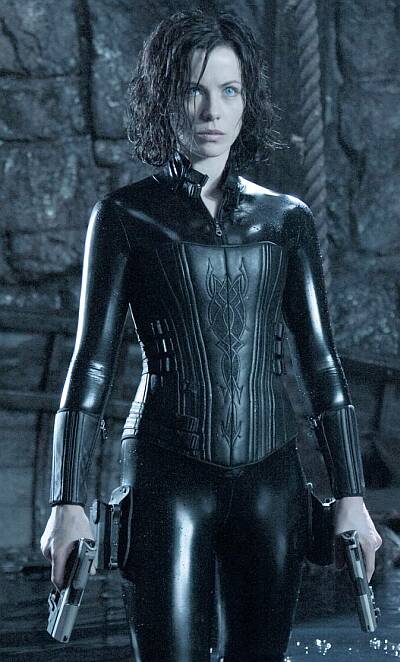 While undeniably flawed, the original Underworld had a big ace up its sleeve, in the basic concept of “vampires vs. werewolves”, which hadn’t received such a full-on depiction in cinema before. This time, the idea is familiar, and the story doesn’t have anything quite as cool to replace it. Sure, there’s the old fall-back of Kate Beckinsale in a PVC suit, but the sense of something genuinely new is rarely apparent. Sure, it’s a sequel, which in Hollywood translates to “more of the same”, but the lack of invention on view is still disappointing.
 No, it’s the moments between the battles that are the problems, not least a dumb and gratuitous sex scene between Selene and Michael that appears to have wandered in from an airline version of a SkineMax movie. And the exposition also has to count as among the most leaden of recent times, achieving the rare double-bill of sending Chris and I independently off to sleep. Hey, we’d been out boating all day. So sue us. :-) However, for any action-fantasy to have both of us snoozing is definitely problematic.
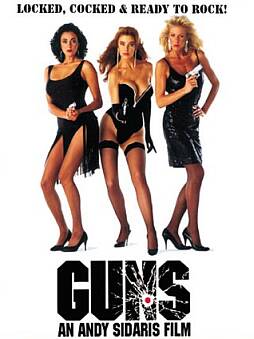 Two federal agents (Speir and Vasquez) are hot on the trail of South American gangster Degas (Estrada), after one of their friends is shot during one of his hits – but perhaps that’s really what he wants? Zipping around from Hawaii to Arizona to Las Vegas, this was the first Sidaris movie I saw, and was probably better than I expected. While obviously not shot on an unlimited budget, most of the deficiencies are made up for in energy and a host of interesting characters.
 This one doesn’t really get going until the second half, when the search for a lost hoard of Japanese wartime gold, looted from the Philippines, leads to a remote island. There are CIA agents, revolutionaries, a left-behind Japanese soldier and, of course, our lovely heroines Dona and Taryn (Speir and Carlton) who end up there after their plane crashes in a storm. Or rather, “storm” – you can get a cheap laugh by seeing the bright blue skies as they land in the middle of a clearly hose-supplied downpour. Sidaris probably felt the need to justify their otherwise implausible strip-tease shortly after departure. Or do FAA regulation stipulate pilots must remove their tops in emergencies? Two take-offs for the price of one…
 Salazar (Aprea) is a famously devious assassin who gets shot by a sniper just after he donates a painting (of the emblematic ‘Picasso triggerfish’) to a Parisian art gallery. This sparks a series of lethal attacks on undercover federal spy teams who are Salazar’s enemies. But are the various bad-guys, who use all manner of tricks to eliminate government agents, all working for a criminal mastermind?